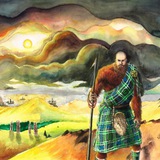
He wielded a gigantic club that had both death dealing and life giving properties.
In “the Intoxication of the Ulaid” it is described as being:
“…a dreadful iron club, one end violent, the other mild. This is his game and his feat: he lays the violent end across the heads of the nine men so that they die in an instant; then he lays the gentle end across them so that they are brought back to life in an instant.”
One of his greatest possessions was his Four-Cornered Harp, named Uaithne, which could alter people’s emotions from sorrow to joy or vice versa, and he could command the seasons with it with sweet melody.
A generous god, who provides for those who are descendants of the people of the British Isles is the good god Daghda.
There is so much to tell on this awesome deity, but will have to be broken down into multiple posts. There is much to say about him, and rest assured, we will revisit him again in greater detail.
In “the Intoxication of the Ulaid” it is described as being:
“…a dreadful iron club, one end violent, the other mild. This is his game and his feat: he lays the violent end across the heads of the nine men so that they die in an instant; then he lays the gentle end across them so that they are brought back to life in an instant.”
One of his greatest possessions was his Four-Cornered Harp, named Uaithne, which could alter people’s emotions from sorrow to joy or vice versa, and he could command the seasons with it with sweet melody.
A generous god, who provides for those who are descendants of the people of the British Isles is the good god Daghda.
There is so much to tell on this awesome deity, but will have to be broken down into multiple posts. There is much to say about him, and rest assured, we will revisit him again in greater detail.
Apologies for the lack in posting lately.
Life has become hectic for everyone. We all have life to get on with, and that applies to myself as well.
Here at the EDC we aim to give the gift of discovery to the channel subscribers, to hopefully rekindle that desire to honor our pre-christian European history, and to keep the flame alive for those that come after us.
Expect regular broadcasting to continue, and we always suggest that you look to your own people’s stories, folklore, myths and art. It is there that you will find wonderful things about yourself that you never would have dreamed.
We are a proud people and have much to celebrate.
Only by trying to understand our past can we truly know who we are.
Life has become hectic for everyone. We all have life to get on with, and that applies to myself as well.
Here at the EDC we aim to give the gift of discovery to the channel subscribers, to hopefully rekindle that desire to honor our pre-christian European history, and to keep the flame alive for those that come after us.
Expect regular broadcasting to continue, and we always suggest that you look to your own people’s stories, folklore, myths and art. It is there that you will find wonderful things about yourself that you never would have dreamed.
We are a proud people and have much to celebrate.
Only by trying to understand our past can we truly know who we are.
Usinš - Latvian horse god
Right around the corner, on April 23rd the Latvian spring festival of Jurģi will be underway to honor the god Ūsiņš.
The god of the horse in Latvian mythology, he also presides over light and bees, and drives the sun in his chariot across the sky.
His worship can be seen by a report by Jesuit priest Joannis Stribingius in the year 1606:
“They sacrifice to the god of horses, whom they call Deviņ Ūšiņe, each two pieces of money and two pieces of bread and a bit of fat which they throw into the fire.”
Right around the corner, on April 23rd the Latvian spring festival of Jurģi will be underway to honor the god Ūsiņš.
The god of the horse in Latvian mythology, he also presides over light and bees, and drives the sun in his chariot across the sky.
His worship can be seen by a report by Jesuit priest Joannis Stribingius in the year 1606:
“They sacrifice to the god of horses, whom they call Deviņ Ūšiņe, each two pieces of money and two pieces of bread and a bit of fat which they throw into the fire.”
Latvian Dainas, which is a form of music or poetry mentions Ūsiņš singing affectionately:
“Ūsiņš rode to night pasture
With nine horses.
I pray you, brother Ūsiņš,
give me a pair of saddled horses
O Ūsiņš, good man,
Ride with me to night pasture.
I to stoke the fire
You to tend the horses.
Ūsiņš stood idle
at the end of my stable.
O Ūsiņš, old father,
Let us both ride to night pasture,
I to stoke the Fire,
You to tend the horses.
The horses neighed to Ūsiņš
As I was riding to night pasture.
The cows mooed to Māršava
As I was driving them out to pasture.”
“Ūsiņš rode to night pasture
With nine horses.
I pray you, brother Ūsiņš,
give me a pair of saddled horses
O Ūsiņš, good man,
Ride with me to night pasture.
I to stoke the fire
You to tend the horses.
Ūsiņš stood idle
at the end of my stable.
O Ūsiņš, old father,
Let us both ride to night pasture,
I to stoke the Fire,
You to tend the horses.
The horses neighed to Ūsiņš
As I was riding to night pasture.
The cows mooed to Māršava
As I was driving them out to pasture.”
Aušrinė - Lithuanian Goddess of the Dawn
Feminine goddess of the morning star, Aušrinė is additionally known throughout Lithuania as their deity of beauty and youth.
First mentioned by 16th-century Polish historian Jan Łasicki as Ausca.
She is described as goddess of the rays of the sun that descend and rise above the horizon.
Each morning Aušrinė and her servant Tarnaitis prepare the way for Saulė (the Sun).
In the myth, Saulė Ir Vėjų Motina (The Sun and the Mother of Winds), Aušrinė appears as: a star in the sky, as a maiden on land, and as a mare in the sea.
Feminine goddess of the morning star, Aušrinė is additionally known throughout Lithuania as their deity of beauty and youth.
First mentioned by 16th-century Polish historian Jan Łasicki as Ausca.
She is described as goddess of the rays of the sun that descend and rise above the horizon.
Each morning Aušrinė and her servant Tarnaitis prepare the way for Saulė (the Sun).
In the myth, Saulė Ir Vėjų Motina (The Sun and the Mother of Winds), Aušrinė appears as: a star in the sky, as a maiden on land, and as a mare in the sea.
Hertha Lake - The goddess bathes
This lore comes to us from Germany in which Hertha, (possibly Nerthus) is active in the Black lake near Hertha castle in Rügen, a German island in the Baltic Sea. The account is as follows:
In the part of the Island of Rügen named Jasmund, not far from Stubbenkammer, one can still see remnants--especially the outer wall--of Hertha Castle, which has stood there for many centuries, ever since the days of heathenism. In this castle the heathens of Rügen worshipped an idol that they called Hertha, whom they perceived to be Mother Earth.
Not far from Hertha Castle there is a deep, black lake, surrounded by woods and hills. The goddess bathed there several times each year. She rode there in a carriage covered with a mysterious veil and drawn by two cows.
This lore comes to us from Germany in which Hertha, (possibly Nerthus) is active in the Black lake near Hertha castle in Rügen, a German island in the Baltic Sea. The account is as follows:
In the part of the Island of Rügen named Jasmund, not far from Stubbenkammer, one can still see remnants--especially the outer wall--of Hertha Castle, which has stood there for many centuries, ever since the days of heathenism. In this castle the heathens of Rügen worshipped an idol that they called Hertha, whom they perceived to be Mother Earth.
Not far from Hertha Castle there is a deep, black lake, surrounded by woods and hills. The goddess bathed there several times each year. She rode there in a carriage covered with a mysterious veil and drawn by two cows.
(Pictured: Herthasee (Rügen) lake)
Only her consecrated priest was allowed to accompany her. Slaves were also brought along to lead the draft animals, but they were drowned in the lake immediately upon completing their task, because any unconsecrated person who caught sight of the goddess would have to die. For this reason nothing more is known about the worship of this goddess.
There are all kinds of stories about uncanny happenings near this lake. Some believe that these happenings are caused by an ancient queen or princess who had been banished to this place.
Especially when the moon is shining brightly, a beautiful woman is often seen emerging from the woods adjacent to Hertha Castle. She proceeds to the lake, where she bathes herself.
Only her consecrated priest was allowed to accompany her. Slaves were also brought along to lead the draft animals, but they were drowned in the lake immediately upon completing their task, because any unconsecrated person who caught sight of the goddess would have to die. For this reason nothing more is known about the worship of this goddess.
There are all kinds of stories about uncanny happenings near this lake. Some believe that these happenings are caused by an ancient queen or princess who had been banished to this place.
Especially when the moon is shining brightly, a beautiful woman is often seen emerging from the woods adjacent to Hertha Castle. She proceeds to the lake, where she bathes herself.
She is surrounded by many female servants, who accompany her into the water. Then they all disappear, but they can be heard splashing about. After a while they all appear again, and they can be seen returning to the woods dressed in long white veils.
It is very dangerous for a wanderer to observe this, for he will be drawn by force into the lake where the white woman is bathing, and as soon as he touches the water, he will be powerless; the water will swallow him up. They say that the woman has to lure one human into the water every year.
No one is allowed to use boats or nets on this lake. Some time ago some people dared to bring a boat to the lake. They left it afloat overnight, and when they returned the next morning, it had disappeared. After a long search, they found it atop a beech tree on the bank. It was spirits of the lake that had put it up there during the night, for when the people were getting it back down, they heard a spiteful voice calling to them from beneath the lake, saying: "My brother Nickel and I did it!"
It is very dangerous for a wanderer to observe this, for he will be drawn by force into the lake where the white woman is bathing, and as soon as he touches the water, he will be powerless; the water will swallow him up. They say that the woman has to lure one human into the water every year.
No one is allowed to use boats or nets on this lake. Some time ago some people dared to bring a boat to the lake. They left it afloat overnight, and when they returned the next morning, it had disappeared. After a long search, they found it atop a beech tree on the bank. It was spirits of the lake that had put it up there during the night, for when the people were getting it back down, they heard a spiteful voice calling to them from beneath the lake, saying: "My brother Nickel and I did it!"
Let us clasp our hands together
That we thus may best remember.
Join we now in merry singing,
Chant we now the oldest folk-lore,
That the dear ones all may hear them,
That the well-inclined may hear them.
Of this rising generation.
These are words in childhood taught me,
Songs preserved from distant ages,
Legends they that once were taken
From the belt of Wainamoinen,
From the forge of Umafinen,
From the sword of Kaukomieli,
From the bow of Youkahainen,
From the pastures of the Northland,
From the meads of Kalevala.
-The Kalevala, Finland’s national epic myth
That we thus may best remember.
Join we now in merry singing,
Chant we now the oldest folk-lore,
That the dear ones all may hear them,
That the well-inclined may hear them.
Of this rising generation.
These are words in childhood taught me,
Songs preserved from distant ages,
Legends they that once were taken
From the belt of Wainamoinen,
From the forge of Umafinen,
From the sword of Kaukomieli,
From the bow of Youkahainen,
From the pastures of the Northland,
From the meads of Kalevala.
-The Kalevala, Finland’s national epic myth
Forwarded from Celtic Folk and Culture
The Goddess Brigid in her role as Goddess of the Forge. She was the patron Goddess of craftsmen and artisans and seen as a Goddess of creativity.
Forwarded from Hyperborean Radio (Uncensored)
"The May Queen is especially important and at times considered the summer maiden who is tied even further to being a figure such as the Goddess Flora. Though it seems unlikely that a Roman goddess is a part of a Northern European tradition and much more likely a figure like Eostre, Eostar, or Ostara takes such a role. This is especially blatant in one such version of a variety of Sleeping Beauty “Sun, Moon, and Talia” where it is the daughter specifically that suckles the flax stalk from Talia’s finger. Sleeping Beauty and its variations are often held to hide the goddess of Easter" - Excerpt from "Easter the Goddesses of New Life" by The Antlered One
The Hymn of HÉLOÏSE
O Abélard, my Abélard,
Twelve summers have passed since first we kissed.
There is no love like that of a bard:
Who loves him lives in a golden mist!
Nor word of French nor Roman tongue,
But only Brezonek could I speak,
When round my lover’s neck I hung
And heard the harmony of the Greek,
The march of Latin, the joy of French,
The valiance of the Hebrew speech,
The while its thirst my soul did quench
In the love-lore that he did teach.
The bossed and bound Evangel’s tome
Is open to me as mine own soul,
But all the watered wine of Rome
Is weak beside the magic bowl.
O Abélard, my Abélard,
Twelve summers have passed since first we kissed.
There is no love like that of a bard:
Who loves him lives in a golden mist!
Nor word of French nor Roman tongue,
But only Brezonek could I speak,
When round my lover’s neck I hung
And heard the harmony of the Greek,
The march of Latin, the joy of French,
The valiance of the Hebrew speech,
The while its thirst my soul did quench
In the love-lore that he did teach.
The bossed and bound Evangel’s tome
Is open to me as mine own soul,
But all the watered wine of Rome
Is weak beside the magic bowl.
The Mass I chant like any priest,
Can shrive the dying or bury the dead,
But dearer to me to raise the Beast
Or watch the gold in the furnace red.
The wolf, the serpent, the crow, the owl,
The demons of sea, of field, of flood,
I can run or fly in their forms so foul,
They come at my call from wave or wood.
I know a song that can raise the sea,
Can rouse the winds or shudder the earth,
Can darken the heavens terribly,
Can wake portents at a prince’s birth.
The first dark drug that ever we sipped
Was brewed from toad and the eye of crow,
Slain in a mead when the moon had slipped
From heav’n to the fetid fogs below.
I know a well as deep as death,
A gloom where I cull the frondent fern,
Whose seed with that of the golden heath
I mingle when mystic lore I’d learn.
I gathered in dusk nine measures of rye,
Nine measures again, and brewed the twain
In a silver pot, while fitfully
The starlight struggled through the rain.
Can shrive the dying or bury the dead,
But dearer to me to raise the Beast
Or watch the gold in the furnace red.
The wolf, the serpent, the crow, the owl,
The demons of sea, of field, of flood,
I can run or fly in their forms so foul,
They come at my call from wave or wood.
I know a song that can raise the sea,
Can rouse the winds or shudder the earth,
Can darken the heavens terribly,
Can wake portents at a prince’s birth.
The first dark drug that ever we sipped
Was brewed from toad and the eye of crow,
Slain in a mead when the moon had slipped
From heav’n to the fetid fogs below.
I know a well as deep as death,
A gloom where I cull the frondent fern,
Whose seed with that of the golden heath
I mingle when mystic lore I’d learn.
I gathered in dusk nine measures of rye,
Nine measures again, and brewed the twain
In a silver pot, while fitfully
The starlight struggled through the rain.
I sought the serpent’s egg of power
In a dell hid low from the night and day:
It was shown to me in an awful hour
When the children of hell came out to play.
I have three spirits—seeming snakes;
The youngest is six score years young,
The second rose from the nether lakes,
And the third was once Duke Satan’s tongue.
The wild bird’s flesh is not their food,
No common umbles are their dole;
I nourish them well with infants’ blood,
Those precious vipers of my soul.
O Satan! Grant me three years still,
But three short years, my love and I,
To work thy fierce, mysterious will,
Then gladly shall we yield and die.
Héloïse, wicked heart, beware!
Think on the dreadful day of wrath,
Think on thy soul; forbear, forbear!
The way thou tak’st is that of death!
Thou craven priest, go, get thee hence!
No fear have I of fate so fell.
Go, suck the milk of innocence,
Leave me to quaff the wine of hell!
In a dell hid low from the night and day:
It was shown to me in an awful hour
When the children of hell came out to play.
I have three spirits—seeming snakes;
The youngest is six score years young,
The second rose from the nether lakes,
And the third was once Duke Satan’s tongue.
The wild bird’s flesh is not their food,
No common umbles are their dole;
I nourish them well with infants’ blood,
Those precious vipers of my soul.
O Satan! Grant me three years still,
But three short years, my love and I,
To work thy fierce, mysterious will,
Then gladly shall we yield and die.
Héloïse, wicked heart, beware!
Think on the dreadful day of wrath,
Think on thy soul; forbear, forbear!
The way thou tak’st is that of death!
Thou craven priest, go, get thee hence!
No fear have I of fate so fell.
Go, suck the milk of innocence,
Leave me to quaff the wine of hell!
The Moon-lit Huntress of the grove, Diana
Although most commonly associated with the hunt, and the moon, the goddess Diana also makes herself known through the untouched wilderness and the wildlife that inhabit it.
A master bowman, she held off the many advances of persistent suitors as she preferred the solitude of the wild, with forest creatures as her preferred company.
Thought she often prefers sweet solitude, Diana would seek the companionship of woodland and water nymphs every now and then, such as her partner Egeris.
One of the most beloved myths involving Diana is told by Roman poet Ovid in his first century masterpiece the Metamorphoses:
Although most commonly associated with the hunt, and the moon, the goddess Diana also makes herself known through the untouched wilderness and the wildlife that inhabit it.
A master bowman, she held off the many advances of persistent suitors as she preferred the solitude of the wild, with forest creatures as her preferred company.
Thought she often prefers sweet solitude, Diana would seek the companionship of woodland and water nymphs every now and then, such as her partner Egeris.
One of the most beloved myths involving Diana is told by Roman poet Ovid in his first century masterpiece the Metamorphoses: