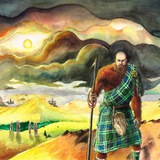
Many times Diasporan heroes and myth have their roots in European lore. American folklore can embody the mythical found in much of European ones, as they are carried over by the people migrating from mother Evropa.
Forwarded from DukeOfDurham 🦌
Folk heroes are imbedded in the consciousness of a people and have traditionally always served as a figure of inspiration. Before children today started to idolise sportsball players and YouTube celebrities, their heroes would often be folk heroes that were immortalised in literature, song, art and film.
When I was a young kid in America (lived there for a year), I remember being captivated by a storyteller that told of the heroic deeds of Davy Crockett, the frontiersman that fell alongside 183 white settlers at the Alamo. A witness described some of the aftermath, noting that Crockett's body was found in the barracks surrounded by "no less than sixteen Mexican corpses", with Crockett's knife buried in one of them.
I hope there are still many Americans, specifically young American boys, that remember their heroes.
When I was a young kid in America (lived there for a year), I remember being captivated by a storyteller that told of the heroic deeds of Davy Crockett, the frontiersman that fell alongside 183 white settlers at the Alamo. A witness described some of the aftermath, noting that Crockett's body was found in the barracks surrounded by "no less than sixteen Mexican corpses", with Crockett's knife buried in one of them.
I hope there are still many Americans, specifically young American boys, that remember their heroes.
Forwarded from Hyperborean Radio (Uncensored) (T.L.K.)
Gandalf, from the Lord of the Rings is a popular and well known figure in modern culture. However, Gandalf is an amalgamation of multiple influences and cultures. While one of the most notable deities he is influenced by is Odin. There is at least 4 other mythic figures who serve as inspirations for Gandalf. The Dwarf "Gandalf" (Magic Staff-Elf) due to initially being a dwarf in early versions. While the wizard Merlin has obvious aspects the two other notable figures are Rübezahl, a mountain spirit from Bohemian folklore whose visage was used as the inspiration for his appearance. Which Tolkien wrote on a postcard featuring him. The final notable inspiration is Väinämöinen, a Finnish deity and wizard/shaman. With at least 5 mythic sources of lore is it any wonder Gandalf is so influential.-TLK
Leshii (Leszi)
Known as the "Forest lord".
He often appeared as a peasant, either without a belt or with shoes on the wrong feet. Sometimes he was said to have wings and a tail and be covered in black hair. Often given goats hooves and horns like Pan in visual representation and he is usually attributed with green eyes.
He could change his size from that of a blade of grass to that of the highest tree and usually he carried a club to show his rulership over the forest creatures.
The Leszi could take the shape of a familiar person and lead you astray with the sound of their voice. Once in his domain, he might tickle his victim to death. He could also become a hare, wolf, bear, raven, pig, horse, rooster, flaming fir tree or even a mushroom.
Known as the "Forest lord".
He often appeared as a peasant, either without a belt or with shoes on the wrong feet. Sometimes he was said to have wings and a tail and be covered in black hair. Often given goats hooves and horns like Pan in visual representation and he is usually attributed with green eyes.
He could change his size from that of a blade of grass to that of the highest tree and usually he carried a club to show his rulership over the forest creatures.
The Leszi could take the shape of a familiar person and lead you astray with the sound of their voice. Once in his domain, he might tickle his victim to death. He could also become a hare, wolf, bear, raven, pig, horse, rooster, flaming fir tree or even a mushroom.
The Leshi is fond of trees and is said to be heard weeping when one is cut down. He is the protector of the forest and all it's creatures. His favorite animal is the wolf - the king of the beasts in Slavic folklore. He is also said to be often seen in the company of bears.
Upon entering a forest it was commonplace to utter a protective spell or prayer lest you run into him. If he got hold of a child, he might replace it with one of his own - who would grow up stupid, with an insatiable appetite.
If the child returned it would ever afterward be a useless derelict and when the Leshii got his hands on an adult, the adult would return sometimes mute and covered with moss, othertimes unable to concentrate and would act oddly for the rest of their lives.
It is believed that Leshii likes offerings of kasha, suet, blini, bread and salt.
Upon entering a forest it was commonplace to utter a protective spell or prayer lest you run into him. If he got hold of a child, he might replace it with one of his own - who would grow up stupid, with an insatiable appetite.
If the child returned it would ever afterward be a useless derelict and when the Leshii got his hands on an adult, the adult would return sometimes mute and covered with moss, othertimes unable to concentrate and would act oddly for the rest of their lives.
It is believed that Leshii likes offerings of kasha, suet, blini, bread and salt.
He is also perfectly happy with a cookie or candy left on a stump or log. It was believed to protect yourself against the leshii, you could turn all your clothing backward and also the collar on your horse, chant "Sheep's mug, sheep’s wool" or if you encounter him, get him to laugh.
When the leshy could be coaxed to befriend a human, the human often had to make a pact, never again wear a cross or take the eucharist. In return, the Leshy would teach the human the secrets of magic. Vast similarities can be made to the widely known Green Man.
When the leshy could be coaxed to befriend a human, the human often had to make a pact, never again wear a cross or take the eucharist. In return, the Leshy would teach the human the secrets of magic. Vast similarities can be made to the widely known Green Man.
Forwarded from Hyperborean Reflections✨🍄
Archetypal characteristics of Thunar are preserved in the Grimm fairy tale ‘Strong Hans’. A youth with super-human strength fashions an iron club that he bludgeons his enemies with. His adventures, similar to that of Siegfried in the Nibelung, lead him to a cunning dwarf he must outsmart and rescue a princess held hostage in his lair. Guided by natural spirits, he uses the dwarf’s magic ring to escape the cave. Hans also meets two giants of similar might named Fir-twister and Rock-splitter whom he also slays after they betray him. Jacob Grimm relates this tale with the Edda poem Hymiskviða in which Thor sets out on a quest to find a cauldron and he wears it on his head. Strong Hans’ strength is so impressive that his frightened employer sends him away on errands to keep him busy. He takes a church bell and wears it as a cap. Other variants of the tale include that Hans gained his great strength from the nourishment of his mothers milk or that of a female animal, and even giant’s milk in some versions.
Folk would fashion rods out of hazelnut, birch, mistletoe, and many other plants for ritual purposes like fertility rites, cleansing the home, or warding against harm. Mistletoe was called Donnerbesen meaning “Thunder’s Broom” (and the church later changed this to teufelbesen ‘devil’s broom’). Grimm also states that another kenning for donnerbesen or donnerkraut was alpruthe (elf-rod) and the word alpgeschoss (elf-shot) was a kenning for the thunderbolt, showing a close relationship between the Gods and elves. At Yule, Father Christmas the jolly old elf, makes his visit riding a goat and sometimes he or one of St. Nicholas’ pagan “helpers” Ruprecht or Belsnickel carries a ‘life rod’ all similar in resemblance to Strong Hans or The Mighty Thunderer and his sacred weapon.
Become the strongman! Thunder’s spirit stir within our people!
Folk would fashion rods out of hazelnut, birch, mistletoe, and many other plants for ritual purposes like fertility rites, cleansing the home, or warding against harm. Mistletoe was called Donnerbesen meaning “Thunder’s Broom” (and the church later changed this to teufelbesen ‘devil’s broom’). Grimm also states that another kenning for donnerbesen or donnerkraut was alpruthe (elf-rod) and the word alpgeschoss (elf-shot) was a kenning for the thunderbolt, showing a close relationship between the Gods and elves. At Yule, Father Christmas the jolly old elf, makes his visit riding a goat and sometimes he or one of St. Nicholas’ pagan “helpers” Ruprecht or Belsnickel carries a ‘life rod’ all similar in resemblance to Strong Hans or The Mighty Thunderer and his sacred weapon.
Become the strongman! Thunder’s spirit stir within our people!
Forwarded from Hyperborean Radio (Uncensored) (Celtic God)
Today we spoke of the many issues facing the modern ethnic faith movement. The issues of the Indo-European fallacy, the toxic politicization of European ethnic faiths, the innate nature of pagan beliefs and its ties to our own nature. The fact that Paganism/Ethnic Faith has become a sub-culture akin to goth or greaser and needs to not allow itself to become this. That we must acknowledge whether we want our ethnic faith to return or to fade. What is this to us? A hobby? or a remembrance of who we truly are? We have allowed ourselves to be taken advantage of by charlatans and false heathens. We cannot allow ourselves to let this continue. This is one of the most important shows we've done, if we want our old ways to return we must be willing to embody them and show who we truly are, and not let others control the narrative.
For the Podcast:
https://anchor.fm/hyperborean-radio/episodes/We-need-to-take-a-stand-e14p1i2
For the Podcast:
https://anchor.fm/hyperborean-radio/episodes/We-need-to-take-a-stand-e14p1i2