Forwarded from Hyperborean Reflections✨🍄
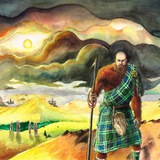
Archetypal characteristics of Thunar are preserved in the Grimm fairy tale ‘Strong Hans’. A youth with super-human strength fashions an iron club that he bludgeons his enemies with. His adventures, similar to that of Siegfried in the Nibelung, lead him to a cunning dwarf he must outsmart and rescue a princess held hostage in his lair. Guided by natural spirits, he uses the dwarf’s magic ring to escape the cave. Hans also meets two giants of similar might named Fir-twister and Rock-splitter whom he also slays after they betray him. Jacob Grimm relates this tale with the Edda poem Hymiskviða in which Thor sets out on a quest to find a cauldron and he wears it on his head. Strong Hans’ strength is so impressive that his frightened employer sends him away on errands to keep him busy. He takes a church bell and wears it as a cap. Other variants of the tale include that Hans gained his great strength from the nourishment of his mothers milk or that of a female animal, and even giant’s milk in some versions.
Folk would fashion rods out of hazelnut, birch, mistletoe, and many other plants for ritual purposes like fertility rites, cleansing the home, or warding against harm. Mistletoe was called Donnerbesen meaning “Thunder’s Broom” (and the church later changed this to teufelbesen ‘devil’s broom’). Grimm also states that another kenning for donnerbesen or donnerkraut was alpruthe (elf-rod) and the word alpgeschoss (elf-shot) was a kenning for the thunderbolt, showing a close relationship between the Gods and elves. At Yule, Father Christmas the jolly old elf, makes his visit riding a goat and sometimes he or one of St. Nicholas’ pagan “helpers” Ruprecht or Belsnickel carries a ‘life rod’ all similar in resemblance to Strong Hans or The Mighty Thunderer and his sacred weapon.
Become the strongman! Thunder’s spirit stir within our people!
Folk would fashion rods out of hazelnut, birch, mistletoe, and many other plants for ritual purposes like fertility rites, cleansing the home, or warding against harm. Mistletoe was called Donnerbesen meaning “Thunder’s Broom” (and the church later changed this to teufelbesen ‘devil’s broom’). Grimm also states that another kenning for donnerbesen or donnerkraut was alpruthe (elf-rod) and the word alpgeschoss (elf-shot) was a kenning for the thunderbolt, showing a close relationship between the Gods and elves. At Yule, Father Christmas the jolly old elf, makes his visit riding a goat and sometimes he or one of St. Nicholas’ pagan “helpers” Ruprecht or Belsnickel carries a ‘life rod’ all similar in resemblance to Strong Hans or The Mighty Thunderer and his sacred weapon.
Become the strongman! Thunder’s spirit stir within our people!
Forwarded from Hyperborean Radio (Uncensored) (Celtic God)
Today we spoke of the many issues facing the modern ethnic faith movement. The issues of the Indo-European fallacy, the toxic politicization of European ethnic faiths, the innate nature of pagan beliefs and its ties to our own nature. The fact that Paganism/Ethnic Faith has become a sub-culture akin to goth or greaser and needs to not allow itself to become this. That we must acknowledge whether we want our ethnic faith to return or to fade. What is this to us? A hobby? or a remembrance of who we truly are? We have allowed ourselves to be taken advantage of by charlatans and false heathens. We cannot allow ourselves to let this continue. This is one of the most important shows we've done, if we want our old ways to return we must be willing to embody them and show who we truly are, and not let others control the narrative.
For the Podcast:
https://anchor.fm/hyperborean-radio/episodes/We-need-to-take-a-stand-e14p1i2
For the Podcast:
https://anchor.fm/hyperborean-radio/episodes/We-need-to-take-a-stand-e14p1i2
Noc Kupały
Kupalo, Slavic deity of water as well as
celebrated as goddess of the Summer Solstice.
It is customary in Slavic culture to construct an effigy named after the celebration of Noc Kupały, welcoming in summertime.
Noc Kupały is also seen as a Slavic Valentine’s Day.
Following the day’s feasting and the evening wreaths collection, great bonfires were built.
Dances and rituals were conducted, people bathed for the first time in at least two weeks.
The bathing was seen as a test of courage, as it was believed that rusalki and other creatures could pull
unaware bathers down underwater, drowning them.
Couples would then try to jump the bonfire at the same time.
Failure to do so was considered a bad omen for a potential marriage and success a good one.
Kupalo, Slavic deity of water as well as
celebrated as goddess of the Summer Solstice.
It is customary in Slavic culture to construct an effigy named after the celebration of Noc Kupały, welcoming in summertime.
Noc Kupały is also seen as a Slavic Valentine’s Day.
Following the day’s feasting and the evening wreaths collection, great bonfires were built.
Dances and rituals were conducted, people bathed for the first time in at least two weeks.
The bathing was seen as a test of courage, as it was believed that rusalki and other creatures could pull
unaware bathers down underwater, drowning them.
Couples would then try to jump the bonfire at the same time.
Failure to do so was considered a bad omen for a potential marriage and success a good one.
The morning after, girls would sprint through
the fields barefoot.
It was believed the dew leftover from Noc Kupały had
supernatural elements and could increase their
possibility of being married.
Farmers would also walk their animals through it
in hopes of promoting their health.
In addition, any foliage or herbs gathered
during Noc Kupały were believed to be extremely
potent and have supernatural properties.
At the end of the jubilee, the effigy of Kupalo is torn asunder
and scattered in the fields.
the fields barefoot.
It was believed the dew leftover from Noc Kupały had
supernatural elements and could increase their
possibility of being married.
Farmers would also walk their animals through it
in hopes of promoting their health.
In addition, any foliage or herbs gathered
during Noc Kupały were believed to be extremely
potent and have supernatural properties.
At the end of the jubilee, the effigy of Kupalo is torn asunder
and scattered in the fields.
Ogma, Celtic god of poets and bards, speech and language who gave the gift of the Ogham, the literary system of the Celts.
He is described as “the fairest of the sons of Danu.”
It is said that rays of sun
would beam from his hair,
and he was called “Ogma grian-aineacg, of the Sunny Countenance.”
He is described as “the fairest of the sons of Danu.”
It is said that rays of sun
would beam from his hair,
and he was called “Ogma grian-aineacg, of the Sunny Countenance.”
"The sun sails high in a neverdark sky
And Maponos rides the tide of summer
Tall are the grasses grown in the fields
the Breeze sighs through them, singing of summer
The forests adorned with a crown of green
beneath plays the god, in the glades of summer
The harp of Maponos vibrates the air,
and late, in the twilight, still it’s summer". - Heron
And Maponos rides the tide of summer
Tall are the grasses grown in the fields
the Breeze sighs through them, singing of summer
The forests adorned with a crown of green
beneath plays the god, in the glades of summer
The harp of Maponos vibrates the air,
and late, in the twilight, still it’s summer". - Heron
Maponus is a god of youth, music and hunting. A “Hyperborean Apollo”,
indicating his worship and reach within the region.
He has a strong connection with the village of Lochmaben in Dumfrieshire, Wales.
His name, which is Gallo-Brythonic,
means ‘the son.’
Maponos’ noscript, Arveriatis,
could mean “provider”, with potential
Indication that he was a god of the
Celtic Arverni tribe.
indicating his worship and reach within the region.
He has a strong connection with the village of Lochmaben in Dumfrieshire, Wales.
His name, which is Gallo-Brythonic,
means ‘the son.’
Maponos’ noscript, Arveriatis,
could mean “provider”, with potential
Indication that he was a god of the
Celtic Arverni tribe.
Forwarded from Hyperborean Radio (Uncensored) (T.L.K.)
One of my most controversial stances is that I don't believe it is right to jam gods together, often over trivial similarities. Such as names or domains. Here are some examples of why.
Hermes Greek messenger god of trade, etc. Vs. Hermus Greek river god
Hilda, a Valkyrie vs. Holda, Multi-faceted German Witch Goddess
Freya, goddess of magic and fertility Norse Vs. Frey God of Kingship and Fertility Norse
Hera, Greek Queen of the Gods Vs, Frau Hera, German goddess who rides a goose
There are many more examples some of which like Aker (Basque Goat God) and Aker (Egyptian Earth god) are even spelled the same in modern English. Etymology is an inexact science and without written records and all but names all or many of the above gods would be shoved together recklessly. I go off of stories and denoscriptions as well as regions and culture. In the Norse alone there are 3 gods whose names translate to Lord and another 3 who translate to beloved. One of which is in both. Why are we getting rid of gods?-TLK
Hermes Greek messenger god of trade, etc. Vs. Hermus Greek river god
Hilda, a Valkyrie vs. Holda, Multi-faceted German Witch Goddess
Freya, goddess of magic and fertility Norse Vs. Frey God of Kingship and Fertility Norse
Hera, Greek Queen of the Gods Vs, Frau Hera, German goddess who rides a goose
There are many more examples some of which like Aker (Basque Goat God) and Aker (Egyptian Earth god) are even spelled the same in modern English. Etymology is an inexact science and without written records and all but names all or many of the above gods would be shoved together recklessly. I go off of stories and denoscriptions as well as regions and culture. In the Norse alone there are 3 gods whose names translate to Lord and another 3 who translate to beloved. One of which is in both. Why are we getting rid of gods?-TLK
I sang of heroes from the
far past, of Bran, god-king
of the Island of the Mighty,
whose deeds outreached
all human strength.
I praised leaders of our time,
Rhydderch Hael, whose sword
flamed from hilt to tip,
and Arthur’s own father,
Uther the Pendragon,
who had led war bands
from west and north and the
farthest reach of Logres to the east.
Yet I knew one day my greatest
song would be of Arthur.
He was like no one else,
more bear, more boar, than man,
reckless yet shrewd,
impulsive yet never wild.
His star was the brightest in our heaven.
⁃The Song of Arthur, Robert Leeson
far past, of Bran, god-king
of the Island of the Mighty,
whose deeds outreached
all human strength.
I praised leaders of our time,
Rhydderch Hael, whose sword
flamed from hilt to tip,
and Arthur’s own father,
Uther the Pendragon,
who had led war bands
from west and north and the
farthest reach of Logres to the east.
Yet I knew one day my greatest
song would be of Arthur.
He was like no one else,
more bear, more boar, than man,
reckless yet shrewd,
impulsive yet never wild.
His star was the brightest in our heaven.
⁃The Song of Arthur, Robert Leeson