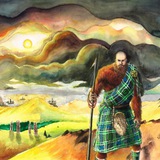
In Scandinavian folk tradition,
there are two types of night riders in pertaining to the Wild Hunt:
The hunter and his dogs pursuing a woman, and the host flying through the air.
This is especially prevalent during Yule season.
In Norway, this host is usually called oskorei (procession of beings)
or jolareidi (Christmas or Yule riders).
there are two types of night riders in pertaining to the Wild Hunt:
The hunter and his dogs pursuing a woman, and the host flying through the air.
This is especially prevalent during Yule season.
In Norway, this host is usually called oskorei (procession of beings)
or jolareidi (Christmas or Yule riders).
Forwarded from Hyperborean Radio (Uncensored) (T.L.K.)
An interesting bit of folklore is that many gods would take forms that would be more familiar to the people, and help them blend in. Gods that would take the form of monks include Wode and Rubezahl, and notably the Mountain Monk and Mine-Monk. While others may appear as kindly old grannies such as Frau Holda. There are also the myriad of deities appearing as huntsmen or in animal form throughout various aspects of folklore and fairy tales. The idea that deities were somehow frozen into their forms in the tribal era, while aesthetically pleasing is simply inaccurate. Greek gods for instance were depicted either naked (as they personified perfection in bodily form) or in a toga, which was a symbol of their station. While I'm not about to argue that the gods should be depicted in suits and sundresses, I do think it pertinent to acknowledge that the continuation of the lore indicates their forms and disguises changed with the times, in many cases gods did not have specified forms, or physical denoscriptions.-TLK
Taranis, the Thunderer
The Celtic ‘Thunder-God’ Taranis, is mentioned from nine innoscriptions found in Italy, Germany, Hungary, Croatia, France and Belgium.
His noscript, as first recorded by Marcus Annaeus Lucanus, or more well known as the poet ‘Lucan’ designates Taranis as the ‘Thunderer’ or perhaps ‘Thunder’ in his writing. “…whose altar is no more benign than that of Scythian Diana.”
He is depicted in antiquity by Lucanus as comparable to the Roman deity Jupiter.
Statues and art displaying Taranis almost always includes a held lightning bolt and a spiral, which could indicate the lightning flash, or a solar wheel.
The Celtic ‘Thunder-God’ Taranis, is mentioned from nine innoscriptions found in Italy, Germany, Hungary, Croatia, France and Belgium.
His noscript, as first recorded by Marcus Annaeus Lucanus, or more well known as the poet ‘Lucan’ designates Taranis as the ‘Thunderer’ or perhaps ‘Thunder’ in his writing. “…whose altar is no more benign than that of Scythian Diana.”
He is depicted in antiquity by Lucanus as comparable to the Roman deity Jupiter.
Statues and art displaying Taranis almost always includes a held lightning bolt and a spiral, which could indicate the lightning flash, or a solar wheel.
The Bern Scholia, also known as the Commenta Bernensia, are commentary notes in a 10th century manunoscript, in which Taranis is described as a “master of war.”
The association of Taranis with fire and storms is alluded to from Augustus Caesar's words; “the fire of the skies: the Sun, and the fire of the air: lightning and its voice thunder, giving the god his name, Taranis.”
It seems more likely that Taranis was firstly a weather deity, associated with storms and more specifically the thunder and lightning that accompanies them.
His most famous depiction is imprinted on the Gundestrup Caludron alongside other deities of Celtic origin.
In Celtic mythology, the mighty god of storms and thunder travels the world at great speeds using his wheel to produce lightning.
The association of Taranis with fire and storms is alluded to from Augustus Caesar's words; “the fire of the skies: the Sun, and the fire of the air: lightning and its voice thunder, giving the god his name, Taranis.”
It seems more likely that Taranis was firstly a weather deity, associated with storms and more specifically the thunder and lightning that accompanies them.
His most famous depiction is imprinted on the Gundestrup Caludron alongside other deities of Celtic origin.
In Celtic mythology, the mighty god of storms and thunder travels the world at great speeds using his wheel to produce lightning.
The wheel was believed by the Celts to spin on the cosmic axis, creating sparks that produce lightning.
With written, linguistic, and artistic depictions of Taranis, we can be reasonably certain that he is a quick-tempered and physically strong thunder god who is one of leaders, and possibly one of the chief deities in the Celtic pantheon .
With written, linguistic, and artistic depictions of Taranis, we can be reasonably certain that he is a quick-tempered and physically strong thunder god who is one of leaders, and possibly one of the chief deities in the Celtic pantheon .
In the British isles and Ireland, the first to finish harvesting grain made a corn dolly, representing the Cailleach (Queen of winter) from the last sheaf of crop.
The last farmer had to care for it for the next year; so they'd have to feed and house the goddess all winter.
The last farmer had to care for it for the next year; so they'd have to feed and house the goddess all winter.
John Barleycorn
One of the more interesting and
astonishing tales I’ve come across is in the folksong of John Barleycorn.
An intriguing character with an
amusing name whose songs
are still sung in taverns and pubs
around Great Britain, he provides
the nectar that patrons of these
establishments imbibe.
Raising cups to his name in
adoration of the merriment that
surrounds them, men and women
alike laud the god of barley from
which the gifts of beer and
whiskey are bestowed upon them.
As of now, he is written about in
song around the 16th century,
during the reign of Queen Elizabeth the 1st.
There are numerous songs about
him but the most famous would have to be the Robert Burns ballad, written in 1782.
One of the more interesting and
astonishing tales I’ve come across is in the folksong of John Barleycorn.
An intriguing character with an
amusing name whose songs
are still sung in taverns and pubs
around Great Britain, he provides
the nectar that patrons of these
establishments imbibe.
Raising cups to his name in
adoration of the merriment that
surrounds them, men and women
alike laud the god of barley from
which the gifts of beer and
whiskey are bestowed upon them.
As of now, he is written about in
song around the 16th century,
during the reign of Queen Elizabeth the 1st.
There are numerous songs about
him but the most famous would have to be the Robert Burns ballad, written in 1782.
The ballad of John Barleycorn by Robert Burns:
There was three kings into the east,
three kings both great and high,
and they hae sworn a solemn oath
John Barleycorn must die.
They took a plough and plough'd him down,
put clods upon his head,
and they hae sworn a solemn oath
John Barleycorn was dead.
But the cheerful Spring came kindly on'
and show'rs began to fall.
John Barleycorn got up again,
and sore surprised them all.
The sultry suns of Summer came,
and he grew thick and strong;
his head well arm'd wi' pointed spears,
that no one should him wrong.
The sober Autumn enter'd mild,
when he grew wan and pale;
his bendin' joints and drooping head
show'd he began to fail.
His colour sicken'd more and more,
and he faded into age;
and then his enemies began
to show their deadly rage.
They took a weapon, long and sharp,
and cut him by the knee;
they ty'd him fast upon a cart,
like a rogue for forgerie.
There was three kings into the east,
three kings both great and high,
and they hae sworn a solemn oath
John Barleycorn must die.
They took a plough and plough'd him down,
put clods upon his head,
and they hae sworn a solemn oath
John Barleycorn was dead.
But the cheerful Spring came kindly on'
and show'rs began to fall.
John Barleycorn got up again,
and sore surprised them all.
The sultry suns of Summer came,
and he grew thick and strong;
his head well arm'd wi' pointed spears,
that no one should him wrong.
The sober Autumn enter'd mild,
when he grew wan and pale;
his bendin' joints and drooping head
show'd he began to fail.
His colour sicken'd more and more,
and he faded into age;
and then his enemies began
to show their deadly rage.
They took a weapon, long and sharp,
and cut him by the knee;
they ty'd him fast upon a cart,
like a rogue for forgerie.
They laid him down upon his back,
and cudgell'd him full sore.
they hung him up before the storm,
and turn'd him o'er and o'er.
They filled up a darksome pit
with water to the brim,
they heav'd in John Barleycorn.
There, let him sink or swim!
They laid him upon the floor,
to work him farther woe;
and still, as signs of life appear'd,
they toss'd him to and fro.
They wasted o'er a scorching flame
the marrow of his bones;
but a miller us'd him worst of all,
for he crush'd him between two stones.
And they hae taen his very hero blood
and drank it round and round;
and still the more and more they drank,
their joy did more abound.
John Barleycorn was a hero bold,
of noble enterprise;
for if you do but taste his blood,
'twill make your courage rise.
'Twill make a man forget his woe;
'twill heighten all his joy;
'twill make the widow's heart to sing,
tho the tear were in her eye.
Then let us toast John Barleycorn,
each man a glass in hand;
and may his great posterity
ne'er fail in old Scotland!
and cudgell'd him full sore.
they hung him up before the storm,
and turn'd him o'er and o'er.
They filled up a darksome pit
with water to the brim,
they heav'd in John Barleycorn.
There, let him sink or swim!
They laid him upon the floor,
to work him farther woe;
and still, as signs of life appear'd,
they toss'd him to and fro.
They wasted o'er a scorching flame
the marrow of his bones;
but a miller us'd him worst of all,
for he crush'd him between two stones.
And they hae taen his very hero blood
and drank it round and round;
and still the more and more they drank,
their joy did more abound.
John Barleycorn was a hero bold,
of noble enterprise;
for if you do but taste his blood,
'twill make your courage rise.
'Twill make a man forget his woe;
'twill heighten all his joy;
'twill make the widow's heart to sing,
tho the tear were in her eye.
Then let us toast John Barleycorn,
each man a glass in hand;
and may his great posterity
ne'er fail in old Scotland!
Forwarded from Hyperborean Radio (Uncensored) (T.L.K.)
The concept of submitting to fate or submitting to god(s) will is not something that allows us to aspire to greatness, the idea that we have no will nor choice, but are mere puppets of some celestial game is a symptom of Christianity, "it's all a part of gods plan" you were born and someday you will die, heroes do not submit to fate they do as they wish and as they view as right. You have agency, you have a choice, the only true destiny any of us have is to die, we can be great or we can be a pointless bit of animate flesh. Which do you want to be? The Choice is not Yahwehs, or fates, or destiny's it is yours. No Excuses, now who and what do you want to be?
This media is not supported in your browser
VIEW IN TELEGRAM
300! Thanks for the subs, lads and lasses. Cheers!
🔥1
Forwarded from THE OLD WAYS (Velesa37)
"Dvorovoi” by Oleg Yahnin.
The Dvorovoi (Russian: Дворово́й) is a Slavic spirit of the courtyard. It was associated with a farmstead's grounds, cattle shed, and stable. A dvorovoi was considered more dangerous than a domovoi as it could pose a threat to livestock, particularly animals with white fur. ...
The Dvorovoi (Russian: Дворово́й) is a Slavic spirit of the courtyard. It was associated with a farmstead's grounds, cattle shed, and stable. A dvorovoi was considered more dangerous than a domovoi as it could pose a threat to livestock, particularly animals with white fur. ...
Wooden idols found in Fischerinsel, Berlin (11th-12th century), Gorbunovo (c. 400 years BC) & Pohjankuru (c. 3000 years BC).