Forwarded from Hyperborean Radio (Uncensored)
Ravens: Ravens are one of the most sacred and important birds in Europe rivaled in their importance by the Owl, Swan, and Eagle almost exclusively at such a position. They are associated with death, prophecy, and magic resulting in being connected to deities such as Chernobog, Apollo, Bran, Branwen, Nanosuelta, The Morrigan, Odin, Hel, Huldr, Perchta, and more. The Raven was the messenger of the gods. Carrying messages for Apollo who eventually burned the bird black in his anger in the story of Aesculapius. While Huginn and Muninn (Thought and Memory) serve as the scouts and spies for Odin. Who he received from the Troll-Maiden (likely giantess) Huldr as a gift. While the Morrigan often takes the form of a raven while visiting our realm and even lands atop Cu Chulain to signify he has indeed died. The Raven was often killed during Christianzation and along with other Corvids like the Magpie were labeled “the devils birds” though they were both messengers of the gods a manifestation of the godhead on earth. Remnants of this belief still exist in fortune telling songs such as “Magpie Songs” across Great Britain. The Christians did not understand the bird itself was not the god but instead just eyes for the god to see through and communicate so their attempts at wiping out the bird did nothing to deter Heathens. The Raven was mostly demonized, but also remained in some positive form. Such as the legend of the Tower of London which likely has its roots in Bran the Blessed, when the Ravens no longer roost in the Tower of London, London will fall. The last time the Ravens were gone the British Empire fell soon after, which many have taken to mean it is true. As such the Ravens remain in the tower now as a sort of protective talisman, though efforts have been made by the current “Government” of London to get rid of them.
Another set of tales involves the Knight of the Round Table Owain fighting Arthur in a dreamscape using a game of Chess and Ravens in “The Dream of Rhonabwy”, as Owain would fight with an army of ravens. Other sources actually speak of King Arthur taking the form of a Raven after death, making it an extremely poor choice to kill such birds. Though the lore of Ravens is not all kind. Such as the story of the Valravn, a Raven who has gained the ability to turn into a knight after consuming many dead soldiers and the heart of a child. Though the enormous Valravn can also appear as a half wolf chimeric monster. The Valravn is a figure in traditional Danish folksongs. This association with the dead is also why along with many older death gods the modern figure of “The Grim Reaper” is often depicted with Ravens as is the Christian Devil. The demonized and darker image they portray often lends them the role as the evil birds in stories. Though the Raven is more often a trickster in folklore, though whether it is malicious or not depends. The Raven is also intricately tied into the “Language of the Birds” A European concept where one can understand birds, This appears in the story of Sigurd, Cu Chulain, The folktales The White Snake, The Language of the Birds, and more. In many ways it is a sign of acquired knowledge such as consuming a creature like a magical white snake, a dragons heart, a salmon who ate from the tree of wisdom. The symbol of the Raven is also present in North America though in a far removed form and should not be combined with European Lore as they are of two completely different mythic traditions. The Role of the Raven in our lore is one of prophet, messenger, eye, a sigil of many peoples, and incarnation of gods. Most important the Raven is a link between this world and the next ,the gifter of knowledge and the animal whom all are equal to in death and in dinner.
Another set of tales involves the Knight of the Round Table Owain fighting Arthur in a dreamscape using a game of Chess and Ravens in “The Dream of Rhonabwy”, as Owain would fight with an army of ravens. Other sources actually speak of King Arthur taking the form of a Raven after death, making it an extremely poor choice to kill such birds. Though the lore of Ravens is not all kind. Such as the story of the Valravn, a Raven who has gained the ability to turn into a knight after consuming many dead soldiers and the heart of a child. Though the enormous Valravn can also appear as a half wolf chimeric monster. The Valravn is a figure in traditional Danish folksongs. This association with the dead is also why along with many older death gods the modern figure of “The Grim Reaper” is often depicted with Ravens as is the Christian Devil. The demonized and darker image they portray often lends them the role as the evil birds in stories. Though the Raven is more often a trickster in folklore, though whether it is malicious or not depends. The Raven is also intricately tied into the “Language of the Birds” A European concept where one can understand birds, This appears in the story of Sigurd, Cu Chulain, The folktales The White Snake, The Language of the Birds, and more. In many ways it is a sign of acquired knowledge such as consuming a creature like a magical white snake, a dragons heart, a salmon who ate from the tree of wisdom. The symbol of the Raven is also present in North America though in a far removed form and should not be combined with European Lore as they are of two completely different mythic traditions. The Role of the Raven in our lore is one of prophet, messenger, eye, a sigil of many peoples, and incarnation of gods. Most important the Raven is a link between this world and the next ,the gifter of knowledge and the animal whom all are equal to in death and in dinner.
Which path do you ascribe to and align with?
Final Results
100%
Paganism
0%
Abrahamic (Christian, Judaism, Islam)
0%
Atheism/Agnosticism
If you enjoy original fantastic pagan artwork from a great guy, check out https://news.1rj.ru/str/AethelwulfArt
He takes commissions for artwork, avatars and has done a lot of work for friends for their channels. Give him a look, you won’t be disappointed!
He takes commissions for artwork, avatars and has done a lot of work for friends for their channels. Give him a look, you won’t be disappointed!
Telegram
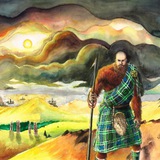
Art of Neale Rundgren
My name is Neale Rundgren and I am of Scandinavian & Rhodesian descent. I am a painter specialising in European cultures & folklore.
Jarilo
Coming to us from the Slavic pantheon is Jarilo, god of spring and fertility.
The Slavic myths were, like others, cyclical in some aspects and this is where the springtime god makes his grand entrance.
Also known as Jarovit, Jarun, and Juraj, he is the embodiment of virility, vigor, young strength, good crops, battle fury, amongst many others.
He is part of the entourage of the spring Wild Hunt in the Czech Republic. He is also looked upon as a god of war, and one of the lost sons of Perun, the Slavic god of thunder.
The ancient beliefs surrounding the springtime god were that he is born around the last day of February, in which the festival of Velja Noć, or the “Great night” was celebrated to bring in the pagan new year. The cycle of death and renewal is engrained in his myth as he is killed by his wife, which brings on the fall and winter seasons.
Coming to us from the Slavic pantheon is Jarilo, god of spring and fertility.
The Slavic myths were, like others, cyclical in some aspects and this is where the springtime god makes his grand entrance.
Also known as Jarovit, Jarun, and Juraj, he is the embodiment of virility, vigor, young strength, good crops, battle fury, amongst many others.
He is part of the entourage of the spring Wild Hunt in the Czech Republic. He is also looked upon as a god of war, and one of the lost sons of Perun, the Slavic god of thunder.
The ancient beliefs surrounding the springtime god were that he is born around the last day of February, in which the festival of Velja Noć, or the “Great night” was celebrated to bring in the pagan new year. The cycle of death and renewal is engrained in his myth as he is killed by his wife, which brings on the fall and winter seasons.
The celebrants of Velja Noć dressed in costumes made of animal skins and masks as it was believed that during this time of year, ancestors of the past made their way into villages and houses to visit their families and celebrate as well.
Even in modern day Russia, effigies are made with an emphasized penis and burned or buried. This is accompanied by songs of sorrow and grief for the death of Jarilo, which results in the return of the chill winter months.
One of the many springtime gods, for the Slavs, Jarilo brings the renewal, rebirth, and life of the spring.
There is much more to his story and I encourage looking into the myths, especially if you are of Slavic heritage.
Even in modern day Russia, effigies are made with an emphasized penis and burned or buried. This is accompanied by songs of sorrow and grief for the death of Jarilo, which results in the return of the chill winter months.
One of the many springtime gods, for the Slavs, Jarilo brings the renewal, rebirth, and life of the spring.
There is much more to his story and I encourage looking into the myths, especially if you are of Slavic heritage.
https://youtu.be/V9oNhzosm7E
Many thanks to Moi Toboi for sharing this great video that expands on the story.
Many thanks to Moi Toboi for sharing this great video that expands on the story.
YouTube
In Honour of Jarilo
Link for the book:
https://www.amazon.com/Chernobogs-Riddles-Mythology-Observed-Through/dp/1986935736
Music by Vidar:
https://vidarofficial.bandcamp.com/
https://www.amazon.com/Chernobogs-Riddles-Mythology-Observed-Through/dp/1986935736
Music by Vidar:
https://vidarofficial.bandcamp.com/
Forwarded from Hilltop Homestead
I'm very excited to announce that I will soon be doing a regular podcast with another lady (hopefully, eventually there will be three of us)! The podcast will be called Sisters of Eos! Eos is a goddess of the dawn and of light; we hope our podcast will be inspirational and uplifting just like this beautiful goddess!
We will be the "sister" podcast to HeimdallR's Home and will be speaking about paganism from a female perspective, as well as discussions on homesteading, homeschooling, and family traditions - to name a few. I'm very excited about this and as soon as we're up and running I'll be providing links! I hope you will all give us a listen! - Myo B.
We will be the "sister" podcast to HeimdallR's Home and will be speaking about paganism from a female perspective, as well as discussions on homesteading, homeschooling, and family traditions - to name a few. I'm very excited about this and as soon as we're up and running I'll be providing links! I hope you will all give us a listen! - Myo B.
Víðarr
The end of days, armageddon, doomsday, Ragnarök…. All of these emit a reaction and emotion to each one of us, but the most common is dread. Many people depict planet earth exploding in a cloud of fire, reminiscent of the potential of every car in Hollywood movies.
The Norse god Víðarr, also known as the “silent god”, possibly a correlation to his lack of showing in the sagas. He plays a vital role during the great conflict of Ragnarök, which means Twilight/Death of the gods, in which he is one of the survivors of the great battle.
Ragnarök is described in the Icelandic poem Völuspá (“Sibyl’s Prophecy”) and in the 13th-century Prose Edda, written down by Snorri Sturluson, which follows the Völuspá.
Víðarr’s name has been understood to mean “The Wide-Ruling one”, is one of the younger generation of gods during the epic event, and his strength is second only to Thor. I haven’t found any other reference to him outside of Ragnarök, but that is not to say that none exist, we just haven’t found any yet.
The end of days, armageddon, doomsday, Ragnarök…. All of these emit a reaction and emotion to each one of us, but the most common is dread. Many people depict planet earth exploding in a cloud of fire, reminiscent of the potential of every car in Hollywood movies.
The Norse god Víðarr, also known as the “silent god”, possibly a correlation to his lack of showing in the sagas. He plays a vital role during the great conflict of Ragnarök, which means Twilight/Death of the gods, in which he is one of the survivors of the great battle.
Ragnarök is described in the Icelandic poem Völuspá (“Sibyl’s Prophecy”) and in the 13th-century Prose Edda, written down by Snorri Sturluson, which follows the Völuspá.
Víðarr’s name has been understood to mean “The Wide-Ruling one”, is one of the younger generation of gods during the epic event, and his strength is second only to Thor. I haven’t found any other reference to him outside of Ragnarök, but that is not to say that none exist, we just haven’t found any yet.
During the great war, the Norse gods and giants (jötnar) battle it out, which results in Óðinn being swallowed whole by the great wolf Fenrir, and Víðarr setting on avenging the death of his father.
He wore a shoe/boot that had been crafted for this exact purpose and moment. It is said to be magical and is the toughest, strongest and sturdiest of shoes. The assault on Fenrir began with Víðarr using his special footwear to kick the beast’s lower jaw to force his mouth open, then bracing his snout up he proceeded to cut Fenrir’s mouth to pieces, killing him and stopping the rampage.
After the conclusion of Ragnarök, some say that time will end, but others surmise that a new earth will spring up, giving new life and a fresh start.
In this scenario, the last two humans in hiding, Líf and Lífþrasir, will have survived the carnage and will come to repopulate the new world.
There is so much more beautiful detail and information that can be learned about Ragnarök, but unfortunately not as much about Víðarr.
He wore a shoe/boot that had been crafted for this exact purpose and moment. It is said to be magical and is the toughest, strongest and sturdiest of shoes. The assault on Fenrir began with Víðarr using his special footwear to kick the beast’s lower jaw to force his mouth open, then bracing his snout up he proceeded to cut Fenrir’s mouth to pieces, killing him and stopping the rampage.
After the conclusion of Ragnarök, some say that time will end, but others surmise that a new earth will spring up, giving new life and a fresh start.
In this scenario, the last two humans in hiding, Líf and Lífþrasir, will have survived the carnage and will come to repopulate the new world.
There is so much more beautiful detail and information that can be learned about Ragnarök, but unfortunately not as much about Víðarr.
The Lebor Gabála Érenn or quite literally "The Book of the Taking of Ireland" is a compilation of prose and poems of the history of Ireland and the Irish. It can be seen as a "mythohistory" by fusion of mythology and history albeit with chrisitan influence by the monks who transcribed the oral myths of Celtic pagans. It is also called the “book of Conquests” or “The book of invasions”.
This piece of history is of extreme importance to me as It is a huge part of my people’s cultural lore.
Whenever a Roman child was born, the parents would make an offering to the Temple of Juno Lucina. Being also a goddess of marital relations and vows, the story goes that after being angered due to the infidelity of her husband, Jupiter, she proceeded to have a child of her own.
This is celebrated on 2 May as another sort of Matronalia comparable to modern Mother’s Day. Then, on the first day of the New Year, the first day of March, Juno gave birth to Mars.
The tradition and custom arose for husbands to shower their wives with gifts on Matronalia as wife and mother to the family’s children.
Children would join in with gifts of their own for their mother, and lovers began to give gifts on the first of the year as well!
This is celebrated on 2 May as another sort of Matronalia comparable to modern Mother’s Day. Then, on the first day of the New Year, the first day of March, Juno gave birth to Mars.
The tradition and custom arose for husbands to shower their wives with gifts on Matronalia as wife and mother to the family’s children.
Children would join in with gifts of their own for their mother, and lovers began to give gifts on the first of the year as well!
Wonderful post on man’s best friend from The Antlered One. Woof woof!!
Forwarded from Hyperborean Radio (Uncensored)
Dogs: The dog is man's best friend, as such it is only natural that dogs have played an extensive part in our mythology from deities to heroes of legend and lore. The Dog has earned its place beside our bed, upon our lap and is the partner of us in spirit and in life. Dogs are often see as healing animals as they were sacred and took part in licking and healing wounds in temples related to Gaulish Nodens and Greek Asclepius, functioning as both emotional support and assistant healer to the doctors in service to the deity. Dogs also serve as deities themselves such as in the case of Cerberus, Garmr, Gwyn Ap Nudd, Simargl, Gaueko, or the daughters of Frau Gode. While other gods have dogs as attendants or sacred animals including: Frau Gode, Hecate, Artemis, Frau Frick, Diana, Nehalennia, Ares, Brigid, The Wild Huntsman, and many many gods and spirits involved from The Wild Hunt. There are untold amount of spirits of dogs in folklore two of the most well known are Grim's and Cŵn Annwn the former being the black dogs of European legend while the second is the spectral white dogs with red ears of the otherworld in Welsh lore. Both of which often follow and take part in the wild hunt. The Cŵn Annwn especially will hunt down wrongdoers (Murderers) and kill them as they had their victims. While figures such as Frau Frick and The Wild Huntsman's dogs are said to be massive and at times seem to breathe fire. These dogs or Grim/Grimhounds are the most common dog associated with the wild hunt and are the likely inspiration for both The Hounds of the Baskervilles and Sirius Black's character in the popular Harry Potter series.
Dogs even appear as powerful beings in Greek Mythology such as Laelaps who was passed along figure to figure until it began to hunt the Teumassian Fox which could never be caught, while Laelaps would catch anything it caught. It created a paradox that caused Zeus to freeze them into stone and cast them into the stars as the constellations Canis Major and Canis Minor, the former of which contains Sirius “the dog star”. While the Church Grim is a common British spirit, and others such as Dando's dogs, Black Shuck, Barghest, and more all take part in folklore especially of the British isles. Many of which are said to be the spirits of peoples dogs who continued to haunt the area to guard or look for their owner. While the Wild Hunt is sometimes said to have dogs that are actually disguised gods, spirits, or even people. The Grim is often seen as an omen of death thought it can also be helpful such as the story of Black Shuck stopping a priest from abusing a girl, functioning in their role as protective spirits. The dog is also a messenger of the gods and is a chtonic animal being the companion of deities like Hades, Hecate, Gwynn Ap Nudd, and Hel. All deities associated with the underworld or liminal spaces. The Hundlings were a legendary Germanic Tribe (Hound Clan) who fought the Wolf Clan, and in Scandinavia the “Dog King” was when a dog was placed on the throne in place of a man as a form of insult. Cu chulain took the place of a guardian hound after killing it thus gaining his name, while Finn Mccool was famous for his great dogs. Hero dogs have had their place in European legend for a long time, from the aforementioned Laelaps, Gellert the Faithful Hound, to Sgt, Stubby from WW2, The dogs who fought in warfare and those that helped find the wounded, bomb sniffing dogs, police dogs, guard dogs, therapy dogs, St, Bernards finding those lost in the alps as rescue dogs. The connection and partnership with dogs is so extensive it would be impossible to list all dogs do for us in one small post. Long after our spirits bonded and Brother Wolf became the half man-half wolf that is the Dog. The fearsome predator became part of the family beloved and warm, always there when you needed them. Never judging, never hating, always loving. Looking into our eyes and seeing how cute we are and we back at them.
Dogs even appear as powerful beings in Greek Mythology such as Laelaps who was passed along figure to figure until it began to hunt the Teumassian Fox which could never be caught, while Laelaps would catch anything it caught. It created a paradox that caused Zeus to freeze them into stone and cast them into the stars as the constellations Canis Major and Canis Minor, the former of which contains Sirius “the dog star”. While the Church Grim is a common British spirit, and others such as Dando's dogs, Black Shuck, Barghest, and more all take part in folklore especially of the British isles. Many of which are said to be the spirits of peoples dogs who continued to haunt the area to guard or look for their owner. While the Wild Hunt is sometimes said to have dogs that are actually disguised gods, spirits, or even people. The Grim is often seen as an omen of death thought it can also be helpful such as the story of Black Shuck stopping a priest from abusing a girl, functioning in their role as protective spirits. The dog is also a messenger of the gods and is a chtonic animal being the companion of deities like Hades, Hecate, Gwynn Ap Nudd, and Hel. All deities associated with the underworld or liminal spaces. The Hundlings were a legendary Germanic Tribe (Hound Clan) who fought the Wolf Clan, and in Scandinavia the “Dog King” was when a dog was placed on the throne in place of a man as a form of insult. Cu chulain took the place of a guardian hound after killing it thus gaining his name, while Finn Mccool was famous for his great dogs. Hero dogs have had their place in European legend for a long time, from the aforementioned Laelaps, Gellert the Faithful Hound, to Sgt, Stubby from WW2, The dogs who fought in warfare and those that helped find the wounded, bomb sniffing dogs, police dogs, guard dogs, therapy dogs, St, Bernards finding those lost in the alps as rescue dogs. The connection and partnership with dogs is so extensive it would be impossible to list all dogs do for us in one small post. Long after our spirits bonded and Brother Wolf became the half man-half wolf that is the Dog. The fearsome predator became part of the family beloved and warm, always there when you needed them. Never judging, never hating, always loving. Looking into our eyes and seeing how cute we are and we back at them.
Forwarded from Hyperborean Radio (Uncensored)
I made the cut and got the Win (top 4) in Duke of Avalon's contest, super excited over making the cut-TAO https://www.youtube.com/watch?v=DJx3cbIpTIQ
YouTube
Ghosts, Angels, Cannibals and Gods | Competition Winners 2021
Big thanks to everyone that participated!
Frisian Tale
https://youtu.be/vqowMocHOKY
Mystery of Mielenex
https://youtu.be/9KtzWM0PJPw
Legend of Lilla Cross
https://youtu.be/PWG_k43rmt0
The Black Angel
https://youtu.be/kCGOruBmhD4
Old Windsor Armouries…
Frisian Tale
https://youtu.be/vqowMocHOKY
Mystery of Mielenex
https://youtu.be/9KtzWM0PJPw
Legend of Lilla Cross
https://youtu.be/PWG_k43rmt0
The Black Angel
https://youtu.be/kCGOruBmhD4
Old Windsor Armouries…
Tuonela - The Finnish land of the Dead
The European concept of the afterlife vary from culture to culture. The only way to know what is in store for us after we pass from this life to the next is a mystery, and that is not necessarily a bad thing. We should become the fullest extent of ourselves, making our ancestors and the gods proud. What will come after this life will come whether we are ready for it or not.
One of the most popular ideas in modern times is to dine with Odin in Valhalla or Freya in Folkvangr, and it is attained through a glorious death in battle where warriors await Ragnarok. Although this is misconceived by many people now, it is widely believed.
For the Celts it was Tír na nÓg, or the land of youth, an island paradise and supernatural realm of everlasting youth, beauty, health, abundance and joy, which is located over the sea, or underground, depending on who you ask.
In ancient Greece, upon death one was greeted by Charon the boatman and ferried to the gates of Hades.
The European concept of the afterlife vary from culture to culture. The only way to know what is in store for us after we pass from this life to the next is a mystery, and that is not necessarily a bad thing. We should become the fullest extent of ourselves, making our ancestors and the gods proud. What will come after this life will come whether we are ready for it or not.
One of the most popular ideas in modern times is to dine with Odin in Valhalla or Freya in Folkvangr, and it is attained through a glorious death in battle where warriors await Ragnarok. Although this is misconceived by many people now, it is widely believed.
For the Celts it was Tír na nÓg, or the land of youth, an island paradise and supernatural realm of everlasting youth, beauty, health, abundance and joy, which is located over the sea, or underground, depending on who you ask.
In ancient Greece, upon death one was greeted by Charon the boatman and ferried to the gates of Hades.