I reused one of those external drive cases for SCSI drives to house my kryoflux setup. Need to get a case with three or more bays to also have a 360k drive at the ready. Maybe switch over to a greaseweasle, too.
What I find really annoying about the kryoflux software is that nobody bothered to implement a way to write just about any floppy image back. Gotta to use an old PC to write .imd 😒
What I find really annoying about the kryoflux software is that nobody bothered to implement a way to write just about any floppy image back. Gotta to use an old PC to write .imd 😒
👍3
Bun's Lab
Got a box full of nice stuff in the mail :3 Thanks, Rik <3
Wew, 12 ATMega644P-20PU and ~100 of those PICs. Thanks a lot!!
Rik also sent me a couple voltage references. That was in fact the whole reason for the box.
LM299AH, REF02, VRE3041A and LTC 6655
LM299AH, REF02, VRE3041A and LTC 6655
Bun's Lab
Rik also sent me a couple voltage references. That was in fact the whole reason for the box. LM299AH, REF02, VRE3041A and LTC 6655
The LM299AH is a real classic. A precision, temperature-stabilized monolithic zener. The temperature stability is 1 ppm/°C, with 20 ppm long term stability, and a noise floor of 7 µVpp typical, 20 µVpp max between 10 Hz - 10 kHz.
The problem is that the initial reverse break down voltage is not well known. It's somewhere between 6.8 - 7.1 V. Which means, in order to build a reference using it, you need a reference to calibrate it to.
The problem is that the initial reverse break down voltage is not well known. It's somewhere between 6.8 - 7.1 V. Which means, in order to build a reference using it, you need a reference to calibrate it to.
Bun's Lab
Photo
The REF02 is a bandgap based 5V precision reference. 10ppm/°C temperature drift, 10µVpp max noise (0.1 Hz - 10 Hz) and a known output voltage of +5 +- 0.2% max. It also has a trim input to further calibrate it within a +- 6% range. The long term stability is specified at +- 100 ppm for the first 1000h, +- 50 ppm for the second 1000h.
Bun's Lab
Photo
The VRE3041A has a known output voltage of 4.094 V +- 0.409 mV, that's 0.01%. A temperature drift of 0.6 ppm/°C, noise of 3 µVpp (0.1 Hz - 10 Hz), and a long term drift of 6 ppm/1kh. It also has a trim option for < 0.01% initial error.
Bun's Lab
Photo
The LTC 6655 is a bandgap based voltage reference.
I have the 5V variant in the hermetically sealed 5x5mm LS8 package. It goes for 16 € a pop on mouser, not including taxes.
Noise is 0.25 ppm pp between 0.1 Hz and 10 Hz, with a 2 ppm/°C temperature drift, a high initial accurary of +- 0.025 % max, and a long term drift of 20 ppm/sqrt(kHr). Dope af.
I have the 5V variant in the hermetically sealed 5x5mm LS8 package. It goes for 16 € a pop on mouser, not including taxes.
Noise is 0.25 ppm pp between 0.1 Hz and 10 Hz, with a 2 ppm/°C temperature drift, a high initial accurary of +- 0.025 % max, and a long term drift of 20 ppm/sqrt(kHr). Dope af.
VRE3041.PDF
195.8 KB
Data sheets
With the power of hackjob soldering I managed to get that weird package onto a SOP14 adapter PCB. Hope it didn't cost me too many ppm. Marco Reps would NOT be proud :(
Snapped off every other leg as to not create loops
Snapped off every other leg as to not create loops
Well, that REF02 is dead :(
I'm pretty sure I didn't zap it. 10V supply results in 8.6V output, output tracks the supply voltage.
I'm pretty sure I didn't zap it. 10V supply results in 8.6V output, output tracks the supply voltage.
Bun's Lab
With the power of hackjob soldering I managed to get that weird package onto a SOP14 adapter PCB. Hope it didn't cost me too many ppm. Marco Reps would NOT be proud :( Snapped off every other leg as to not create loops
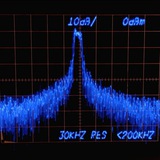
The VRE3041 seems to work perfectly, as far as I can tell at least. My crude measurement setup was very noisy in itself so I couldn't verify its noise level. Unplugging it from the breadboard gives me noise reduction of an order of magnitude - surprise surprise.