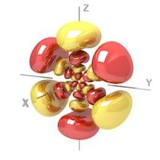
Reaction rates beyond transition state theory? The new platform Overreact (http://github.com/geem-lab/overreact) from the group of @CaramoriFinoto can use ORCA for the QM part and include tunneling, concentration and the whole microkinetics into the models. #compchem
https://onlinelibrary.wiley.com/doi/10.1002/jcc.26861
https://onlinelibrary.wiley.com/doi/10.1002/jcc.26861
GitHub
GitHub - geem-lab/overreact: ⚛️📈 Create and analyze chemical microkinetic models built from computational chemistry data. Crafted…
⚛️📈 Create and analyze chemical microkinetic models built from computational chemistry data. Crafted at the @geem-lab. - GitHub - geem-lab/overreact: ⚛️📈 Create and analyze chemical microkinetic mo...
👍1
Stylish Academic Writing.pdf
896.2 KB
Stylish Academic Writing - Helen Sword
Watch "Schrodinger Equation and the Wave Function (Full Course)" on YouTube
https://youtu.be/WcNiA06WNvI
https://youtu.be/WcNiA06WNvI
YouTube
Schrodinger Equation. Get the Deepest Understanding.
https://www.youtube.com/watch?v=WcNiA06WNvI&list=PLTjLwQcqQzNKzSAxJxKpmOtAriFS5wWy4
Theoretical Physics Book
https://www.azonlinks.com/B0CYZ279NN
Physics Equations Book
https://www.azonlinks.com/B0C47N3TGF
My Daily Blog about my life: https://aleksandr.live…
Theoretical Physics Book
https://www.azonlinks.com/B0CYZ279NN
Physics Equations Book
https://www.azonlinks.com/B0C47N3TGF
My Daily Blog about my life: https://aleksandr.live…
❤5👍1
Watch "Mathematical Foundations of Quantum Mechanics - Ch. 3: Why do we need a Hilbert Space? (TEASER#2)" on YouTube
https://youtu.be/_nL4SznGPgU
https://youtu.be/_nL4SznGPgU
YouTube
Mathematical Foundations of Quantum Mechanics - Ch. 3: Why do we need a Hilbert Space? (TEASER#2)
Hello!
This upload is a teaser for a series I am currently working on, Mathematical Foundations of Quantum Mechanics. This series will give intuition into the fundamental mathematics that underlies quantum mechanics.
I am hoping to answers questions such…
This upload is a teaser for a series I am currently working on, Mathematical Foundations of Quantum Mechanics. This series will give intuition into the fundamental mathematics that underlies quantum mechanics.
I am hoping to answers questions such…
👍4
By Stephan Grimme and co-workers:
Best Practice DFT Protocols for Basic Molecular Computational Chemistry
Nowadays, many chemical investigations can be supported theoretically by routine molecular structure calculations, conformer ensembles, reaction energies, barrier heights, and predicted spectroscopic properties. Such standard computational chemistry applications are most often conducted with density functional theory (DFT) and atom-centered atomic orbital basis sets implemented in many standard quantum chemistry software packages. This work aims to provide general guidance on the various technical and methodological aspects of DFT calculations for molecular systems, and how to achieve an optimal balance between accuracy, robustness, and computational efficiency through multi-level approaches. The main points discussed are the density functional, the atomic orbital basis sets, and the computational protocol to describe and predict experimental behavior properly. This is done in three main parts: Firstly, in the form of a step-by-step decision tree to guide the overall computational approach depending on the problem; secondly, using a recommendation matrix that addresses the most critical aspects regarding the functional and basis set depending on the computational task at hand (structure optimization, reaction energy calculations, etc.); and thirdly, by applying all steps to some representative examples to illustrate the recommended protocols and effect of methodological choices.
https://chemrxiv.org/engage/chemrxiv/article-details/625eb9c9742e9f89b7639c5b
Best Practice DFT Protocols for Basic Molecular Computational Chemistry
Nowadays, many chemical investigations can be supported theoretically by routine molecular structure calculations, conformer ensembles, reaction energies, barrier heights, and predicted spectroscopic properties. Such standard computational chemistry applications are most often conducted with density functional theory (DFT) and atom-centered atomic orbital basis sets implemented in many standard quantum chemistry software packages. This work aims to provide general guidance on the various technical and methodological aspects of DFT calculations for molecular systems, and how to achieve an optimal balance between accuracy, robustness, and computational efficiency through multi-level approaches. The main points discussed are the density functional, the atomic orbital basis sets, and the computational protocol to describe and predict experimental behavior properly. This is done in three main parts: Firstly, in the form of a step-by-step decision tree to guide the overall computational approach depending on the problem; secondly, using a recommendation matrix that addresses the most critical aspects regarding the functional and basis set depending on the computational task at hand (structure optimization, reaction energy calculations, etc.); and thirdly, by applying all steps to some representative examples to illustrate the recommended protocols and effect of methodological choices.
https://chemrxiv.org/engage/chemrxiv/article-details/625eb9c9742e9f89b7639c5b
ChemRxiv
Best Practice DFT Protocols for Basic Molecular Computational Chemistry
Nowadays, many chemical investigations can be supported theoretically by routine molecular structure calculations, conformer ensembles, reaction energies, barrier heights, and predicted spectroscopic properties.
Such standard computational chemistry applications…
Such standard computational chemistry applications…
❤6👍2
Team demonstrates rare form of electricity in ultra-thin material
https://phys.org/news/2022-04-team-rare-electricity-ultra-thin-material.html
https://phys.org/news/2022-04-team-rare-electricity-ultra-thin-material.html
phys.org
Team demonstrates rare form of electricity in ultra-thin material
The nanoscopic equivalent of stacking a deck of cards—layering materials a mere few atoms thick atop one another—has emerged as a favorite pastime of material scientists and electrical engineers worldwide.
Discovering Chemistry With Natural Bond Orbitals.pdf
9.9 MB
Discovering Chemistry With Natural Bond Orbitals
Molecular Cage Reveals Near-Atomic Level Details of Cancer Proteins
https://scitechdaily.com/molecular-cage-reveals-near-atomic-level-details-of-cancer-proteins/
https://scitechdaily.com/molecular-cage-reveals-near-atomic-level-details-of-cancer-proteins/
SciTechDaily
Molecular Cage Reveals Near-Atomic Level Details of Cancer Proteins
Sandwiching wiggly proteins between two other layers allows scientists to get the most detailed images yet of a protein that’s key to the spread of acute myeloid leukemia. According to the American Cancer Institute, acute myeloid leukemia (AML) will afflict…
Electron Motion Tracked in a Quantum State of Matter Using X-Ray Pulses Less Than a Millionth of a Billionth of a Second Long
https://scitechdaily.com/electron-motion-tracked-in-a-quantum-state-of-matter-using-x-ray-pulses-less-than-a-millionth-of-a-billionth-of-a-second-long/
https://scitechdaily.com/electron-motion-tracked-in-a-quantum-state-of-matter-using-x-ray-pulses-less-than-a-millionth-of-a-billionth-of-a-second-long/
SciTechDaily
Electron Motion Tracked in a Quantum State of Matter Using X-Ray Pulses Less Than a Millionth of a Billionth of a Second Long
Less than a millionth of a billionth of a second long, attosecond X-ray pulses allow researchers to peer deep inside molecules and follow electrons as they zip around and ultimately initiate chemical reactions. Scientists at the Department of Energy's SLAC…
Mechanism 'splits' electron spins in magnetic material
https://phys.org/news/2022-05-mechanism-electron-magnetic-material.html
https://phys.org/news/2022-05-mechanism-electron-magnetic-material.html
phys.org
Mechanism 'splits' electron spins in magnetic material
Holding the right material at the right angle, Cornell researchers have discovered a strategy to switch the magnetization in thin layers of a ferromagnet—a technique that could eventually lead to the ...
PhD and Postdoc positions available at the Max Planck Institute
[1] Simulations of organic semiconductors:
https://www.mpip-mainz.mpg.de/759544/2022_05_Andrienko_MERCK
[2] Simulations of perovskite solar cells:
https://www.mpip-mainz.mpg.de/759523/2022_05_Andrienko_KAUST
[1] Simulations of organic semiconductors:
https://www.mpip-mainz.mpg.de/759544/2022_05_Andrienko_MERCK
[2] Simulations of perovskite solar cells:
https://www.mpip-mainz.mpg.de/759523/2022_05_Andrienko_KAUST
Max-Planck-Gesellschaft
PhD/Postdoc offer in simulations of organic semiconductors
Stellenangebot vom 1. Mai 2022
Live Webinar: COVID Moonshot - Collaborative Antiviral Discovery
COVID Moonshot - A Collaborative Approach to Antiviral Discovery
Thursday, June 9 at 9:00 am PT, 12:00 pm ET and 17:00 BST
In the early days of the COVID-19 pandemic, a group of scientists hailing from academic and industrial organizations around the world came together with the ambitious goal of discovering an antiviral against the virus. Two years later, the COVID Moonshot consortium has identified multiple compounds to be entered into preclinical trial.
Join this webinar to hear behind-the-scene stories of COVID Moonshot and learn how this non-profit, open-science project was able to achieve significant results with limited resources.
Speakers: Monalisa Chatterji, PhD (Sekkei Bio Pvt. Ltd.), Ed Griffen, PhD
(MedChemica Ltd.) and Annette von Delft, MD, PhD (University of Oxford)
https://info.collaborativedrug.com/2022-q2-scientific-webinar
COVID Moonshot - A Collaborative Approach to Antiviral Discovery
Thursday, June 9 at 9:00 am PT, 12:00 pm ET and 17:00 BST
In the early days of the COVID-19 pandemic, a group of scientists hailing from academic and industrial organizations around the world came together with the ambitious goal of discovering an antiviral against the virus. Two years later, the COVID Moonshot consortium has identified multiple compounds to be entered into preclinical trial.
Join this webinar to hear behind-the-scene stories of COVID Moonshot and learn how this non-profit, open-science project was able to achieve significant results with limited resources.
Speakers: Monalisa Chatterji, PhD (Sekkei Bio Pvt. Ltd.), Ed Griffen, PhD
(MedChemica Ltd.) and Annette von Delft, MD, PhD (University of Oxford)
https://info.collaborativedrug.com/2022-q2-scientific-webinar
Collaborativedrug
CDD Webinar: COVID Moonshot
👍1
“Visualizing the Proton” – Physicists’ Innovative Animation Depicts the Subatomic World in a New Way
https://scitechdaily.com/visualizing-the-proton-physicists-innovative-animation-depicts-the-subatomic-world-in-a-new-way/
https://scitechdaily.com/visualizing-the-proton-physicists-innovative-animation-depicts-the-subatomic-world-in-a-new-way/
SciTechDaily
“Visualizing the Proton” – Physicists’ Innovative Animation Depicts the Subatomic World in a New Way
An Art-Science Collaboration Tests the Limits of Visual Technologies Try to picture a proton — the tiny, positively charged particle within an atomic nucleus — and you may envision a familiar, textbook diagram: a bundle of billiard balls representing quarks…
👍1
Crystal study may resolve DNA mystery
https://phys.org/news/2022-05-crystal-dna-mystery.html
https://phys.org/news/2022-05-crystal-dna-mystery.html
phys.org
Crystal study may resolve DNA mystery
When cells reproduce, the internal mechanisms that copy DNA get it right nearly every time. Rice University bioscientists have uncovered a tiny detail that helps understand how the process could go wrong.
Energy researchers invent chameleon metal that acts like many others
https://phys.org/news/2022-05-energy-chameleon-metal.html
https://phys.org/news/2022-05-energy-chameleon-metal.html
phys.org
Energy researchers invent chameleon metal that acts like many others
A team of energy researchers led by the University of Minnesota Twin Cities have invented a device that electronically converts one metal so that it behaves like another for use as a catalyst in chemical ...
As much pressure as Uranus' core: The first materials synthesis research and study in the terapascal range
https://phys.org/news/2022-05-pressure-uranus-core-materials-synthesis.html
https://phys.org/news/2022-05-pressure-uranus-core-materials-synthesis.html
phys.org
As much pressure as Uranus' core: The first materials synthesis research and study in the terapascal range
Jules Verne could not even dream of this: A research team from the University of Bayreuth, together with international partners, has pushed the boundaries of high-pressure and high-temperature research ...
Psi4 is an open-source first-class computational chemistry package that is built with Python bindings. The great part is that it can even work from the Jupyter Notebook. Here is a way for you to run Psi4 using the free Google Colab (yes, that gives you a lot of computational power for free!):
https://colab.research.google.com/drive/1Z5DWnToMWiKIM9k8fi3ux-GtrWYlQ5nw?usp=sharing
https://colab.research.google.com/drive/1Z5DWnToMWiKIM9k8fi3ux-GtrWYlQ5nw?usp=sharing
Google
Installing and running Psi4 (v 1.5).ipynb
Colaboratory notebook