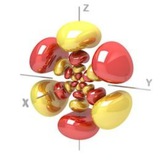
“Visualizing the Proton” – Physicists’ Innovative Animation Depicts the Subatomic World in a New Way
https://scitechdaily.com/visualizing-the-proton-physicists-innovative-animation-depicts-the-subatomic-world-in-a-new-way/
https://scitechdaily.com/visualizing-the-proton-physicists-innovative-animation-depicts-the-subatomic-world-in-a-new-way/
SciTechDaily
“Visualizing the Proton” – Physicists’ Innovative Animation Depicts the Subatomic World in a New Way
An Art-Science Collaboration Tests the Limits of Visual Technologies Try to picture a proton — the tiny, positively charged particle within an atomic nucleus — and you may envision a familiar, textbook diagram: a bundle of billiard balls representing quarks…
👍1
Crystal study may resolve DNA mystery
https://phys.org/news/2022-05-crystal-dna-mystery.html
https://phys.org/news/2022-05-crystal-dna-mystery.html
phys.org
Crystal study may resolve DNA mystery
When cells reproduce, the internal mechanisms that copy DNA get it right nearly every time. Rice University bioscientists have uncovered a tiny detail that helps understand how the process could go wrong.
Energy researchers invent chameleon metal that acts like many others
https://phys.org/news/2022-05-energy-chameleon-metal.html
https://phys.org/news/2022-05-energy-chameleon-metal.html
phys.org
Energy researchers invent chameleon metal that acts like many others
A team of energy researchers led by the University of Minnesota Twin Cities have invented a device that electronically converts one metal so that it behaves like another for use as a catalyst in chemical ...
As much pressure as Uranus' core: The first materials synthesis research and study in the terapascal range
https://phys.org/news/2022-05-pressure-uranus-core-materials-synthesis.html
https://phys.org/news/2022-05-pressure-uranus-core-materials-synthesis.html
phys.org
As much pressure as Uranus' core: The first materials synthesis research and study in the terapascal range
Jules Verne could not even dream of this: A research team from the University of Bayreuth, together with international partners, has pushed the boundaries of high-pressure and high-temperature research ...
Psi4 is an open-source first-class computational chemistry package that is built with Python bindings. The great part is that it can even work from the Jupyter Notebook. Here is a way for you to run Psi4 using the free Google Colab (yes, that gives you a lot of computational power for free!):
https://colab.research.google.com/drive/1Z5DWnToMWiKIM9k8fi3ux-GtrWYlQ5nw?usp=sharing
https://colab.research.google.com/drive/1Z5DWnToMWiKIM9k8fi3ux-GtrWYlQ5nw?usp=sharing
Google
Installing and running Psi4 (v 1.5).ipynb
Colaboratory notebook
It is time to update your Periodic Table! ⏰
#IUPAC has just released a new Periodic Table https://iupac.org/what-we-do/periodic-table-of-elements/ with the revised standard atomic weights and/or the uncertainties of fourteen elements. https://degruyter.com/document/doi/10.1515/pac-2019-0603/pdf
#IUPAC has just released a new Periodic Table https://iupac.org/what-we-do/periodic-table-of-elements/ with the revised standard atomic weights and/or the uncertainties of fourteen elements. https://degruyter.com/document/doi/10.1515/pac-2019-0603/pdf
IUPAC | International Union of Pure and Applied Chemistry
Periodic Table of Elements - IUPAC | International Union of Pure and Applied Chemistry
View the latest release of the Periodic Table (dated 8 Jan 2016) includes the recently added elements 113, 115, 117, and 118 with their temporary names and symbols
👍3
Atomic and Electronic Structure of Solids.pdf
7.1 MB
Atomic and Electronic Structure of Solids
Join my lab in Vienna!
We have one vacant PhD position starting June or later.
If you bring in a background in Biochemistry/Biotechnology, please apply via email.
Funding available for 4 y.
Deadline 31.05.2022
Please check: https://mdt.univie.ac.at
We have one vacant PhD position starting June or later.
If you bring in a background in Biochemistry/Biotechnology, please apply via email.
Funding available for 4 y.
Deadline 31.05.2022
Please check: https://mdt.univie.ac.at
mdt.univie.ac.at
Molecular Drug Targeting
👍2
QuantumVITAS (Quantum Visualization Interacting Toolkit for Ab-initio Simulations) is a software aiming at bringing user friendly graphical user interface to quantum chemistry software. In the current stage Quantum ESPRESSO is the calculation engine.
https://www.quantumvitas.org/
(Thanks to D K Raman for the suggestion)
https://www.quantumvitas.org/
(Thanks to D K Raman for the suggestion)
QuantumVITAS
Home - QuantumVITAS
Quantum Visual Interactive Toolkit for Abinitio Simulation Quantum VITAS Download Learn more Quantum calculations, easily accessed graphically yet fully controllable QuantumVITAS (Quantum Visualization Interacting Toolkit for Ab-initio Simulations) is a software…
👍3😱1
Scientists Just Measured a Mechanical Quantum System Without Destroying It
https://www.sciencealert.com/scientists-just-measured-a-mechanical-quantum-system-without-destroying-it
https://www.sciencealert.com/scientists-just-measured-a-mechanical-quantum-system-without-destroying-it
ScienceAlert
Scientists Just Measured a Mechanical Quantum System Without Destroying It
There's a key aspect of quantum computing you may not have thought about before. Called 'quantum non-demolition measurements', they refer to observing certain quantum states without destroying them in the process.
Assistant Professor/Postdoctoral Researcher in the area of data-driven material discovery
Institutes of Innovation for Future Society, Nagoya University (located in Nagoya City in Japan) is seeking a specially appointed assistant professor or postdoctoral researcher in the area of data-driven materials discovery. We are looking for a researcher who can enthusiastically promote research on machine learning and materials design algorithms based on computational data, and the search for specific functional materials in collaboration with experimental researchers. The position is open immediately, but the starting date is negotiable. The position is full-time and single-year contract with the possibility for additional years of support provided adequate progress on the project. The position will remain open until filled.
Desired qualifications: (1) PhD in Materials Science, Chemistry, Physics, Chemical Engineering, Informatics or closely related fields. (2) Prior experience with machine learning, materials informatics. (3) (option) Experience with ab-initio calculations. (4) Excellent oral and written communication skills that will facilitate interdisciplinary collaborations with multiple teams.
To apply: Please send your CV and a brief denoscription of your research interests to Dr. Ryoji Asahi (ryoji.asahi@chem.material.nagoya-u.ac.jp).
Institutes of Innovation for Future Society, Nagoya University (located in Nagoya City in Japan) is seeking a specially appointed assistant professor or postdoctoral researcher in the area of data-driven materials discovery. We are looking for a researcher who can enthusiastically promote research on machine learning and materials design algorithms based on computational data, and the search for specific functional materials in collaboration with experimental researchers. The position is open immediately, but the starting date is negotiable. The position is full-time and single-year contract with the possibility for additional years of support provided adequate progress on the project. The position will remain open until filled.
Desired qualifications: (1) PhD in Materials Science, Chemistry, Physics, Chemical Engineering, Informatics or closely related fields. (2) Prior experience with machine learning, materials informatics. (3) (option) Experience with ab-initio calculations. (4) Excellent oral and written communication skills that will facilitate interdisciplinary collaborations with multiple teams.
To apply: Please send your CV and a brief denoscription of your research interests to Dr. Ryoji Asahi (ryoji.asahi@chem.material.nagoya-u.ac.jp).
Long-hypothesized 'next generation wonder material' created for first time
https://phys.org/news/2022-05-long-hypothesized-material.html
https://phys.org/news/2022-05-long-hypothesized-material.html
phys.org
Long-hypothesized 'next generation wonder material' created for first time
For over a decade, scientists have attempted to synthesize a new form of carbon called graphyne with limited success. That endeavor is now at an end, though, thanks to new research from the University ...
👍1
** XTB version 6.5.0 is out!***
There is now a Windows binary available.
# New features
* Implemented ORCA Hessian for thermo submodule (#504)
* Add Oniom calculator (#573, #574, #577, #581, #578)
* Use mctc library for geometry input / output, (#591, #594, #592)
* support QCSchema JSON, QChem molecule files and FHI-aims geometry.in inputs
* Allow printing of GFN-FF topology lists (#545, #570)
* Add parameters for GFN1(Si)-xTB (#550)
* Added C API option to call gradient calculations on point charges (#584)
* Writing GFN-FF adjacency to output (#497)
* Implement noscript driver (#579)
* Reparametrization of Pt in Toluene for ALPB. (#524)
# Bug fixes
* Fix issues with structure converter (#604)
* Catch out-of-bounds indexing for constraints (#602)
* Don't check for existence of gfnff_topo (#595)
* Fix hessian calculations for single atoms (#587)
* Make sure to not allow filling more electrons than orbitals available (#526)
* Fix overflow of array for long dynamics (#554)
* Fix formatting in bond order printout (#544)
* Fix duplicated key entry in JSON dump (#537)
* Wrong cube sizing (#527)
* Initialize number of electrons in SP calculation (#525)
* Revert calculation of GFN-FF topological charges (#520)
* Bump C standard to C11 for using _Generic (#623)
# Refactoring
* Add reference for ALPB and GBSA model (#502)
* Use unit testing framework (#517)
* Refactor CMake build files (#518)
* Remove dead-code (symparam, symtrans) (#522)
* Update meson build options (#533)
* Update handling of charges in GFN-FF (#558, #609)
* Refactoring of external drivers (#568, #582)
* Add hessian calculation to calculator type (#569)
* Cleanup printout of spin (#576)
* Use iso_c_binding for building signal handlers (#622)
https://github.com/grimme-lab/xtb/releases/tag/v6.5.0
There is now a Windows binary available.
# New features
* Implemented ORCA Hessian for thermo submodule (#504)
* Add Oniom calculator (#573, #574, #577, #581, #578)
* Use mctc library for geometry input / output, (#591, #594, #592)
* support QCSchema JSON, QChem molecule files and FHI-aims geometry.in inputs
* Allow printing of GFN-FF topology lists (#545, #570)
* Add parameters for GFN1(Si)-xTB (#550)
* Added C API option to call gradient calculations on point charges (#584)
* Writing GFN-FF adjacency to output (#497)
* Implement noscript driver (#579)
* Reparametrization of Pt in Toluene for ALPB. (#524)
# Bug fixes
* Fix issues with structure converter (#604)
* Catch out-of-bounds indexing for constraints (#602)
* Don't check for existence of gfnff_topo (#595)
* Fix hessian calculations for single atoms (#587)
* Make sure to not allow filling more electrons than orbitals available (#526)
* Fix overflow of array for long dynamics (#554)
* Fix formatting in bond order printout (#544)
* Fix duplicated key entry in JSON dump (#537)
* Wrong cube sizing (#527)
* Initialize number of electrons in SP calculation (#525)
* Revert calculation of GFN-FF topological charges (#520)
* Bump C standard to C11 for using _Generic (#623)
# Refactoring
* Add reference for ALPB and GBSA model (#502)
* Use unit testing framework (#517)
* Refactor CMake build files (#518)
* Remove dead-code (symparam, symtrans) (#522)
* Update meson build options (#533)
* Update handling of charges in GFN-FF (#558, #609)
* Refactoring of external drivers (#568, #582)
* Add hessian calculation to calculator type (#569)
* Cleanup printout of spin (#576)
* Use iso_c_binding for building signal handlers (#622)
https://github.com/grimme-lab/xtb/releases/tag/v6.5.0
GitHub
Release xtb version 6.5.0 · grimme-lab/xtb
Many thanks to Christian Hölzer (@hoelzerC), Albert Katbashev (@Albkat), Jeroen Koopman (@JayTheDog), Hagen Neugebauer (@haneug), Felix Pultar (@pultar), Thomas Rose (@Thomas3R), Jordy Schifferstei...
❤5👍1
Elementary Molecular Quantum Mechanics.pdf
10.6 MB
Elementary Molecular Quantum Mechanics: Mathematical Methods and Applications
❤5
PhD student position at Florida State University
A fully-funded Ph.D. student position (starting in August 2022) is available in Prof. Chen Huang's group at the Department of Scientific Computing, Florida State University. We work in the field of density functional theory (DFT). The student may choose to work on one of the following projects: (a) developing a local-correlation method for large-scale DFT simulations with advanced exchange-correlation functionals, (b) developing a new orbital-free DFT method for efficient simulations of high-entropy alloys, and (c) developing a new local hybrid DFT for polaron simulations.
Candidates with a Bachelor's or Master's degree in physics, chemistry, materials science, or a related field are encouraged to apply. Since the projects require programming, prior programming experience is a plus, but not necessary.
Please contact Dr. Huang at chuang3@fsu.edu, if you are interested in this position. More details about our research can be found on the group's website: https://sites.google.com/site/huangfsu/home
https://psi-k.net/jobs/phd-student-position-at-florida-state-university
A fully-funded Ph.D. student position (starting in August 2022) is available in Prof. Chen Huang's group at the Department of Scientific Computing, Florida State University. We work in the field of density functional theory (DFT). The student may choose to work on one of the following projects: (a) developing a local-correlation method for large-scale DFT simulations with advanced exchange-correlation functionals, (b) developing a new orbital-free DFT method for efficient simulations of high-entropy alloys, and (c) developing a new local hybrid DFT for polaron simulations.
Candidates with a Bachelor's or Master's degree in physics, chemistry, materials science, or a related field are encouraged to apply. Since the projects require programming, prior programming experience is a plus, but not necessary.
Please contact Dr. Huang at chuang3@fsu.edu, if you are interested in this position. More details about our research can be found on the group's website: https://sites.google.com/site/huangfsu/home
https://psi-k.net/jobs/phd-student-position-at-florida-state-university
Google
HUANG GROUP
Chen Huang
Associate Professor
Department of Scientific Computing, Florida State University, Tallahassee, Florida
Email: chuang3@fsu.edu
2020- Associate Professor, Department of Scientific Computing, Florida State University
2014-2020 Assistant…
Associate Professor
Department of Scientific Computing, Florida State University, Tallahassee, Florida
Email: chuang3@fsu.edu
2020- Associate Professor, Department of Scientific Computing, Florida State University
2014-2020 Assistant…
❤3👍1
A special camera that can 'see' the intimate details of the helium-3 universe
https://phys.org/news/2022-05-special-camera-intimate-helium-universe.html
https://phys.org/news/2022-05-special-camera-intimate-helium-universe.html
phys.org
A special camera that can 'see' the intimate details of the helium-3 universe
A team of physicists at Lancaster University has developed a camera system that can be used to capture the shadow of a sample of helium-3. In their paper published in the journal Physical Review B, the ...
Are you interested in seeing academic position offers here in the group?
Anonymous Poll
93%
Yes
7%
No
❤8
Postdoctoral Recruitment for Prof. Fan Xiaoli’s Team at Northwestern Polytechnical University
Professor Fan Xiaoli's team at Center of Advanced Lubrication and Seal Materials, School of Materials Science and Engineering, Northwestern Polytechnical University is now recruiting 2-3 postdoctoral fellows due to work needs. (long- term valid)
Please see Prof. Fan Xiaoli's faculty homepage at http://teacher.nwpu.edu.cn/fanxiaoli
The requirements of recruitment are as follows:
# Ⅰ.Requried Professional Direction
* Machine learning, database, multi-scale computation of materials structure, properties and performance etc.
Requirements
Applicants shall be under 35 years old, and have obtained a doctoral degree in China or abroad (generally within 3 years of obtaining the doctoral degree).
Applicants shall have a research background in machine learning, databases, computational materials science (first principles, molecular dynamics and other multi-scale computing), etc.
Applicants shall be passionate about scientific research and have a rigorous academic attitude, professional dedication, strong research and innovation ability, team spirit, communication, coordination and organization ability.
Applicant shall be able to engage in postdoctoral research work on a full-time basis and meet the requirements of the Regulations on Postdoctoral Management (The National Ministry of Personnel [2006] No. 149) and Regulations on Postdoctoral Management of Northwestern Polytechnical University (X.R.Z [2021] No. 143). at https://renshi.nwpu.edu.cn/info/1212/6532.htm
# III. Recruitment Procedure
Please send the e-copy of your resume, degree certificates and other supporting documents to junqin.shi@nwpu.edu.cn if you are interested in this position. (with the email noscript of : Postdoctoral + name + name of university graduated + major).
Preliminary screening will be conducted for qualified applicants, passed applicants will proceed to the interview phase and the best by selection will be employed .
Assessment and Salary
Please refers to the "Regulations on Postdoctoral Management of Northwestern Polytechnical University" for assessment and salary:
Specially funded postdoctoral fellows: 290,000 RMB; Regular postdoctoral fellows: 240,000 RMB; The research group will provide other competitive compensation rewards (performance + rewards ≥ 50,000 RMB).
The research centre will provide good research conditions and adequate financial support.
Applicants are encouraged and assisted in the application of Postdoctoral Innovation Talent Support Programme, China Postdoctoral Science Foundation, National Youth Science Foundation and various international exchange programmes. Those who are excellent in station assessment and meet NPU faculty introduction criteria will be recommended to apply for the corresponding teaching and research positions in the NPU.
Please Contact: Mr. Shi
Tel: 15339149110
Email: junqin.shi@nwpu.edu.cn
Professor Fan Xiaoli's team at Center of Advanced Lubrication and Seal Materials, School of Materials Science and Engineering, Northwestern Polytechnical University is now recruiting 2-3 postdoctoral fellows due to work needs. (long- term valid)
Please see Prof. Fan Xiaoli's faculty homepage at http://teacher.nwpu.edu.cn/fanxiaoli
The requirements of recruitment are as follows:
# Ⅰ.Requried Professional Direction
* Machine learning, database, multi-scale computation of materials structure, properties and performance etc.
Requirements
Applicants shall be under 35 years old, and have obtained a doctoral degree in China or abroad (generally within 3 years of obtaining the doctoral degree).
Applicants shall have a research background in machine learning, databases, computational materials science (first principles, molecular dynamics and other multi-scale computing), etc.
Applicants shall be passionate about scientific research and have a rigorous academic attitude, professional dedication, strong research and innovation ability, team spirit, communication, coordination and organization ability.
Applicant shall be able to engage in postdoctoral research work on a full-time basis and meet the requirements of the Regulations on Postdoctoral Management (The National Ministry of Personnel [2006] No. 149) and Regulations on Postdoctoral Management of Northwestern Polytechnical University (X.R.Z [2021] No. 143). at https://renshi.nwpu.edu.cn/info/1212/6532.htm
# III. Recruitment Procedure
Please send the e-copy of your resume, degree certificates and other supporting documents to junqin.shi@nwpu.edu.cn if you are interested in this position. (with the email noscript of : Postdoctoral + name + name of university graduated + major).
Preliminary screening will be conducted for qualified applicants, passed applicants will proceed to the interview phase and the best by selection will be employed .
Assessment and Salary
Please refers to the "Regulations on Postdoctoral Management of Northwestern Polytechnical University" for assessment and salary:
Specially funded postdoctoral fellows: 290,000 RMB; Regular postdoctoral fellows: 240,000 RMB; The research group will provide other competitive compensation rewards (performance + rewards ≥ 50,000 RMB).
The research centre will provide good research conditions and adequate financial support.
Applicants are encouraged and assisted in the application of Postdoctoral Innovation Talent Support Programme, China Postdoctoral Science Foundation, National Youth Science Foundation and various international exchange programmes. Those who are excellent in station assessment and meet NPU faculty introduction criteria will be recommended to apply for the corresponding teaching and research positions in the NPU.
Please Contact: Mr. Shi
Tel: 15339149110
Email: junqin.shi@nwpu.edu.cn
Open Access
Artificial intelligence-enhanced quantum chemical method with broad applicability
High-level quantum mechanical (QM) calculations are indispensable for accurate explanation of natural phenomena on the atomistic level. Their staggering computational cost, however, poses great limitations, which luckily can be lifted to a great extent by exploiting advances in artificial intelligence (AI). Here we introduce the general-purpose, highly transferable artificial intelligence–quantum mechanical method 1 (AIQM1). It approaches the accuracy of the gold-standard coupled cluster QM method with high computational speed of the approximate low-level semiempirical QM methods for the neutral, closed-shell species in the ground state. AIQM1 can provide accurate ground-state energies for diverse organic compounds as well as geometries for even challenging systems such as large conjugated compounds (fullerene C60) close to experiment. This opens an opportunity to investigate chemical compounds with previously unattainable speed and accuracy as we demonstrate by determining geometries of polyyne molecules—the task difficult for both experiment and theory. Noteworthy, our method’s accuracy is also good for ions and excited-state properties, although the neural network part of AIQM1 was never fitted to these properties.
https://www.nature.com/articles/s41467-021-27340-2
Artificial intelligence-enhanced quantum chemical method with broad applicability
High-level quantum mechanical (QM) calculations are indispensable for accurate explanation of natural phenomena on the atomistic level. Their staggering computational cost, however, poses great limitations, which luckily can be lifted to a great extent by exploiting advances in artificial intelligence (AI). Here we introduce the general-purpose, highly transferable artificial intelligence–quantum mechanical method 1 (AIQM1). It approaches the accuracy of the gold-standard coupled cluster QM method with high computational speed of the approximate low-level semiempirical QM methods for the neutral, closed-shell species in the ground state. AIQM1 can provide accurate ground-state energies for diverse organic compounds as well as geometries for even challenging systems such as large conjugated compounds (fullerene C60) close to experiment. This opens an opportunity to investigate chemical compounds with previously unattainable speed and accuracy as we demonstrate by determining geometries of polyyne molecules—the task difficult for both experiment and theory. Noteworthy, our method’s accuracy is also good for ions and excited-state properties, although the neural network part of AIQM1 was never fitted to these properties.
https://www.nature.com/articles/s41467-021-27340-2
Nature
Artificial intelligence-enhanced quantum chemical method with broad applicability
Nature Communications - Artificial intelligence is combined with quantum mechanics to break the limitations of traditional methods and create a new general-purpose method for computational...
👍6