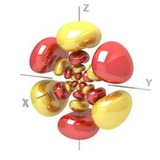
Open Access - Completing density functional theory by machine learning hidden messages from molecules
—
Kohn–Sham density functional theory (DFT) is the basis of modern computational approaches to electronic structures. Their accuracy heavily relies on the exchange-correlation energy functional, which encapsulates electron–electron interaction beyond the classical model. As its universal form remains undiscovered, approximated functionals constructed with heuristic approaches are used for practical studies. However, there are problems in their accuracy and transferability, while any systematic approach to improve them is yet obscure. In this study, we demonstrate that the functional can be systematically constructed using accurate density distributions and energies in reference molecules via machine learning. Surprisingly, a trial functional machine learned from only a few molecules is already applicable to hundreds of molecules comprising various first- and second-row elements with the same accuracy as the standard functionals. This is achieved by relating density and energy using a flexible feed-forward neural network, which allows us to take a functional derivative via the back-propagation algorithm. In addition, simply by introducing a nonlocal density denoscriptor, the nonlocal effect is included to improve accuracy, which has hitherto been impractical. Our approach thus will help enrich the DFT framework by utilizing the rapidly advancing machine-learning technique.
https://www.nature.com/articles/s41524-020-0310-0
—
Kohn–Sham density functional theory (DFT) is the basis of modern computational approaches to electronic structures. Their accuracy heavily relies on the exchange-correlation energy functional, which encapsulates electron–electron interaction beyond the classical model. As its universal form remains undiscovered, approximated functionals constructed with heuristic approaches are used for practical studies. However, there are problems in their accuracy and transferability, while any systematic approach to improve them is yet obscure. In this study, we demonstrate that the functional can be systematically constructed using accurate density distributions and energies in reference molecules via machine learning. Surprisingly, a trial functional machine learned from only a few molecules is already applicable to hundreds of molecules comprising various first- and second-row elements with the same accuracy as the standard functionals. This is achieved by relating density and energy using a flexible feed-forward neural network, which allows us to take a functional derivative via the back-propagation algorithm. In addition, simply by introducing a nonlocal density denoscriptor, the nonlocal effect is included to improve accuracy, which has hitherto been impractical. Our approach thus will help enrich the DFT framework by utilizing the rapidly advancing machine-learning technique.
https://www.nature.com/articles/s41524-020-0310-0
Nature
Completing density functional theory by machine learning hidden messages from molecules
npj Computational Materials - Completing density functional theory by machine learning hidden messages from molecules
❤8👍1
xtb version 6.5.1 is out
* Fixes for Windows build (#629)
* Allow finding of installed test-drive dependencies (#633)
* Calculate number of electrons before restart (#638)
* Copy number of bonds for writing (#637)
* Declare optional arguments in C-API (#636)
* Fix MKL finding with Intel 2021 and newer (#640)
* Added rr-ho interpolation for heat capacity in thermo module (#644)
* Turn off GFN-FF fragmentation if it is not needed (#654)
* Make c-api example MSVC compatible (#648)
* Fixes Orca sanity check (#658)
* Resolve out-of-bounds access in ONIOM (#661)
https://github.com/grimme-lab/xtb/releases/tag/v6.5.1
* Fixes for Windows build (#629)
* Allow finding of installed test-drive dependencies (#633)
* Calculate number of electrons before restart (#638)
* Copy number of bonds for writing (#637)
* Declare optional arguments in C-API (#636)
* Fix MKL finding with Intel 2021 and newer (#640)
* Added rr-ho interpolation for heat capacity in thermo module (#644)
* Turn off GFN-FF fragmentation if it is not needed (#654)
* Make c-api example MSVC compatible (#648)
* Fixes Orca sanity check (#658)
* Resolve out-of-bounds access in ONIOM (#661)
https://github.com/grimme-lab/xtb/releases/tag/v6.5.1
GitHub
Release xtb version 6.5.1 · grimme-lab/xtb
Many thanks to Ty Balduf (@TyBalduf), Albert Katbashev (@Albkat), Philipp Pracht (@pprcht), and Marcel Stahn (@MtoLStoN) for contributing to this release.
Bug fixes
Fixes for Windows build (#629)
...
Bug fixes
Fixes for Windows build (#629)
...
🤩2
Chemists change the bonds between atoms in a single molecule for the first time
https://phys.org/news/2022-07-chemists-bonds-atoms-molecule.html
https://phys.org/news/2022-07-chemists-bonds-atoms-molecule.html
phys.org
Chemists change the bonds between atoms in a single molecule for the first time
A team of researchers from IBM Research Europe, Universidade de Santiago de Compostela and the University of Regensburg has changed the bonds between the atoms in a single molecule for the first time. ...
Rational Density Functional Selection Using Game Theory
Theoretical chemistry has a paradox of choice due to the availability of a myriad of density functionals and basis sets. Traditionally, a particular density functional is chosen on the basis of the level of user expertise (i.e., subjective experiences). Herein we circumvent the user-centric selection procedure by describing a novel approach for objectively selecting a particular functional for a given application. We achieve this by employing game theory to identify optimal functional/basis set combinations. A three-player (accuracy, complexity, and similarity) game is devised, through which Nash equilibrium solutions can be obtained. This approach has the advantage that results can be systematically improved by enlarging the underlying knowledge base, and the deterministic selection procedure mathematically justifies the density functional and basis set selections.
https://pubs.acs.org/doi/10.1021/acs.jcim.7b00542
Theoretical chemistry has a paradox of choice due to the availability of a myriad of density functionals and basis sets. Traditionally, a particular density functional is chosen on the basis of the level of user expertise (i.e., subjective experiences). Herein we circumvent the user-centric selection procedure by describing a novel approach for objectively selecting a particular functional for a given application. We achieve this by employing game theory to identify optimal functional/basis set combinations. A three-player (accuracy, complexity, and similarity) game is devised, through which Nash equilibrium solutions can be obtained. This approach has the advantage that results can be systematically improved by enlarging the underlying knowledge base, and the deterministic selection procedure mathematically justifies the density functional and basis set selections.
https://pubs.acs.org/doi/10.1021/acs.jcim.7b00542
A gentle introduction to DFT calculations
—————————————————————--
Density-functional theory has become a very popular and very powerful approach to the calculation from first-principles of the properties of molecules and materials. In these three talks, Nicola Marzari provides a gentle introduction 1) to the fundamentals of density-functional theory, 2) to the calculations that can be done with modern, open-source codes such as Quantum ESPRESSO, and 3) to its capabilities and limits. A typical target audience would be scientists (e.g. experimental colleagues) that want to learn more about what is possible and what is good for this kind of calculations (and what is not possible, and what is not good).
The second talk is complemented by a simple tutorial that can be done on any desktop or personal computer, independently of the operating system used (e.g. Windows, Mac, Linux), thanks to the Quantum Mobile virtual machine (for this tutorial we use the release 20.03.1). All the tutorial material is available on Github.
https://www.materialscloud.org/learn/sections/VNL7RL/a-gentle-introduction-to-dft-calculations-april-2020
—————————————————————--
Density-functional theory has become a very popular and very powerful approach to the calculation from first-principles of the properties of molecules and materials. In these three talks, Nicola Marzari provides a gentle introduction 1) to the fundamentals of density-functional theory, 2) to the calculations that can be done with modern, open-source codes such as Quantum ESPRESSO, and 3) to its capabilities and limits. A typical target audience would be scientists (e.g. experimental colleagues) that want to learn more about what is possible and what is good for this kind of calculations (and what is not possible, and what is not good).
The second talk is complemented by a simple tutorial that can be done on any desktop or personal computer, independently of the operating system used (e.g. Windows, Mac, Linux), thanks to the Quantum Mobile virtual machine (for this tutorial we use the release 20.03.1). All the tutorial material is available on Github.
https://www.materialscloud.org/learn/sections/VNL7RL/a-gentle-introduction-to-dft-calculations-april-2020
www.materialscloud.org
Materials Cloud
Materials Cloud is built to enable the seamless sharing and dissemination of
resources in computational materials science, encompassing educational material, interactive tools,
simulation services, and curated and raw data.
resources in computational materials science, encompassing educational material, interactive tools,
simulation services, and curated and raw data.
Q-Chem 6.0 was just released!!
It is not free/open source but, wow, what an amazing software!
Read more about all the new features here: https://q-chem.com/support/releaselog60/
It is not free/open source but, wow, what an amazing software!
Read more about all the new features here: https://q-chem.com/support/releaselog60/
Q-Chem
Release Log for Q-Chem 6.0 | Q-Chem
Release Log for Q-Chem 6.0
Request your free Q-Chem 6.0 trial.
Q-Chem 6.0.0 Release
July 3, 2022
Request your free Q-Chem 6.0 trial.
Q-Chem 6.0.0 Release
July 3, 2022
❤4👍2👎1
Frontier molecular orbitalets
A recent article in Chemistry World caught my attention. It reported the recent work by Yang and co-workers on describing chemical reactivity with so-called orbitalets. Orbitalets are a type of localized molecular orbital that came out of the Yang group's work on eliminating the delocalization error from density functionals. The highest occupied orbitalet is called the HOMOL, and the lowest unoccupied orbitalet is called the LUMOL.
Orbitalets can be seen as an intermediate between the fully delocalized canonical molecular orbitals (CMOs) and fully localized orbitals (LOs). As such, their energies are fairly close to the CMOs, while their localized character allows easier interpretation of reactivity in terms of frontier molecular orbital theory (FMO). Regular localization schemes like Foster-Boys, Natural Bond Orbitals loose the connection to the CMO energies, and therefore the resulting LOs are more difficult to relate directly to reactivity. The orbitalets represent some type of compromise, although it remains to be seen how well they work in practice, over a large range of different compounds and reactivity patterns.
https://kjelljorner.github.io/blog/quantum_chemistry/2022/07/17/Orbitalets.html
A recent article in Chemistry World caught my attention. It reported the recent work by Yang and co-workers on describing chemical reactivity with so-called orbitalets. Orbitalets are a type of localized molecular orbital that came out of the Yang group's work on eliminating the delocalization error from density functionals. The highest occupied orbitalet is called the HOMOL, and the lowest unoccupied orbitalet is called the LUMOL.
Orbitalets can be seen as an intermediate between the fully delocalized canonical molecular orbitals (CMOs) and fully localized orbitals (LOs). As such, their energies are fairly close to the CMOs, while their localized character allows easier interpretation of reactivity in terms of frontier molecular orbital theory (FMO). Regular localization schemes like Foster-Boys, Natural Bond Orbitals loose the connection to the CMO energies, and therefore the resulting LOs are more difficult to relate directly to reactivity. The orbitalets represent some type of compromise, although it remains to be seen how well they work in practice, over a large range of different compounds and reactivity patterns.
https://kjelljorner.github.io/blog/quantum_chemistry/2022/07/17/Orbitalets.html
👍3🔥1🤩1
Character Tables for Point Groups used in Chemistry
http://gernot-katzers-spice-pages.com/character_tables/
http://gernot-katzers-spice-pages.com/character_tables/
MIT Discovers Semiconductor That Can Perform Far Better Than Silicon
https://scitechdaily.com/mit-discovers-semiconductor-that-can-perform-far-better-than-silicon/
https://scitechdaily.com/mit-discovers-semiconductor-that-can-perform-far-better-than-silicon/
SciTechDaily
MIT Discovers Semiconductor That Can Perform Far Better Than Silicon
Researchers from MIT and elsewhere have found a material that can perform much better than silicon. The next step is finding practical and economic ways to manufacture it. Silicon is one of the most plentiful elements on Earth, and in its pure form, the semiconductor…
Chemistry breakthrough offers unprecedented control over atomic bonds
https://newatlas.com/science/chemistry-breakthrough-first-control-atomic-bonds-molecule/
https://newatlas.com/science/chemistry-breakthrough-first-control-atomic-bonds-molecule/
New Atlas
Chemistry breakthrough offers unprecedented control over atomic bonds
In what's being hailed as an important first for chemistry, an international team of scientists has developed a new technology that can selectively rearrange atomic bonds within a single molecule. The breakthrough allows for an unprecedented level of control…
Could machine learning fuel a reproducibility crisis in science?
https://www.nature.com/articles/d41586-022-02035-w
https://www.nature.com/articles/d41586-022-02035-w
Nature
Could machine learning fuel a reproducibility crisis in science?
Nature - ‘Data leakage’ threatens the reliability of machine-learning use across disciplines, researchers warn.
A new theory of quantum subsystems
https://phys.org/news/2022-07-theory-quantum-subsystems.html
https://phys.org/news/2022-07-theory-quantum-subsystems.html
phys.org
A new theory of quantum subsystems
When studying a complex system, scientists identify smaller pieces called subsystems that they can make sense of. By studying subsystems and the correlations between them, they reconstruct an understanding ...
Forwarded from Lets Learn Bio-IT School 🇫🇷🇮🇳
#nyberman #workshop #membrane #simulations #charmmgui
🌀Workshop Features:
- The workshop focuses on membrane Protein Simulations using CHARMM-GUI.
- Hands-on training and examples will be provided based on GROMACS software.
- The post Workshop Assessment Free Merit Seats will be given upon strict evolutions.
- Certifications will be provided for all the participants.
👥Trainers
Trained by highly skilled trainers
👩🎓Ms. Hemavathy Nagarajan, India
👨💻Dr. Shiv Bharadwaj, Prague Czech Republic
📚Four different Modules to be covered
👥Number Of Seats?
- 10 Post Workshop Assessment Free-Merit seats
- 30 Paid Seats (25 Euros / 2000 ₹)
🌐For More Info & 👨💻Register
https://www.nyberman.com/merit-workshops
📢«««««««
Channel @llbschool
Forum @letslearnbioinformatics
We are delighted to inform our
Two days Virtual Hands-on Training Workshop on "Membrane Protein Simulations using CHARMM-GUI” 🌀Workshop Features:
- The workshop focuses on membrane Protein Simulations using CHARMM-GUI.
- Hands-on training and examples will be provided based on GROMACS software.
- The post Workshop Assessment Free Merit Seats will be given upon strict evolutions.
- Certifications will be provided for all the participants.
👥Trainers
Trained by highly skilled trainers
👩🎓Ms. Hemavathy Nagarajan, India
👨💻Dr. Shiv Bharadwaj, Prague Czech Republic
📚Four different Modules to be covered
👥Number Of Seats?
- 10 Post Workshop Assessment Free-Merit seats
- 30 Paid Seats (25 Euros / 2000 ₹)
🌐For More Info & 👨💻Register
https://www.nyberman.com/merit-workshops
📢«««««««
Channel @llbschool
Forum @letslearnbioinformatics
👍1
Advanced Quantum ESPRESSO tutorial: Hubbard and Koopmans functionals from linear response
* Dates: 9-11 November 2022
* Format: Online
* Registration fee: 0 (free of charge)
* Deadline for applications: 1 October 2022
Website of the event: https://sites.google.com/view/hubbard-koopmans
The goal of this tutorial is to introduce PhD students, postdocs, and junior scientists to the use of advanced functionals aimed at modeling complex materials, such as the extended Hubbard and Koopmans functionals. By eliminating self-interaction errors and restoring total energy piecewise linearity, these advances broaden the scope of DFT by either improving the ground-state denoscription of transition-metal and rare-earth compounds or by giving access to accurate spectral properties (like fundamental band gaps and band structures). Their actual implementation also takes advantage of linear-response theory through the self-consistent incarnation contained in density-functional perturbation theory. The first day of the tutorial will be devoted to an introduction to fundamental aspects of DFT using local and semi-local functionals, its application to materials science and physics, and its limitations. In the next 2 days, the tutorial will cover the theoretical framework of Hubbard and Koopmans functionals (the main topic of this event) and their applications to representative case studies. The reference computational platform of the tutorial will be Quantum ESPRESSO, a widely used open-source electronic-structure software, which implements both extended Hubbard and Koopmans functionals.
* Dates: 9-11 November 2022
* Format: Online
* Registration fee: 0 (free of charge)
* Deadline for applications: 1 October 2022
Website of the event: https://sites.google.com/view/hubbard-koopmans
The goal of this tutorial is to introduce PhD students, postdocs, and junior scientists to the use of advanced functionals aimed at modeling complex materials, such as the extended Hubbard and Koopmans functionals. By eliminating self-interaction errors and restoring total energy piecewise linearity, these advances broaden the scope of DFT by either improving the ground-state denoscription of transition-metal and rare-earth compounds or by giving access to accurate spectral properties (like fundamental band gaps and band structures). Their actual implementation also takes advantage of linear-response theory through the self-consistent incarnation contained in density-functional perturbation theory. The first day of the tutorial will be devoted to an introduction to fundamental aspects of DFT using local and semi-local functionals, its application to materials science and physics, and its limitations. In the next 2 days, the tutorial will cover the theoretical framework of Hubbard and Koopmans functionals (the main topic of this event) and their applications to representative case studies. The reference computational platform of the tutorial will be Quantum ESPRESSO, a widely used open-source electronic-structure software, which implements both extended Hubbard and Koopmans functionals.
Google
Home
ABOUT THE TUTORIAL
👍2
👍1
The big Africa Calling Symposium is this Friday, and you still have time to submit your Single-Figure Presentation!
The best SFP will receive a prize: one speaker seat at the 2023 Virtual Winter School on Computational Chemistry.
REMEMBER: YOU DON'T HAVE TO BE FROM AFRICA TO PARTICIPATE
Read more and submit your presentation: https://winterschool.cc/africa-calling/africa-calling-program
The best SFP will receive a prize: one speaker seat at the 2023 Virtual Winter School on Computational Chemistry.
REMEMBER: YOU DON'T HAVE TO BE FROM AFRICA TO PARTICIPATE
Read more and submit your presentation: https://winterschool.cc/africa-calling/africa-calling-program
Virtual Winter School on Computational Chemistry
Africa Calling the World
Online congress discussing state of the art computational chemistry
😱1
Scientists Reveal The First Images of Atoms 'Swimming' in Liquid
https://www.sciencealert.com/these-are-the-first-images-of-atoms-swimming-in-liquid
https://www.sciencealert.com/these-are-the-first-images-of-atoms-swimming-in-liquid
ScienceAlert
Scientists Reveal The First Images of Atoms 'Swimming' in Liquid
Amazingly, they move faster in liquid.
Forwarded from Lets Learn Bio-IT School 🇫🇷🇮🇳 (Mahesh Velusamy)
Hello Bioinformatics aspirants and experts!
Join our largest telegram Bioinformatics discussion forum with ~4.6k Bio/IT experts across the global.
We freely helps everyone to solve queries related to bioinformatics & its allied subjects.
We also conduct Bioinformatics free e-Events for students.
Click here to join and help us to build large bioinfo community:
https://news.1rj.ru/str/LetsLearnBioinformatics
Join our largest telegram Bioinformatics discussion forum with ~4.6k Bio/IT experts across the global.
We freely helps everyone to solve queries related to bioinformatics & its allied subjects.
We also conduct Bioinformatics free e-Events for students.
Click here to join and help us to build large bioinfo community:
https://news.1rj.ru/str/LetsLearnBioinformatics
👍1
Watch "Practical Advice for Quantum Chemistry Computations" on YouTube
https://youtu.be/mnWh2SFzk6g
https://youtu.be/mnWh2SFzk6g
YouTube
Practical Advice for Quantum Chemistry Computations
Learn how to properly set up quantum chemistry computations and how to troubleshoot common problems