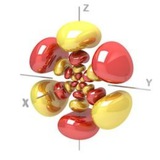
New Research Reveals the Biochemical “Rings of Power”
https://scitechdaily.com/new-research-reveals-the-biochemical-rings-of-power/
https://scitechdaily.com/new-research-reveals-the-biochemical-rings-of-power/
SciTechDaily
New Research Reveals the Biochemical “Rings of Power”
The process of genome mining reveals a common category of naturally occurring compounds that have the potential as viable drug candidates. Researchers at the Max Planck Institute for Terrestrial Microbiology have discovered the biosynthesis of a rare compound…
👍1
Researcher posits that electrons do spin, thanks to their fields
https://phys.org/news/2023-01-posits-electrons-fields.html
https://phys.org/news/2023-01-posits-electrons-fields.html
phys.org
Researcher posits that electrons do spin, thanks to their fields
Deep inside all matter in the universe, electrons are buzzing around and behaving as if they are twirling around on their axes like spinning tops. These "spinning" electrons are fundamental to quantum ...
👀1
Watch "Ch 9: What are Hermitian operators? | Maths of Quantum Mechanics" on YouTube
https://youtu.be/da1rH0Hq62Q
https://youtu.be/da1rH0Hq62Q
YouTube
Ch 9: What are Hermitian operators? | Maths of Quantum Mechanics
Hello!
This is the ninth chapter in my series "Maths of Quantum Mechanics." In this episode, we'll take a look into what Hermitian operators are, and some of their properties. Then, we'll show how we can use our physical intuition to actually derive that…
This is the ninth chapter in my series "Maths of Quantum Mechanics." In this episode, we'll take a look into what Hermitian operators are, and some of their properties. Then, we'll show how we can use our physical intuition to actually derive that…
🔥2
A New Scientific Paper Credits ChatGPT AI as a Coauthor
https://futurism.com/scientific-paper-credits-chatgpt-ai-coauthor
https://futurism.com/scientific-paper-credits-chatgpt-ai-coauthor
Futurism
A New Scientific Paper Credits ChatGPT AI as a Coauthor
One group of researchers is now so confident in the capabilities of OpenAI's ChatGPT that they've included it as a coauthor in a scientific paper.
Should automatic AI text-generator tools like ChatGPT be allowed in scientific writing?
Anonymous Poll
30%
No
39%
Yes
31%
Yes, since explicitly credited
Professor Dr. Rodolfo Goetze Fiorot from Universidade Federal Fluminense (Rio de Janeiro/Brazil) is recruiting a researcher, with a PhD for a maximum of 7 years, to submit a new FAPERJ project in theoretical chemistry for reaction mechanisms. The deadline is January 26th and interested parties should write to rodolfofiorot@id.uff.br.
👍5
Conquest v1.1 released
We are very pleased to announce the release of v1.1 of CONQUEST, a large-scale and linear scaling DFT code, capable of modelling thousands of atoms with exact diagonalisation and millions of atoms with linear scaling. This is the first full release of CONQUEST, featuring a significant number of changes:
* Reworking output completely for clarity and concision
* Implementation of the stabilised quasi-Newton method (SQNM) for robust, efficient structural optimisation
* Compatibility with LibXC v5 and ASE
* Implementation of spin polarisation for multi-site orbitals
* Updates to pseudopotential and pseudo-atomic orbital (PAO) generation and defaults for better accuracy and robustness
* Post-processing tools for DOS, charge density and STM image simulation (VESTA, Gaussian, VMD compatible)
* Identified and fixed many bugs
CONQUEST is freely available under an MIT licence. It runs well on a wide range of hardware, from laptops to HPC centres, and we encourage the community to use the code widely. Interested developers are always welcome to join the team - please contact one of us for more in-depth discussion.
CONQUEST GitHub: https://github.com/OrderN/CONQUEST-release
CONQUEST manual: https://conquest.readthedocs.io/en/latest/index.html
We are very pleased to announce the release of v1.1 of CONQUEST, a large-scale and linear scaling DFT code, capable of modelling thousands of atoms with exact diagonalisation and millions of atoms with linear scaling. This is the first full release of CONQUEST, featuring a significant number of changes:
* Reworking output completely for clarity and concision
* Implementation of the stabilised quasi-Newton method (SQNM) for robust, efficient structural optimisation
* Compatibility with LibXC v5 and ASE
* Implementation of spin polarisation for multi-site orbitals
* Updates to pseudopotential and pseudo-atomic orbital (PAO) generation and defaults for better accuracy and robustness
* Post-processing tools for DOS, charge density and STM image simulation (VESTA, Gaussian, VMD compatible)
* Identified and fixed many bugs
CONQUEST is freely available under an MIT licence. It runs well on a wide range of hardware, from laptops to HPC centres, and we encourage the community to use the code widely. Interested developers are always welcome to join the team - please contact one of us for more in-depth discussion.
CONQUEST GitHub: https://github.com/OrderN/CONQUEST-release
CONQUEST manual: https://conquest.readthedocs.io/en/latest/index.html
GitHub
GitHub - OrderN/CONQUEST-release: Full public release of large scale and linear scaling DFT code CONQUEST
Full public release of large scale and linear scaling DFT code CONQUEST - OrderN/CONQUEST-release
🔥2👍1👏1👌1
The 2023 Virtual Winter School on Computational Chemistry will begin next Monday, February 6th. Don’t miss the chance to register to this free online event! There will be lectures from prominent computational scientists, Q&A sessions, and two official workshops ministered by Q-Chem and Tinker.
https://winterschool.cc/
https://winterschool.cc/
winterschool.cc
Virtual Winter School on Computational Chemistry - Home
Online congress discussing state of the art computational chemistry
👍1
Four new bonds to one carbon atom, in a single step | Research | Chemistry World
https://www.chemistryworld.com/news/four-new-bonds-to-one-carbon-atom-in-a-single-step/4016933.article
https://www.chemistryworld.com/news/four-new-bonds-to-one-carbon-atom-in-a-single-step/4016933.article
Chemistry World
Four new bonds to one carbon atom, in a single step
Accidental discovery shows that N-heterocyclic carbenes can act as sources of atomic carbon
AlphaFold works with other AI tools to go from target to hit molecule in 30 days | Research | Chemistry World
https://www.chemistryworld.com/news/alphafold-works-with-other-ai-tools-to-go-from-target-to-hit-molecule-in-30-days/4016935.article
https://www.chemistryworld.com/news/alphafold-works-with-other-ai-tools-to-go-from-target-to-hit-molecule-in-30-days/4016935.article
Chemistry World
AlphaFold works with other AI tools to go from target to hit molecule in 30 days
End-to-end AI drug discovery process predicts potential inhibitors for a protein implicated in liver cancer
👍2
New Form of Carbon Discovered – “Opening Up Entirely New Possibilities”
https://scitechdaily.com/new-form-of-carbon-discovered-opening-up-entirely-new-possibilities/
https://scitechdaily.com/new-form-of-carbon-discovered-opening-up-entirely-new-possibilities/
SciTechDaily
New Form of Carbon Discovered – “Opening Up Entirely New Possibilities”
The novel form of carbon is created through the heating of fullerenes with lithium nitride. The most recognized forms of carbon are graphite and diamond, however, there exist other unique nanoscale allotropes of carbon such as graphene and fullerenes. These…
From orbitals to observables and back
https://aip.scitation.org/doi/full/10.1063/5.0018597
https://aip.scitation.org/doi/full/10.1063/5.0018597
AIP Publishing
From orbitals to observables and back
Molecular orbital framework is of central importance in chemistry. Often used by chemists and physicists to gain insight into molecular properties, Hartree–Fock
❤1
CalcUS - Quantum Chemistry Web Platform
CalcUS brings all the necessary tools to perform quantum chemistry in a user-friendly web interface. It strives for simplicity, clarity and efficiency.
Read the paper: https://pubs.acs.org/doi/10.1021/acs.jcim.1c01502
Access the service: https://calcus.cloud/
CalcUS brings all the necessary tools to perform quantum chemistry in a user-friendly web interface. It strives for simplicity, clarity and efficiency.
Read the paper: https://pubs.acs.org/doi/10.1021/acs.jcim.1c01502
Access the service: https://calcus.cloud/
ACS Publications
CalcUS: An Open-Source Quantum Chemistry Web Platform
Computational chemistry is an increasingly active field due to the improvement of computing resources and theoretical tools. However, its use remains usually limited to technically inclined users due to the technical challenges of preparing, launching, and…
👍5
Simons - 2023 - Why Is Quantum Chemistry So Complicated.pdf
2.5 MB
Why Is Quantum Chemistry so Complicated? - Jack Simons
👍6
GROMACS 2023 is available!
As always, we’ve got several useful performance improvements, with or without GPUs, all enabled and automated by default. In addition, several new features are available for running simulations. We are extremely interested in your feedback on how well the new release works on your simulations and hardware. The new features are:
* The SYCL GPU implementation, which is the GPU portability layer that supports all major GPU platforms, has received major extensions in support for both platforms and features. To ensure portability in practice, the GROMACS GPU portability layer is actively developed with multiple SYCL implementations (hipSYCL, oneAPI DPC++, IntelLLVM) and regularly tested on multiple GPU backends.
* SYCL supports more GPU offload features: bonded forces and direct GPU-GPU communication with GPU-aware MPI.
* SYCL hardware support includes AMD (including RDNA support added here) and Intel for production as well as NVIDIA GPUs (not for production).
* SYCL optimizations targeting important HPC platforms.
* PME decomposition has been optimized and extended to support offloading the entire PME calculation to multiple GPUs, including the FFT computation; when combined with cuFFTmp or heFFTe this enables much improved strong scaling (experimental feature).
* CUDA Graph support has been added to execute GPU-resident single-/multi-GPU simulations using thread-MPI entirely on the GPU to improve performance (experimental feature).
* Apple M1/M2 GPUs are now supported via the OpenCL GPU backend.
* New ensemble temperature mdp options allow setting the temperature of the ensemble for simulations without temperature coupling or with different reference temperatures.
* With gmx dssp, GROMACS now has a native implementation of the DSSP algorithm, which replaces gmx do_dssp.
https://manual.gromacs.org/current/download.html
As always, we’ve got several useful performance improvements, with or without GPUs, all enabled and automated by default. In addition, several new features are available for running simulations. We are extremely interested in your feedback on how well the new release works on your simulations and hardware. The new features are:
* The SYCL GPU implementation, which is the GPU portability layer that supports all major GPU platforms, has received major extensions in support for both platforms and features. To ensure portability in practice, the GROMACS GPU portability layer is actively developed with multiple SYCL implementations (hipSYCL, oneAPI DPC++, IntelLLVM) and regularly tested on multiple GPU backends.
* SYCL supports more GPU offload features: bonded forces and direct GPU-GPU communication with GPU-aware MPI.
* SYCL hardware support includes AMD (including RDNA support added here) and Intel for production as well as NVIDIA GPUs (not for production).
* SYCL optimizations targeting important HPC platforms.
* PME decomposition has been optimized and extended to support offloading the entire PME calculation to multiple GPUs, including the FFT computation; when combined with cuFFTmp or heFFTe this enables much improved strong scaling (experimental feature).
* CUDA Graph support has been added to execute GPU-resident single-/multi-GPU simulations using thread-MPI entirely on the GPU to improve performance (experimental feature).
* Apple M1/M2 GPUs are now supported via the OpenCL GPU backend.
* New ensemble temperature mdp options allow setting the temperature of the ensemble for simulations without temperature coupling or with different reference temperatures.
* With gmx dssp, GROMACS now has a native implementation of the DSSP algorithm, which replaces gmx do_dssp.
https://manual.gromacs.org/current/download.html
👍4👌3
acs.chemrev.1c00107.pdf
12.3 MB
Combining Machine Learning and Computational Chemistry for Predictive Insights Into Chemical Systems - Chem. Rev. 2021, 121, 16, 9816–9872
❤2
Shape-shifting experiment challenges interpretation of how cadmium nuclei move
https://phys.org/news/2023-02-shape-shifting-cadmium-nuclei.html
https://phys.org/news/2023-02-shape-shifting-cadmium-nuclei.html
phys.org
Shape-shifting experiment challenges interpretation of how cadmium nuclei move
Atomic nuclei take a range of shapes, from spherical (like a basketball) to deformed (like an American football). Spherical nuclei are often described by the motion of a small fraction of the protons ...