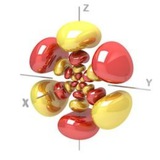
Shape-shifting experiment challenges interpretation of how cadmium nuclei move
https://phys.org/news/2023-02-shape-shifting-cadmium-nuclei.html
https://phys.org/news/2023-02-shape-shifting-cadmium-nuclei.html
phys.org
Shape-shifting experiment challenges interpretation of how cadmium nuclei move
Atomic nuclei take a range of shapes, from spherical (like a basketball) to deformed (like an American football). Spherical nuclei are often described by the motion of a small fraction of the protons ...
We Just Got The Most Precise Measurement of a Property of a Particle, Ever : ScienceAlert
https://www.sciencealert.com/we-just-got-the-most-precise-measurement-of-a-property-of-a-particle-ever
https://www.sciencealert.com/we-just-got-the-most-precise-measurement-of-a-property-of-a-particle-ever
ScienceAlert
We Just Got The Most Precise Measurement of a Property of a Particle, Ever
One step closer to completing the Standard Model.
❤1😁1
Quantum Chemistry Breakthrough: Molecules Caught Tunneling for the First Time
https://scitechdaily.com/quantum-chemistry-breakthrough-molecules-caught-tunneling-for-the-first-time/
https://scitechdaily.com/quantum-chemistry-breakthrough-molecules-caught-tunneling-for-the-first-time/
SciTechDaily
Quantum Chemistry Breakthrough: Molecules Caught Tunneling for the First Time
Breakthrough for modeling tunneling reactions in molecular chemistry. Tunneling reactions in chemistry are very difficult to predict. The quantum mechanically exact denoscription of chemical reactions with more than three particles is difficult, with more than…
🔥3
OPEN ACCESS - Advances in Molecular Dynamics Simulations and Enhanced Sampling Methods for the Study of Protein Systems
https://www.mdpi.com/1422-0067/21/17/6339
https://www.mdpi.com/1422-0067/21/17/6339
MDPI
Advances in Molecular Dynamics Simulations and Enhanced Sampling Methods for the Study of Protein Systems | MDPI
Molecular dynamics (MD) simulation is a rigorous theoretical tool that when used efficiently could provide reliable answers to questions pertaining to the structure-function relationship of proteins.
👏1
ORCA 5.0.4 was released!
This is a bugfix release, meaning that there are no new features until ORCA 6 is released sometime this year.
ORCA 5.0.4 addresses some quite severe bugs affecting the D4 dispersion correction, the wB97M functional, CASSCF and more. For now Linux binaries are available, with MacOS and Windows coming shortly.
https://orcaforum.kofo.mpg.de/app.php/dlext/?cat=21
This is a bugfix release, meaning that there are no new features until ORCA 6 is released sometime this year.
ORCA 5.0.4 addresses some quite severe bugs affecting the D4 dispersion correction, the wB97M functional, CASSCF and more. For now Linux binaries are available, with MacOS and Windows coming shortly.
https://orcaforum.kofo.mpg.de/app.php/dlext/?cat=21
👍6❤1
OPEN ACCESS - Real-time observation of the charge transfer to solvent dynamics
Intermolecular electron-transfer reactions have a crucial role in biology, solution chemistry and electrochemistry. The first step of such reactions is the expulsion of the electron to the solvent, whose mechanism is determined by the structure and dynamical response of the latter. Here we visualize the electron transfer to water using ultrafast fluorescence spectroscopy with polychromatic detection from the ultraviolet to the visible region, upon photo-excitation of the so-called charge transfer to solvent states of aqueous iodide. The initial emission is short lived (~60 fs) and it relaxes to a broad distribution of lower-energy charge transfer to solvent states upon rearrangement of the solvent cage. This distribution reflects the inhomogeneous character of the solvent cage around iodide. Electron ejection occurs from the relaxed charge transfer to solvent states with lifetimes of 100–400 fs that increase with decreasing emission energy.
https://www.nature.com/articles/ncomms3119
Intermolecular electron-transfer reactions have a crucial role in biology, solution chemistry and electrochemistry. The first step of such reactions is the expulsion of the electron to the solvent, whose mechanism is determined by the structure and dynamical response of the latter. Here we visualize the electron transfer to water using ultrafast fluorescence spectroscopy with polychromatic detection from the ultraviolet to the visible region, upon photo-excitation of the so-called charge transfer to solvent states of aqueous iodide. The initial emission is short lived (~60 fs) and it relaxes to a broad distribution of lower-energy charge transfer to solvent states upon rearrangement of the solvent cage. This distribution reflects the inhomogeneous character of the solvent cage around iodide. Electron ejection occurs from the relaxed charge transfer to solvent states with lifetimes of 100–400 fs that increase with decreasing emission energy.
https://www.nature.com/articles/ncomms3119
Nature
Real-time observation of the charge transfer to solvent dynamics
Nature Communications - Electron transfer from solute to solvent has a crucial role in chemistry, but this process has not yet been visualized in real time. Messina et al.provide the first...
🔥3👍1
s10698-023-09469-8.pdf
1.3 MB
Interpreting the bonding of B2H6 and the nature of the 3-center-2-electron bond: decisive test of theory of valency
👍2
D. Hartree published his seminal paper about the self-consistent field in 1928. The paper was not received well and Hartree was heavily criticized for it.
Anonymous Quiz
42%
That is true! Nobody was impressed.
36%
That is false. The paper was groundbreaking!
22%
Who is D. Hartree? 🤔
👍10
The Electron Is Having a (Magnetic) Moment. It’s a Big Deal | WIRED
https://www.wired.com/story/the-electron-is-having-a-magnetic-moment-its-a-big-deal/
https://www.wired.com/story/the-electron-is-having-a-magnetic-moment-its-a-big-deal/
WIRED
The Electron Is Having a (Magnetic) Moment. It’s a Big Deal
A new experiment pulled off the most precise measurement of an electron’s self-generated magnetic field—and the universe’s subatomic model is at stake.
Ph.D. Position in Molecular Dynamics for Materials Science available in France
We are seeking a highly motivated and talented PhD candidate with a strong background in computational materials science and molecular dynamics simulations to join our group Physique et Mécanique des Milieux Divisés at the Laboratory of Mechanics and Civil Engineering (LMGC) at the University of Montpellier in France.
The successful candidate will work in a highly prolific environment on an exciting project that aims to advance our understanding of the formation of capacitive electrodes via pyrolysis of biomass and of the adsorption of ions in capacitive electrodes.
The Ph.D. project will involve the development and implementation of new simulation algorithms to investigate various conditions (temperature, heating rate, microstructure, etc.) and study the performance of carbon electrodes. The successful candidate will work closely with our postdoctoral researcher who will simulate the diffusion of ions in electrodes and compare with simulation results obtained with our experimental colleagues at INRAE.
The ideal candidate should be fluent in English, have a master's degree in materials science, statistical physics, or a related field, with a strong background in computational materials science and molecular dynamics simulations. Experience with classical force fields or ab-initio approaches for simulating materials synthesis or processing is desirable. Programming skills in C++, Fortran, or Python, and knowledge of parallel computing are also useful.
Our research team at the LMGC is highly international and has worked on different topics related to materials science, including the simulation of ionic transport in capacitive systems. The successful candidate will have the opportunity to participate in these collaborative projects and contribute to the development of cutting-edge simulation tools for studying complex systems.
This is a full-time Ph.D. position for three years starting in October 2023. To apply, please submit a cover letter, CV, and contact information for references to Romain Dupuis at romain.dupuis@umontpellier.fr and/or Katerina Ioannidou at aikaterini.ioannidou@umontpellier.fr. Applications will be reviewed on a rolling basis until the position is filled.
We are seeking a highly motivated and talented PhD candidate with a strong background in computational materials science and molecular dynamics simulations to join our group Physique et Mécanique des Milieux Divisés at the Laboratory of Mechanics and Civil Engineering (LMGC) at the University of Montpellier in France.
The successful candidate will work in a highly prolific environment on an exciting project that aims to advance our understanding of the formation of capacitive electrodes via pyrolysis of biomass and of the adsorption of ions in capacitive electrodes.
The Ph.D. project will involve the development and implementation of new simulation algorithms to investigate various conditions (temperature, heating rate, microstructure, etc.) and study the performance of carbon electrodes. The successful candidate will work closely with our postdoctoral researcher who will simulate the diffusion of ions in electrodes and compare with simulation results obtained with our experimental colleagues at INRAE.
The ideal candidate should be fluent in English, have a master's degree in materials science, statistical physics, or a related field, with a strong background in computational materials science and molecular dynamics simulations. Experience with classical force fields or ab-initio approaches for simulating materials synthesis or processing is desirable. Programming skills in C++, Fortran, or Python, and knowledge of parallel computing are also useful.
Our research team at the LMGC is highly international and has worked on different topics related to materials science, including the simulation of ionic transport in capacitive systems. The successful candidate will have the opportunity to participate in these collaborative projects and contribute to the development of cutting-edge simulation tools for studying complex systems.
This is a full-time Ph.D. position for three years starting in October 2023. To apply, please submit a cover letter, CV, and contact information for references to Romain Dupuis at romain.dupuis@umontpellier.fr and/or Katerina Ioannidou at aikaterini.ioannidou@umontpellier.fr. Applications will be reviewed on a rolling basis until the position is filled.
👍2
FREE ONLINE COURSE
Characterizing and Tailoring Polymers using Nuclear Magnetic Resonance
Co-produced with the ACS Division of Polymeric Materials: Science and Engineering
Thursday, April 6th | 2-3:30pm ET
Register here: https://www.acs.org/acs-webinars/library/nuclear-magnetic-resonance.html
Characterizing and Tailoring Polymers using Nuclear Magnetic Resonance
Co-produced with the ACS Division of Polymeric Materials: Science and Engineering
Thursday, April 6th | 2-3:30pm ET
Register here: https://www.acs.org/acs-webinars/library/nuclear-magnetic-resonance.html
American Chemical Society
Characterizing and Tailoring Polymers using Nuclear Magnetic Resonance
American Chemical Society: Chemistry for Life.