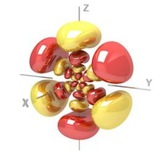
🔬 Fun Fact of the Day
Wien’s Displacement Law
λₘₐₓ = b / T
where
b = 2.897 × 10⁻³ m·K
This law explains why heated objects change color as temperature increases — from red-hot to white-hot — as the peak of thermal emission shifts to shorter wavelengths.
Although deceptively simple, this relationship provided crucial empirical evidence leading Max Planck to propose his quantum hypothesis. That step directly triggered the birth of quantum mechanics, which underpins modern computational chemistry methods such as DFT and post–Hartree–Fock theories.
A classic result with far-reaching consequences.
Wien’s Displacement Law
λₘₐₓ = b / T
where
b = 2.897 × 10⁻³ m·K
This law explains why heated objects change color as temperature increases — from red-hot to white-hot — as the peak of thermal emission shifts to shorter wavelengths.
Although deceptively simple, this relationship provided crucial empirical evidence leading Max Planck to propose his quantum hypothesis. That step directly triggered the birth of quantum mechanics, which underpins modern computational chemistry methods such as DFT and post–Hartree–Fock theories.
A classic result with far-reaching consequences.
❤12
Forwarded from Pe4eneg
Do you perform biomolecular MD simulations and wish you could achieve DFT-level accuracy for an entire protein or enzyme in explicit solvent, at timescales relevant to biomolecular processes?
I’m very happy to share our new neural network potential, AMPv3-BMS25, designed for efficient ML/MM simulations. The model is trained on the new BMS25 dataset, which features over 1.5 million DFT/MM calculations focused on proteins, small organic molecules, and transition states.
The model runs very efficiently on a single GPU and scales smoothly to systems with tens of thousands of ML atoms and hundreds of thousands of water molecules.
This work pushes the boundaries of computational chemistry and serves as a powerful complement to generative models. We demonstrate its scalability and accuracy across a wide range of benchmarks (>23 μs), including solvation free energies, protein structural features, and free-energy profiles of enzymatically catalyzed reactions. Interestingly, the model can also handle gas-phase structures with high accuracy, despite not being explicitly trained on them.
We have made the code, weights, and training dataset freely available to the community. 🚀
Preprint:
https://chemrxiv.org/engage/chemrxiv/article-details/695c160d098cdc781ff4d62b
Dataset preprint:
https://chemrxiv.org/engage/chemrxiv/article-details/6936ba61a10c9f5ca1e12680
Github:
https://github.com/rinikerlab/amp_bms
I’m very happy to share our new neural network potential, AMPv3-BMS25, designed for efficient ML/MM simulations. The model is trained on the new BMS25 dataset, which features over 1.5 million DFT/MM calculations focused on proteins, small organic molecules, and transition states.
The model runs very efficiently on a single GPU and scales smoothly to systems with tens of thousands of ML atoms and hundreds of thousands of water molecules.
This work pushes the boundaries of computational chemistry and serves as a powerful complement to generative models. We demonstrate its scalability and accuracy across a wide range of benchmarks (>23 μs), including solvation free energies, protein structural features, and free-energy profiles of enzymatically catalyzed reactions. Interestingly, the model can also handle gas-phase structures with high accuracy, despite not being explicitly trained on them.
We have made the code, weights, and training dataset freely available to the community. 🚀
Preprint:
https://chemrxiv.org/engage/chemrxiv/article-details/695c160d098cdc781ff4d62b
Dataset preprint:
https://chemrxiv.org/engage/chemrxiv/article-details/6936ba61a10c9f5ca1e12680
Github:
https://github.com/rinikerlab/amp_bms
ChemRxiv
AMP-BMS/MM: A Multiscale Neural Network Potential for the Fast and Accurate Simulation of Protein Dynamics and Enzymatic Reactions…
We present the next generation of AMP, a neural network potential (NNP) with anisotropic
message passing designed to study large biomolecular systems at DFT accuracy in the
condensed phase using a multiscale approach similar to quantum-mechanics/molecular…
message passing designed to study large biomolecular systems at DFT accuracy in the
condensed phase using a multiscale approach similar to quantum-mechanics/molecular…
👍8😍2
Fun Fact of the Day
The computational cost of canonical CCSD(T) formally scales as O(N⁷), yet with modern locality and sparsity exploitation, effective scaling in large insulating systems is often closer to N⁴-N⁵, blurring the once‑clear boundary between “benchmark” and “production” methods.
The computational cost of canonical CCSD(T) formally scales as O(N⁷), yet with modern locality and sparsity exploitation, effective scaling in large insulating systems is often closer to N⁴-N⁵, blurring the once‑clear boundary between “benchmark” and “production” methods.
🔥8
Fun Fact of the Day
Hydrogen cyanide, although highly polar, can form solid-state cocrystals with nonpolar hydrocarbons such as methane and ethane under Titan-like cryogenic conditions, violating the textbook “like dissolves like” intuition for mixing polar and nonpolar species. Quantum-mechanical calculations confirm that insertion of these small hydrocarbons into the HCN lattice can be energetically favorable, with distinct shifts in Raman-active vibrational modes as a spectroscopic signature.
DOI: 10.1073/pnas.2507522122
Hydrogen cyanide, although highly polar, can form solid-state cocrystals with nonpolar hydrocarbons such as methane and ethane under Titan-like cryogenic conditions, violating the textbook “like dissolves like” intuition for mixing polar and nonpolar species. Quantum-mechanical calculations confirm that insertion of these small hydrocarbons into the HCN lattice can be energetically favorable, with distinct shifts in Raman-active vibrational modes as a spectroscopic signature.
DOI: 10.1073/pnas.2507522122
❤6
Fun Fact of the Day
Even in a perfect electromagnetic vacuum, quantum field theory predicts non‑zero “zero‑point energy,” so the ground state contains incessant fluctuations and virtual particle–antiparticle pairs. These vacuum fluctuations contribute to phenomena like the Casimir effect and set fundamental baselines for excited‑state and response calculations.
Even in a perfect electromagnetic vacuum, quantum field theory predicts non‑zero “zero‑point energy,” so the ground state contains incessant fluctuations and virtual particle–antiparticle pairs. These vacuum fluctuations contribute to phenomena like the Casimir effect and set fundamental baselines for excited‑state and response calculations.
👍5❤1
❄️ The Virtual Winter School on Computational Chemistry starts in one week! ❄️
💻 The event is fully online and free of charge.
📊 Submit your Single-Figure Presentation (SFP) to earn a participation certificate,
🧪 enjoy workshops led by the Q-Chem and GROMACS teams,
🎓 and attend lectures by leading experts across different areas of computational chemistry.
⏰ SFP submission deadline: *January 21st, 23:59 CET*
🚀 Do not miss this opportunity!
🔗 More information and registration: https://winterschool.cc
💻 The event is fully online and free of charge.
📊 Submit your Single-Figure Presentation (SFP) to earn a participation certificate,
🧪 enjoy workshops led by the Q-Chem and GROMACS teams,
🎓 and attend lectures by leading experts across different areas of computational chemistry.
⏰ SFP submission deadline: *January 21st, 23:59 CET*
🚀 Do not miss this opportunity!
🔗 More information and registration: https://winterschool.cc
winterschool.cc
Virtual Winter School on Computational Chemistry - Home
Online congress discussing state of the art computational chemistry
❤3
IUPAC announces it is moving from the US to a joint home in Spain and Italy
https://www.chemistryworld.com/news/iupac-announces-it-is-moving-from-the-us-to-a-joint-home-in-spain-and-italy/4021802.article#/
https://www.chemistryworld.com/news/iupac-announces-it-is-moving-from-the-us-to-a-joint-home-in-spain-and-italy/4021802.article#/
👏8❤2😁1
🚀 Tomorrow (08:55 CET) the 2026 Virtual Winter School on Computational Chemistry begins!
🧪 Five days of free talks, Single-Figure Presentations, round tables, and workshops by #Q-Chem and #GROMACS.
🏅 SFP submitters and GROMACS workshop participants receive certificates.
#CompChem #VWSCC
https://winterschool.cc/
🧪 Five days of free talks, Single-Figure Presentations, round tables, and workshops by #Q-Chem and #GROMACS.
🏅 SFP submitters and GROMACS workshop participants receive certificates.
#CompChem #VWSCC
https://winterschool.cc/
winterschool.cc
Virtual Winter School on Computational Chemistry - Home
Online congress discussing state of the art computational chemistry
❤5
We’re about to kick off!
In just a few minutes (08:55 CET), Dr. Cate Anstöter officially opens VWSCC 2026 welcoming our first speaker, Dr. Esther Heid, with the talk
“Predictive and Generative Deep Learning Approaches for Chemical Reactions.”
The week starts strong - don’t miss it https://winterschool.cc/program/day-1/welcome-to-vwscc26#/
#CompChem
In just a few minutes (08:55 CET), Dr. Cate Anstöter officially opens VWSCC 2026 welcoming our first speaker, Dr. Esther Heid, with the talk
“Predictive and Generative Deep Learning Approaches for Chemical Reactions.”
The week starts strong - don’t miss it https://winterschool.cc/program/day-1/welcome-to-vwscc26#/
#CompChem
winterschool.cc
Virtual Winter School on Computational Chemistry - Welcome to VWSCC26
Online congress discussing state of the art computational chemistry
❤3
The GROMACS workshop is about to start and will provide a certificate of participation:
https://winterschool.cc/program/day-4/gromacs-2026
https://winterschool.cc/program/day-4/gromacs-2026
winterschool.cc
Virtual Winter School on Computational Chemistry - GROMACS Workshop (videos available)
Online congress discussing state of the art computational chemistry
❤4
Today's #GROMACS workshop was awesome (videos already available)! 🎉
Tomorrow we close the 2026 #VWSCC with a bang: #Q-Chem is hosting a workshop in two sessions - 9:00 AM CET and 10:00 PM CET - so attendees from all timezones can participate.
Don't miss it! #CompChem
https://winterschool.cc/program/day-5/q-chem-2026
Tomorrow we close the 2026 #VWSCC with a bang: #Q-Chem is hosting a workshop in two sessions - 9:00 AM CET and 10:00 PM CET - so attendees from all timezones can participate.
Don't miss it! #CompChem
https://winterschool.cc/program/day-5/q-chem-2026
winterschool.cc
Virtual Winter School on Computational Chemistry - Q-Chem Workshop (videos available)
Online congress discussing state of the art computational chemistry
❤7👏1
The second Q-Chem Workshop is starting right now. Come and join us!
https://winterschool.cc/program/day-5/q-chem-2026
https://winterschool.cc/program/day-5/q-chem-2026
winterschool.cc
Virtual Winter School on Computational Chemistry - Q-Chem Workshop (videos available)
Online congress discussing state of the art computational chemistry
❤3
📢 Postdoctoral Fellowship Opportunity – Computational Catalysis
I’m looking to support an outstanding early-career researcher interested in computational strategies for catalyst design and mechanistic insight, in the context of the Royal Society Newton International Fellowship.
Our research combines quantum chemical calculations, mechanistic analysis, and machine learning, working closely with experimental collaborators to understand, predict, and control catalytic reactivity and selectivity. We are interested in systems ranging from organocatalysis to more complex catalytic transformations, with a strong focus on fundamental principles.
If this aligns with your interests and you are considering applying for an international fellowship, I’d be very happy to discuss potential project ideas.
📅 Internal University of Manchester deadline: late February
🔗 Fellowship info: https://lnkd.in/dV7-ZYNr
https://www.linkedin.com/posts/dr-cristina-trujillo-89a58319_newton-international-fellowships-royal-activity-7420036159990575104-jGLN?utm_source=social_share_send&utm_medium=member_desktop_web&rcm=ACoAADByb54BZAu0zfSJLooSdNdx0bXFCOsvoA0
I’m looking to support an outstanding early-career researcher interested in computational strategies for catalyst design and mechanistic insight, in the context of the Royal Society Newton International Fellowship.
Our research combines quantum chemical calculations, mechanistic analysis, and machine learning, working closely with experimental collaborators to understand, predict, and control catalytic reactivity and selectivity. We are interested in systems ranging from organocatalysis to more complex catalytic transformations, with a strong focus on fundamental principles.
If this aligns with your interests and you are considering applying for an international fellowship, I’d be very happy to discuss potential project ideas.
📅 Internal University of Manchester deadline: late February
🔗 Fellowship info: https://lnkd.in/dV7-ZYNr
https://www.linkedin.com/posts/dr-cristina-trujillo-89a58319_newton-international-fellowships-royal-activity-7420036159990575104-jGLN?utm_source=social_share_send&utm_medium=member_desktop_web&rcm=ACoAADByb54BZAu0zfSJLooSdNdx0bXFCOsvoA0
lnkd.in
LinkedIn
This link will take you to a page that’s not on LinkedIn
❤2
CP2K v2026.1 was released!
New featuures:
• New BASIS_AUG_MOLOPT and BASIS_RI_AUG_MOLOPT all-electron basis sets
• Active Space: long-range truncated potential for ERIs
• Support for GTH-SOC pseudopotentials in SIRIUS
• Improved access to occupied orbital eigenvalues from OT
• CNEO-DFT energies and forces
• Sternheimer BSE (initial implementation with W matrix)
• SF-TDDFT implementation
• PAO-ML migrated to the NequIP framework
• GAPW DC-DFT + EC via EXTERNAL coupling
• NEGF: new method to extract electrode Hamiltonian matrices
• Fortitude linter added to pre-commit checks
• RT-TDDFT + RT-BSE: Fourier-transform outputs
• RIXS for open-shell systems
• Interface to MiMiC for multiscale simulations
• Restricted-space excitations for TDDFPT
• Vibronic spectroscopy post-processing tools
• Extended XYZ trajectory format
• MAX_FILE_SIZE_MB keyword in the MO_CUBES section
• Moments implementation for k-point calculations
https://github.com/cp2k/cp2k/releases/tag/v2026.1
New featuures:
• New BASIS_AUG_MOLOPT and BASIS_RI_AUG_MOLOPT all-electron basis sets
• Active Space: long-range truncated potential for ERIs
• Support for GTH-SOC pseudopotentials in SIRIUS
• Improved access to occupied orbital eigenvalues from OT
• CNEO-DFT energies and forces
• Sternheimer BSE (initial implementation with W matrix)
• SF-TDDFT implementation
• PAO-ML migrated to the NequIP framework
• GAPW DC-DFT + EC via EXTERNAL coupling
• NEGF: new method to extract electrode Hamiltonian matrices
• Fortitude linter added to pre-commit checks
• RT-TDDFT + RT-BSE: Fourier-transform outputs
• RIXS for open-shell systems
• Interface to MiMiC for multiscale simulations
• Restricted-space excitations for TDDFPT
• Vibronic spectroscopy post-processing tools
• Extended XYZ trajectory format
• MAX_FILE_SIZE_MB keyword in the MO_CUBES section
• Moments implementation for k-point calculations
https://github.com/cp2k/cp2k/releases/tag/v2026.1
GitHub
Release CP2K v2026.1 · cp2k/cp2k
doi:10.5281/zenodo.18162946
New Features
Add new BASIS_AUG_MOLOPT and BASIS_RI_AUG_MOLOPT basis sets (all electron) (#4354)
Active Space: Added a new longrange truncated potential for the ERI (#43...
New Features
Add new BASIS_AUG_MOLOPT and BASIS_RI_AUG_MOLOPT basis sets (all electron) (#4354)
Active Space: Added a new longrange truncated potential for the ERI (#43...
❤6🔥1
🚀 Avogadro2 v1.103.0 Released
A major update focused on performance, visualization, and workflow improvements across molecular, periodic, and materials use cases.
🌟 Highlights (TL;DR)
• Migration to OpenGL 4.0 core profile → noticeably faster rendering
• Volumetric rendering for surfaces (orbitals, electron density, spin density)
• Peptide builder added
• Keyboard shortcuts for functional groups & ligands in the template tool
• Display α / β orbitals simultaneously
• Performance optimizations for basis-set calculations
• Smarter heuristics for CIF / crystallographic files
• Updated conformer plots (RMSD & energy)
• Isotope specification support
• Improved LAMMPS and Turbomole integration
✨ New & Improved Features
• Volumetric rendering engine and improved force/dipole arrows
• OpenGL 4.0 migration (core profile)
• Hall symbols typeset via HTML
• Enhanced unit-cell filling tools with safety warnings
• JSON-RPC support restored
• Updated AutoSave behavior
• One-click export graphics toolbar button
• Support for PDB trajectories and molfile/SDF conformers
• VASP OUTCAR element parsing
• Orthographic projection and interaction refinements
• Imported spectra, vibrational CD, magnetic CD support
• Custom residue labels
• Improved crystal tools (right-handed cell conversion)
• Expanded Turbomole and LAMMPS format support
🙏 Thanks
Many thanks to the community for bug reports, testing, suggestions, and ideas—this release reflects a strong collaborative effort.
🔗 Full release notes & downloads
[https://github.com/OpenChemistry/avogadrolibs/releases/tag/1.103.0](https://github.com/OpenChemistry/avogadrolibs/releases/tag/1.103.0)
#Avogadro2 #ComputationalChemistry #MolecularModeling #DFT #Crystallography #OpenSource
A major update focused on performance, visualization, and workflow improvements across molecular, periodic, and materials use cases.
🌟 Highlights (TL;DR)
• Migration to OpenGL 4.0 core profile → noticeably faster rendering
• Volumetric rendering for surfaces (orbitals, electron density, spin density)
• Peptide builder added
• Keyboard shortcuts for functional groups & ligands in the template tool
• Display α / β orbitals simultaneously
• Performance optimizations for basis-set calculations
• Smarter heuristics for CIF / crystallographic files
• Updated conformer plots (RMSD & energy)
• Isotope specification support
• Improved LAMMPS and Turbomole integration
✨ New & Improved Features
• Volumetric rendering engine and improved force/dipole arrows
• OpenGL 4.0 migration (core profile)
• Hall symbols typeset via HTML
• Enhanced unit-cell filling tools with safety warnings
• JSON-RPC support restored
• Updated AutoSave behavior
• One-click export graphics toolbar button
• Support for PDB trajectories and molfile/SDF conformers
• VASP OUTCAR element parsing
• Orthographic projection and interaction refinements
• Imported spectra, vibrational CD, magnetic CD support
• Custom residue labels
• Improved crystal tools (right-handed cell conversion)
• Expanded Turbomole and LAMMPS format support
🙏 Thanks
Many thanks to the community for bug reports, testing, suggestions, and ideas—this release reflects a strong collaborative effort.
🔗 Full release notes & downloads
[https://github.com/OpenChemistry/avogadrolibs/releases/tag/1.103.0](https://github.com/OpenChemistry/avogadrolibs/releases/tag/1.103.0)
#Avogadro2 #ComputationalChemistry #MolecularModeling #DFT #Crystallography #OpenSource
GitHub
Release Avogadro 1.103.0 · OpenChemistry/avogadrolibs
🌟 Highlights (tldr)
Switch to use OpenGL 4.0 core profile for improved rendering speed
Volumetric rendering style for surfaces (orbitals, electron density, spin density)
Add peptide builder
Add ke...
Switch to use OpenGL 4.0 core profile for improved rendering speed
Volumetric rendering style for surfaces (orbitals, electron density, spin density)
Add peptide builder
Add ke...
❤3🔥3
Forwarded from PhDFinder
📢 Germany – Postdoc in Molecular AI & Quantum Mechanics at Bayer
🏛 University: Bayer AG
🌍 Country: Germany
🎓 Fields:
computational chemistry, materials science, physics, computer science, cheminformatics
🔗 Apply Now: (If the link doesn’t open, tap and hold it, then choose “Open in browser.”)
https://phdfinder.com/2026/02/14/germany-postdoc-in-molecular-ai-quantum-mechanics-at-bayer/
🏛 University: Bayer AG
🌍 Country: Germany
🎓 Fields:
computational chemistry, materials science, physics, computer science, cheminformatics
🔗 Apply Now: (If the link doesn’t open, tap and hold it, then choose “Open in browser.”)
https://phdfinder.com/2026/02/14/germany-postdoc-in-molecular-ai-quantum-mechanics-at-bayer/
PhDFinder
Germany – Postdoc in Molecular AI & Quantum Mechanics at Bayer - PhDFinder
University: Bayer AG
👍4🔥1
ORNL_AISD-Ex: Quantum chemical prediction of UV/Vis absorption spectra for over 10 million organic molecules
Oak Ridge National Laboratory has released unprecedented UV–vis spectral datasets for over 10 million organic molecules, substantially enriching reference data for benchmarking electronic-structure methods and excited-state protocols beyond standard small test sets.
https://doi.ccs.ornl.gov/dataset/13423cfb-df80-541c-a3d9-a2f042fbe507
Oak Ridge National Laboratory has released unprecedented UV–vis spectral datasets for over 10 million organic molecules, substantially enriching reference data for benchmarking electronic-structure methods and excited-state protocols beyond standard small test sets.
https://doi.ccs.ornl.gov/dataset/13423cfb-df80-541c-a3d9-a2f042fbe507
❤9