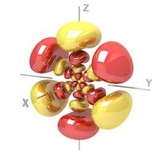
Advanced Visual Quantum Mechanics.pdf
3.5 MB
Advanced Visual Quantum Mechanics - Bernd Thaller - 1 Ed.
Alcohols exhibit quantum effects
https://phys.org/news/2021-01-alcohols-quantum-effects.html
https://phys.org/news/2021-01-alcohols-quantum-effects.html
phys.org
Alcohols exhibit quantum effects
Skoltech scientists and their colleagues from the Russian Quantum Center revealed a significant role of nuclear quantum effects in the polarization of alcohol in an external electric field. Their research ...
Media is too big
VIEW IN TELEGRAM
Eckhard Bill - Spin Hamiltonian Formalism for Transition Metal Complexes
The Schrödinger Equation.pdf
56 MB
The Schrodinger Equation - F. A. Berezin
Media is too big
VIEW IN TELEGRAM
05 - Thorsten Glaser - Introduction to Magnetochemistry
"How many water molecules make a droplet? | Research | Chemistry World" https://www.chemistryworld.com/news/how-many-water-molecules-make-a-droplet/4013080.article#/
Chemistry World
How many water molecules make a droplet?
Water molecules behave like bulk water when surrounded by a sea of 20 others
Special Webinar: "From single-molecule magnets to infinite spin chains: A many-body adventure"
https://youtu.be/2Nw5z3OI92I
https://youtu.be/2Nw5z3OI92I
YouTube
Special Webinar: "From single-molecule magnets to infinite spin chains: A many-body adventure"
An excerpt from this year's 2020 Wormit Award ceremony: Presentation by Dr. Pavel Pokhilko.
Abstract: Single-molecule magnets are molecules with one or several radical centers, showing magnetic properties. They can serve as building blocks of extended…
Abstract: Single-molecule magnets are molecules with one or several radical centers, showing magnetic properties. They can serve as building blocks of extended…
Media is too big
VIEW IN TELEGRAM
06 - Maurice van Gastel - EPR Spectroscopy
"Significance of hydrogen bonding and other noncovalent interactions in determining octahedral tilting in the CH 3 NH 3 PbI 3 hybrid organic-inorganic halide perovskite solar cell semiconductor | Scientific Reports" https://www.nature.com/articles/s41598-018-36218-1
Nature
Significance of hydrogen bonding and other noncovalent interactions in determining octahedral tilting in the CH3NH3PbI3 hybrid…
Scientific Reports - Significance of hydrogen bonding and other noncovalent interactions in determining octahedral tilting in the CH3NH3PbI3 hybrid organic-inorganic halide perovskite solar cell...
Ab_initio_molecular_dynamics_basic_theory_and_advanced_methods.pdf
2.4 MB
Ab initio molecular dynamics basic theory and advanced methods
Artificial_Intelligence_By_Example_Acquire_Advanced_AI,_Machine.pdf
11.3 MB
Artificial Intelligence By Example Acquire Advanced AI, Machine Learning and Deep Learning design skills
Media is too big
VIEW IN TELEGRAM
07 - Eckhard Bill - Mössbauer Spectroscopy
Elk version 7.0.12 has just been released.
This release includes a new method coded by Chung-Yu Wang for including
the electron-phonon interaction at the mean-field level.
Alyn James added an interface to the dynamical mean-field theory (DMFT)
code TRIQS. For the moment this is a separate branch and can be
downloaded here: https://github.com/AlynJ/Elk_interface-TRIQS
The ultra long-rage code has been further improved and the method has
been published here:
https://journals.aps.org/prl/abstract/10.1103/PhysRevLett.125.256402
This version also contains many optimisations, improvements and bug
fixes. Note that a serious bug in the DFT+U code was discovered and
fixed. This affects dftu=3 (interpolation of FLL and AFM) and previous
calculations for this DFT+U type should be checked.
Best wishes,
Kay Dewhurst, Sangeeta Sharma, Lars Nordström, Francesco Cricchio, Oscar
Grånäs and Hardy Gross
-------------------------------------------------------
elk-7.0.12
-Chung-Yu Wang added electron-phonon mean-field theory; this is a new
method and
still highly experimental
-Alyn James wrote an interface for Elk to the DMFT code TRIQS; this
interface is
maintained in a separate branch of the Elk code:
https://github.com/AlynJ/Elk_interface-TRIQS
-fixed serious problem with DFT+U for dftu=3 (interpolation of FLL and
AFM);
this bug was introduced some time ago; we recommend that you check any
previous
calculations which use dftu=3
-lots of optimisations throughout the code
-further improved Ehrenfest dynamics
-added the calculation of Born effective charges using Ehrenfest
dynamics
(task=478); this is intended as a test for the method; Born effective
charges
are more accurately calculated with the King-Smith and Vanderbilt
method
(task=208)
-Pietro Bonfa found and fixed several problems with the calculation of
Mössbauer
hyperfine fields
-PB also added a new Mössbauer example: antiferromagnetic NiF2; see the
examples/Mossbauer/NiF2 directory
-Ronald Cohen fixed a bug in iso-volumetric lattice optimisation
-RC also discovered a problem with the Wu-Cohen '06 GGA functional which
has now
been fixed
-RC also suggested an efficiency improvement to the non-linear optics
code
-added tests for non-linear optics
-Antonio Sanna helped fix a bug with TD forces
-Karel Carva discovered that lmaxo should be at least 7 for phonopy
calculations
-change the default ntswrite from 10 to 500 time steps in order to
reduce I/O
-confirmed compatibility with Libxc version 5.1.0
-Further improved the ultra long-range code; the method has now been
published:
T. Müller, S. Sharma, E. K. U. Gross, and J. K. Dewhurst, Phys. Rev.
Lett. 125,
256402 (2020).
This release includes a new method coded by Chung-Yu Wang for including
the electron-phonon interaction at the mean-field level.
Alyn James added an interface to the dynamical mean-field theory (DMFT)
code TRIQS. For the moment this is a separate branch and can be
downloaded here: https://github.com/AlynJ/Elk_interface-TRIQS
The ultra long-rage code has been further improved and the method has
been published here:
https://journals.aps.org/prl/abstract/10.1103/PhysRevLett.125.256402
This version also contains many optimisations, improvements and bug
fixes. Note that a serious bug in the DFT+U code was discovered and
fixed. This affects dftu=3 (interpolation of FLL and AFM) and previous
calculations for this DFT+U type should be checked.
Best wishes,
Kay Dewhurst, Sangeeta Sharma, Lars Nordström, Francesco Cricchio, Oscar
Grånäs and Hardy Gross
-------------------------------------------------------
elk-7.0.12
-Chung-Yu Wang added electron-phonon mean-field theory; this is a new
method and
still highly experimental
-Alyn James wrote an interface for Elk to the DMFT code TRIQS; this
interface is
maintained in a separate branch of the Elk code:
https://github.com/AlynJ/Elk_interface-TRIQS
-fixed serious problem with DFT+U for dftu=3 (interpolation of FLL and
AFM);
this bug was introduced some time ago; we recommend that you check any
previous
calculations which use dftu=3
-lots of optimisations throughout the code
-further improved Ehrenfest dynamics
-added the calculation of Born effective charges using Ehrenfest
dynamics
(task=478); this is intended as a test for the method; Born effective
charges
are more accurately calculated with the King-Smith and Vanderbilt
method
(task=208)
-Pietro Bonfa found and fixed several problems with the calculation of
Mössbauer
hyperfine fields
-PB also added a new Mössbauer example: antiferromagnetic NiF2; see the
examples/Mossbauer/NiF2 directory
-Ronald Cohen fixed a bug in iso-volumetric lattice optimisation
-RC also discovered a problem with the Wu-Cohen '06 GGA functional which
has now
been fixed
-RC also suggested an efficiency improvement to the non-linear optics
code
-added tests for non-linear optics
-Antonio Sanna helped fix a bug with TD forces
-Karel Carva discovered that lmaxo should be at least 7 for phonopy
calculations
-change the default ntswrite from 10 to 500 time steps in order to
reduce I/O
-confirmed compatibility with Libxc version 5.1.0
-Further improved the ultra long-range code; the method has now been
published:
T. Müller, S. Sharma, E. K. U. Gross, and J. K. Dewhurst, Phys. Rev.
Lett. 125,
256402 (2020).
GitHub
GitHub - AlynJ/Elk_interface-TRIQS
Contribute to AlynJ/Elk_interface-TRIQS development by creating an account on GitHub.
Molecular_Orbitals_and_Organic_Chemical_Reactions_Reference_Edition.pdf
11.9 MB
Molecular Orbitals and Organic Chemical Reactions Reference Edition
Molecular_Orbitals_and_Organic_Chemical_Reactions,_Student_Edition.pdf
10.8 MB
Molecular Orbitals and Organic Chemical Reactions Student Edition
The chemical bond fundamental aspects of chemical bonding.pdf
7.4 MB
The chemical bond fundamental aspects of chemical bonding by Frenking, Gernot Shaik
Media is too big
VIEW IN TELEGRAM
08 - Serena DeBeer - Introduction to X-ray Spectroscopy - mainly CAS and a bit of XES
A Mathematical Primer on Quantum Mechanics.pdf
3.2 MB
A Mathematical Primer on Quantum Mechanics
Charges Cascading Along a Molecular Chain: Paving the Way for Information Transfer in Tiny Circuits
https://scitechdaily.com/charges-cascading-along-a-molecular-chain-paving-the-way-for-information-transfer-in-tiny-circuits/
https://scitechdaily.com/charges-cascading-along-a-molecular-chain-paving-the-way-for-information-transfer-in-tiny-circuits/
SciTechDaily
Charges Cascading Along a Molecular Chain: Paving the Way for Information Transfer in Tiny Circuits
Removing one charged molecule from a one-dimensional array causes the others to alternately turn 'on' or 'off,' paving the way for information transfer in tiny circuits. Small electronic circuits power our everyday lives, from the tiny cameras in our phones…
The direct observation of the Pauli principle
https://phys.org/news/2021-02-pauli-principle.html
https://phys.org/news/2021-02-pauli-principle.html
phys.org
The direct observation of the Pauli principle
The Pauli exclusion principle is a law of quantum mechanics introduced by Austrian physicist Wolfgang Pauli, which offers valuable insight about the structure of matter. More specifically, the Pauli principle ...