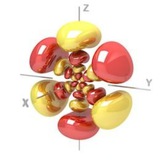
Free Registrations for the II #CompChem at Universidade Federal Fluminense are open. The online event features lectures by prominent scientists and a Workshop by Dr. Julia Contreras-García on NCIPlot.
http://compchem.uff.br/
http://compchem.uff.br/
Uranium’s strong covalent bond breaks periodic table predictions | Research | Chemistry World
https://www.chemistryworld.com/news/uraniums-strong-covalent-bond-breaks-periodic-table-predictions/4014524.article
https://www.chemistryworld.com/news/uraniums-strong-covalent-bond-breaks-periodic-table-predictions/4014524.article
Chemistry World
Uranium surprises scientists with strong covalent bond
Actinide's unusual covalency could explain its ability to fix nitrogen
Exploiting evolution to explore chemical space shows promise for drug discovery | Research | Chemistry World
https://www.chemistryworld.com/news/exploiting-evolution-to-explore-chemical-space-shows-promise-for-drug-discovery/4014561.article
https://www.chemistryworld.com/news/exploiting-evolution-to-explore-chemical-space-shows-promise-for-drug-discovery/4014561.article
Chemistry World
Exploiting evolution to explore chemical space shows promise for ...
Using molecular trees - similar to family trees - chemists could predict how products will evolve to make new molecules
7th ORCA User Meeting - 15th / 16th of December 2021
"ORCA in action - showcase spectacular simulations"
In the afternoon of 15th and 16th December 2021, the 7th ORCA User Meeting will take place as an online event. This time, the meeting will focus on real-life applications and we will have plenty of space for you to present your own calculations and how you use ORCA to solve challenging problems.
Keynote lectures will contain examples of the latest new ORCA features including several applications of ORCA in different fields. Participation is free of charge and if you want to present your own work (15 minute time slots) please send a one-page abstract to orca-cfp@kofo.mpg.de until November 15th.
We are looking forward to meeting you and learning about your applications, stay tuned for further details on the schedule !
"ORCA in action - showcase spectacular simulations"
In the afternoon of 15th and 16th December 2021, the 7th ORCA User Meeting will take place as an online event. This time, the meeting will focus on real-life applications and we will have plenty of space for you to present your own calculations and how you use ORCA to solve challenging problems.
Keynote lectures will contain examples of the latest new ORCA features including several applications of ORCA in different fields. Participation is free of charge and if you want to present your own work (15 minute time slots) please send a one-page abstract to orca-cfp@kofo.mpg.de until November 15th.
We are looking forward to meeting you and learning about your applications, stay tuned for further details on the schedule !
Scientists just broke the record for the coldest temperature ever recorded in a lab | Live Science
https://www.livescience.com/coldest-temperature-ever
https://www.livescience.com/coldest-temperature-ever
livescience.com
Scientists just broke the record for the coldest temperature ever recorded in a lab
Scientists just broke the record for the coldest temperature ever recorded in a lab
Dear colleague,
the fifth QBtopIC event will take place on October 27th 2021 at 16:30 CEST: Ulf Ryde has invited Louis Noodleman and Lubomir Rulisek for a discussion on the Accurate Calculations of Redox Potentials in Proteins. You can put forward your questions or comments either before the session as an e-mail to the discussion host (ulf.ryde@teokem.lu.se) or during the session using the Zoom chat function.
Registration is now open: http://bitly.com/QBtopIC5. You will receive an e-mail with a Zoom link approximately 24 hours before the event.
The next event is scheduled to take place on November 24th at 4:30 pm, and we will be back with more topics and discussions after a winter break. The discussion reports of the previous QBtopIC events are available on our website: http://www.qbicsoc.org/qbtopics.html
All the best
the fifth QBtopIC event will take place on October 27th 2021 at 16:30 CEST: Ulf Ryde has invited Louis Noodleman and Lubomir Rulisek for a discussion on the Accurate Calculations of Redox Potentials in Proteins. You can put forward your questions or comments either before the session as an e-mail to the discussion host (ulf.ryde@teokem.lu.se) or during the session using the Zoom chat function.
Registration is now open: http://bitly.com/QBtopIC5. You will receive an e-mail with a Zoom link approximately 24 hours before the event.
The next event is scheduled to take place on November 24th at 4:30 pm, and we will be back with more topics and discussions after a winter break. The discussion reports of the previous QBtopIC events are available on our website: http://www.qbicsoc.org/qbtopics.html
All the best
Google Docs
QBtopIC Series
The QBtopIC series is a new activity of the QBIC Society (www.qbicsoc.org). In these panel meetings, a discussion leader speaks with a number of invited experts on a topic that is of interest to the wider QBIC community and takes questions from the audience.…
A_Students_Guide_to_the_Schrödinger_Equation_by_Daniel_A_Fleisch.pdf
7 MB
A Student's Guide to the Schrödinger Equation - Daniel A. Fleisch
Physics - Superpositions of Chiral Molecules
https://physics.aps.org/articles/v14/s108
https://physics.aps.org/articles/v14/s108
Physics
Superpositions of Chiral Molecules
Matter-wave diffraction can put chiral molecules into superpositions of left- and right-handed forms, enabling new studies of how the two states interact with their environment.
Chemists develop a fundamentally new mode of adsorption
https://phys.org/news/2021-10-chemists-fundamentally-mode-adsorption.html
https://phys.org/news/2021-10-chemists-fundamentally-mode-adsorption.html
phys.org
Chemists develop a fundamentally new mode of adsorption
A research team, led by Northwestern Universitychemists, has made a breakthrough in surface science by introducing a new active mechanism of adsorption. Such adsorption-based phenomena, in which molecules ...
Experiments reveal formation of a new state o | EurekAlert!
https://www.eurekalert.org/news-releases/931832
https://www.eurekalert.org/news-releases/931832
EurekAlert!
Experiments reveal formation of a new state of matter—electron quadruplets
The central principle of superconductivity is that electrons form pairs. But can they also condense into foursomes? Recent findings have suggested they can, and a physicist at KTH Royal Institute of Technology today published the first experimental evidence…
Three-dimensionally oriented orbital angular momentum of light
https://phys.org/news/2021-10-three-dimensionally-orbital-angular-momentum.html
https://phys.org/news/2021-10-three-dimensionally-orbital-angular-momentum.html
phys.org
Three-dimensionally oriented orbital angular momentum of light
Recently, National Science Review published online the research results on three-dimensionally oriented orbital angular momentum of light from Professor Qiwen Zhan's team at the University of Shanghai ...
Researchers develop recursively embedded atom neural network model
https://phys.org/news/2021-10-recursively-embedded-atom-neural-network.html
https://phys.org/news/2021-10-recursively-embedded-atom-neural-network.html
phys.org
Researchers develop recursively embedded atom neural network model
In a recent study published in Physical Review Letters, a research team led by Prof. Jiang Bin from University of Science and Technology of China (USTC) of the Chinese Academy of Sciences proposed a recursively ...
Molecular modelling for beginners.pdf
4.1 MB
Molecular modelling for beginners
Alan Hinchliffe
Alan Hinchliffe
The Art of Molecular Dynamics Simulation.pdf
6.9 MB
The Art of Molecular Dynamics Simulation
D. C. Rapaport
D. C. Rapaport
Principles_and_Practices_of_Molecular_Properties_Theory,_Modeling.pdf
5.4 MB
Principles and Practices of Molecular Properties: Theory, Modeling, and Simulations
Non_Covalent_Interactions_in_Quantum_Chemistry_and_Physics_Theory.pdf
16.4 MB
Non-Covalent Interactions in Quantum Chemistry and Physics. Theory and Applications
Evaluating Oxidation States in Challenging Organometallic Complexes: What are the Electrons Doing?
https://www.youtube.com/watch?v=r-X3evT6mhk
https://www.youtube.com/watch?v=r-X3evT6mhk
YouTube
Evaluating Oxidation States in Challenging Organometallic Complexes: What are the Electrons Doing?
Abstract:
Oxidation states are of great interest in organometallic complexes, especially when non-innocent ligands are involved, together with multiple redox states. How are reducing equivalents stored? How are unusual oxidation states stabilized? Standard…
Oxidation states are of great interest in organometallic complexes, especially when non-innocent ligands are involved, together with multiple redox states. How are reducing equivalents stored? How are unusual oxidation states stabilized? Standard…
Starting Structures of Metal Complexes with Stereochemical Control for Molecular Modeling
The complex build algorithm to set up starting structures of lanthanoid complexes with stereochemical control for molecular modeling
https://complexbuild.sparkle.pro.br/
https://www.youtube.com/watch?v=Zvl4dkQZaxA
The complex build algorithm to set up starting structures of lanthanoid complexes with stereochemical control for molecular modeling
https://complexbuild.sparkle.pro.br/
https://www.youtube.com/watch?v=Zvl4dkQZaxA
YouTube
Complex Build Software
The Complex Build Software to set up Starting Structures of Metal Complexes with Stereochemical Control for Molecular Modeling.
Supported output file formats: .mol2 .ml2 .mop .pdb .xyz .orca .gamess .gjf
Stereoisomerism in Lanthanide…
Supported output file formats: .mol2 .ml2 .mop .pdb .xyz .orca .gamess .gjf
Stereoisomerism in Lanthanide…
Quantum physics in proteins: AI affords unprecedented insights into how biomolecules work
https://phys.org/news/2021-11-quantum-physics-proteins-ai-unprecedented.html
https://phys.org/news/2021-11-quantum-physics-proteins-ai-unprecedented.html
phys.org
Quantum physics in proteins: AI affords unprecedented insights into how biomolecules work
A new analytical technique is able to provide hitherto unattainable insights into the extremely rapid dynamics of biomolecules. The team of developers, led by Abbas Ourmazd from the University of Wisconsin–Milwaukee ...