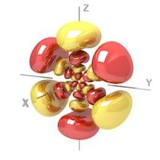
AN ELECTRONIC STRUCTURE PROGRAM
eT is an open source program with coupled cluster, multiscale and multilevel methods.
https://etprogram.org/
eT is an open source program with coupled cluster, multiscale and multilevel methods.
https://etprogram.org/
Novel theory of entropy may solve materials design issues
https://phys.org/news/2022-03-theory-entropy-materials-issues.html
https://phys.org/news/2022-03-theory-entropy-materials-issues.html
phys.org
Novel theory of entropy may solve materials design issues
A challenge in materials design is that in both natural and manmade materials, volume sometimes decreases, or increases, with increasing temperature. While there are mechanical explanations for this phenomenon ...
👍1
Quantum Computers Getting Smarter at Simulating Chemistry
https://spectrum.ieee.org/quantum-chemistry-largest
https://spectrum.ieee.org/quantum-chemistry-largest
IEEE Spectrum
Quantum Computers Getting Smarter at Simulating Chemistry
A new hybrid quantum-classical approach could help avoid issues with noise in quantum circuits
👍2
Open Access of the day - A Quantitative Molecular Orbital Perspective of the Chalcogen Bond:
https://chemistry-europe.onlinelibrary.wiley.com/doi/full/10.1002/open.202000323
https://chemistry-europe.onlinelibrary.wiley.com/doi/full/10.1002/open.202000323
Could you share your opinions on this? Is it viable in a real world application?
https://www.nature.com/articles/ncomms15174
https://www.nature.com/articles/ncomms15174
Nature
Directly converting CO2 into a gasoline fuel
Nature Communications - Direct hydrogenation of CO2 into liquid fuels can mitigate CO2 emissions and reduce the rapid depletion of fossil fuels. Here, the authors show an iron-based multifunctional...
A super explosive compound (open access)
https://www.science.org/doi/10.1126/sciadv.abn3176
https://www.science.org/doi/10.1126/sciadv.abn3176
👍2
Light derails electrons through graphene
https://phys.org/news/2022-03-derails-electrons-graphene.html
https://phys.org/news/2022-03-derails-electrons-graphene.html
phys.org
Light derails electrons through graphene
The way electrons flow in a material determines its electronic properties. For example, when a voltage is sustained across a conducting material, electrons start flowing, generating an electrical current. ...
Elk version 8.4.6 has just been released.
https://sourceforge.net/projects/elk/
This version has several important improvements and bug fixes, including a problem related to restarting TDDFT calculations (tasks 461 and 463). This was discovered by Antonio Sanna.
The second-order optics code has also been completely re-written and now follows the derivation and convention of Sipe and Ghahramani in Phys. Rev. B 48, 11705 (1993). Thanks go to Xavier Gonze for pointing out an error in our non-linear optics paper Phys. Rev. B 67, 165332 (2003). This has now been fixed in the code.
We also added 'batch' calculations as a new feature: this allows a single run of Elk to perform multiple calculations while varying a particular parameter. For example, you can produce an energy-vs-volume plot, or check the convergence of the magnetic moment with respect to the number of k-points, all in one run. See the examples in elk/examples/batch-calculations for details. Note that additional input and output variables will be added upon request.
Ultra-long range calculations have been significantly sped up, thanks to improvements in calculating the long-range density and magnetisation.
Finally, Elk has been recognized with a Community Choice award by SourceForge; thanks to all the users and contributors for making the code as useful as it is, as well as for making the forums a congenial place for everyone.
https://sourceforge.net/projects/elk/
This version has several important improvements and bug fixes, including a problem related to restarting TDDFT calculations (tasks 461 and 463). This was discovered by Antonio Sanna.
The second-order optics code has also been completely re-written and now follows the derivation and convention of Sipe and Ghahramani in Phys. Rev. B 48, 11705 (1993). Thanks go to Xavier Gonze for pointing out an error in our non-linear optics paper Phys. Rev. B 67, 165332 (2003). This has now been fixed in the code.
We also added 'batch' calculations as a new feature: this allows a single run of Elk to perform multiple calculations while varying a particular parameter. For example, you can produce an energy-vs-volume plot, or check the convergence of the magnetic moment with respect to the number of k-points, all in one run. See the examples in elk/examples/batch-calculations for details. Note that additional input and output variables will be added upon request.
Ultra-long range calculations have been significantly sped up, thanks to improvements in calculating the long-range density and magnetisation.
Finally, Elk has been recognized with a Community Choice award by SourceForge; thanks to all the users and contributors for making the code as useful as it is, as well as for making the forums a congenial place for everyone.
SourceForge
Elk
Download Elk for free. An all-electron full-potential linearised augmented-planewave (FP-LAPW) code. Designed to be as developer friendly as possible so that new developments in the field of density functional theory (DFT) can be added quickly and reliably.
SELFIES and the future of molecular string representations
Artificial intelligence (AI) and machine learning (ML) are expanding in popularity for broad applications to challenging tasks in chemistry and materials science. Examples include the prediction of properties, the discovery of new reaction pathways, or the design of new molecules. The machine needs to read and write fluently in a chemical language for each of these tasks. Strings are a common tool to represent molecular graphs, and the most popular molecular string representation, SMILES, has powered cheminformatics since the late 1980s. However, in the context of AI and ML in chemistry, SMILES has several shortcomings -- most pertinently, most combinations of symbols lead to invalid results with no valid chemical interpretation. To overcome this issue, a new language for molecules was introduced in 2020 that guarantees 100\% robustness: SELFIES (SELF-referencIng Embedded Strings). SELFIES has since simplified and enabled numerous new applications in chemistry. In this manunoscript, we look to the future and discuss molecular string representations, along with their respective opportunities and challenges. We propose 16 concrete Future Projects for robust molecular representations. These involve the extension toward new chemical domains, exciting questions at the interface of AI and robust languages and interpretability for both humans and machines. We hope that these proposals will inspire several follow-up works exploiting the full potential of molecular string representations for the future of AI in chemistry and materials science.
https://arxiv.org/abs/2204.00056
Artificial intelligence (AI) and machine learning (ML) are expanding in popularity for broad applications to challenging tasks in chemistry and materials science. Examples include the prediction of properties, the discovery of new reaction pathways, or the design of new molecules. The machine needs to read and write fluently in a chemical language for each of these tasks. Strings are a common tool to represent molecular graphs, and the most popular molecular string representation, SMILES, has powered cheminformatics since the late 1980s. However, in the context of AI and ML in chemistry, SMILES has several shortcomings -- most pertinently, most combinations of symbols lead to invalid results with no valid chemical interpretation. To overcome this issue, a new language for molecules was introduced in 2020 that guarantees 100\% robustness: SELFIES (SELF-referencIng Embedded Strings). SELFIES has since simplified and enabled numerous new applications in chemistry. In this manunoscript, we look to the future and discuss molecular string representations, along with their respective opportunities and challenges. We propose 16 concrete Future Projects for robust molecular representations. These involve the extension toward new chemical domains, exciting questions at the interface of AI and robust languages and interpretability for both humans and machines. We hope that these proposals will inspire several follow-up works exploiting the full potential of molecular string representations for the future of AI in chemistry and materials science.
https://arxiv.org/abs/2204.00056
👍2
casanova_paez_goerigk_2021_time_dependent_long_range_corrected_double.pdf
2 MB
Time-Dependent Long-Range-Corrected Double-Hybrid Density Functionals with Spin-Component and Spin-Opposite Scaling: A Comprehensive Analysis of Singlet–Singlet and Singlet–Triplet Excitation Energies
In a sea of magic angles, 'twistons' keep electrons flowing through three layers of graphene
https://phys.org/news/2022-04-sea-magic-angles-twistons-electrons.html
https://phys.org/news/2022-04-sea-magic-angles-twistons-electrons.html
phys.org
In a sea of magic angles, 'twistons' keep electrons flowing through three layers of graphene
The discovery of superconductivity in two ever-so-slightly twisted layers of graphene made waves a few years ago in the quantum materials community. With just two atom-thin sheets of carbon, researchers ...
👍2