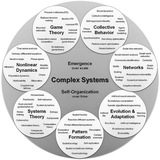
#سمینارهای_هفتگی گروه سیستمهای پیچیده و علم شبکه دانشگاه شهید بهشتی
🔹شنبه، ۰۱ مهرماه، ساعت ۴:۳۰ - کلاس ۴ دانشکده فیزیک دانشگاه شهید بهشتی
@carimi
🔹شنبه، ۰۱ مهرماه، ساعت ۴:۳۰ - کلاس ۴ دانشکده فیزیک دانشگاه شهید بهشتی
@carimi
💲 I'm looking to take 1-2 PhD students in Fall 2018. Please pass on to those interested in social & behavioral neuro. https://t.co/oPoOvSxUUI
⚡️ "Random Walks" Tutorial
Lead instructor: Sid Redner
🔗 https://www.complexityexplorer.org/tutorials/46-random-walks
🔹 Syllabus
Introduction
Root Mean Square Displacement
Role of the Spatial Dimension
Probability Distribution and Diffusion Equation
Central Limit Theorem
First Passage Phenomena
Elementary Applications
📌 About the Tutorial:
The goal of this tutorial is to outline some elementary, but beautiful aspects of random walks. Random walks are ubiquitous in nature. They naturally arise in describing the motion of microscopic particles, such as bacteria or pollen grains, whose motion is governed by being buffeted by collisions with the molecules in a surrounding fluid. Random walks also control many type of fluctuation phenomena that arise in finance.
The tutorial begins by presenting examples of random walks in nature and summarizing important classes of random walks. We'll then give a quantitative discussion of basic properties of random walks. We'll show that the root mean-square displacement of a random walk grows as the square-root of the elapsed time. Next, we will determine the underlying probability distribution of a random walk. In the long-time limit, this distribution is independent of almost all microscopic details of the random-walk motion. This universality is embodied by the central-limit theorem. In addition to presenting this theorem, we'll also discuss the anomalous features that arise when the very mild conditions that underlie the central-limit theorem are not satisfied. Finally, we will show how to recover the diffusion equation as the continuum limit of the evolution equation for the probability distribution of a random walk.
We will then present some basic first-passage properties of random walks, which address the following simple question: does a random walk reach a specified point for the first time? We will determine the first-passage properties in a finite interval; specifically, how long does it take for a random walk to leave an interval of length L, and what is the probability to leave either end of the interval as a function of the starting location. Finally, we'll discus the application of first-passage ideas to reaction-rate theory, which defines how quickly diffusion-controlled chemical reactions can occur.
Note that Complexity Explorer tutorials are meant to introduce students to various important techniques and to provide illustrations of their application in complex systems. A given tutorial is not meant to offer complete coverage of its topic or substitute for an entire course on that topic.
This tutorial is designed for more advanced math students. Math prerequisites for this course are an understanding of calculus, basic probability, and Fourier transforms.
Lead instructor: Sid Redner
🔗 https://www.complexityexplorer.org/tutorials/46-random-walks
🔹 Syllabus
Introduction
Root Mean Square Displacement
Role of the Spatial Dimension
Probability Distribution and Diffusion Equation
Central Limit Theorem
First Passage Phenomena
Elementary Applications
📌 About the Tutorial:
The goal of this tutorial is to outline some elementary, but beautiful aspects of random walks. Random walks are ubiquitous in nature. They naturally arise in describing the motion of microscopic particles, such as bacteria or pollen grains, whose motion is governed by being buffeted by collisions with the molecules in a surrounding fluid. Random walks also control many type of fluctuation phenomena that arise in finance.
The tutorial begins by presenting examples of random walks in nature and summarizing important classes of random walks. We'll then give a quantitative discussion of basic properties of random walks. We'll show that the root mean-square displacement of a random walk grows as the square-root of the elapsed time. Next, we will determine the underlying probability distribution of a random walk. In the long-time limit, this distribution is independent of almost all microscopic details of the random-walk motion. This universality is embodied by the central-limit theorem. In addition to presenting this theorem, we'll also discuss the anomalous features that arise when the very mild conditions that underlie the central-limit theorem are not satisfied. Finally, we will show how to recover the diffusion equation as the continuum limit of the evolution equation for the probability distribution of a random walk.
We will then present some basic first-passage properties of random walks, which address the following simple question: does a random walk reach a specified point for the first time? We will determine the first-passage properties in a finite interval; specifically, how long does it take for a random walk to leave an interval of length L, and what is the probability to leave either end of the interval as a function of the starting location. Finally, we'll discus the application of first-passage ideas to reaction-rate theory, which defines how quickly diffusion-controlled chemical reactions can occur.
Note that Complexity Explorer tutorials are meant to introduce students to various important techniques and to provide illustrations of their application in complex systems. A given tutorial is not meant to offer complete coverage of its topic or substitute for an entire course on that topic.
This tutorial is designed for more advanced math students. Math prerequisites for this course are an understanding of calculus, basic probability, and Fourier transforms.
Complex Systems Studies
Quantum Field Theory and Condensed Matter: An Introduction by Ramamurti Shankar (Cambridge Monographs on Mathematical Physics) 1st Edition
Providing a broad review of many techniques and their application to condensed matter systems, this book begins with a review of #thermodynamics and #statistical_mechanics, before moving onto real and imaginary time path integrals and the link between Euclidean quantum mechanics and statistical mechanics. A detailed study of the #Ising, #gauge-Ising and #XY models is included. The #renormalization group is developed and applied to #critical_phenomena, #Fermi_liquid theory and the renormalization of field theories. Next, the book explores bosonization and its applications to one-dimensional fermionic systems and the correlation functions of homogeneous and random-bond Ising models. It concludes with Bohm-Pines and Chern-Simons theories applied to the quantum Hall effect. Introducing the reader to a variety of techniques, it opens up vast areas of condensed matter theory for both graduate students and researchers in theoretical, statistical and condensed matter physics.
📜 Sloppiness and Emergent Theories in Physics, Biology, and Beyond
Mark K. Transtrum, Benjamin Machta, Kevin Brown, Bryan C. Daniels, Christopher R. Myers, James P. Sethna
(Submitted on 30 Jan 2015)
🔗 https://arxiv.org/pdf/1501.07668
📌 ABSTRACT
Large scale models of physical phenomena demand the development of new statistical and computational tools in order to be effective. Many such models are `sloppy', i.e., exhibit behavior controlled by a relatively small number of parameter combinations. We review an information theoretic framework for analyzing sloppy models. This formalism is based on the Fisher Information Matrix, which we interpret as a Riemannian metric on a parameterized space of models. Distance in this space is a measure of how distinguishable two models are based on their predictions. Sloppy model manifolds are bounded with a hierarchy of widths and extrinsic curvatures. We show how the manifold boundary approximation can extract the simple, hidden theory from complicated sloppy models. We attribute the success of simple effective models in physics as likewise emerging from complicated processes exhibiting a low effective dimensionality. We discuss the ramifications and consequences of sloppy models for biochemistry and science more generally. We suggest that the reason our complex world is understandable is due to the same fundamental reason: simple theories of macroscopic behavior are hidden inside complicated microscopic processes.
Mark K. Transtrum, Benjamin Machta, Kevin Brown, Bryan C. Daniels, Christopher R. Myers, James P. Sethna
(Submitted on 30 Jan 2015)
🔗 https://arxiv.org/pdf/1501.07668
📌 ABSTRACT
Large scale models of physical phenomena demand the development of new statistical and computational tools in order to be effective. Many such models are `sloppy', i.e., exhibit behavior controlled by a relatively small number of parameter combinations. We review an information theoretic framework for analyzing sloppy models. This formalism is based on the Fisher Information Matrix, which we interpret as a Riemannian metric on a parameterized space of models. Distance in this space is a measure of how distinguishable two models are based on their predictions. Sloppy model manifolds are bounded with a hierarchy of widths and extrinsic curvatures. We show how the manifold boundary approximation can extract the simple, hidden theory from complicated sloppy models. We attribute the success of simple effective models in physics as likewise emerging from complicated processes exhibiting a low effective dimensionality. We discuss the ramifications and consequences of sloppy models for biochemistry and science more generally. We suggest that the reason our complex world is understandable is due to the same fundamental reason: simple theories of macroscopic behavior are hidden inside complicated microscopic processes.
🔹 Roughly speaking, an #ergodic system is one that mixes well. You get the same result whether you #average its values over #time or over #space.
🔗 https://www.johndcook.com/blog/tag/ergodic-theory/
🎯 In the late 1800s, the physicist Ludwig Boltzmann needed a word to express the idea that if you took an isolated system at constant energy and let it run, any one trajectory, continued long enough, would be representative of the system as a whole. Being a highly-educated nineteenth century German-speaker, Boltzmann knew far too much ancient Greek, so he called this the “ergodic property”, from ergon “energy, work” and hodos “way, path.” The name stuck.
🔗 footnote on page 479: http://www.stat.cmu.edu/~cshalizi/ADAfaEPoV/
🔗 https://www.johndcook.com/blog/tag/ergodic-theory/
🎯 In the late 1800s, the physicist Ludwig Boltzmann needed a word to express the idea that if you took an isolated system at constant energy and let it run, any one trajectory, continued long enough, would be representative of the system as a whole. Being a highly-educated nineteenth century German-speaker, Boltzmann knew far too much ancient Greek, so he called this the “ergodic property”, from ergon “energy, work” and hodos “way, path.” The name stuck.
🔗 footnote on page 479: http://www.stat.cmu.edu/~cshalizi/ADAfaEPoV/