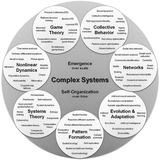
#سمینارهای_هفتگی گروه سیستمهای پیچیده و علم شبکه دانشگاه شهید بهشتی
🔹دوشنبه، ۱ آبان ماه، ساعت ۴:۰۰ - کلاس۱ دانشکده فیزیک دانشگاه شهید بهشتی.
@carimi
🔹دوشنبه، ۱ آبان ماه، ساعت ۴:۰۰ - کلاس۱ دانشکده فیزیک دانشگاه شهید بهشتی.
@carimi
💥 In physics, the Fermi–Pasta–Ulam–Tsingou problem or formerly the Fermi–Pasta–Ulam problem was the apparent paradox in chaos theory that many complicated enough physical systems exhibited almost exactly periodic behavior – called Fermi–Pasta–Ulam–Tsingou recurrence (or Fermi–Pasta–Ulam recurrence) – instead of ergodic behavior. One of the resolutions of the paradox includes the insight that many non-linear equations are exactly integrable. Another may be that ergodic behavior may depend on the initial energy of the system.
https://en.wikipedia.org/wiki/Fermi%E2%80%93Pasta%E2%80%93Ulam%E2%80%93Tsingou_problem
https://en.wikipedia.org/wiki/Fermi%E2%80%93Pasta%E2%80%93Ulam%E2%80%93Tsingou_problem
Complex Systems Studies
💥 In physics, the Fermi–Pasta–Ulam–Tsingou problem or formerly the Fermi–Pasta–Ulam problem was the apparent paradox in chaos theory that many complicated enough physical systems exhibited almost exactly periodic behavior – called Fermi–Pasta–Ulam–Tsingou…
"Fermi, Pasta, Ulam and the Birth of Experimental Mathematics"
http://people.maths.ox.ac.uk/porterm/papers/fpupop_final.pdf
A numerical experiment by Enrico Fermi, John Pasta, and Stanislaw Ulam
http://people.maths.ox.ac.uk/porterm/papers/fpupop_final.pdf
A numerical experiment by Enrico Fermi, John Pasta, and Stanislaw Ulam
رامین گلستانیان و محمدرضا اجتهادی اعضای جدید کمیسیون بیوفیزیک IUPAP
http://www.psi.ir/news2_fa.asp?id=2316
۲۹ امین مجمع عمومی کمیسیون بیوفیزیک انجمن بین المللی فیزیک محض و کاربردی International Union of Pure and Applied Physics(IUPAP) اعضای جدید مدیریتی این کمیسیون را انتخاب کرد.
http://www.psi.ir/news2_fa.asp?id=2316
۲۹ امین مجمع عمومی کمیسیون بیوفیزیک انجمن بین المللی فیزیک محض و کاربردی International Union of Pure and Applied Physics(IUPAP) اعضای جدید مدیریتی این کمیسیون را انتخاب کرد.
Forwarded from ترجمان علوم انسانى
چکیده: علم تا به امروز توانسته است مسائل عجیب و غریبی را محاسبه کند. مثلاً ما میتوانیم نحوۀ چرخیدن سیارات به دور خورشید را موبهمو پیشبینی کنیم. یا توانستهایم با معادلات فیزیکِ فضا موشکهایی بسازیم که ما را از اتمسفر زمین بیرون ببرد. اما این محاسبات در مواجهه با بعضی از موضوعات عملاً به بنبست میخورند، مثلاً بدن خودمان، یا شهرها. برای فهم این سیستمهای پیچیده باید راههای دیگری پیدا کنیم. (۴۲۰۰ کلمه، زمان مطالعه ۲۵ دقیقه)
ادامه مطلب را در لینک زیر بخوانید:
http://tarjomaan.com/vdca.6nak49n0e5k14.html
@tarjomaanweb
ادامه مطلب را در لینک زیر بخوانید:
http://tarjomaan.com/vdca.6nak49n0e5k14.html
@tarjomaanweb
🎬 https://www.ted.com/talks/geoffrey_west_the_surprising_math_of_cities_and_corporations/?language=fa
Ted
رياضيات شگفتآور شهرها و شركتها
فیزیکدان جفری وست قوانین ریاضياتی ساده حاکم بر ویژگیهای شهرها را یافته است بدين معنا كه ثروت، نرخ جرائم، سرعت راه رفتن و بسیاری از دیگر جنبه های یک شهر را می توان از یک عدد ساده استنباط کرد: جمعیت یک شهر. او در این سخنرانی موثر در نشست جهاني تد( TEDGlobal)…
Listen to The Future of AI and Civilization with Stephen Wolfram—Part 1 Ep. 5 by The Stephen Wolfram Podcast #np on #SoundCloud
https://soundcloud.com/stephenwolfram/future-of-ai-civilization-ep-1
https://soundcloud.com/stephenwolfram/future-of-ai-civilization-ep-1
SoundCloud
The Future of AI and Civilization with Stephen Wolfram—Part 1
In this first episode of a three-part series live from the Wolfram Summer School, Stephen Wolfram gives an overview of his thoughts on theories of ethics, symbolic discourse language, and the possibil
♦️ ICYMI: A theory called maximum entropy may illuminate some of nature’s large-scale patterns.
https://www.quantamagazine.org/the-thermodynamic-theory-of-ecology-20140903/?utm_content=buffer785f9&utm_medium=social&utm_source=twitter.com&utm_campaign=buffer
https://www.quantamagazine.org/the-thermodynamic-theory-of-ecology-20140903/?utm_content=buffer785f9&utm_medium=social&utm_source=twitter.com&utm_campaign=buffer
Quanta Magazine
The Thermodynamic Theory of Ecology
Nature’s large-scale patterns emerge from incomplete surveys that borrow ideas from information theory.
🔖 From global scaling to the dynamics of individual cities
Jules Depersin, Marc Barthelemy
🔗 https://arxiv.org/pdf/1710.09559
📌 ABSTRACT
Scaling has been proposed as a powerful tool to analyze the properties of complex systems, and in particular for cities where it describes how various properties change with population. The empirical study of scaling on a wide range of urban datasets displays apparent nonlinear behaviors whose statistical validity and meaning were recently the focus of many debates. We discuss here another aspect which is the implication of such scaling forms on individual cities and how they can be used for predicting the behavior of a city when its population changes. We illustrate this discussion on the case of delay due to traffic congestion with a dataset for 101 US cities in the range 1982-2014. We show that the scaling form obtained by agglomerating all the available data for different cities and for different years displays indeed a nonlinear behavior, but which appears to be unrelated to the dynamics of individual cities when their population grow. In other words, the congestion induced delay in a given city does not depend on its population only, but also on its previous history. This strong path-dependency prohibits the existence of a simple scaling form valid for all cities and shows that we cannot always agglomerate the data for many different systems. More generally, these results also challenge the use of transversal data for understanding longitudinal series for cities.
Jules Depersin, Marc Barthelemy
🔗 https://arxiv.org/pdf/1710.09559
📌 ABSTRACT
Scaling has been proposed as a powerful tool to analyze the properties of complex systems, and in particular for cities where it describes how various properties change with population. The empirical study of scaling on a wide range of urban datasets displays apparent nonlinear behaviors whose statistical validity and meaning were recently the focus of many debates. We discuss here another aspect which is the implication of such scaling forms on individual cities and how they can be used for predicting the behavior of a city when its population changes. We illustrate this discussion on the case of delay due to traffic congestion with a dataset for 101 US cities in the range 1982-2014. We show that the scaling form obtained by agglomerating all the available data for different cities and for different years displays indeed a nonlinear behavior, but which appears to be unrelated to the dynamics of individual cities when their population grow. In other words, the congestion induced delay in a given city does not depend on its population only, but also on its previous history. This strong path-dependency prohibits the existence of a simple scaling form valid for all cities and shows that we cannot always agglomerate the data for many different systems. More generally, these results also challenge the use of transversal data for understanding longitudinal series for cities.