Forwarded from رادیوفیزیک 📣
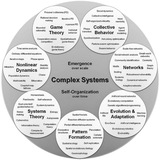
🎞 در جشنواره روز فیزیک دانشگاه شهید بهشتی، عباس کریمی درباره اینکه به طور کلی فیزیکدانان به دنبال چه هستند صحبت می کند. سپس به مثالهایی اشاره میکند که دانشمندان پیچیدگی به بررسی آن ها می پردازند. مخاطب این سخرانی غیرمتخصصان است.
https://www.aparat.com/v/ul8kh
https://www.aparat.com/v/ul8kh
آپارات - سرویس اشتراک ویدیو
در جستجوی الگوها؛ کار فیزیکدانان و دانشمندان پیچیدگی
در جشنواره روز فیزیک دانشگاه شهید بهشتی، عباس کریمی درباره اینکه به طور کلی فیزیکدانان به دنبال چه هستند صحبت می کند. سپس به مثال هایی اشاره می کند که دانشمندان پیچیدگی به بررسی آن ها می پردازند. مخاطب این سخرانی غیرمتخصصان است.
Watch this short video to learn how to classify images at the pixel level and analyze them with MATLAB
https://t.co/qr6kTl5Wtj
https://t.co/qr6kTl5Wtj
Complex Systems Studies
Old theory: Long-term memories form in the brain as short-term ones expire. New discovery: Both types of memory form at the same time — but we only get to experience one.
Quanta Magazine
Light-Triggered Genes Reveal the Hidden Workings of Memory
Nobel laureate Susumu Tonegawa’s lab is overturning old assumptions about how memories form, how recall works and whether lost memories might be restored from "silent engrams."
🔅 Lyapunov exponent as a metric for assessing the dynamic content and predictability of large-eddy simulations
https://journals.aps.org/prfluids/abstract/10.1103/PhysRevFluids.2.094606
https://journals.aps.org/prfluids/abstract/10.1103/PhysRevFluids.2.094606
Physical Review Fluids
Lyapunov exponent as a metric for assessing the dynamic content and predictability of large-eddy simulations
Temporal evolution of the solution separation of two initially infinitesimally perturbed simulations for a turbulent flow. This metric provides assessment of the Lyapunov exponent as a measure for the predictability time and dynamic content of turbulent flow…
🔖 Change points, memory and epidemic spreading in temporal networks
Tiago P. Peixoto, Laetitia Gauvin
🔗 https://arxiv.org/pdf/1712.08948
📌 ABSTRACT
Dynamic networks exhibit temporal patterns that vary across different time scales, all of which can potentially affect processes that take place on the network. However, most data-driven approaches used to model time-varying networks attempt to capture only a single characteristic time scale in isolation --- typically associated with the short-time memory of a Markov chain or with long-time abrupt changes caused by external or systemic events. Here we propose a unified approach to model both aspects simultaneously, detecting short and long-time behaviors of temporal networks. We do so by developing an arbitrary-order mixed Markov model with change points, and using a nonparametric Bayesian formulation that allows the Markov order and the position of change points to be determined from data without overfitting. In addition, we evaluate the quality of the multiscale model in its capacity to reproduce the spreading of epidemics on the temporal network, and we show that describing multiple time scales simultaneously has a synergistic effect, where statistically significant features are uncovered that otherwise would remain hidden by treating each time scale independently.
Tiago P. Peixoto, Laetitia Gauvin
🔗 https://arxiv.org/pdf/1712.08948
📌 ABSTRACT
Dynamic networks exhibit temporal patterns that vary across different time scales, all of which can potentially affect processes that take place on the network. However, most data-driven approaches used to model time-varying networks attempt to capture only a single characteristic time scale in isolation --- typically associated with the short-time memory of a Markov chain or with long-time abrupt changes caused by external or systemic events. Here we propose a unified approach to model both aspects simultaneously, detecting short and long-time behaviors of temporal networks. We do so by developing an arbitrary-order mixed Markov model with change points, and using a nonparametric Bayesian formulation that allows the Markov order and the position of change points to be determined from data without overfitting. In addition, we evaluate the quality of the multiscale model in its capacity to reproduce the spreading of epidemics on the temporal network, and we show that describing multiple time scales simultaneously has a synergistic effect, where statistically significant features are uncovered that otherwise would remain hidden by treating each time scale independently.
🔖 Big Data, Data Science, and Civil Rights
Solon Barocas, Elizabeth Bradley, Vasant Honavar, Foster Provost
🔗 https://arxiv.org/pdf/1706.03102
📌 ABSTRACT
Advances in data analytics bring with them civil rights implications. Data-driven and algorithmic decision making increasingly determine how businesses target advertisements to consumers, how police departments monitor individuals or groups, how banks decide who gets a loan and who does not, how employers hire, how colleges and universities make admissions and financial aid decisions, and much more. As data-driven decisions increasingly affect every corner of our lives, there is an urgent need to ensure they do not become instruments of discrimination, barriers to equality, threats to social justice, and sources of unfairness. In this paper, we argue for a concrete research agenda aimed at addressing these concerns, comprising five areas of emphasis: (i) Determining if models and modeling procedures exhibit objectionable bias; (ii) Building awareness of fairness into machine learning methods; (iii) Improving the transparency and control of data- and model-driven decision making; (iv) Looking beyond the algorithm(s) for sources of bias and unfairness-in the myriad human decisions made during the problem formulation and modeling process; and (v) Supporting the cross-disciplinary scholarship necessary to do all of that well.
Solon Barocas, Elizabeth Bradley, Vasant Honavar, Foster Provost
🔗 https://arxiv.org/pdf/1706.03102
📌 ABSTRACT
Advances in data analytics bring with them civil rights implications. Data-driven and algorithmic decision making increasingly determine how businesses target advertisements to consumers, how police departments monitor individuals or groups, how banks decide who gets a loan and who does not, how employers hire, how colleges and universities make admissions and financial aid decisions, and much more. As data-driven decisions increasingly affect every corner of our lives, there is an urgent need to ensure they do not become instruments of discrimination, barriers to equality, threats to social justice, and sources of unfairness. In this paper, we argue for a concrete research agenda aimed at addressing these concerns, comprising five areas of emphasis: (i) Determining if models and modeling procedures exhibit objectionable bias; (ii) Building awareness of fairness into machine learning methods; (iii) Improving the transparency and control of data- and model-driven decision making; (iv) Looking beyond the algorithm(s) for sources of bias and unfairness-in the myriad human decisions made during the problem formulation and modeling process; and (v) Supporting the cross-disciplinary scholarship necessary to do all of that well.
🔖 The physicist's guide to one of biotechnology's hottest new topics: CRISPR-Cas
Melia E. Bonomo, Michael W. Deem
🔗 arxiv.org/pdf/1712.09865.pdf
📌 ABSTRACT
Clustered regularly interspaced short palindromic repeats (CRISPR) and CRISPR-associated proteins (Cas) constitute a multi-functional, constantly evolving immune system in bacteria and archaea cells. A heritable, molecular memory is generated of phage, plasmids, or other mobile genetic elements that attempt to attack the cell. This memory is used to recognize and interfere with subsequent invasions from the same genetic elements. This versatile prokaryotic tool has also been used to advance applications in biotechnology. Here we review a large body of CRISPR-Cas research to explore themes of evolution and selection, population dynamics, horizontal gene transfer, specific and cross-reactive interactions, cost and regulation, as well as non-defensive CRISPR functions that boost host cell robustness. Physical understanding of the CRISPR-Cas system will advance applications, such as efficient and specific genetic engineering, cell labeling and information storage, and combating antibiotic resistance.
Melia E. Bonomo, Michael W. Deem
🔗 arxiv.org/pdf/1712.09865.pdf
📌 ABSTRACT
Clustered regularly interspaced short palindromic repeats (CRISPR) and CRISPR-associated proteins (Cas) constitute a multi-functional, constantly evolving immune system in bacteria and archaea cells. A heritable, molecular memory is generated of phage, plasmids, or other mobile genetic elements that attempt to attack the cell. This memory is used to recognize and interfere with subsequent invasions from the same genetic elements. This versatile prokaryotic tool has also been used to advance applications in biotechnology. Here we review a large body of CRISPR-Cas research to explore themes of evolution and selection, population dynamics, horizontal gene transfer, specific and cross-reactive interactions, cost and regulation, as well as non-defensive CRISPR functions that boost host cell robustness. Physical understanding of the CRISPR-Cas system will advance applications, such as efficient and specific genetic engineering, cell labeling and information storage, and combating antibiotic resistance.
💰 The relevance of thermodynamics to economics
https://en.wikipedia.org/wiki/Nicholas_Georgescu-Roegen#The_relevance_of_thermodynamics_to_economics
The physical theory of #thermodynamics is based on two laws: The first law states that energy is neither created nor destroyed in any isolated system (a conservation principle). The second law of thermodynamics — also known as the #entropy law — states that energy tends to be degraded to ever poorer qualities (a degradation principle).
Georgescu argues that the relevance of thermodynamics to #economics stems from the physical fact that man can neither create nor destroy matter or energy, only transform it. The usual economic terms of "#production" and "#consumption" are mere verbal conventions that tend to obscure that nothing is created and nothing is destroyed in the economic process — everything is being transformed.
The science of thermodynamics features a #cosmology of its own predicting the #heat_death_of_the_universe: Any transformation of energy — whether in nature or in human society — is moving the universe closer towards a final state of inert physical uniformity and #maximum_entropy. According to this cosmological perspective, all of man's economic activities are only speeding up the general march against a future planetary heat death locally on earth, Georgescu submits. This view on the economy was later termed '#entropy_pessimism'. Some of Georgescu's followers and interpreters have elaborated on this view.
https://en.wikipedia.org/wiki/Nicholas_Georgescu-Roegen#The_relevance_of_thermodynamics_to_economics
The physical theory of #thermodynamics is based on two laws: The first law states that energy is neither created nor destroyed in any isolated system (a conservation principle). The second law of thermodynamics — also known as the #entropy law — states that energy tends to be degraded to ever poorer qualities (a degradation principle).
Georgescu argues that the relevance of thermodynamics to #economics stems from the physical fact that man can neither create nor destroy matter or energy, only transform it. The usual economic terms of "#production" and "#consumption" are mere verbal conventions that tend to obscure that nothing is created and nothing is destroyed in the economic process — everything is being transformed.
The science of thermodynamics features a #cosmology of its own predicting the #heat_death_of_the_universe: Any transformation of energy — whether in nature or in human society — is moving the universe closer towards a final state of inert physical uniformity and #maximum_entropy. According to this cosmological perspective, all of man's economic activities are only speeding up the general march against a future planetary heat death locally on earth, Georgescu submits. This view on the economy was later termed '#entropy_pessimism'. Some of Georgescu's followers and interpreters have elaborated on this view.
🥁 Networks Course blog - lots of interesting current events viewed from a network perspective:
http://blogs.cornell.edu/info2040/
http://blogs.cornell.edu/info2040/