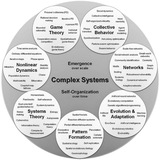
Complex Systems Studies
🔖 Scale-free networks are rare Anna D. Broido, Aaron Clauset 🔗 arxiv.org/pdf/1801.03400.pdf 📌 ABSTRACT A central claim in modern network science is that real-world networks are typically "scale free," meaning that the fraction of nodes with degree k follows…
Petter Holme
Power-laws and me
A day or two ago Anna Broido and Aaron Clauset arxived a paper about how rare scale-free networks really are. If network science was invented today, I think such a paper would not raise many eyebro…
#جلسه_دفاع_کارشناسی_ارشد
پوریا ترنج
یکشنبه ۲۴ دیماه، ساعت ۱۱:۳۰، کلاس ۴، دانشکده فیزیک دانشگاه شهیدبهشتی
پوریا ترنج
یکشنبه ۲۴ دیماه، ساعت ۱۱:۳۰، کلاس ۴، دانشکده فیزیک دانشگاه شهیدبهشتی
#جلسه_دفاع_کارشناسی_ارشد
مینا زمانی
یکشنبه ۲۴ دیماه، ساعت ۱۴، کلاس ۴، دانشکده فیزیک دانشگاه شهیدبهشتی
مینا زمانی
یکشنبه ۲۴ دیماه، ساعت ۱۴، کلاس ۴، دانشکده فیزیک دانشگاه شهیدبهشتی
Call for applicants of the Summer School of the Centre for Neural Dynamics
The summer school is intended for graduate students and undergraduate students in their third and fourth year of study in the physical sciences (e.g. physics, applied mathematics, engineering, computer science) and the life sciences (e.g. neuroscience, biology, physiology, human kinetics) who wish to develop their skills in neural data analysis and in mathematical modeling of neural activity. The topics will range from cellular to systems neuroscience, with applications in medicine. Individuals outside of academia may also participate.
Dates: May 20 - June 2, 2018.
Location: Ottawa, Canada.
Application Deadline: February 15, 2018.
Faculty
André Longtin (uOttawa)
Richard Naud (uOttawa)
Steve Prescott (Sick Kids)
Jonathan Rubin (UPitt)
Jean-Philippe Thivierge (uOttawa)
Majid Mohajerani (ULethbridge)
Greg Silasi (uOttawa)
Adam Sachs (uOttawa)
Jean-Claude Béïque (uOttawa)
Maurice Chacron (McGill)
Georg Northoff (uOttawa)
Detailed information can be found on the website of the Centre of Neural Dynamics.
Kind Regards,
André Longtin and Richard Naud
The summer school is intended for graduate students and undergraduate students in their third and fourth year of study in the physical sciences (e.g. physics, applied mathematics, engineering, computer science) and the life sciences (e.g. neuroscience, biology, physiology, human kinetics) who wish to develop their skills in neural data analysis and in mathematical modeling of neural activity. The topics will range from cellular to systems neuroscience, with applications in medicine. Individuals outside of academia may also participate.
Dates: May 20 - June 2, 2018.
Location: Ottawa, Canada.
Application Deadline: February 15, 2018.
Faculty
André Longtin (uOttawa)
Richard Naud (uOttawa)
Steve Prescott (Sick Kids)
Jonathan Rubin (UPitt)
Jean-Philippe Thivierge (uOttawa)
Majid Mohajerani (ULethbridge)
Greg Silasi (uOttawa)
Adam Sachs (uOttawa)
Jean-Claude Béïque (uOttawa)
Maurice Chacron (McGill)
Georg Northoff (uOttawa)
Detailed information can be found on the website of the Centre of Neural Dynamics.
Kind Regards,
André Longtin and Richard Naud
🦆 How may network analysis help to understand what happens in biological and ecological systems? Biologist Ferenc Jordán explained in detail the potentialities of the use of a complex network approach in Biology. Read our new blog post:
https://cns.ceu.edu/article/2018-01-15/ecological-networks-individuals-ecosystems
https://cns.ceu.edu/article/2018-01-15/ecological-networks-individuals-ecosystems
🔖 Gene regulatory network inference: an introductory survey
Vân Anh Huynh-Thu, Guido Sanguinetti
🔗 https://arxiv.org/pdf/1801.04087
📌 ABSTRACT
Gene regulatory networks are powerful abstractions of biological systems. Since the advent of high-throughput measurement technologies in biology in the late 90s, reconstructing the structure of such networks has been a central computational problem in systems biology. While the problem is certainly not solved in its entirety, considerable progress has been made in the last two decades, with mature tools now available. This chapter aims to provide an introduction to the basic concepts underpinning network inference tools, attempting a categorisation which highlights commonalities and relative strengths. While the chapter is meant to be self-contained, the material presented should provide a useful background to the later, more specialised chapters of this book.
Vân Anh Huynh-Thu, Guido Sanguinetti
🔗 https://arxiv.org/pdf/1801.04087
📌 ABSTRACT
Gene regulatory networks are powerful abstractions of biological systems. Since the advent of high-throughput measurement technologies in biology in the late 90s, reconstructing the structure of such networks has been a central computational problem in systems biology. While the problem is certainly not solved in its entirety, considerable progress has been made in the last two decades, with mature tools now available. This chapter aims to provide an introduction to the basic concepts underpinning network inference tools, attempting a categorisation which highlights commonalities and relative strengths. While the chapter is meant to be self-contained, the material presented should provide a useful background to the later, more specialised chapters of this book.
All teaching materials from the 2017 Summer Institute in Computational Social Science videos of lectures, slides & code are available open source:
🔗 https://compsocialscience.github.io/summer-institute/2017/#schedule
🔗 https://compsocialscience.github.io/summer-institute/2017/#schedule
💲 The #economy includes two flows—wages for work that people use to buy goods and services, and investing that leads to returns. Understanding how these two loops should be balanced can lead to sustained economic growth for all.
http://necsi.edu/research/economics/econuniversal?platform=hootsuite
http://necsi.edu/research/economics/econuniversal?platform=hootsuite
🕸 شکلگیری شبکههای کارآمد
http://www.psi.ir/news2_fa.asp?id=2374
مدلی جدید نشان میدهد که برای توضیح نحوه تشکیل شبکههای عروقی سلسله مراتبی و بهینهسازیشده، دانستن رشد بافتها حیاتی است، و این درست همانند آن چیزی است که در گیاهان و حیوانات دیده میشود.
http://www.psi.ir/upload/news/1396/tavakolidust/961016Images_PhysRevLett_117.png
http://www.psi.ir/news2_fa.asp?id=2374
مدلی جدید نشان میدهد که برای توضیح نحوه تشکیل شبکههای عروقی سلسله مراتبی و بهینهسازیشده، دانستن رشد بافتها حیاتی است، و این درست همانند آن چیزی است که در گیاهان و حیوانات دیده میشود.
http://www.psi.ir/upload/news/1396/tavakolidust/961016Images_PhysRevLett_117.png
🔅 Networks and graph theory are beautifully introduced in this package of articles, a great starting point for anyone curious about this exciting part of math and science:
https://plus.maths.org/content/graphs-and-networks
https://plus.maths.org/content/graphs-and-networks
🔖 Random Multi-Hopper Model. Super-Fast Random Walks on Graphs
Ernesto Estrada, Jean-Charles Delvenne, Naomichi Hatano, José L. Mateos, Ralf Metzler, Alejandro P. Riascos, Michael T. Schaub
🔗 arxiv.org/pdf/1612.08631.pdf
📌 ABSTRACT
We develop a model for a random walker with long-range hops on general graphs. This random multi-hopper jumps from a node to any other node in the graph with a probability that decays as a function of the shortest-path distance between the two nodes. We consider here two decaying functions in the form of the Laplace and Mellin transforms of the shortest-path distances. Remarkably, when the parameters of these transforms approach zero asymptotically, the multi-hopper's hitting times between any two nodes in the graph converge to their minimum possible value, given by the hitting times of a normal random walker on a complete graph. Stated differently, for small parameter values the multi-hopper explores a general graph as fast as possible when compared to a random walker on a full graph. Using computational experiments we show that compared to the normal random walker, the multi-hopper indeed explores graphs with clusters or skewed degree distributions more efficiently for a large parameter range. We provide further computational evidence of the speed-up attained by the random multi-hopper model with respect to the normal random walker by studying deterministic, random and real-world networks.
Ernesto Estrada, Jean-Charles Delvenne, Naomichi Hatano, José L. Mateos, Ralf Metzler, Alejandro P. Riascos, Michael T. Schaub
🔗 arxiv.org/pdf/1612.08631.pdf
📌 ABSTRACT
We develop a model for a random walker with long-range hops on general graphs. This random multi-hopper jumps from a node to any other node in the graph with a probability that decays as a function of the shortest-path distance between the two nodes. We consider here two decaying functions in the form of the Laplace and Mellin transforms of the shortest-path distances. Remarkably, when the parameters of these transforms approach zero asymptotically, the multi-hopper's hitting times between any two nodes in the graph converge to their minimum possible value, given by the hitting times of a normal random walker on a complete graph. Stated differently, for small parameter values the multi-hopper explores a general graph as fast as possible when compared to a random walker on a full graph. Using computational experiments we show that compared to the normal random walker, the multi-hopper indeed explores graphs with clusters or skewed degree distributions more efficiently for a large parameter range. We provide further computational evidence of the speed-up attained by the random multi-hopper model with respect to the normal random walker by studying deterministic, random and real-world networks.