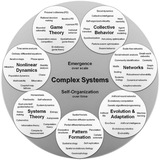
nsfworkshopREPORT.pdf
971.2 KB
The report from the NSF Workshop “Multidisciplinary Complex Systems Research”
🔹 مقدمهای بر تحلیل داده تپولوژیک:
https://dsweb.siam.org/The-Magazine/Article/topological-data-analysis-1
https://dsweb.siam.org/The-Magazine/Article/topological-data-analysis-1
Dynamical Systems
Topological Data Analysis
I find most plenary talks at SIAM conferences to be rather spellbinding, but one is especially burned into my brain: Robert Ghrist’s Network Topology, Sensors and Systems, delivered at Snowbird in 2009. This talk was my first introduction to the idea that…
Don't miss #MultiNets2018, Satellite on #NetworkScience for Multidimensional #DataAnalysis at @netsci2018, 11 Jun.
https://comunelab.fbk.eu/MultiNets2018/
https://comunelab.fbk.eu/MultiNets2018/
👏 Predicting whether a developer uses R or Python
Myself being an avid Python user, I thought it'd be fun to see if based on this survey I could predict whether a given developer uses R or Python - and of course if so, which features allow the classifier to determine that. I'll try to keep the analysis as simple as possible and focus on clarity of code and analysis rather than on creating anything overly complex and detailed.
🔹 Conclusions?
If you do not want to go through the notebook, the quick conclusion is that among data scientists and analysts, Python and R users are pretty similar. It is however possible to create pretty decent classifiers for predicting whether a user uses R or Python, and there are a few funny conclusions and reasonings to be found within those classifiers.
https://www.kaggle.com/nanomathias/predicting-r-vs-python?utm_medium=social&utm_source=twitter.com&utm_campaign=Weekly-Kernel-Awards
Myself being an avid Python user, I thought it'd be fun to see if based on this survey I could predict whether a given developer uses R or Python - and of course if so, which features allow the classifier to determine that. I'll try to keep the analysis as simple as possible and focus on clarity of code and analysis rather than on creating anything overly complex and detailed.
🔹 Conclusions?
If you do not want to go through the notebook, the quick conclusion is that among data scientists and analysts, Python and R users are pretty similar. It is however possible to create pretty decent classifiers for predicting whether a user uses R or Python, and there are a few funny conclusions and reasonings to be found within those classifiers.
https://www.kaggle.com/nanomathias/predicting-r-vs-python?utm_medium=social&utm_source=twitter.com&utm_campaign=Weekly-Kernel-Awards
💰 Lots of #postdoc positions get posted on this Soft Matter mailing list: https://t.co/CmuJpKMAtF
www1.maths.leeds.ac.uk
The Soft Matter Mailing List
Soft Matter Mailing List Information
🔹 هاروارد کورسی گذاشته توی edX لینوکس و گیت و ... درس میده:
https://www.edx.org/course/data-science-productivity-tools-harvardx-ph125-5x?utm_source=twitter&utm_medium=social&utm_campaign=pc%2Ccourse%2Charvardx%2Cdata-science-productivity-tools%2Cjune92018
به نظر کورس مهمی هست و جاش خالی بود.
خیلیا کد بلدن بنویسن، ولی همهی پروژهشون شلختهس چون نمیدونن چه ابزارهایی برای مرتب نگه داشتنش هست.
https://www.edx.org/course/data-science-productivity-tools-harvardx-ph125-5x?utm_source=twitter&utm_medium=social&utm_campaign=pc%2Ccourse%2Charvardx%2Cdata-science-productivity-tools%2Cjune92018
به نظر کورس مهمی هست و جاش خالی بود.
خیلیا کد بلدن بنویسن، ولی همهی پروژهشون شلختهس چون نمیدونن چه ابزارهایی برای مرتب نگه داشتنش هست.
edX
Data Science: Productivity Tools
Keep your projects organized and produce reproducible reports using GitHub, git, Unix/Linux, and RStudio.
💰 Open #Postdoc position in the field of Granular Matter Physics offered at the MPI for Dynamics and Self-Organization https://t.co/cg8EQrxrlI #PostdocGermany
www.mpg.de
Postdoc position - Granular Matter, Soft Matter Physics
We seek highly motivated, outstanding candidates interested in questions about the research topics “granular matter” and “numerical simulations”.
Within the framework of research program funded by a third party, we have investigated the impact of geometry…
Within the framework of research program funded by a third party, we have investigated the impact of geometry…
2018 Fellows of the Network Science Society announced at #netsci2018.
🔖 The importance of the whole: topological data analysis for the network neuroscientist
Ann E. Sizemore, Jennifer Phillips-Cremins, Robert Ghrist, Danielle S. Bassett
🔗 https://arxiv.org/pdf/1806.05167
📌 ABSTRACT
The application of network techniques to the analysis of neural data has greatly improved our ability to quantify and describe these rich interacting systems. Among many important contributions, networks have proven useful in identifying sets of node pairs that are densely connected and that collectively support brain function. Yet the restriction to pairwise interactions prevents us from realizing intrinsic topological features such as cavities within the interconnection structure that may be just as crucial for proper function. To detect and quantify these topological features we must turn to methods from algebraic topology that encode data as a simplicial complex built of sets of interacting nodes called simplices. On this substrate, we can then use the relations between simplices and higher-order connectivity to expose cavities within the complex, thereby summarizing its topological nature. Here we provide an introduction to persistent homology, a fundamental method from applied topology that builds a global denoscriptor of system structure by chronicling the evolution of cavities as we move through a combinatorial object such as a weighted network. We detail the underlying mathematics and perform demonstrative calculations on the mouse structural connectome, electrical and chemical synapses in \textit{C. elegans}, and genomic interaction data. Finally we suggest avenues for future work and highlight new advances in mathematics that appear ready for use in revealing the architecture and function of neural systems.
Ann E. Sizemore, Jennifer Phillips-Cremins, Robert Ghrist, Danielle S. Bassett
🔗 https://arxiv.org/pdf/1806.05167
📌 ABSTRACT
The application of network techniques to the analysis of neural data has greatly improved our ability to quantify and describe these rich interacting systems. Among many important contributions, networks have proven useful in identifying sets of node pairs that are densely connected and that collectively support brain function. Yet the restriction to pairwise interactions prevents us from realizing intrinsic topological features such as cavities within the interconnection structure that may be just as crucial for proper function. To detect and quantify these topological features we must turn to methods from algebraic topology that encode data as a simplicial complex built of sets of interacting nodes called simplices. On this substrate, we can then use the relations between simplices and higher-order connectivity to expose cavities within the complex, thereby summarizing its topological nature. Here we provide an introduction to persistent homology, a fundamental method from applied topology that builds a global denoscriptor of system structure by chronicling the evolution of cavities as we move through a combinatorial object such as a weighted network. We detail the underlying mathematics and perform demonstrative calculations on the mouse structural connectome, electrical and chemical synapses in \textit{C. elegans}, and genomic interaction data. Finally we suggest avenues for future work and highlight new advances in mathematics that appear ready for use in revealing the architecture and function of neural systems.
"The importance of the whole: topological data analysis for the network neuroscientist"
https://arxiv.org/pdf/1806.05167
https://arxiv.org/pdf/1806.05167