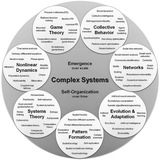
Complex Systems Studies
😮 https://theweek.com/articles-amp/810303/physics-panic?__twitter_impression=true
Agent-based Crowd Simulation Considering Emotion Contagion for Emergency Evacuation Problem
Hamed Faroqi, Mohammad-Saadi Mesgari
bit.ly/2H6RWw8
Hamed Faroqi, Mohammad-Saadi Mesgari
bit.ly/2H6RWw8
Ant Encounters Interaction Networks and Colony Behavior
Deborah M. Gordon
press.princeton.edu/noscripts/9240.html
Deborah M. Gordon
press.princeton.edu/noscripts/9240.html
Complex Systems Studies
Ant Encounters Interaction Networks and Colony Behavior Deborah M. Gordon press.princeton.edu/noscripts/9240.html
Aeon
An ant colony has memories that its individual members don’t have | Aeon Ideas
Why your brain is like an ant colony: they both get wiser and more stable by using collective memory for learning
💥 Is there an infinite set that's bigger than the set of integers but smaller than the set of real numbers? Cantor guessed the answer is *no*. This guess, shown on the shirt below, is called the Continuum Hypothesis. Now it's been connected to #machine_learning!
https://t.co/lNIQzHrU4v
In 1938 Kurt Gödel showed the #Continuum_Hypothesis cannot be *disproved* using the standard axioms of set theory (the ZFC axioms).
In 1963 Paul Cohen showed the Continuum Hypothesis cannot be *proved* using these axioms!
Since the Continuum Hypothesis can neither be proved nor disproved using the standard axioms of set theory, we say it's "independent" of these axioms.
It's surprisingly useless: I've never seen an interesting question that it would settle, except itself.
But now 5 mathematicians working on machine learning have found an interesting question whose answer is "yes" if we assume there are *at most finitely many* cardinals of size between the cardinality of the integers and that of the reals, and *no* otherwise.
🔗 https://www.nature.com/articles/d41586-019-00083-3
The claim that there are at most finitely many cardinals intermediate in size between the integers and the reals is a variant of the Continuum Hypothesis, which is *also* independent of the usual axioms of set theory.
Let me call this variant Axiom Q.
There's an unknown probability measure P on some finite subset of the interval [0,1]. You get to see some number N of independent and identically distributed samples from P.
Your task: find a finite subset of [0,1] whose P-measure is at least 2/3.
Can you?
You can always succeed in doing this task if we assume Axiom Q , but you cannot if we assume the negation of Axiom Q.
So, your ability to carry out this task cannot be determined using the standard axioms of set theory!
Read the paper for details!
🧷 https://www.nature.com/articles/s42256-018-0002-3
The surprise is not that a question coming up in machine learning turns out to be independent of the standard axioms of set theory. Lots of interesting math questions are!
The surprise is that it could be settled by a variant of the Continuum Hypothesis!
🖇 https://threadreaderapp.com/thread/1083047483368890368.html
https://t.co/lNIQzHrU4v
In 1938 Kurt Gödel showed the #Continuum_Hypothesis cannot be *disproved* using the standard axioms of set theory (the ZFC axioms).
In 1963 Paul Cohen showed the Continuum Hypothesis cannot be *proved* using these axioms!
Since the Continuum Hypothesis can neither be proved nor disproved using the standard axioms of set theory, we say it's "independent" of these axioms.
It's surprisingly useless: I've never seen an interesting question that it would settle, except itself.
But now 5 mathematicians working on machine learning have found an interesting question whose answer is "yes" if we assume there are *at most finitely many* cardinals of size between the cardinality of the integers and that of the reals, and *no* otherwise.
🔗 https://www.nature.com/articles/d41586-019-00083-3
The claim that there are at most finitely many cardinals intermediate in size between the integers and the reals is a variant of the Continuum Hypothesis, which is *also* independent of the usual axioms of set theory.
Let me call this variant Axiom Q.
There's an unknown probability measure P on some finite subset of the interval [0,1]. You get to see some number N of independent and identically distributed samples from P.
Your task: find a finite subset of [0,1] whose P-measure is at least 2/3.
Can you?
You can always succeed in doing this task if we assume Axiom Q , but you cannot if we assume the negation of Axiom Q.
So, your ability to carry out this task cannot be determined using the standard axioms of set theory!
Read the paper for details!
🧷 https://www.nature.com/articles/s42256-018-0002-3
The surprise is not that a question coming up in machine learning turns out to be independent of the standard axioms of set theory. Lots of interesting math questions are!
The surprise is that it could be settled by a variant of the Continuum Hypothesis!
🖇 https://threadreaderapp.com/thread/1083047483368890368.html
Twitter
John Carlos Baez
Is there an infinite set that's bigger than the set of integers but smaller than the set of real numbers? Cantor guessed the answer is *no*. This guess, shown on the shirt below, is called the Continuum Hypothesis. Now it's been connected to... machine learning!…
This free course on #fractals starts in 5 days, open to anyone with basic #math skills.
You don't even have to be an academic. That's part of our ethos: making a world-class #complex #systems education available to anyone with an internet connection.
https://t.co/s1DWIcJZln
You don't even have to be an academic. That's part of our ethos: making a world-class #complex #systems education available to anyone with an internet connection.
https://t.co/s1DWIcJZln
🎞 These “excitable” bee waves obey the same math as electrical waves in nerve & heart tissue and BZ chem reaction. https://t.co/5rs9CmwneL
💥 “One of the problems network science sets out to solve is to find important nodes. Of course, what is important depends on the context....”
New blog entry:
https://t.co/AIf8QXHtun
New blog entry:
https://t.co/AIf8QXHtun
Petter Holme
The importance of being earnest about the importance of nodes
One of the problems network science sets out to solve is to find important nodes. Of course, what is important depends on the context, but an applied scientist coming to network science for an answ…
🍓 "Principal components regression meets the lasso". We have just uploaded our new R package ``pcLasso'' to CRAN!
https://t.co/wbgav1zdbf We hope that people find it useful and promise to respond to help requests, bug reports and suggestions for new features.
Rob Tibshirani
https://t.co/wbgav1zdbf We hope that people find it useful and promise to respond to help requests, bug reports and suggestions for new features.
Rob Tibshirani
🧰 Causal Inference
https://www.coursera.org/learn/causal-inference
This course offers a rigorous mathematical survey of causal inference at the Master’s level. Inferences about causation are of great importance in science, medicine, policy, and business. This course provides an introduction to the statistical literature on causal inference that has emerged in the last 35-40 years and that has revolutionized the way in which statisticians and applied researchers in many disciplines use data to make inferences about causal relationships. We will study methods for collecting data to estimate causal relationships. Students will learn how to distinguish between relationships that are causal and non-causal; this is not always obvious. We shall then study and evaluate the various methods students can use — such as matching, sub-classification on the propensity score, inverse probability of treatment weighting, and machine learning — to estimate a variety of effects — such as the average treatment effect and the effect of treatment on the treated. At the end, we discuss methods for evaluating some of the assumptions we have made, and we offer a look forward to the extensions we take up in the sequel to this course.
https://www.coursera.org/learn/causal-inference
This course offers a rigorous mathematical survey of causal inference at the Master’s level. Inferences about causation are of great importance in science, medicine, policy, and business. This course provides an introduction to the statistical literature on causal inference that has emerged in the last 35-40 years and that has revolutionized the way in which statisticians and applied researchers in many disciplines use data to make inferences about causal relationships. We will study methods for collecting data to estimate causal relationships. Students will learn how to distinguish between relationships that are causal and non-causal; this is not always obvious. We shall then study and evaluate the various methods students can use — such as matching, sub-classification on the propensity score, inverse probability of treatment weighting, and machine learning — to estimate a variety of effects — such as the average treatment effect and the effect of treatment on the treated. At the end, we discuss methods for evaluating some of the assumptions we have made, and we offer a look forward to the extensions we take up in the sequel to this course.
Coursera
Causal Inference
Offered by Columbia University. This course offers a ... Enroll for free.
💡 "Econophysics: Still fringe after 30 years?" (by Jean-Philippe Bouchaud): https://t.co/I8VDyxZEx0
"Some personal reflections on the past and future of "econophysics", to appear in Europhysics News"
"Some personal reflections on the past and future of "econophysics", to appear in Europhysics News"
arXiv.org
Econophysics: Still fringe after 30 years?
Some personal reflections on the past and future of "econophysics", to appear
in Europhysics News
in Europhysics News
Why Data Science matters, but Computational Science matters more > De Dataloog
https://www.dedataloog.nl/blogpost/why-data-science-matters-but-computational-science-matters-more/
https://www.dedataloog.nl/blogpost/why-data-science-matters-but-computational-science-matters-more/
De Dataloog
Why Data Science matters, but Computational Science matters more > De Dataloog
There are fundamental limits of solely data usage with ML and computational science may extend results of data science in specific cases. Data is dead, computational science lives.
🔺 The emergence of consensus: a 10-page review / introduction to micro-macro connection, role of social networks, social contagion, committed minorities, etc. With models and empirical results.
https://arxiv.org/ct?url=https%3A%2F%2Fdx.doi.org%2F10.1098%252Frsos.172189&v=1ca06282
https://arxiv.org/ct?url=https%3A%2F%2Fdx.doi.org%2F10.1098%252Frsos.172189&v=1ca06282
💡 Glauber's dynamics.
Never heard of Glauber or his eponymous dynamics? This beautiful post is a must read. A master class in science exposition
http://bit-player.org/2019/glaubers-dynamics
Never heard of Glauber or his eponymous dynamics? This beautiful post is a must read. A master class in science exposition
http://bit-player.org/2019/glaubers-dynamics
🧰 Some materials (homework assignments, quizzes, midterm, a few other things) from the spring 2018 edition of my undergraduate course on networks: https://t.co/zd8XcsaVEM
I discuss the development, evolution, & philosophy of my course in this book chapter: https://t.co/tyyhBcrlPG
Over a period of several years, I designed and taught an undergraduate course on networks. The course, which I first taught in the Mathematical Institute at the University of Oxford, was initially a masters-level course. It then evolved into a course for both undergraduate and graduate students, and it now also exists in the form of an advanced undergraduate course at UCLA. In this article, I discuss my networks course, its evolution, and my experiences teaching it. I hope to help encourage people, especially those in mathematics and mathematical-science departments, to design and teach introductory courses in network analysis. Such courses complement existing courses in graph theory and other subjects, and they give a chance to introduce students to state-of-the-art topics that apply ideas from graph theory, probability, dynamical systems, and other important subjects in fascinating ways. Group projects are particularly beneficial for courses on network analysis, as they take advantage of the subject’s accessibility, provide a valuable gateway for undergraduates to conduct research in (both theoretical and applied) mathematics, and open the door to longer-term research projects.
I discuss the development, evolution, & philosophy of my course in this book chapter: https://t.co/tyyhBcrlPG
Over a period of several years, I designed and taught an undergraduate course on networks. The course, which I first taught in the Mathematical Institute at the University of Oxford, was initially a masters-level course. It then evolved into a course for both undergraduate and graduate students, and it now also exists in the form of an advanced undergraduate course at UCLA. In this article, I discuss my networks course, its evolution, and my experiences teaching it. I hope to help encourage people, especially those in mathematics and mathematical-science departments, to design and teach introductory courses in network analysis. Such courses complement existing courses in graph theory and other subjects, and they give a chance to introduce students to state-of-the-art topics that apply ideas from graph theory, probability, dynamical systems, and other important subjects in fascinating ways. Group projects are particularly beneficial for courses on network analysis, as they take advantage of the subject’s accessibility, provide a valuable gateway for undergraduates to conduct research in (both theoretical and applied) mathematics, and open the door to longer-term research projects.
25th Annual IASBS Meeting on Condensed Matter Physics
June 13-14, 2019 (23-24 Khordad 1398)
The aim of this meeting is to bring together experimental and theoretical scientists in the field of condensed matter physics to present their recent results and to make an atmosphere for discussion. Moreover it is a good opportunity for young researchers and students to gain experience by joining this community.
Deadline for registration and paper submission:
March 19, 2019 (28 Esfand, 1397)
https://iasbs.ac.ir/seminars/condmat-meeting/m25/
June 13-14, 2019 (23-24 Khordad 1398)
The aim of this meeting is to bring together experimental and theoretical scientists in the field of condensed matter physics to present their recent results and to make an atmosphere for discussion. Moreover it is a good opportunity for young researchers and students to gain experience by joining this community.
Deadline for registration and paper submission:
March 19, 2019 (28 Esfand, 1397)
https://iasbs.ac.ir/seminars/condmat-meeting/m25/
how the spread of ideas in academia is shaped by where they are born: https://t.co/HVhDMEyUdw paper: https://t.co/EmMIFAWGNQ