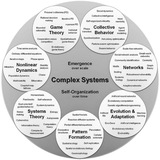
🌀 Complex systems can exhibit a rich phase structure and have a huge variety of macrostates that often cannot be inferred from the properties of the elements. This is sometimes referred to as emergence. Simple forms of emergence are, of course, already present in physics. The spectrum of the hydrogen atom or the liquid phase of water are emergent properties of the involved particles and their interactions.
⭕️ The theory of complex systems is the quantitative, predictive and experimentally testable science of generalized matter interacting through generalized interactions.
📗 Introduction to the Theory of Complex Systems Author(s): Stefan Thurner, Rudolf Hanel, Peter Klimek
⭕️ The theory of complex systems is the quantitative, predictive and experimentally testable science of generalized matter interacting through generalized interactions.
📗 Introduction to the Theory of Complex Systems Author(s): Stefan Thurner, Rudolf Hanel, Peter Klimek
🎓Master in Physics of Complex Systems: The registration and enrolment period has begun. You can apply using the form at the website
https://t.co/znl562VNrh
Further information about the program and our fellowships can be found at https://t.co/mSbsemwUGa
https://t.co/znl562VNrh
Further information about the program and our fellowships can be found at https://t.co/mSbsemwUGa
www.uib.eu
Academic Year 2019-20 -
Master's Degree in Physics of Complex Systems - Masters - Study at the UIB - Universitat de les…
Master's Degree in Physics of Complex Systems - Masters - Study at the UIB - Universitat de les…
Masters. Study at the UIB. Master's Degree in Physics of Complex Systems. Academic Year 2019-20
IX GEFENOL Summer School on Statistical Physics of Complex Systems is open for applications. 🎓2-13 September in Santander. The dead line for application to the early bird registration is May 3rd.
https://t.co/UMsaB1W7VQ
https://t.co/UMsaB1W7VQ
🎞 State-Space Compression, Coarse-Graining, and the Averaging of Life and Mind
Simon DeDeo
Abstract
Renormalization is a principled coarse-graining of space-time. It shows us how the small-scale details of a system may become irrelevant when looking at larger scales and lower energies. Coarse-graining is also crucial, however, for biological and cultural systems that lack a natural spatial arrangement. I introduce the notion of coarse-graining and equivalence classes, and give a brief history of attempts to tame the problem of simplifying and "averaging" things as various as algorithms and languages. I then present state-space compression, a new framework for understanding the general problem. At the end, I present recent empirical results, in an animal social system, that show evidence for the coupling of scales: the reaction of coarse-grained facts about a system "downwards" to influence the microphysics.
🔗 http://www.perimeterinstitute.ca/videos/state-space-compression-coarse-graining-and-averaging-life-and-mind
Simon DeDeo
Abstract
Renormalization is a principled coarse-graining of space-time. It shows us how the small-scale details of a system may become irrelevant when looking at larger scales and lower energies. Coarse-graining is also crucial, however, for biological and cultural systems that lack a natural spatial arrangement. I introduce the notion of coarse-graining and equivalence classes, and give a brief history of attempts to tame the problem of simplifying and "averaging" things as various as algorithms and languages. I then present state-space compression, a new framework for understanding the general problem. At the end, I present recent empirical results, in an animal social system, that show evidence for the coupling of scales: the reaction of coarse-grained facts about a system "downwards" to influence the microphysics.
🔗 http://www.perimeterinstitute.ca/videos/state-space-compression-coarse-graining-and-averaging-life-and-mind
www.perimeterinstitute.ca
State-Space Compression, Coarse-Graining, and the Averaging of Life and Mind | Perimeter Institute
Renormalization is a principled coarse-graining of space-time. It shows us how the small-scale details of a system may become irrelevant when looking at larger scales and lower energies. Coarse-graining is also crucial, however, for biological and cultural…
💡 Coarse-Graining
In physics a fine-grained denoscription of a system is a detailed denoscription of its microscopic behavior. A coarse-grained denoscription is one in which some of this fine detail has been smoothed over.
Coarse-graining is at the core of the second law of thermodynamics, which states that the entropy of the universe is increasing. As entropy, or randomness, increases there is a loss of structure. This simply means that some of the information we originally had about the system has become no longer useful for making predictions about the behavior of a system as a whole. To make this more concrete, think about temperature.
Temperature is the average speed of particles in a system. Temperature is a coarse-grained representation of all of the particles’ behavior–the particles in aggregate. When we know the temperature we can use it to predict the system’s future state better than we could if we actually measured the speed of individual particles. This is why coarse-graining is so important–it is incredibly useful. It gives us what is called an effective theory. An effective theory allows us to model the behavior of a system without specifying all of the underlying causes that lead to system state changes.
It is important to recognize that a critical property of a coarse-grained denoscription is that it is “true” to the system, meaning that it is a reduction or simplification of the actual microscopic details. When we give a coarse-grained denoscription we do not introduce any outside information. We do not add anything that isn’t already in the details. This “lossy but true” property is one factor that distinguishes coarse-graining from other types of abstraction.
A second property of coarse-graining is that it involves integrating over component behavior. An average is a simple example but more complicated computations are also possible.
Normally when we talk of coarse-graining, we mean coarse-grainings that we as scientists impose on the system to find compact denoscriptions of system behavior sufficient for good prediction. In other words, coarse-graining helps the scientist identify the relevant regularities for explaining system behavior.
However, we can also ask how adaptive systems identify (in evolutionary, developmental, or learning time) regularities and build effective theories to guide decision making and behavior. Coarse-graining is one kind of inference mechanism that adaptive systems can use to build effective theories. To distinguish coarse-graining in nature from coarse-graining by scientists, we refer to coarse-graining in nature as endogenous coarse-graining.
Because adaptive systems are imperfect information processors, coarse-graining in nature is unlikely to be a perfect or “true” simplification of the microscopic details as it is the physics sense. It is also worth noting that coarse-graining in nature is complicated by the fact that in adaptive systems it is often a collective process performed by a large number of semi-independent components. One of many interesting questions is whether the subjectivity and error inherent in biological information processing can be overcome through collective coarse-graining.
In my view two key questions for 21st-century biology are how nature coarse-grains and how the capacity for coarse-graining influences the quality of the effective theories that adaptive systems build to make predictions. Answering these questions might help us gain traction on some traditionally quite slippery philosophical questions. Among these, is downward causation “real” and are biological systems law-like?
In physics a fine-grained denoscription of a system is a detailed denoscription of its microscopic behavior. A coarse-grained denoscription is one in which some of this fine detail has been smoothed over.
Coarse-graining is at the core of the second law of thermodynamics, which states that the entropy of the universe is increasing. As entropy, or randomness, increases there is a loss of structure. This simply means that some of the information we originally had about the system has become no longer useful for making predictions about the behavior of a system as a whole. To make this more concrete, think about temperature.
Temperature is the average speed of particles in a system. Temperature is a coarse-grained representation of all of the particles’ behavior–the particles in aggregate. When we know the temperature we can use it to predict the system’s future state better than we could if we actually measured the speed of individual particles. This is why coarse-graining is so important–it is incredibly useful. It gives us what is called an effective theory. An effective theory allows us to model the behavior of a system without specifying all of the underlying causes that lead to system state changes.
It is important to recognize that a critical property of a coarse-grained denoscription is that it is “true” to the system, meaning that it is a reduction or simplification of the actual microscopic details. When we give a coarse-grained denoscription we do not introduce any outside information. We do not add anything that isn’t already in the details. This “lossy but true” property is one factor that distinguishes coarse-graining from other types of abstraction.
A second property of coarse-graining is that it involves integrating over component behavior. An average is a simple example but more complicated computations are also possible.
Normally when we talk of coarse-graining, we mean coarse-grainings that we as scientists impose on the system to find compact denoscriptions of system behavior sufficient for good prediction. In other words, coarse-graining helps the scientist identify the relevant regularities for explaining system behavior.
However, we can also ask how adaptive systems identify (in evolutionary, developmental, or learning time) regularities and build effective theories to guide decision making and behavior. Coarse-graining is one kind of inference mechanism that adaptive systems can use to build effective theories. To distinguish coarse-graining in nature from coarse-graining by scientists, we refer to coarse-graining in nature as endogenous coarse-graining.
Because adaptive systems are imperfect information processors, coarse-graining in nature is unlikely to be a perfect or “true” simplification of the microscopic details as it is the physics sense. It is also worth noting that coarse-graining in nature is complicated by the fact that in adaptive systems it is often a collective process performed by a large number of semi-independent components. One of many interesting questions is whether the subjectivity and error inherent in biological information processing can be overcome through collective coarse-graining.
In my view two key questions for 21st-century biology are how nature coarse-grains and how the capacity for coarse-graining influences the quality of the effective theories that adaptive systems build to make predictions. Answering these questions might help us gain traction on some traditionally quite slippery philosophical questions. Among these, is downward causation “real” and are biological systems law-like?
🎞 Fields Medal winner (2010) Cédric Villani gives a talk devoted to the presentation of some of the most important concepts in statistical mechanics, including Boltzmann's statistical entropy, the notion of macroscopic irreversibility and molecular chaos, and the Boltzmann equation.
https://www.youtube.com/watch?v=u3zU3HLQWf8
https://www.youtube.com/watch?v=u3zU3HLQWf8
Forwarded from Complex Networks (SBU)
#سمینارهای_هفتگی
مرکز شبکههای پیچیده و علمداده اجتماعی دانشگاه شهید بهشتی (CCNSD)
🗣 محمد شرافتی - دانشگاه شهیدبهشتی
⏰ دوشنبه، ۹ اردیبهشت ساعت ۱۶:۰۰
🏛 محل برگزاری: سالن ابنهیثم
~~~~~~~~~~~~~~~~
⭕️ مشتاق دیدار همه اقشار جامعه در مرکز هستیم. برای هماهنگی با مسئول جلسه میتوانید با آقای محمد شرافتی تماس بگیرید:
📞 @herman1
—————————————
🕸 مرکز شبکههای پیچیده و علم داده اجتماعی دانشگاه شهید بهشتی
🕸 @CCNSD 🔗 ccnsd.ir
—————————————
مرکز شبکههای پیچیده و علمداده اجتماعی دانشگاه شهید بهشتی (CCNSD)
🗣 محمد شرافتی - دانشگاه شهیدبهشتی
⏰ دوشنبه، ۹ اردیبهشت ساعت ۱۶:۰۰
🏛 محل برگزاری: سالن ابنهیثم
~~~~~~~~~~~~~~~~
⭕️ مشتاق دیدار همه اقشار جامعه در مرکز هستیم. برای هماهنگی با مسئول جلسه میتوانید با آقای محمد شرافتی تماس بگیرید:
📞 @herman1
—————————————
🕸 مرکز شبکههای پیچیده و علم داده اجتماعی دانشگاه شهید بهشتی
🕸 @CCNSD 🔗 ccnsd.ir
—————————————
Forwarded from انجمن علمی فیزیک شریف (Mohammad Hossein Amiri)
💠 آغاز ثبتنام در سمینار مغز و علوم شناختی
🕰 سهشنبه ۱۰ اردیبهشت
ساعت ۱۳:۳۰ الی ۱۸
چهارشنبه ۱۱ اردیبهشت
ساعت ۱۰ الی ۱۸
🏛 سالن آمفیتئاتر دانشکده مهندسی انرژی دانشگاه شریف
🌐 ثبتنام در evnd.co/jCktA
#BrainAwarenessWeek
@Shenasa_Sharif
@anjoman_elmi_phys_sut
🕰 سهشنبه ۱۰ اردیبهشت
ساعت ۱۳:۳۰ الی ۱۸
چهارشنبه ۱۱ اردیبهشت
ساعت ۱۰ الی ۱۸
🏛 سالن آمفیتئاتر دانشکده مهندسی انرژی دانشگاه شریف
🌐 ثبتنام در evnd.co/jCktA
#BrainAwarenessWeek
@Shenasa_Sharif
@anjoman_elmi_phys_sut
✅ In this paper "Testing statistical laws in complex systems" they have revisitef the controversy #power_laws, showing that correlations are responsible for many of the recent (false) rejections.
PRL version: https://t.co/DmdzPycEFi arXiv version: https://t.co/6227uYYBpt
PRL version: https://t.co/DmdzPycEFi arXiv version: https://t.co/6227uYYBpt
Physical Review Letters
Testing Statistical Laws in Complex Systems
The availability of large datasets requires an improved view on statistical laws in complex systems, such as Zipf's law of word frequencies, the Gutenberg-Richter law of earthquake magnitudes, or scale-free degree distribution in networks. In this Letter…
🚨 https://comdig.unam.mx/2019/04/27/the-stochastic-thermodynamics-of-computation/
https://t.co/PwiBHp5SxW via #IOPscience
https://t.co/PwiBHp5SxW via #IOPscience
Complexity Digest
The stochastic thermodynamics of computation
(…) In this paper I review some of this recent work on the ‘stochastic thermodynamics of computation’. After reviewing the salient parts of information theory, computer science th…
🎞 Paul Andersen explains the concepts of genetics. He starts with a brief discussion of the nature vs. nurture debate and shows how epigenetics blurs this distinction. He explains how differentiation of cell types results from the inactivation of certain genes. He describes the three processes of epigenetics: DNA methylation, Histone acteylation and microRNA.
https://www.youtube.com/watch?v=i9a-ru2ES6Y
https://www.youtube.com/watch?v=i9a-ru2ES6Y
YouTube
Epigenetics
Paul Andersen explains the concepts of genetics. He starts with a brief discussion of the nature vs. nurture debate and shows how epigenetics blurs this distinction. He explains how differentiation of cell types results from the inactivation of certain…
Forwarded from انجمن علمی فیزیک بهشتی (SBU)
#سمینار_عمومی این هفته
Some idea from social science to study Gene-Gene Interactions of the Cancerous Cells
- سهشنبه ۱۰ اردیبهشت؛ ساعت ۱۵:۳۰ الی ۱۶:۳۰
- تالار ابن هیثم، دانشکده فیزیک
کانال انجمن علمی فیزیک بهشتی
@sbu_physics
Some idea from social science to study Gene-Gene Interactions of the Cancerous Cells
- سهشنبه ۱۰ اردیبهشت؛ ساعت ۱۵:۳۰ الی ۱۶:۳۰
- تالار ابن هیثم، دانشکده فیزیک
کانال انجمن علمی فیزیک بهشتی
@sbu_physics
Geometric renormalization unravels self-similarity of the multiscale human connectome
“structure of the human brain remains self-similar when the resolution length is progressively decreased by hierarchical coarse-graining of the anatomical regions”
https://t.co/YEIjyWNoYd
“structure of the human brain remains self-similar when the resolution length is progressively decreased by hierarchical coarse-graining of the anatomical regions”
https://t.co/YEIjyWNoYd
Forwarded from انجمن علمی شناسا
⏰ برنامه زمانبندی و عناوین ارائهها
🔺سمینار “مغز و علوم شناختی”
🏛سالن آمفیتئاتر دانشکده انرژی
🌟همراه با پنل فلسفه، هوش مصنوعی و علوم شناختی
دانشجویان فلسفه علم و مهندسی کامپیوتر
⭐ابوطالب صفدری و امیرحسین حاجی شمسایی
🔗لینک ثبتنام:
evnd.co/jCktA
#BrainAwarenessWeek
@Shenasa_Sharif
🔺سمینار “مغز و علوم شناختی”
🏛سالن آمفیتئاتر دانشکده انرژی
🌟همراه با پنل فلسفه، هوش مصنوعی و علوم شناختی
دانشجویان فلسفه علم و مهندسی کامپیوتر
⭐ابوطالب صفدری و امیرحسین حاجی شمسایی
🔗لینک ثبتنام:
evnd.co/jCktA
#BrainAwarenessWeek
@Shenasa_Sharif