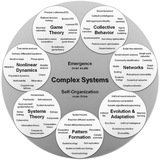
Anyone interested in a phd on big-data-driven modelling of complex environmental systems (e.g. multiplexes of natural resources users in river basins) please contact me at roger.cremades@hzg.de, please do send it to potentially interested friends 👍🏿✨
Forwarded from Complex Networks (SBU)
#سمینارهای_هفتگی
مرکز شبکههای پیچیده و علمداده اجتماعی دانشگاه شهید بهشتی (CCNSD)
برای یک شبیهسازی موفق چه چیزهایی غیر از زبانهای برنامهنویسی را باید بدانیم؟
🗣 بابک اسعدی - دانشگاه شهیدبهشتی
⏰ دوشنبه، ۱۶ اردیبهشت ساعت ۱۶:۰۰
🏛 محل برگزاری: سالن ابنهیثم
~~~~~~~~~~~~~~~~
⭕️ مشتاق دیدار همه اقشار جامعه در مرکز هستیم. برای هماهنگی با مسئول جلسه میتوانید با آقای محمد شرافتی تماس بگیرید:
📞 @herman1
—————————————
🕸 مرکز شبکههای پیچیده و علم داده اجتماعی دانشگاه شهید بهشتی
🕸 @CCNSD 🔗 ccnsd.ir
—————————————
مرکز شبکههای پیچیده و علمداده اجتماعی دانشگاه شهید بهشتی (CCNSD)
برای یک شبیهسازی موفق چه چیزهایی غیر از زبانهای برنامهنویسی را باید بدانیم؟
🗣 بابک اسعدی - دانشگاه شهیدبهشتی
⏰ دوشنبه، ۱۶ اردیبهشت ساعت ۱۶:۰۰
🏛 محل برگزاری: سالن ابنهیثم
~~~~~~~~~~~~~~~~
⭕️ مشتاق دیدار همه اقشار جامعه در مرکز هستیم. برای هماهنگی با مسئول جلسه میتوانید با آقای محمد شرافتی تماس بگیرید:
📞 @herman1
—————————————
🕸 مرکز شبکههای پیچیده و علم داده اجتماعی دانشگاه شهید بهشتی
🕸 @CCNSD 🔗 ccnsd.ir
—————————————
Origins of Life course is now open for enrollment! Free and open to everyone - Class starts June 14 -
http://origins.complexityexplorer.org
Syllabus
Introduction
Chemical Origins
Chemical Comminalities
Early Life
Evolution
Astrobiology & General Outlook
#originsoflife
http://origins.complexityexplorer.org
Syllabus
Introduction
Chemical Origins
Chemical Comminalities
Early Life
Evolution
Astrobiology & General Outlook
#originsoflife
www.complexityexplorer.org
Complexity Explorer
Complexity Explorer provides online courses and educational materials about complexity science. Complexity Explorer is an education project of the Santa Fe Institute - the world headquarters for complexity science.
Forwarded from Sitpor.org سیتپـــــور
همایش «دانشنامهٔ آزاد ویکیپدیا و نقش اجتماعی دانشگاه در عرصهٔ عمومی علم»
سخنرانان:
دکتر ناصر فکوهی
آرش امامی
عباس کریمی
دبیر علمی نشست:دکتر زهیر صیامیان
یک شنبه ۱۵ اردیبهشت ماه
دانشکده ادبیات و علوم انسانی دانشگاه شهید بهشتی
@akhbartarikh
سخنرانان:
دکتر ناصر فکوهی
آرش امامی
عباس کریمی
دبیر علمی نشست:دکتر زهیر صیامیان
یک شنبه ۱۵ اردیبهشت ماه
دانشکده ادبیات و علوم انسانی دانشگاه شهید بهشتی
@akhbartarikh
Forwarded from انجمن علمی ژرفا
This media is not supported in your browser
VIEW IN TELEGRAM
⭕️ خبری در راه است!
🦠 گردهمایی "سیستمهای پیچیده" ژرفا
🌀 ۲۴ اردیبهشتماه
📍 دانشگاه صنعتی شریف
➕ منتظر خبرهای تکمیلی باشید...
🆔 @Zharfa90
🦠 گردهمایی "سیستمهای پیچیده" ژرفا
🌀 ۲۴ اردیبهشتماه
📍 دانشگاه صنعتی شریف
➕ منتظر خبرهای تکمیلی باشید...
🆔 @Zharfa90
On Turbulence and Geometry
from Nash to Onsager [PDF] https://t.co/SNS5pD9ZZl
from Nash to Onsager [PDF] https://t.co/SNS5pD9ZZl
💰 new postdoc opening on "Statistical Inference & Learning: Mathematical & Algorithmic Aspects" in our department at ICTP
https://t.co/NCbPvLwmTQ
https://t.co/NCbPvLwmTQ
Forwarded from انجمن علمی ژرفا
Complex Systems Studies
https://www.nature.com/articles/s42254-019-0054-2
New review article: "The Statistical Physics of Cities" (by Marc Barthelemy): https://t.co/8GeTuX0eWr
In Nature Reviews Physics: DOI:10.1038/s42254-019-0054-2
In Nature Reviews Physics: DOI:10.1038/s42254-019-0054-2
arXiv.org
The statistical physics of Cities
Challenges due to the rapid urbanization of the world -- especially in
emerging countries -- range from an increasing dependence on energy, to air
pollution, socio-spatial inequalities,...
emerging countries -- range from an increasing dependence on energy, to air
pollution, socio-spatial inequalities,...
PostDoc Position to study "What do the 'people' want?"!
https://t.co/wL7QGKNgW2
https://t.co/wL7QGKNgW2
Balance in signed networks
Alec Kirkley, George T. Cantwell, and M. E. J. Newman
Phys. Rev. E 99, 012320 – Published 22 January 2019
https://arxiv.org/pdf/1809.05140
Alec Kirkley, George T. Cantwell, and M. E. J. Newman
Phys. Rev. E 99, 012320 – Published 22 January 2019
https://arxiv.org/pdf/1809.05140
🎞 Entropy: Gaining Knowledge by Admitting Ignorance
🔗 http://media.podcasts.ox.ac.uk/physics/general/2018-11-17-physics-theoretical-schekochihin-1.mp4
Alexander Schekochihin, Professor of Theoretical Physics, gives a talk on entropy.
When dealing with physical systems that contain many degrees of freedom, a researcher's most consequential realisation is of the enormous amount of detailed information about them that she does not have, and has no hope of obtaining. It turns out that this vast ignorance is not a curse but a blessing: by admitting ignorance and constructing a systematic way of making fair predictions about the system that rely only on the information that one has and on nothing else, one can get surprisingly far in describing the natural world. In an approach anticipated by Boltzmann and Gibbs and given mathematical foundation by Shannon, entropy emerges as a mathematical measure of our uncertainty about large systems and, paradoxically, a way to describe their likely behaviour—and even, some argue, the ultimate fate of the Universe. Alex Schekochihin will admit ignorance and attempt to impart some knowledge.
🔗 http://media.podcasts.ox.ac.uk/physics/general/2018-11-17-physics-theoretical-schekochihin-1.mp4
Alexander Schekochihin, Professor of Theoretical Physics, gives a talk on entropy.
When dealing with physical systems that contain many degrees of freedom, a researcher's most consequential realisation is of the enormous amount of detailed information about them that she does not have, and has no hope of obtaining. It turns out that this vast ignorance is not a curse but a blessing: by admitting ignorance and constructing a systematic way of making fair predictions about the system that rely only on the information that one has and on nothing else, one can get surprisingly far in describing the natural world. In an approach anticipated by Boltzmann and Gibbs and given mathematical foundation by Shannon, entropy emerges as a mathematical measure of our uncertainty about large systems and, paradoxically, a way to describe their likely behaviour—and even, some argue, the ultimate fate of the Universe. Alex Schekochihin will admit ignorance and attempt to impart some knowledge.
🎞 Magnets, superfluids and superconductors
🔗 http://media.podcasts.ox.ac.uk/physics/general/2016-10-29-theoretical-physics-2-720p.mp4
Second lecture "#More_is_different" - how states of matter emerge from quantum theory Saturday morning of Theoretical Physics. With Professor Fabian Essler, introduction by Professor John Wheeler.
Fabian Essler will discuss the hugely successful framework for classifying possible states of quantum matter, pioneered by the great Russian Nobel Laureate, Lev Landau. This framework is conceptually remarkably simple, but is broad enough to describe physics ranging from magnets to superconductors to fundamental physics in the guise of relativistic quantum field theory and the Higgs phenomenon.
More on this mini-series;
The properties of all forms of matter, from the most mundane to the most exotic kinds produced in advanced laboratories, are consequences of the laws of quantum mechanics. Understanding how macroscopic behaviour emerges from microscopic laws in a system of many particles is one of the intellectually most demanding, yet most important, challenges of physics, and is the subject of this series of lectures.
🔗 http://media.podcasts.ox.ac.uk/physics/general/2016-10-29-theoretical-physics-2-720p.mp4
Second lecture "#More_is_different" - how states of matter emerge from quantum theory Saturday morning of Theoretical Physics. With Professor Fabian Essler, introduction by Professor John Wheeler.
Fabian Essler will discuss the hugely successful framework for classifying possible states of quantum matter, pioneered by the great Russian Nobel Laureate, Lev Landau. This framework is conceptually remarkably simple, but is broad enough to describe physics ranging from magnets to superconductors to fundamental physics in the guise of relativistic quantum field theory and the Higgs phenomenon.
More on this mini-series;
The properties of all forms of matter, from the most mundane to the most exotic kinds produced in advanced laboratories, are consequences of the laws of quantum mechanics. Understanding how macroscopic behaviour emerges from microscopic laws in a system of many particles is one of the intellectually most demanding, yet most important, challenges of physics, and is the subject of this series of lectures.
🎞 Disordered serendipity: a glassy path to discovery
A workshop in honour of Giorgio Parisi's 70th birthday
23 videos, Sapienza Università di Roma, September 19-22, 2018
https://www.youtube.com/playlist?list=PLWEeoIep_PT-3SKg2TLWuBNpqbG4wcIw6
A workshop in honour of Giorgio Parisi's 70th birthday
23 videos, Sapienza Università di Roma, September 19-22, 2018
https://www.youtube.com/playlist?list=PLWEeoIep_PT-3SKg2TLWuBNpqbG4wcIw6
Complex Systems Studies
🎞 Disordered serendipity: a glassy path to discovery A workshop in honour of Giorgio Parisi's 70th birthday 23 videos, Sapienza Università di Roma, September 19-22, 2018 https://www.youtube.com/playlist?list=PLWEeoIep_PT-3SKg2TLWuBNpqbG4wcIw6
🎞 Marc Mézard - Statistical inference: the impact of statistical physics concepts and methods
https://www.youtube.com/watch?v=hoKphRCtbRQ
In recent years, ideas from statistical physics of disordered systems, notably the cavity method, have helped to develop new algorithms for important inference problems, ranging from community detection to compressed sensing, machine learning (neural networks) and generalized linear regression. The talk will review these developments and explain how they can be used, together with the replica method, to identify phase transitions in benchmark ensembles of inference problems.
https://www.youtube.com/watch?v=hoKphRCtbRQ
In recent years, ideas from statistical physics of disordered systems, notably the cavity method, have helped to develop new algorithms for important inference problems, ranging from community detection to compressed sensing, machine learning (neural networks) and generalized linear regression. The talk will review these developments and explain how they can be used, together with the replica method, to identify phase transitions in benchmark ensembles of inference problems.
YouTube
Marc Mézard - Statistical inference: the impact of statistical physics concepts and methods
In recent years, ideas from statistical physics of disordered systems, notably the cavity method, have helped to develop new algorithms for important inference problems, ranging from community detection to compressed sensing, machine learning (neural networks)…
Complex Systems Studies
🎞 Disordered serendipity: a glassy path to discovery A workshop in honour of Giorgio Parisi's 70th birthday 23 videos, Sapienza Università di Roma, September 19-22, 2018 https://www.youtube.com/playlist?list=PLWEeoIep_PT-3SKg2TLWuBNpqbG4wcIw6
🎞 Florent Krzakala - On statistical physics and inference problems
https://www.youtube.com/watch?v=dFCghDh2aQE
Heuristic tools from statistical physics, in particular the replica method, have been used in the past to locate the phase transitions and compute the optimal learning and generalisation errors in many machine learning tasks. This field is currently witnessing an impressive revival. In this talk, we provide a rigorous justification of these approaches for high-dimensional generalized linear models — used in signal processing, statistical inference, machine learning, communication theory and other fields — and discuss computational to statistical gaps where the learning is possible, but computationally hard.
https://www.youtube.com/watch?v=dFCghDh2aQE
Heuristic tools from statistical physics, in particular the replica method, have been used in the past to locate the phase transitions and compute the optimal learning and generalisation errors in many machine learning tasks. This field is currently witnessing an impressive revival. In this talk, we provide a rigorous justification of these approaches for high-dimensional generalized linear models — used in signal processing, statistical inference, machine learning, communication theory and other fields — and discuss computational to statistical gaps where the learning is possible, but computationally hard.
YouTube
Florent Krzakala - On statistical physics and inference problems
Heuristic tools from statistical physics, in particular the replica method, have been used in the past to locate the phase transitions and compute the optimal learning and generalisation errors in many machine learning tasks. This field is currently witnessing…