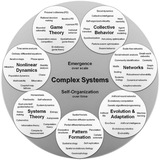
🎞 Is Complexity a Science? Is it a possibly useful new way of engineering?
In this video narrated by Maxi San Miguel it will be argued that Complexity is a new way of thinking, necessary for a scientific renaissance that can transform society.
📺 https://t.co/OR41RZjRCd
In this video narrated by Maxi San Miguel it will be argued that Complexity is a new way of thinking, necessary for a scientific renaissance that can transform society.
📺 https://t.co/OR41RZjRCd
YouTube
Complexity: Science, Engineering or a State of Mind? Towards a Scientific Renaissance
Is complexity a Science? Is it a possibly useful new way of engineering? In this video narrated by Maxi San Miguel it will be argued that Complexity is a new...
geoplot looks like a nice tool for plotting geo data in Python. Seaborn but for spatial data ;) You can try there quick start tutorial here: https://t.co/2JjhfsvFBV
no install needed
no install needed
🖤 Recollecting Mitchell Feigenbaum— a chaos pioneer
by SFI External Professor Fred Cooper
https://medium.com/@sfiscience/recollecting-mitchell-feigenbaum-a-chaos-pioneer-206a73a91a42
Feigenbaum’s constants are universal ratios … that relate to phenomena with oscillatory (cyclic) behavior, such as swinging pendulums or heart rhythms. The most well-known one, Feigenbaum’s Delta, refers to the spacing between parameter values required to double the cycle’s length, which decreases exponentially by a factor approaching approximately 4.669.
Among all my friends, Mitchell was the most unusual and brilliant. He viewed the world through the lens of a scientist. When he walked through the forest he wondered “at what distance do the trees merge and become inseparable?” When he looked at the moon he wondered “why does the moon appear larger when it is on the horizon?” He then needed to develop a theory to explain these phenomena “from scratch.” This led him to study how vision evolved from fish to humans and why optical illusions occur as a result of “mistakes” made by our sensory cognition. When he was asked by Pete Carruthers, “what is the origin of turbulence?” Mitchell looked at the simplest nonlinear system — the logistic map where bifurcations took place. This led to the famous Feigenbaum numbers, which were an essential part in understanding the onset of chaos.
Mitchell had a great love of music and again wondered how can one improve on digital technology so that the sound of the onset of a bow string could be captured. His interest in photography led him to write computer codes to undo the mistakes made by existing copying machines so that a perfect image could be printed. I found it fascinating that not only did he ask these questions, which were unusual to me, but then he dropped everything to figure out the answer. This also led to the production of maps with minimal distortion and computer codes for figuring out how to label maps in the clearest fashion.
Mitchell was a dear friend and he will be missed.
by SFI External Professor Fred Cooper
https://medium.com/@sfiscience/recollecting-mitchell-feigenbaum-a-chaos-pioneer-206a73a91a42
Feigenbaum’s constants are universal ratios … that relate to phenomena with oscillatory (cyclic) behavior, such as swinging pendulums or heart rhythms. The most well-known one, Feigenbaum’s Delta, refers to the spacing between parameter values required to double the cycle’s length, which decreases exponentially by a factor approaching approximately 4.669.
Among all my friends, Mitchell was the most unusual and brilliant. He viewed the world through the lens of a scientist. When he walked through the forest he wondered “at what distance do the trees merge and become inseparable?” When he looked at the moon he wondered “why does the moon appear larger when it is on the horizon?” He then needed to develop a theory to explain these phenomena “from scratch.” This led him to study how vision evolved from fish to humans and why optical illusions occur as a result of “mistakes” made by our sensory cognition. When he was asked by Pete Carruthers, “what is the origin of turbulence?” Mitchell looked at the simplest nonlinear system — the logistic map where bifurcations took place. This led to the famous Feigenbaum numbers, which were an essential part in understanding the onset of chaos.
Mitchell had a great love of music and again wondered how can one improve on digital technology so that the sound of the onset of a bow string could be captured. His interest in photography led him to write computer codes to undo the mistakes made by existing copying machines so that a perfect image could be printed. I found it fascinating that not only did he ask these questions, which were unusual to me, but then he dropped everything to figure out the answer. This also led to the production of maps with minimal distortion and computer codes for figuring out how to label maps in the clearest fashion.
Mitchell was a dear friend and he will be missed.
Medium
Recollecting Mitchell Feigenbaum— a chaos pioneer
by SFI External Professor Fred Cooper
Spectral properties and the accuracy of mean-field approaches for epidemics on correlated networks
“comparison between stochastic simulations and mean-field theories of the susceptible-infected-susceptible (SIS) model on correlated networks”
https://t.co/h6h6o7KPqy
“comparison between stochastic simulations and mean-field theories of the susceptible-infected-susceptible (SIS) model on correlated networks”
https://t.co/h6h6o7KPqy
🎞 We are biased but the Internet could help us measure it & possibly fix it. Also, let's save the Internet instead of blaming it for everything!
https://t.co/eN9hRTrrhZ
https://t.co/eN9hRTrrhZ
YouTube
The Internet and your inner English tea merchant | Taha Yasseri | TEDxThessaloniki
The Internet is a totally internet phenomenon. In this talk, Dr Taha Yasseri gives answers to burning internet questions. Are users biased like an English te...
Calling all quantitative life scientists! Deadline to apply to this postdoc is July 10, 2019!
https://t.co/1utmJVxueR
https://t.co/1utmJVxueR
🎞 Taha Yasseri course on "Research Design in Social Data Science" is finally live!
Here is a sneak preview!
If you like it, enrol to join the next cohort, starting 10 Oct, here:
https://t.co/xkiREH7yk3
Here is a sneak preview!
If you like it, enrol to join the next cohort, starting 10 Oct, here:
https://t.co/xkiREH7yk3
SAGE Campus - Online Data Science Courses for Social Scientists from Sage Publishing
Research Design in Social Data Science — SAGE Campus - Online Data Science Courses for Social Scientists from Sage Publishing
SAGE Campus online data science course on research design in social data science. This short course is perfect for social scientists looking to work with big data. Enroll or register your interest today for just $199.
terrific paper on causal emergence: https://t.co/ZNBVvq0dhy
Since then, we’ve been building a formalism to study causal emergence in networks. Today we posted our first paper on it https://t.co/Til7g7LCEk
Since then, we’ve been building a formalism to study causal emergence in networks. Today we posted our first paper on it https://t.co/Til7g7LCEk
Complex Systems Studies
terrific paper on causal emergence: https://t.co/ZNBVvq0dhy Since then, we’ve been building a formalism to study causal emergence in networks. Today we posted our first paper on it https://t.co/Til7g7LCEk
Networks are such powerful objects. They've changed how we study complex systems. But I’ve always been struck by how nontrivial the “what is a node?” question can be.
We provide a framework for identifying the most informative *scale* to describe interdependencies in a system...
We provide a framework for identifying the most informative *scale* to describe interdependencies in a system...
Complex Systems Studies
Networks are such powerful objects. They've changed how we study complex systems. But I’ve always been struck by how nontrivial the “what is a node?” question can be. We provide a framework for identifying the most informative *scale* to describe interdependencies…
...which is to say, we find that compressed or coarse-grained or macroscale denoscriptions of networks often have more *effective information* than the original microscale network (e.g. your raw network data).
This noise-minimizing process is known as causal emergence.
So what?
This noise-minimizing process is known as causal emergence.
So what?
Complex Systems Studies
...which is to say, we find that compressed or coarse-grained or macroscale denoscriptions of networks often have more *effective information* than the original microscale network (e.g. your raw network data). This noise-minimizing process is known as causal…
It's a question of zoom: what's the right scale to represent brain networks, given what we want from our model? What's the best scale to model economic systems? What counts as a "node" in a genome?
They're rich, tough, fun problems. And there's a long way to go.
They're rich, tough, fun problems. And there's a long way to go.
Complex Systems Studies
It's a question of zoom: what's the right scale to represent brain networks, given what we want from our model? What's the best scale to model economic systems? What counts as a "node" in a genome? They're rich, tough, fun problems. And there's a long way…
This research fascinates me, and there's a bunch of directions to go with it.
Feel free to send feedback or questions, and stay tuned for the release of some tutorials / open python code.
https://t.co/Til7g7LCEk
Feel free to send feedback or questions, and stay tuned for the release of some tutorials / open python code.
https://t.co/Til7g7LCEk
arXiv.org
Uncertainty and causal emergence in complex networks
The connectivity of a network conveys information about the dependencies
between nodes. We show that this information can be analyzed by measuring the
uncertainty (and certainty) contained in...
between nodes. We show that this information can be analyzed by measuring the
uncertainty (and certainty) contained in...
What are the gender differences in scientific productivity and impact?
We reconstructed 1.5 million careers with fascinating findings at
https://t.co/5VuiWpxXxo.
1. Paradoxically, as the fraction of women has increased in academia, so did the productivity and impact gender gaps.
2. The good news: there are no systematic differences between the annual productivity of male and female scientists! Annual productivity is a key gender-invariant.
3. There is, however, a persistent higher dropout rate for women at all stages of their careers.
4. Once we correct for the different dropout rate, the productivity and the impact differences between female and male scientists are reduced by roughly two-thirds.
5. We also discover a second gender invariant quantity: men and women have equivalent career-wise impact for the same size body of work (total number of publications).
The bottom line:
https://twitter.com/barabasi/status/1149210323724984321?s=19
We reconstructed 1.5 million careers with fascinating findings at
https://t.co/5VuiWpxXxo.
1. Paradoxically, as the fraction of women has increased in academia, so did the productivity and impact gender gaps.
2. The good news: there are no systematic differences between the annual productivity of male and female scientists! Annual productivity is a key gender-invariant.
3. There is, however, a persistent higher dropout rate for women at all stages of their careers.
4. Once we correct for the different dropout rate, the productivity and the impact differences between female and male scientists are reduced by roughly two-thirds.
5. We also discover a second gender invariant quantity: men and women have equivalent career-wise impact for the same size body of work (total number of publications).
The bottom line:
https://twitter.com/barabasi/status/1149210323724984321?s=19
Forwarded from Complex Networks (SBU)
#سمینارهای_هفتگی
«مقدمهای بر حسابان کسری و کاربردهای آن»
🗣 معین خلیقی - دانشگاه تربیت مدرس
⏰ دوشنبه، ۲۴ تیر - ساعت ۱۶:۰۰
🏛 محل برگزاری: سالن ابنهیثم
~~~~~~~~~~~~~~~~
⭕️ به امید دیدار
📞 @herman1
—————————————
🕸 مرکز شبکههای پیچیده و علم داده اجتماعی دانشگاه شهید بهشتی
🕸 @CCNSD 🔗 ccnsd.ir
—————————————
«مقدمهای بر حسابان کسری و کاربردهای آن»
🗣 معین خلیقی - دانشگاه تربیت مدرس
⏰ دوشنبه، ۲۴ تیر - ساعت ۱۶:۰۰
🏛 محل برگزاری: سالن ابنهیثم
~~~~~~~~~~~~~~~~
⭕️ به امید دیدار
📞 @herman1
—————————————
🕸 مرکز شبکههای پیچیده و علم داده اجتماعی دانشگاه شهید بهشتی
🕸 @CCNSD 🔗 ccnsd.ir
—————————————
⌨ In July’s issue of Nature Machine Intelligence, find out about machine intelligence in drug discovery, an approach for automatic classification of answers in free-form surveys and whether AI will soon surpass humans in playing Angry Birds!
https://go.nature.com/2S4N24P
https://go.nature.com/2S4N24P
💡 Statistical mechanics of time series.
https://arxiv.org/abs/1907.04925
Countless natural and social multivariate systems are studied through sets of simultaneous and time-spaced measurements of the observables that drive their dynamics, i.e., through sets of time series. Typically, this is done via hypothesis testing: the statistical properties of the empirical time series are tested against those expected under a suitable null hypothesis. This is a very challenging task in complex interacting systems, where statistical stability is often poor due to lack of stationarity and ergodicity. Here, we describe an unsupervised, data-driven framework to perform hypothesis testing in such situations. This consists of a statistical mechanical theory - derived from first principles - for ensembles of time series designed to preserve, on average, some of the statistical properties observed on an empirical set of time series. We showcase its possible applications on a set of stock market returns from the NYSE.
https://arxiv.org/abs/1907.04925
Countless natural and social multivariate systems are studied through sets of simultaneous and time-spaced measurements of the observables that drive their dynamics, i.e., through sets of time series. Typically, this is done via hypothesis testing: the statistical properties of the empirical time series are tested against those expected under a suitable null hypothesis. This is a very challenging task in complex interacting systems, where statistical stability is often poor due to lack of stationarity and ergodicity. Here, we describe an unsupervised, data-driven framework to perform hypothesis testing in such situations. This consists of a statistical mechanical theory - derived from first principles - for ensembles of time series designed to preserve, on average, some of the statistical properties observed on an empirical set of time series. We showcase its possible applications on a set of stock market returns from the NYSE.
The State of the Art in Multilayer Network Visualization
“literature to survey visualization techniques suitable for multilayer graph visualization, as well as tools, tasks, and analytic techniques”
https://t.co/o6sRQfXIJY
“literature to survey visualization techniques suitable for multilayer graph visualization, as well as tools, tasks, and analytic techniques”
https://t.co/o6sRQfXIJY