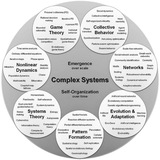
'Short Course' on "Mathematical and Computational Methods for Complex Social Systems" at the 2021 Joint Mathematics Meetings!
https://t.co/A4rXWVOWSU
https://t.co/A4rXWVOWSU
Anonymized mobile phone data can help curb #COVID19 by aiding efforts such as testing and tracing, bans on large gatherings and non-essential business closures, argue the authors of this @ScienceAdvances Editorial: https://t.co/PZIpaqXCN6
📱 #Mobile_phone #data for informing public health actions across the COVID-19 pandemic life cycle, freely available here:
https://t.co/AFZIf4FNWt
https://t.co/AFZIf4FNWt
Science
Mobile phone data for informing public health actions across the COVID-19 pandemic life cycle
The coronavirus 2019-2020 pandemic (COVID-19) poses unprecedented challenges for governments and societies around the world ( 1 ). Non-pharmaceutical interventions (NPIs) have proven to be critical for delaying and containing the COVID-19 pandemic ( 2 – 6…
💉 More than 90 #coronavirus #vaccines are being developed by research teams around the world. Our graphical guide explains each vaccine design.
https://t.co/FubzKkPlqZ
https://t.co/FubzKkPlqZ
💰 We have a #postdoc opening on modelling the COVID-19 epidemic. The position should be filled as soon as possible.
You can find more information
here https://t.co/EAejH8e5vZ
You can find more information
here https://t.co/EAejH8e5vZ
chiara-poletto.github.io
Chiara Poletto
Chiara Poletto's personal webpage
💰 Come do your #PhD with me in Estonia! We combine neuroscience, virtual reality and deep learning to study the master algorithm(s) of the human brain.
See projects 5 & 8 https://t.co/yb77MzA89w
See projects 5 & 8 https://t.co/yb77MzA89w
www.ut.ee
PhD in Computer Science
*/ /*-->*/ */ /*-->*/
Understanding complexity via network theory: a gentle introduction
Vaiva Vasiliauskaite, Fernando E. Rosas
Download PDF
Network theory provides tools which are particularly appropriate for assessing the complex interdependencies that characterise our modern connected world. This article presents an introduction to network theory, in a way that doesn't require a strong mathematical background. We explore how network theory unveils commonalities in the interdependency profiles of various systems, ranging from biological, to social, and artistic domains. Our aim is to enable an intuitive understanding while conveying the fundamental principles and aims of complexity science. Additionally, various network-theoretic tools are discussed, and numerous references for more advanced materials are provided.
Vaiva Vasiliauskaite, Fernando E. Rosas
Download PDF
Network theory provides tools which are particularly appropriate for assessing the complex interdependencies that characterise our modern connected world. This article presents an introduction to network theory, in a way that doesn't require a strong mathematical background. We explore how network theory unveils commonalities in the interdependency profiles of various systems, ranging from biological, to social, and artistic domains. Our aim is to enable an intuitive understanding while conveying the fundamental principles and aims of complexity science. Additionally, various network-theoretic tools are discussed, and numerous references for more advanced materials are provided.
Multilayer network simplification: approaches, models and methods
Roberto Interdonato, Matteo Magnani, Diego Perna, Andrea Tagarelli, Davide Vega
Download PDF
Multilayer networks have been widely used to represent and analyze systems of interconnected entities where both the entities and their connections can be of different types. However, real multilayer networks can be difficult to analyze because of irrelevant information, such as layers not related to the objective of the analysis, because of their size, or because traditional methods defined to analyze simple networks do not have a straightforward extension able to handle multiple layers. Therefore, a number of methods have been devised in the literature to simplify multilayer networks with the objective of improving our ability to analyze them. In this article we provide a unified and practical taxonomy of existing simplification approaches, and we identify categories of multilayer network simplification methods that are still underdeveloped, as well as emerging trends.
Comments:Accepted for publication in Computer Science Review, Elsevier
Roberto Interdonato, Matteo Magnani, Diego Perna, Andrea Tagarelli, Davide Vega
Download PDF
Multilayer networks have been widely used to represent and analyze systems of interconnected entities where both the entities and their connections can be of different types. However, real multilayer networks can be difficult to analyze because of irrelevant information, such as layers not related to the objective of the analysis, because of their size, or because traditional methods defined to analyze simple networks do not have a straightforward extension able to handle multiple layers. Therefore, a number of methods have been devised in the literature to simplify multilayer networks with the objective of improving our ability to analyze them. In this article we provide a unified and practical taxonomy of existing simplification approaches, and we identify categories of multilayer network simplification methods that are still underdeveloped, as well as emerging trends.
Comments:Accepted for publication in Computer Science Review, Elsevier
💰 #PhD at University of Vienna
Doctoral College Advanced Functional Materials
New positions for doctoral students available
The Doctoral College Advanced Functional Materials (DCAFM) is looking for 11 new doctoral students for the focus program Hierarchical Design of Hybrid Systems (HiDHyS), funded through a doc.funds project from the Austrian Science Fund (FWF). The positions are embedded within the Vienna Doctoral School in Physics (VDSP) and the doctoral training programs at the Faculties of Physics and Chemistry of the University of Vienna .
Focus of HiDHyS is the design of hybrid materials and their structural, mechanical, electronic and magnetic properties. The complexity of these materials is addressed through complementary experimental and computational methods, offering the new doctoral students opportunity for unique training and research experience. More information on DCAFM and HiDHyS is available on the DCAFM website .
The selected candidates will be employed at the University of Vienna for four years with a planned starting date in October 2020. Applicants are expected to have completed a master’s degree in physics, materials science or chemistry by the time of joining. Employment is for 30h/week as usual for doctoral students and the salary corresponds to the collective bargaining agreement of the University of Vienna .
To apply, please visit the VDSP website .
https://euraxess.ec.europa.eu/jobs/518670
The application deadline is 28 May 2020.
Doctoral College Advanced Functional Materials
New positions for doctoral students available
The Doctoral College Advanced Functional Materials (DCAFM) is looking for 11 new doctoral students for the focus program Hierarchical Design of Hybrid Systems (HiDHyS), funded through a doc.funds project from the Austrian Science Fund (FWF). The positions are embedded within the Vienna Doctoral School in Physics (VDSP) and the doctoral training programs at the Faculties of Physics and Chemistry of the University of Vienna .
Focus of HiDHyS is the design of hybrid materials and their structural, mechanical, electronic and magnetic properties. The complexity of these materials is addressed through complementary experimental and computational methods, offering the new doctoral students opportunity for unique training and research experience. More information on DCAFM and HiDHyS is available on the DCAFM website .
The selected candidates will be employed at the University of Vienna for four years with a planned starting date in October 2020. Applicants are expected to have completed a master’s degree in physics, materials science or chemistry by the time of joining. Employment is for 30h/week as usual for doctoral students and the salary corresponds to the collective bargaining agreement of the University of Vienna .
To apply, please visit the VDSP website .
https://euraxess.ec.europa.eu/jobs/518670
The application deadline is 28 May 2020.
EURAXESS
Fully funded PhD positions at the University of Vienna
University of Vienna Doctoral College Advanced Functional Materials New positions for doctoral students available
Network science and the human brain
Our group is looking for #PhD students in the area of network science. Our current work spans the development of network approaches for understanding brain functioning, characterizing neurological diseases, and discovering predictive biomarkers.
· Basic Qualifications
We seek students motivated to explore the complexity of biological systems from a network viewpoint. The ideal candidate has a physics, mathematics, computer science or statistics MS. Familiarity with network science and neuroscience/imaging is expected.
· Application Instructions
Prospective students should submit an application consisting of i) a current CV with university grades list, ii) a brief statement of research experience and interests, and iii) one letter of recommendation sent by the writer to: fabrizio.de-vico-fallani@inria.fr
Team Website www.sites.google.com/site/devicofallanifabrizio/
Lab Website www.aramislab.fr/
🔗 https://cssociety.org/job-openings/236/attachments/PhD-scholarships.pdf
Our group is looking for #PhD students in the area of network science. Our current work spans the development of network approaches for understanding brain functioning, characterizing neurological diseases, and discovering predictive biomarkers.
· Basic Qualifications
We seek students motivated to explore the complexity of biological systems from a network viewpoint. The ideal candidate has a physics, mathematics, computer science or statistics MS. Familiarity with network science and neuroscience/imaging is expected.
· Application Instructions
Prospective students should submit an application consisting of i) a current CV with university grades list, ii) a brief statement of research experience and interests, and iii) one letter of recommendation sent by the writer to: fabrizio.de-vico-fallani@inria.fr
Team Website www.sites.google.com/site/devicofallanifabrizio/
Lab Website www.aramislab.fr/
🔗 https://cssociety.org/job-openings/236/attachments/PhD-scholarships.pdf
Google
Fabrizio, De Vico Fallani
Fabrizio de Vico Fallani is INRIA Head of Research at the Paris Brain Spine Institute (ICM). Italian born native of Rome, he received his Masters in Computer Science Engineering at the Sapienza University in Rome (2005), and was awarded a Ph.D. in Biophysics…
💰3 junior #postdoc positions on Complex Systems, IFISC, Mallorca, Spain
https://cssociety.org/job-openings/230
https://cssociety.org/job-openings/230
💰 We have a #postdoc opening on investigating the effects of the COVID-19 pandemic on illicit online trade. Position is to be filled as soon as possible.
https://t.co/gc6FqQSx9j
You will work with: Dr. Andrea Baronchelli, based in the Mathematics Department, Dr. Angela Gallo, from Cass Business School, and Alex Teytelboym, from the Economics Department of Oxford University.
https://t.co/gc6FqQSx9j
You will work with: Dr. Andrea Baronchelli, based in the Mathematics Department, Dr. Angela Gallo, from Cass Business School, and Alex Teytelboym, from the Economics Department of Oxford University.
دوره کامل فیزیک حالت جامد دانشگاه آکسفورد:
روی آپارات:
https://www.aparat.com/playlist/381117
سایت اصلی:
https://podcasts.ox.ac.uk/series/oxford-solid-state-basics
روی آپارات:
https://www.aparat.com/playlist/381117
سایت اصلی:
https://podcasts.ox.ac.uk/series/oxford-solid-state-basics
💡 What progress has been made in terms of understanding the Ising model in three dimensions?
https://www.quora.com/What-progress-has-been-made-in-terms-of-understanding-the-Ising-model-in-three-dimensions
https://www.quora.com/What-progress-has-been-made-in-terms-of-understanding-the-Ising-model-in-three-dimensions
Quora
What progress has been made in terms of understanding the Ising model in three dimensions? - Quora
Understanding the 3d Ising model has been a primary main focus of my research over the last few years. As it was originally defined, the 3d Ising model refers to a thermodynamic system given by a lattice of spins with nearest-neighbor interaction...
Bitcoin Transaction Networks: an overview of recent results.
(arXiv:2005.00114v1 [physics.soc-ph]) http://arxiv.org/abs/2005.00114
(arXiv:2005.00114v1 [physics.soc-ph]) http://arxiv.org/abs/2005.00114
چهارشنبه ساعت ۵/۵ عصر به وقت تهران.
http://indico.ictp.it/event/9357/overview
Abstract
The data science revolution is finally enabling the development of large-scale data-driven models that provide real- or near-real-time forecasts and risk analysis for infectious disease threats. These models also provide rationales and quantitative analysis to support policy making decisions and intervention plans. At the same time, the non-incremental advance of the field presents a broad range challenges: algorithmic (multiscale constitutive equations, scalability, parallelization), real time integration of novel digital data stream (social networks, participatory platform, human mobility etc.). I will review and discuss recent results and challenges in the area, and focus on ongoing work aimed at responding to the COVID-19 pandemic.
http://indico.ictp.it/event/9357/overview
Abstract
The data science revolution is finally enabling the development of large-scale data-driven models that provide real- or near-real-time forecasts and risk analysis for infectious disease threats. These models also provide rationales and quantitative analysis to support policy making decisions and intervention plans. At the same time, the non-incremental advance of the field presents a broad range challenges: algorithmic (multiscale constitutive equations, scalability, parallelization), real time integration of novel digital data stream (social networks, participatory platform, human mobility etc.). I will review and discuss recent results and challenges in the area, and focus on ongoing work aimed at responding to the COVID-19 pandemic.
📺 Online CSH Workshop: “Stochastic thermodynamics of complex systems”
May 27, 2020—May 29, 2020
https://www.csh.ac.at/event/csh-workshop-stochastic-thermodynamics-complex-systems/
May 27, 2020—May 29, 2020
https://www.csh.ac.at/event/csh-workshop-stochastic-thermodynamics-complex-systems/
Modeling the impact of social distancing, testing, contact tracing and household quarantine on second-wave scenarios of the COVID-19 epidemic
https://t.co/W5QPrgmKln
https://t.co/W5QPrgmKln