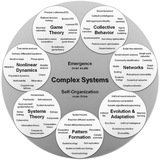
short course on Mathematics of Complex Social Systems" is in January 2021!
It will be online.
Awesome mathematicians and social/political scientists as speakers and panelists! (Feel free to reveal yourselves.)
More details in September: https://t.co/A4rXWVOWSU
It will be online.
Awesome mathematicians and social/political scientists as speakers and panelists! (Feel free to reveal yourselves.)
More details in September: https://t.co/A4rXWVOWSU
Forwarded from انجمن فیزیک ایران
✅ سخنرانی آقای دکتر هاتف صادقی در گرایش فیزیک محاسباتی
شورای اجرایی شاخه فیزیک محاسباتی انجمن فیزیک ایران، قرار است سلسله سخنرانیهایی را به صورت ماهانه و مجازی برای علاقهمندان به این رشته برگزار کند. آقای دکتر هاتف صادقی از دانشگاه وارویک انگلیس، نخستین سخنران این برنامه هستند و درباره Quantum and phonon interference in molecular scale junctions ...
📣 متن کامل را در Instant View ⚡️ (دکمه پایین صفحه) و یا در وبگاه انجمن فیزیک ایران بخوانید:
🚩http://www.psi.ir/news2_fa.asp?id=3085
⏪ وبگاه انجمن فیزیک ایران:
🌍 http://www.psi.ir
✅ به کانال خبرى انجمن فیزیک ايران بپيوندید:
👇👇🏽👇👇🏽👇👇🏽👇
http://t.me/psinews
شورای اجرایی شاخه فیزیک محاسباتی انجمن فیزیک ایران، قرار است سلسله سخنرانیهایی را به صورت ماهانه و مجازی برای علاقهمندان به این رشته برگزار کند. آقای دکتر هاتف صادقی از دانشگاه وارویک انگلیس، نخستین سخنران این برنامه هستند و درباره Quantum and phonon interference in molecular scale junctions ...
📣 متن کامل را در Instant View ⚡️ (دکمه پایین صفحه) و یا در وبگاه انجمن فیزیک ایران بخوانید:
🚩http://www.psi.ir/news2_fa.asp?id=3085
⏪ وبگاه انجمن فیزیک ایران:
🌍 http://www.psi.ir
✅ به کانال خبرى انجمن فیزیک ايران بپيوندید:
👇👇🏽👇👇🏽👇👇🏽👇
http://t.me/psinews
t.me
سخنرانی آقای دکتر هاتف صادقی در گرایش فیزیک محاسباتی
🎓 Mathematics for Machine Learning - Linear Algebra 🎓
These are some great bite-sized lessons to get familiar with and gain some intuition about linear algebra concepts for machine learning.
by Imperial College London
https://t.co/lNYLiMKLma
These are some great bite-sized lessons to get familiar with and gain some intuition about linear algebra concepts for machine learning.
by Imperial College London
https://t.co/lNYLiMKLma
💡 “To put it mildly, the competition seems absolutely insane to me, and seems to be exponentially increasing. Many top researchers claim they wouldn't have made it if the competition was like this when they started.”
https://t.co/Mucs68sKNc
https://t.co/Mucs68sKNc
reddit
[D] Is it still worth getting into machine learning research
I tried posting this in r/cscareerquestions but they crowd over there are largely not oriented with machine learning research, and this is a very...
Forwarded from Sci-Hub
aleta2018.pdf
5.1 MB
Aleta, A., & Moreno, Y. (2018). Multilayer Networks in a Nutshell. Annual Review of Condensed Matter Physics, 10(1). doi:10.1146/annurev-conmatphys-031218-013259
Sci-Hub
aleta2018.pdf
Complex systems are characterized by many interacting units that give rise to emergent behavior. A particularly advantageous way to study these systems is through the analysis of the networks that encode the interactions among the system constituents. During the past two decades, network science has provided many insights in natural, social, biological, and technological systems. However, real systems are often interconnected, with many interdependencies that are not properly captured by single-layer networks. To account for this source of complexity, a more general framework, in which different networks evolve or interact with each other, is needed. These are known as multilayer networks. Here, we provide an overview of the basic methodology used to describe multilayer systems as well as of some representative dynamical processes that take place on top of them. We round off the review with a summary of several applications in diverse fields of science.
Don’t miss this next #mtllectureseries on Wednesday: “Chemically Active Matter” presented by Ramin Golestanian from MPI for Dynamics and Self-Organization.
Registration under👇https://t.co/CMdSKLTieC
Registration under👇https://t.co/CMdSKLTieC
👉Why do people respond so differently?
👉What do we know about immunity and how long it might last?
👉Has the virus developed any worrying mutations?
👉How well will a vaccine work?
👉What's the origin of the virus?
https://t.co/n5d5DqUBat
👉What do we know about immunity and how long it might last?
👉Has the virus developed any worrying mutations?
👉How well will a vaccine work?
👉What's the origin of the virus?
https://t.co/n5d5DqUBat
Nature
Six months of coronavirus: the mysteries scientists are still racing to solve
Six months into the outbreak, Nature looks at the pressing questions that researchers are tackling.
https://mhpc.it/how-apply
Standard applications for the academic year 2020/2021 are now open!
Send your application: https://pica.cineca.it/sissa/sissa-ilas-mhpc-2020/
DEADLINE: July 10, 2020 - 11:59 AM
Standard applications for the academic year 2020/2021 are now open!
Send your application: https://pica.cineca.it/sissa/sissa-ilas-mhpc-2020/
DEADLINE: July 10, 2020 - 11:59 AM
"SIAM Conference on Applications of Dynamical Systems (DS21)": https://t.co/pgDv1M1nHM
SIAM News
SIAM Conference on Applications of Dynamical Systems (DS21)
This is the meeting of the SIAM Activity Group on Dynamical Systems.
The application of dynamical systems theory to areas outside of mathematics continues to be a vibrant, exciting, and fruitful endeavor. These application areas are diverse and multidisciplinary…
The application of dynamical systems theory to areas outside of mathematics continues to be a vibrant, exciting, and fruitful endeavor. These application areas are diverse and multidisciplinary…
💡 Now, researchers at DeepMind, a Google-owned artificial intelligence company, have used AI to study what’s happening to the molecules in glass as it hardens. DeepMind’s artificial neural network was able to predict how the molecules move over extremely long timescales, using only a “snapshot” of their physical arrangement at one moment in time. According to DeepMind’s Victor Bapst, even though the microscopic structure of a glass appears featureless, “the structure is maybe more predictive of the dynamics than people thought.”
https://www.quantamagazine.org/why-is-glass-rigid-signs-of-its-secret-structure-emerge-20200707/
https://www.quantamagazine.org/why-is-glass-rigid-signs-of-its-secret-structure-emerge-20200707/
Quanta Magazine
Why Is Glass Rigid? Signs of Its Secret Structure Emerge.
At the molecular level, glass looks like a liquid. But an artificial neural network has picked up on hidden structure in its molecules that may explain why glass is rigid like a solid.
Data science and the art of modelling
Hykel Hosni, Angelo Vulpiani
https://arxiv.org/abs/2007.04095
Datacentric enthusiasm is growing strong across a variety of domains. Whilst data science asks unquestionably exciting scientific questions, we argue that its contributions should not be extrapolated from the scientific context in which they originate. In particular we suggest that the simple-minded idea to the effect that data can be seen as a replacement for scientific modelling is not tenable. By recalling some well-known examples from dynamical systems we conclude that data science performs at its best when coupled with the subtle art of modelling
Hykel Hosni, Angelo Vulpiani
https://arxiv.org/abs/2007.04095
Datacentric enthusiasm is growing strong across a variety of domains. Whilst data science asks unquestionably exciting scientific questions, we argue that its contributions should not be extrapolated from the scientific context in which they originate. In particular we suggest that the simple-minded idea to the effect that data can be seen as a replacement for scientific modelling is not tenable. By recalling some well-known examples from dynamical systems we conclude that data science performs at its best when coupled with the subtle art of modelling
Fourth edition of "Machine Learning in Network Science"! Satellite @netsci2020. 19 Sept, 13-18 CET. Deadline for abstracts 31/07. All details here: https://t.co/gvpjL98I9g
I'll be teaching our intro to proofs class in the fall. This is where our students first learn LaTeX. I spent the last few days making this video for them, "A Quick Introduction to #LaTeX."
Here's a link to the video: https://t.co/4MgbqxHaU9.
The topics I cover are shown.
Here's a link to the video: https://t.co/4MgbqxHaU9.
The topics I cover are shown.
Forwarded from Sitpor.org سیتپـــــور
🦄 نوشتههایی برای ورود به گرایش فیزیک سیستمهای پیچیده:
🔸 پیچیدگی چیست؟
1️⃣ پروژه «پیچیدگی برای همه»
2️⃣ شرح پیچیدگی؛ دفترچهای برای توضیح مفهوم پیچیدگی بر اساس آرا صاحبنظران این حوزه
3️⃣ سیستمهای پیچیده: «ماهیت و ویژگی»
4️⃣ داستان پیچیدگی : «چرا بیشتر، متفاوت است؟»
🔹 یادگیری سیستمهای پیچیده به طور حرفهای
5️⃣ یادگیری سیستمهای پیچیده رو از کجا و چهطور شروع کنیم؟!
6️⃣ پیشنهادهایی برای دانشجویان تحصیلات تکمیلی سیستمهای پیچیده
7️⃣ لیست اساتید دانشگاه ایران که روی موضوع سیستمهای پیچیده کار میکنند
=======
@sitpor
🔸 پیچیدگی چیست؟
1️⃣ پروژه «پیچیدگی برای همه»
2️⃣ شرح پیچیدگی؛ دفترچهای برای توضیح مفهوم پیچیدگی بر اساس آرا صاحبنظران این حوزه
3️⃣ سیستمهای پیچیده: «ماهیت و ویژگی»
4️⃣ داستان پیچیدگی : «چرا بیشتر، متفاوت است؟»
🔹 یادگیری سیستمهای پیچیده به طور حرفهای
5️⃣ یادگیری سیستمهای پیچیده رو از کجا و چهطور شروع کنیم؟!
6️⃣ پیشنهادهایی برای دانشجویان تحصیلات تکمیلی سیستمهای پیچیده
7️⃣ لیست اساتید دانشگاه ایران که روی موضوع سیستمهای پیچیده کار میکنند
=======
@sitpor
Abstract: Thermodynamics provides a robust conceptual framework and set of laws that govern the exchange of energy and matter. Although these laws were originally articulated for macroscopic objects, nanoscale systems also exhibit “thermodynamic¬-like” behavior – for instance, biomolecular motors convert chemical fuel into mechanical work, and single molecules exhibit hysteresis when manipulated using optical tweezers. To what extent can the laws of thermodynamics be scaled down to apply to individual microscopic systems, and what new features emerge at the nanoscale? I will describe some of the challenges and recent progress – both theoretical and experimental – associated with addressing these questions. Along the way, my talk will touch on non-equilibrium fluctuations, “violations” of the second law, the thermodynamic arrow of time, nanoscale feedback control, strong system-environment coupling, and quantum thermodynamics.
The event is free and open to all, held on Zoom (pre-register)
The event is free and open to all, held on Zoom (pre-register)
Interesting new paper! Related questions about agency in/and/of networks has been gnawing at my side for years.
https://arxiv.org/abs/2007.05300
https://arxiv.org/abs/2007.05300