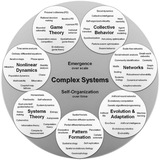
💰 We are looking for a #PhD student at the exciting frontier of collective behavior and #complexity science @CSHVienna
See attached flyer for some details https://t.co/r1N9BkcoFR.
Full details here: https://t.co/esLAwm1Imq.
See attached flyer for some details https://t.co/r1N9BkcoFR.
Full details here: https://t.co/esLAwm1Imq.
Forwarded from Complex Networks (SBU)
وبینار هفتگی دانشکده. امروز ۱۳ دی ساعت ۱۶:۳۰
*Complexity meets criticality*
سخنران: آقای دکتر افشین منتخب
دانشکده فیزیک، دانشگاه شیراز
میزبان: آقای دکتر جعفری
لینک وبینار: https://meet.google.com/pwg-otbe-gzm
*Complexity meets criticality*
سخنران: آقای دکتر افشین منتخب
دانشکده فیزیک، دانشگاه شیراز
میزبان: آقای دکتر جعفری
لینک وبینار: https://meet.google.com/pwg-otbe-gzm
🎞 Where does the statistics of complex systems come from? by Stefan Thurner
https://youtu.be/xsG0zdYAaIA
https://youtu.be/xsG0zdYAaIA
YouTube
Where does the statistics of complex systems come from? by Stefan Thurner
Program
Summer Research Program on Dynamics of Complex Systems
ORGANIZERS: Amit Apte, Soumitro Banerjee, Pranay Goel, Partha Guha, Neelima Gupte, Govindan Rangarajan and Somdatta Sinha
DATE : 15 May 2019 to 12 July 2019
VENUE : Madhava hall for…
Summer Research Program on Dynamics of Complex Systems
ORGANIZERS: Amit Apte, Soumitro Banerjee, Pranay Goel, Partha Guha, Neelima Gupte, Govindan Rangarajan and Somdatta Sinha
DATE : 15 May 2019 to 12 July 2019
VENUE : Madhava hall for…
🦠 Non-pharmaceutical interventions during the COVID-19 pandemic: a rapid review
Nicola Perra
Download PDF
Infectious diseases and human behavior are intertwined. On one side, our movements and interactions are the engines of transmission. On the other, the unfolding of viruses might induce changes to our daily activities. While intuitive, our understanding of such feedback loop is still limited. Before COVID-19 the literature on the subject was mainly theoretical and largely missed validation. The main issue was the lack of empirical data capturing behavioral change induced by diseases. Things have dramatically changed in 2020. Non-pharmaceutical interventions (NPIs) have been the key weapon against the SARS-CoV-2 virus and affected virtually any societal process. Travels bans, events cancellation, social distancing, curfews, and lockdowns have become unfortunately very familiar. The scale of the emergency, the ease of survey as well as crowdsourcing deployment guaranteed by the latest technology, several Data for Good programs developed by tech giants, major mobile phone providers, and other companies have allowed unprecedented access to data describing behavioral changes induced by the pandemic. Here, I aim to review some of the vast literature written on the subject of NPIs during the COVID-19 pandemic. In doing so, I analyze 347 articles written by more than 2518 of authors in the last 12 months. While the large majority of the sample was obtained by querying PubMed, it includes also a hand-curated list. Considering the focus, and methodology I have classified the sample into seven main categories: epidemic models, surveys, comments/perspectives, papers aiming to quantify the effects of NPIs, reviews, articles using data proxies to measure NPIs, and publicly available datasets describing NPIs. I summarize the methodology, data used, findings of the articles in each category and provide an outlook highlighting future challenges as well as opportunitie.
Nicola Perra
Download PDF
Infectious diseases and human behavior are intertwined. On one side, our movements and interactions are the engines of transmission. On the other, the unfolding of viruses might induce changes to our daily activities. While intuitive, our understanding of such feedback loop is still limited. Before COVID-19 the literature on the subject was mainly theoretical and largely missed validation. The main issue was the lack of empirical data capturing behavioral change induced by diseases. Things have dramatically changed in 2020. Non-pharmaceutical interventions (NPIs) have been the key weapon against the SARS-CoV-2 virus and affected virtually any societal process. Travels bans, events cancellation, social distancing, curfews, and lockdowns have become unfortunately very familiar. The scale of the emergency, the ease of survey as well as crowdsourcing deployment guaranteed by the latest technology, several Data for Good programs developed by tech giants, major mobile phone providers, and other companies have allowed unprecedented access to data describing behavioral changes induced by the pandemic. Here, I aim to review some of the vast literature written on the subject of NPIs during the COVID-19 pandemic. In doing so, I analyze 347 articles written by more than 2518 of authors in the last 12 months. While the large majority of the sample was obtained by querying PubMed, it includes also a hand-curated list. Considering the focus, and methodology I have classified the sample into seven main categories: epidemic models, surveys, comments/perspectives, papers aiming to quantify the effects of NPIs, reviews, articles using data proxies to measure NPIs, and publicly available datasets describing NPIs. I summarize the methodology, data used, findings of the articles in each category and provide an outlook highlighting future challenges as well as opportunitie.
The Dunning-Kruger effect IS real.
My thoughts, with simulations here https://t.co/OrxZqOjfvJ
#DunningKruger
My thoughts, with simulations here https://t.co/OrxZqOjfvJ
#DunningKruger
Medium
The Dunning-Kruger effect probably is real
The Dunning-Kruger effect refers to the idea that people with low ability levels overestimate their ability by a lot, and people with high…
Calling all young #physicists looking for a #postdoc position in the field of #CondensedMatter and #StatisticalPhysics! Come work with us: https://t.co/Tl9XFZSs7B
#workatICTP
#workatICTP
The Atlas for the Aspiring Network Scientist
Michele Coscia
Network science is the field dedicated to the investigation and analysis of complex systems via their representations as networks. We normally model such networks as graphs: sets of nodes connected by sets of edges and a number of node and edge attributes. This deceptively simple object is the starting point of never-ending complexity, due to its ability to represent almost every facet of reality: chemical interactions, protein pathways inside cells, neural connections inside the brain, scientific collaborations, financial relations, citations in art history, just to name a few examples. If we hope to make sense of complex networks, we need to master a large analytic toolbox: graph and probability theory, linear algebra, statistical physics, machine learning, combinatorics, and more.
https://arxiv.org/abs/2101.00863
Michele Coscia
Network science is the field dedicated to the investigation and analysis of complex systems via their representations as networks. We normally model such networks as graphs: sets of nodes connected by sets of edges and a number of node and edge attributes. This deceptively simple object is the starting point of never-ending complexity, due to its ability to represent almost every facet of reality: chemical interactions, protein pathways inside cells, neural connections inside the brain, scientific collaborations, financial relations, citations in art history, just to name a few examples. If we hope to make sense of complex networks, we need to master a large analytic toolbox: graph and probability theory, linear algebra, statistical physics, machine learning, combinatorics, and more.
https://arxiv.org/abs/2101.00863
Non-Linear Dynamics is back! Enroll today in our free online course and learn the mathematics and computational tools to study chaotic systems.
Instructor Liz Bradley، January 15th:
https://t.co/PNfk4femCn
#ChaosTheory #SystemsThinking #Math #MOOCs
Instructor Liz Bradley، January 15th:
https://t.co/PNfk4femCn
#ChaosTheory #SystemsThinking #Math #MOOCs
A Survey of Community Detection Approaches: From Statistical Modeling to Deep Learning.
https://arxiv.org/abs/2101.01669
https://arxiv.org/abs/2101.01669
Complex Systems Studies
The Atlas for the Aspiring Network Scientist Michele Coscia Network science is the field dedicated to the investigation and analysis of complex systems via their representations as networks. We normally model such networks as graphs: sets of nodes connected…
Blog post presenting my Atlas for the Aspiring Network Scientist: https://t.co/LNxrlHtE0m
Dear Computational Neuroscientists,
Please share the following event information with anyone who may be interested.
We at the Bernstein Center for Computational Neuroscience (BCCN) Berlin will hold a "Digital Info Day" to discuss our International Master & Doctoral Programs in Computational Neuroscience on Wednesday, January 27th, at 3pm (CET).
The event will consist of talks by:
Prof. Dr. Klaus Obermayer (head of the programs)
Lisa Velenosi (teaching coordinator)
Current master and doctoral students
Attendees will also have the opportunity to meet & discuss with current students and ask any questions or concerns that they may have.
See our website for a more detailed schedule and registration link.
Best regards and happy new year,
Lisa Velenosi
Please share the following event information with anyone who may be interested.
We at the Bernstein Center for Computational Neuroscience (BCCN) Berlin will hold a "Digital Info Day" to discuss our International Master & Doctoral Programs in Computational Neuroscience on Wednesday, January 27th, at 3pm (CET).
The event will consist of talks by:
Prof. Dr. Klaus Obermayer (head of the programs)
Lisa Velenosi (teaching coordinator)
Current master and doctoral students
Attendees will also have the opportunity to meet & discuss with current students and ask any questions or concerns that they may have.
See our website for a more detailed schedule and registration link.
Best regards and happy new year,
Lisa Velenosi
Curious about quantum computing and how it might be applied in biological research across different areas and scales? Check out this Comment from scientists with diverse backgrounds on the basic principles of quantum computing.
https://t.co/UiIrjZLDE0
https://t.co/UiIrjZLDE0
Artificial Intelligence may beat us in chess, but not in memory.
Out now in PhysRevLett
https://journals.aps.org/prl/abstract/10.1103/PhysRevLett.126.018301
Out now in PhysRevLett
https://journals.aps.org/prl/abstract/10.1103/PhysRevLett.126.018301
یک کلاس آمار جذاب از Richard McElreath.
ایشون رئیس مرکز انسانشناسی ماکس پلانکه.
Max Planck Institute for Evolutionary Anthropology
ویدیوها در یوتیوب و در آپارات:
🎞 https://www.aparat.com/playlist/765182
ایشون رئیس مرکز انسانشناسی ماکس پلانکه.
Max Planck Institute for Evolutionary Anthropology
ویدیوها در یوتیوب و در آپارات:
🎞 https://www.aparat.com/playlist/765182
Wikipedia
Richard McElreath
American anthropologist
One important addition to the discussion on networks
"True scale-free networks hidden by finite size effects"
https://t.co/QSi0W4KGyo
"True scale-free networks hidden by finite size effects"
https://t.co/QSi0W4KGyo
💰 36 fully funded (four years of tuition fee + an annual stipend of €18,500) structured #PhD positions in
Foundations of Data Science
in the only English speaking country of the EU (apart from Malta!)
Application deadline: 5 February
https://t.co/EAEoYtOidj
Foundations of Data Science
in the only English speaking country of the EU (apart from Malta!)
Application deadline: 5 February
https://t.co/EAEoYtOidj
💰 The ICT department is opening several #PhD and #PostDoc positions, see https://t.co/pt85Qt3GhF
This is not the US! Take a look:https://t.co/TBWhbE6Mzw
This is not the US! Take a look:https://t.co/TBWhbE6Mzw
Combinatorial approach to spreading processes on networks
Dario Mazzilli, Filippo Radicchi
https://arxiv.org/pdf/2101.02176
Stochastic spreading models defined on complex network topologies are used to mimic the diffusion of diseases, information, and opinions in real-world systems. Existing theoretical approaches to the characterization of the models in terms of microscopic configurations rely on some approximation of independence among dynamical variables, thus introducing a systematic bias in the prediction of the ground-truth dynamics. Here, we develop a combinatorial framework based on the approximation that spreading may occur only along the shortest paths connecting pairs of nodes. The approximation overestimates dynamical correlations among node states and leads to biased predictions. Systematic bias is, however, pointing in the opposite direction of existing approximations. We show that the combination of the two biased approaches generates predictions of the ground-truth dynamics that are more accurate than the ones given by the two approximations if used in isolation. We further take advantage of the combinatorial approximation to characterize theoretical properties of some inference problems, and show that the reconstruction of microscopic configurations is very sensitive to both the place where and the time when partial knowledge of the system is acquired.
Dario Mazzilli, Filippo Radicchi
https://arxiv.org/pdf/2101.02176
Stochastic spreading models defined on complex network topologies are used to mimic the diffusion of diseases, information, and opinions in real-world systems. Existing theoretical approaches to the characterization of the models in terms of microscopic configurations rely on some approximation of independence among dynamical variables, thus introducing a systematic bias in the prediction of the ground-truth dynamics. Here, we develop a combinatorial framework based on the approximation that spreading may occur only along the shortest paths connecting pairs of nodes. The approximation overestimates dynamical correlations among node states and leads to biased predictions. Systematic bias is, however, pointing in the opposite direction of existing approximations. We show that the combination of the two biased approaches generates predictions of the ground-truth dynamics that are more accurate than the ones given by the two approximations if used in isolation. We further take advantage of the combinatorial approximation to characterize theoretical properties of some inference problems, and show that the reconstruction of microscopic configurations is very sensitive to both the place where and the time when partial knowledge of the system is acquired.