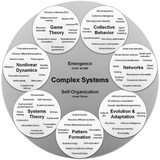
2020 is almost over, we can get ready for 2021! Apply now for the Spring College on the Physics of Complex Systems: https://t.co/eoXGuCUTdT
#ComplexSystems
#ComplexSystems
Unlocking US vaccine distribution
COVID vaccine distribution in the United States has been hobbled by a web of mismatched technology systems, inconsistent vaccine supplies, under-resourced states and a lack of coordination about getting shots to people once they arrive at local clinics. US President Joe Biden's administration has a goal of delivering 100 million doses in 100 days. To keep that promise, experts say the federal government will need to supply states with better resources and technology. “National coordination will be a game-changer,” says Hana Schank, from the think-tank New America
https://www.technologyreview.com/2021/01/27/1016790/covid-vaccine-distribution-us
COVID vaccine distribution in the United States has been hobbled by a web of mismatched technology systems, inconsistent vaccine supplies, under-resourced states and a lack of coordination about getting shots to people once they arrive at local clinics. US President Joe Biden's administration has a goal of delivering 100 million doses in 100 days. To keep that promise, experts say the federal government will need to supply states with better resources and technology. “National coordination will be a game-changer,” says Hana Schank, from the think-tank New America
https://www.technologyreview.com/2021/01/27/1016790/covid-vaccine-distribution-us
MIT Technology Review
This is how America gets its vaccines
The Biden administration has inherited a web of tech systems and policies that it must navigate to meet its goal of administering 100 million doses in the first 100 days.
Giraffes have a very familiar skin/fur pattern, but you probably never knew that there's more than one and that they are different on a regional and genetic basis [source, read more: https://buff.ly/2TLKoSr]
💉 Let’s talk about where variants ARE coming from and under what circumstances?
Ashish K. Jha, MD, MPH
Variants arise when infections run wild and selection pressures lead to dangerous mutations that can then thrive. Remember, every infection creates opportunities for “errors” – or mutations.
Most mutations are meaningless. They will have no real clinical implications. But every once in a while, a set of mutations will lead the virus to become more contagious, more lethal, or improve its ability to escape our vaccines
🦠 So where are the variants coming from?
UK , South Africa, Brazil –and possibly US (LA variant still being sorted out). Each of these countries had large outbreaks even before their variants took off. So what are implications if we ever want to end this pandemic? We have to bring pandemic under control
Letting virus run wild, like US, Brazil did, endangers everyone. Imagine this; Some nations are largely vaccinated but outbreaks are surging elsewhere. What might happen? We might see rise of variants that eventually escape the vaccines. And make everyone vulnerable again.
In a future where US is vaccinated but others are not, we could see rise of variants that can infect, cause outbreaks here and other vaccinated places requiring us to update our vaccines and vaccinate everyone again! It’s the nightmare scenario of a never-ending pandemic.
🦠 There is only one solution to put this nightmare pandemic behind us; Get outbreaks under control everywhere. How?
Put in place virus control policies, get people to wear high quality masks, have more testing AND Vaccinate the world NOW As quickly as possible.
This is what makes herd immunity advocates (remember Great Barrington Declaration?) so naive; They literally advocated for virus to have more chances to mutate and what makes U.S. isolationist policies so naive because we live on one planet and variants travel!
🦠 Want to end the pandemic?
Lets marshal global manufacturing effort to make lots of vaccine quickly and vaccinate everyone! Because large outbreaks anywhere can give rise to variants that can escape vaccines everywhere. At the end of the day, we really are in this together.
https://twitter.com/ashishkjha/status/1354995270619181056
Ashish K. Jha, MD, MPH
Variants arise when infections run wild and selection pressures lead to dangerous mutations that can then thrive. Remember, every infection creates opportunities for “errors” – or mutations.
Most mutations are meaningless. They will have no real clinical implications. But every once in a while, a set of mutations will lead the virus to become more contagious, more lethal, or improve its ability to escape our vaccines
🦠 So where are the variants coming from?
UK , South Africa, Brazil –and possibly US (LA variant still being sorted out). Each of these countries had large outbreaks even before their variants took off. So what are implications if we ever want to end this pandemic? We have to bring pandemic under control
everywhere.Letting virus run wild, like US, Brazil did, endangers everyone. Imagine this; Some nations are largely vaccinated but outbreaks are surging elsewhere. What might happen? We might see rise of variants that eventually escape the vaccines. And make everyone vulnerable again.
In a future where US is vaccinated but others are not, we could see rise of variants that can infect, cause outbreaks here and other vaccinated places requiring us to update our vaccines and vaccinate everyone again! It’s the nightmare scenario of a never-ending pandemic.
🦠 There is only one solution to put this nightmare pandemic behind us; Get outbreaks under control everywhere. How?
Put in place virus control policies, get people to wear high quality masks, have more testing AND Vaccinate the world NOW As quickly as possible.
This is what makes herd immunity advocates (remember Great Barrington Declaration?) so naive; They literally advocated for virus to have more chances to mutate and what makes U.S. isolationist policies so naive because we live on one planet and variants travel!
🦠 Want to end the pandemic?
Lets marshal global manufacturing effort to make lots of vaccine quickly and vaccinate everyone! Because large outbreaks anywhere can give rise to variants that can escape vaccines everywhere. At the end of the day, we really are in this together.
https://twitter.com/ashishkjha/status/1354995270619181056
Twitter
Ashish K. Jha, MD, MPH
This is what makes herd immunity advocates (remember Great Barrington Declaration?) so naive They literally advocated for virus to have more chances to mutate And what makes U.S. isolationist policies so naive Because we live on one planet And variants travel…
The Hard Lessons of Modeling the Coronavirus Pandemic
In the fight against COVID-19, disease modelers have struggled with misunderstanding and misuse of their work. They have also come to realize how unready the state of modeling was for this pandemic.
https://www.quantamagazine.org/the-hard-lessons-of-modeling-the-coronavirus-pandemic-20210128/
In the fight against COVID-19, disease modelers have struggled with misunderstanding and misuse of their work. They have also come to realize how unready the state of modeling was for this pandemic.
https://www.quantamagazine.org/the-hard-lessons-of-modeling-the-coronavirus-pandemic-20210128/
Percolation on complex networks: Theory and application
🔗 arxiv.org/abs/2101.11761
In the last two decades, network science has blossomed and influenced various fields, such as statistical physics, computer science, biology and sociology, from the perspective of the heterogeneous interaction patterns of components composing the complex systems. As a paradigm for random and semi-random connectivity, percolation model plays a key role in the development of network science and its applications. On the one hand, the concepts and analytical methods, such as the emergence of the giant cluster, the finite-size scaling, and the mean-field method, which are intimately related to the percolation theory, are employed to quantify and solve some core problems of networks. On the other hand, the insights into the percolation theory also facilitate the understanding of networked systems, such as robustness, epidemic spreading, vital node identification, and community detection. Meanwhile, network science also brings some new issues to the percolation theory itself, such as percolation of strong heterogeneous systems, topological transition of networks beyond pairwise interactions, and emergence of a giant cluster with mutual connections. So far, the percolation theory has already percolated into the researches of structure analysis and dynamic modeling in network science. Understanding the percolation theory should help the study of many fields in network science, including the still opening questions in the frontiers of networks, such as networks beyond pairwise interactions, temporal networks, and network of networks. The intention of this paper is to offer an overview of these applications, as well as the basic theory of percolation transition on network systems.
🔗 arxiv.org/abs/2101.11761
In the last two decades, network science has blossomed and influenced various fields, such as statistical physics, computer science, biology and sociology, from the perspective of the heterogeneous interaction patterns of components composing the complex systems. As a paradigm for random and semi-random connectivity, percolation model plays a key role in the development of network science and its applications. On the one hand, the concepts and analytical methods, such as the emergence of the giant cluster, the finite-size scaling, and the mean-field method, which are intimately related to the percolation theory, are employed to quantify and solve some core problems of networks. On the other hand, the insights into the percolation theory also facilitate the understanding of networked systems, such as robustness, epidemic spreading, vital node identification, and community detection. Meanwhile, network science also brings some new issues to the percolation theory itself, such as percolation of strong heterogeneous systems, topological transition of networks beyond pairwise interactions, and emergence of a giant cluster with mutual connections. So far, the percolation theory has already percolated into the researches of structure analysis and dynamic modeling in network science. Understanding the percolation theory should help the study of many fields in network science, including the still opening questions in the frontiers of networks, such as networks beyond pairwise interactions, temporal networks, and network of networks. The intention of this paper is to offer an overview of these applications, as well as the basic theory of percolation transition on network systems.
Perspective: Foundations of complexity economics. Brian Arthur sketches the ideas of complexity economics and describes how it links to complexity science more broadly.
https://t.co/XU2olGv5Mh
https://t.co/XU2olGv5Mh
You have until 𝘁𝗵𝗲 𝗲𝗻𝗱 𝗼𝗳 𝘁𝗼𝗱𝗮𝘆 (𝗖𝗘𝗧) to apply for priority applications (BA programs) or if you are applying for financial aid (most CEU programs).
Undergrad ➡️ https://t.co/bV5Ltp5ZhM
Graduate ➡️ https://t.co/qY4Cz7gh6f https://t.co/ioJ6lPAJm5
Undergrad ➡️ https://t.co/bV5Ltp5ZhM
Graduate ➡️ https://t.co/qY4Cz7gh6f https://t.co/ioJ6lPAJm5
Nokia BellLabs has open internship positions in:
1. Data Visualization
2. Mobile Sensing and Ubicomp
3. Machine Learning and Data Science
Application deadline is February 6th. More info on the team and on how to
apply can be found under https://t.co/pcHcbOthlS
1. Data Visualization
2. Mobile Sensing and Ubicomp
3. Machine Learning and Data Science
Application deadline is February 6th. More info on the team and on how to
apply can be found under https://t.co/pcHcbOthlS
Latest #coronavirus research:
👉 Scientists engineer an antibody that effectively disables SARS-CoV-2 and closely related coronaviruses.
👉 Death risk for essential workers 20–40% higher than expected.
👉 Moderna vaccine seems to work against new variants.
https://t.co/RLPGImM0P0
👉 Scientists engineer an antibody that effectively disables SARS-CoV-2 and closely related coronaviruses.
👉 Death risk for essential workers 20–40% higher than expected.
👉 Moderna vaccine seems to work against new variants.
https://t.co/RLPGImM0P0
Nature
COVID research updates: An antibody that clamps onto the COVID virus’s ‘Achilles heel’
A selection of the latest research on the new coronavirus.
Dynamic graphs are a big part of how Twitter does what it does. We use them to model networks that evolve over time. In this post @emaros96 & @mmbronstein discuss a new ML model developed by Twitter to efficiently predict activity in dynamic graphs.
https://t.co/BKk0BBTAk0
https://t.co/BKk0BBTAk0
Twitter
Deep learning on dynamic graphs
A new neural network architecture for dynamic graphs
document.pdf
354.5 KB
💉 نتایج واکسن اسپوتنیک روسی در Lancet منتشر شد. این واکسن ۹۱.۶٪ اثربخشی دارد و هیچ خطر جدی ندارد. #واکسن_روسی #اسپوتنیک
Safety and efficacy of an rAd26 and rAd5 vector-based heterologous prime-boost COVID-19 vaccine: an interim analysis of a randomised controlled phase 3 trial in Russia
Interpretation
This interim analysis of the phase 3 trial of Gam-COVID-Vac showed 91.6% efficacy against COVID-19 and was well tolerated in a large cohort.
https://www.thelancet.com/journals/lancet/article/PIIS0140-6736(21)00234-8/fulltext
Safety and efficacy of an rAd26 and rAd5 vector-based heterologous prime-boost COVID-19 vaccine: an interim analysis of a randomised controlled phase 3 trial in Russia
Interpretation
This interim analysis of the phase 3 trial of Gam-COVID-Vac showed 91.6% efficacy against COVID-19 and was well tolerated in a large cohort.
https://www.thelancet.com/journals/lancet/article/PIIS0140-6736(21)00234-8/fulltext
Coronavirus is in the air — there’s too much focus on surfaces
Catching the coronavirus from surfaces is rare. The World Health Organization and national public-health agencies need to clarify their advice.
https://www.nature.com/articles/d41586-021-00277-8
Catching the coronavirus from surfaces is rare. The World Health Organization and national public-health agencies need to clarify their advice.
https://www.nature.com/articles/d41586-021-00277-8
Nature
Coronavirus is in the air — there’s too much focus on surfaces
Nature - Catching the coronavirus from surfaces is rare. The World Health Organization and national public-health agencies need to clarify their advice.
Foundations of Temporal Text Networks
Davide Vega & Matteo Magnani
https://appliednetsci.springeropen.com/articles/10.1007/s41109-018-0082-3
Abstract
Three fundamental elements to understand human information networks are the individuals (actors) in the network, the information they exchange, that is often observable online as text content (emails, social media posts, etc.), and the time when these exchanges happen. An extremely large amount of research has addressed some of these aspects either in isolation or as combinations of two of them. There are also more and more works studying systems where all three elements are present, but typically using ad hoc models and algorithms that cannot be easily transfered to other contexts. To address this heterogeneity, in this article we present a simple, expressive and extensible model for temporal text networks, that we claim can be used as a common ground across different types of networks and analysis tasks, and we show how simple procedures to produce views of the model allow the direct application of analysis methods already developed in other domains, from traditional data mining to multilayer network mining.
Davide Vega & Matteo Magnani
https://appliednetsci.springeropen.com/articles/10.1007/s41109-018-0082-3
Abstract
Three fundamental elements to understand human information networks are the individuals (actors) in the network, the information they exchange, that is often observable online as text content (emails, social media posts, etc.), and the time when these exchanges happen. An extremely large amount of research has addressed some of these aspects either in isolation or as combinations of two of them. There are also more and more works studying systems where all three elements are present, but typically using ad hoc models and algorithms that cannot be easily transfered to other contexts. To address this heterogeneity, in this article we present a simple, expressive and extensible model for temporal text networks, that we claim can be used as a common ground across different types of networks and analysis tasks, and we show how simple procedures to produce views of the model allow the direct application of analysis methods already developed in other domains, from traditional data mining to multilayer network mining.
SpringerOpen
Foundations of Temporal Text Networks - Applied Network Science
Three fundamental elements to understand human information networks are the individuals (actors) in the network, the information they exchange, that is often observable online as text content (emails, social media posts, etc.), and the time when these exchanges…
💉 VACCINE UPDATE:
New study shows that the #OxfordVaccine offers protection of 76% up to 12 weeks after a single dose, with further data supporting a 4-12 week dosing interval.
Further analysis also shows that the #OxfordVaccine may have a substantial effect on coronavirus transmission, with 67% reduction in positive PCR swabs among those who have been vaccinated: https://t.co/7aZAWgFqQH
New study shows that the #OxfordVaccine offers protection of 76% up to 12 weeks after a single dose, with further data supporting a 4-12 week dosing interval.
Further analysis also shows that the #OxfordVaccine may have a substantial effect on coronavirus transmission, with 67% reduction in positive PCR swabs among those who have been vaccinated: https://t.co/7aZAWgFqQH
www.ox.ac.uk
Oxford coronavirus vaccine shows sustained protection of 76% during the 3-month interval until the second dose | University of…
Analyses reveal single standard dose efficacy from day 22 to day 90 post vaccination of 76% with protection not falling in this three-month periodAfter the second dose vaccine efficacy from two standard doses is 82.4% with the 3-month interval being used…
Two very particular patterns of random movement — Brownian motion and Lévy walks — describe a great many physical phenomena. Recent data hint that Lévy walks may be a default movement pattern for many animal species. https://t.co/U6xAh3Qw2F
Network motifs involving both competition and facilitation predict biodiversity in alpine plant communities [Ecology] https://t.co/ovDA3r1gKU
Updates on Networks 2021: A Joint Sunbelt and NetSci Conference: a thread.
First: the deadline for submissions for #Networks2021 has been extended until Feb 17 at noon EST. Those who have already submitted may continue to edit until that time. https://t.co/TmXcZa8tY4
if you want to sign up for our announcement newsletter list, please visit: https://t.co/NqLHWgKW2O
First: the deadline for submissions for #Networks2021 has been extended until Feb 17 at noon EST. Those who have already submitted may continue to edit until that time. https://t.co/TmXcZa8tY4
if you want to sign up for our announcement newsletter list, please visit: https://t.co/NqLHWgKW2O
💰Open #postdoc positions to work on covid-19 modeling with @vcolizza and @alainbarrat, starting April 2021. We look for enthusiastic young researchers with expertise in network science, epidemic modelling, numerical simulations. To apply, please send us CV and motivation letter.
More info on https://t.co/qhOjjC5VMH and https://t.co/ZThkPdaewK
More info on https://t.co/qhOjjC5VMH and https://t.co/ZThkPdaewK
Forwarded from Complex Networks (SBU)
اگر در این سخنرانی حضور داشتهاید و مشتاق هستید که بیشتر بدانید، این مقاله را ببینید:
Five reasons why researchers should learn to love the command line
The text interface is intimidating, but can save researchers from mundane computing tasks. Just be sure you know what you’re doing.
https://www.nature.com/articles/d41586-021-00263-0
Five reasons why researchers should learn to love the command line
The text interface is intimidating, but can save researchers from mundane computing tasks. Just be sure you know what you’re doing.
https://www.nature.com/articles/d41586-021-00263-0
Telegram
CCNSD
#سمینارهای_هفتگی
«پردازش داده بدون تلاش اضافه!»
🗣 حسین نادری - مهندس داده
میراث
🗣 امید مومنزاده - توسعهدهنده نرمافزار
میراث
⏰ دوشنبه، ۲۰ خرداد ساعت ۱۶:۰۰
🏛 محل برگزاری: سالن ابنهیثم
~~~~~~~~~~~~~~~~
⭕️ مشتاق دیدار همه اقشار جامعه در مرکز هستیم.…
«پردازش داده بدون تلاش اضافه!»
🗣 حسین نادری - مهندس داده
میراث
🗣 امید مومنزاده - توسعهدهنده نرمافزار
میراث
⏰ دوشنبه، ۲۰ خرداد ساعت ۱۶:۰۰
🏛 محل برگزاری: سالن ابنهیثم
~~~~~~~~~~~~~~~~
⭕️ مشتاق دیدار همه اقشار جامعه در مرکز هستیم.…