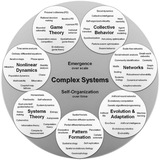
Complex Systems Studies
Systems Biology at MIT This course provides an introduction to cellular and population-level systems biology with an emphasis on synthetic biology, modeling of genetic networks, cell-cell interactions, and evolutionary dynamics. Cellular systems include genetic…
Media is too big
VIEW IN TELEGRAM
Stochastic Modeling
In this lecture, Prof. Jeff Gore discusses modeling stochastic systems. The discussion of the master equation continues from last lecture. Then he talks about the Gillespie algorithm, an exact way to simulate stochastic systems. He then moves on to the Fokker-Planck equation.
- Master Equation and Fokker Plank Equation (PDF), by Alexander van Oudenaarden.
🎞 aparat.com/v/5C4uR
🎞 youtu.be/EXBO08-78IU
In this lecture, Prof. Jeff Gore discusses modeling stochastic systems. The discussion of the master equation continues from last lecture. Then he talks about the Gillespie algorithm, an exact way to simulate stochastic systems. He then moves on to the Fokker-Planck equation.
- Master Equation and Fokker Plank Equation (PDF), by Alexander van Oudenaarden.
🎞 aparat.com/v/5C4uR
🎞 youtu.be/EXBO08-78IU
Code.org (@codeorg) Tweeted:
Upon learning about Jeffrey Ullman’s discriminatory comments, we join computer scientists from around the world to call on the ACM to revisit its criteria for granting Ullman the $1M Turing Award. https://t.co/G6bHeyB7MM https://twitter.com/codeorg/status/1381734032933744643?s=20
Upon learning about Jeffrey Ullman’s discriminatory comments, we join computer scientists from around the world to call on the ACM to revisit its criteria for granting Ullman the $1M Turing Award. https://t.co/G6bHeyB7MM https://twitter.com/codeorg/status/1381734032933744643?s=20
Medium
Statement: Professor Jeffrey Ullman’s discriminatory comments against students
We believe the ACM can do more and revisit its decision to bestow Ullman its highest award.
💰 Are you open to multi-disciplinary analysis? Do you have a PhD in CS, physics, sociology or psychology? Here you have an awesome #Postdoc Research Fellowship Position to analyse human behaviour during the COVID-19 pandemic https://t.co/sER0LizwId
The Master in High Performance Computing @mhpc_sissa_ictp, coordinated by ICTP and @Sissaschool is now accepting applications for the new academic year!
ICTP is providing scholarships for applicants from developing countries ➡️ deadline: 30 April 2021
🔸 https://t.co/id88kdXYyJ https://t.co/5nGk7DDgJI
ICTP is providing scholarships for applicants from developing countries ➡️ deadline: 30 April 2021
🔸 https://t.co/id88kdXYyJ https://t.co/5nGk7DDgJI
India, one of the world’s biggest suppliers of vaccines, is facing a COVID-19 vaccine crunch, partly due to an explosion of cases linked to new variants. This spells trouble for many countries relying on Indian-made vaccines: https://t.co/nQideBL3HU
اگه دوست دارید در مورد تجربه ما در سه حوزه پردازش زبان طبیعی، فینتک و ریکامندیشن سیستمها بیشتر بدونید:
https://www.instagram.com/p/CNxnl6FAQKH/?igshid=145e6plx4036f
https://www.instagram.com/p/CNxnl6FAQKH/?igshid=145e6plx4036f
New year, new Data Stories exhibition @ceu! Submit your awesome research/data visualizations! Fantastic opportunity to showcase your most important findings, reveal a novel perspective on an old problem, connect dots that haven't been connected before: https://t.co/X7e9VcM3Kk
This course on Covid-19 transmission from MIT by a physics professor is released today and seems quite remarkable.
https://t.co/skFSeaiEBJ
https://t.co/skFSeaiEBJ
MIT OpenCourseWare
Physics of COVID-19 Transmission
This resource is a collection of videos taught using a LightBoard, a specialized glass that creates a transparent white board. It teaches scientific principles to quantitatively assess the risk of airborne transmission of COVID-19 in indoor spaces based on…
ICTP's Quantitative Life Sciences section seeks applications from students interested in a #PhD scholarship to study olfactory search in a turbulent environment.
The application deadline is 15 June, with a starting date of 1 November 2021.
More info: https://t.co/0qAlM88Ujz https://t.co/xnWW4h6qWh
The application deadline is 15 June, with a starting date of 1 November 2021.
More info: https://t.co/0qAlM88Ujz https://t.co/xnWW4h6qWh
Looking for a #PhD-Position in #QuantumPhysics with a Focus on #TensorNetworks? 👩🎓👨🎓 Then join our "Quantum Information and Quantum Many-Body Physics"-Research Group, led by Norbert Schuch! ✨ Info on how to apply is available at https://t.co/CIT9g7iITB
Do you want to enter the exciting world of #ComplexSystems? 🔍
📣Pre-registration open!
IFISC offers mobility fellowships to study the IFISC Master in Physics of #ComplexSystems, one of them is sponsored by @F_Sicomoro
ℹ https://t.co/d629pXL8oS
📣Pre-registration open!
IFISC offers mobility fellowships to study the IFISC Master in Physics of #ComplexSystems, one of them is sponsored by @F_Sicomoro
ℹ https://t.co/d629pXL8oS
ifisc.uib-csic.es
Master in Physics of Complex Systems | Fellowships
Master in Physics of Complex Systems.
Official degree offered by the University of the Balearic Islands (UIB)
in collaboration with the Spanish National Research Council (CSIC)
Official degree offered by the University of the Balearic Islands (UIB)
in collaboration with the Spanish National Research Council (CSIC)
New paper from Duncan J Watts: Theories of organizations are sympathetic to long-standing ideas from network science that organizational networks should be regarded as multiscale and capable of displaying emergent properties. However, the historical difficulty of collecting individual- level network data for many (N ≫ 1) organizations, each of which comprises many (n ≫ 1) individuals, has hobbled efforts to develop specific, theoretically motivated hypotheses connecting micro- (i.e., individual-level) network structure with macro-organizational properties. In this paper we seek to stimulate such efforts with an exploratory analysis of a unique data set of aggregated, anonymized email data from an enterprise email system that includes 1.8 billion messages sent by 1.4 million users from 65 publicly traded U.S. firms spanning a wide range of sizes and 7 industrial sectors. We uncover wide hetero- geneity among firms with respect to all measured network characteristics, and we find robust network and organizational variation as a result of size. Interestingly, we find no clear associations between organizational network structure and firm age, industry, or performance; however, we do find that centralization increases with geographical dispersion—a result that is not explained by network size. Although preliminary, these results raise new questions for organizational theory as well as new issues for collecting, processing, and interpreting digital network data.
Coming up soon: a mooc to learn machine learning in Python with #scikit_learn
https://t.co/mkf8g2x44x
8 weeks, 4.5Hrs/wk, from zero to hero in machine learning: from knowing only basic Python to understanding ML
https://t.co/mkf8g2x44x
8 weeks, 4.5Hrs/wk, from zero to hero in machine learning: from knowing only basic Python to understanding ML
FUN MOOC
Machine learning in Python with scikit-learn
Build predictive models with scikit-learn and gain a practical understanding of the strengths and limitations of machine learning!
درس فیزیک دستگاههای پیچیده
دکتر سامان مقیمی - دانشکده فیزیک، دانشگاه صنعتی شریف
https://www.aparat.com/playlist/838442
دکتر سامان مقیمی - دانشکده فیزیک، دانشگاه صنعتی شریف
https://www.aparat.com/playlist/838442
👍 The 2nd edition of 'The Hitchhiker's Guide to #CondensedMatter and #StatisticalPhysics: Topological Phenomena in Condensed Matter', an ICTP Virtual School, will be held (virtually) on 6th, 13th, 20th May and 3rd June 2021.
Register here by 30 April: https://t.co/yZmES8AvTw
Register here by 30 April: https://t.co/yZmES8AvTw
📺 Opinion Dynamics on Networks: http://video.albanova.se/ALBANOVA20210422/video.mp4
I survey three different types of opinion models (with examples of each from my work): threshold models, voter models, and bounded-confidence models.
I survey three different types of opinion models (with examples of each from my work): threshold models, voter models, and bounded-confidence models.
📺 Computational Epidemiology at the time of COVID-19 by @alexvespi https://t.co/UwPUhsCuzL https://t.co/1EslXAl3Xy
YouTube
Computational Epidemiology at the time of COVID-19 by Alessandro Vespignani. Northeastern University
Colloquium Virtual Complexity at C3-UNAM
Universities for Science Consortium
"Computational Epidemiology at the time of COVID-19"
Alessandro Vespignani
Network Science Institute at Northeastern University
Abstract:
The data science revolution is finally…
Universities for Science Consortium
"Computational Epidemiology at the time of COVID-19"
Alessandro Vespignani
Network Science Institute at Northeastern University
Abstract:
The data science revolution is finally…