"In 1969 he lectured at Oxford. He (Dumitru Stăniloae) went to the Vatican as a member of the B.O.R. (The Burning Bush Organization) delegation in 1971. During this period he published in The Voice of the Fatherland, the propaganda organ of the communist regime for Romanians abroad. One of his articles denounced Constantine Virgil Gheorghiu as a legionnaire and member of the Iron-Guard. He also wrote a number of publications in which he reiterated and developed criticism of the Uniate Church."
Modern Orthodox Theology, by Paul Ladouceur👍1
Two articles on Symeon The "New Theologian"s innovative trinitarianism" (even by Byzantine standards). EOs would re-interpret it by saying that proceeding from the essence, means proceeding by means of natural energy which would equate to the ever vague "Energetic Procession".
https://www.academia.edu/34952708/_The_Procession_of_the_Holy_Spirit_from_the_Divine_Substance_Observations_about_the_Trinitarian_Theology_of_Symeon_the_New_Theologian_and_Nicetas_Stethatos_Greek_Orthodox_Theological_Review_60_2015_75_91
https://www.academia.edu/10614527/_Reconfiguring_the_Trinity_Symeon_the_New_Theologian_the_Holy_Spirit_and_the_Imago_Trinitatis_Byzantion_81_2011_212_236
https://www.academia.edu/34952708/_The_Procession_of_the_Holy_Spirit_from_the_Divine_Substance_Observations_about_the_Trinitarian_Theology_of_Symeon_the_New_Theologian_and_Nicetas_Stethatos_Greek_Orthodox_Theological_Review_60_2015_75_91
https://www.academia.edu/10614527/_Reconfiguring_the_Trinity_Symeon_the_New_Theologian_the_Holy_Spirit_and_the_Imago_Trinitatis_Byzantion_81_2011_212_236
www.academia.edu
‘The Procession of the Holy Spirit from the Divine Substance: Observations about the Trinitarian Theology of Symeon the New Theologian…
The debate about the procession of the Holy Spirit, which began in the ninth century and became more intense from the eleventh century onwards, has often been seen as a clash between two monolithic blocks. It is said that unlike their Latin
👍2❤1
This media is not supported in your browser
VIEW IN TELEGRAM
EOs: “We don’t venerate statues”
“You can’t venerate a statue”
“Statues are outside so they won’t be venerated”
Metropolitan Agafangel of Odessa:
“You can’t venerate a statue”
“Statues are outside so they won’t be venerated”
Metropolitan Agafangel of Odessa:
🤔12👍6❤1
"Filaret’s mysticism was reflection both of the fashion of the day (in the early years, he read Eckartshausen and Swedenborg, both popular with many members of the Holy Synod) and of the development of his own mystical theology, which appeared in his sermons. His October 1, 1812, homily delivered on the opening of Golitsyn’s house church noted the beauty of the chief procurator’s chapel but emphasized the greater importance of the “invisible temple” and the “inner temple” that must be consecrated in the hearts of the renewed. In his Christmas 1812 sermon, he explained the importance of experiencing a spiritual “rebirth [vozrozhdenie].” The Pietist keyword of rebirth ("Wiedergeburt") and renewal are notable in this sermon; however, there were also mystical references. The preacher spoke of the invisible “mystical gates” of the soul and the cleansing of the “inner body” by the Spirit (as opposed to the external body that is cleansed by water), and he reflected on accepting revelation from esoteric non-Orthodox sources (a reference to Jung-Stilling?) that come from “enlightened spirits who, similar to transparent objects, receive and transmit light but do not feel that light themselves.” Filaret also spoke of the “inner Kingdom,” the “inner church,” and “the mystery of your own personal Bethlehem,” seeing mystical meanings in familiar biblical story lines. His close relationship with Golitsyn and with the culture of the "Awakening" in the capital had strong critics."
- A Spiritual Revolution: The Impact of Reformation & Enlightenment in Orthodox Russia
By Andrey V. Ivanov
- A Spiritual Revolution: The Impact of Reformation & Enlightenment in Orthodox Russia
By Andrey V. Ivanov
👍1
"Fotii said the following about Filaret: "He was the chief culprit of all disruption during the days of Prince Golitsyn. He was a friend and ally of Koshelev and Labzin, as well as of all overt and covert enemies of the faith and church. No one could stop his audacity, for he was well-connected to the powers that be...Filaret’s influence extended to all in positions of authority, nobility and others followed his will...Wherever I attempted to destroy a conventicle of wickedness [sborishche zlochestiia], I found Filaret there." As was the fashion during the Awakening, Filaret’s views were also very ecumenical. In his 1815 work, "Conversations between a Doubter and a Believer about the Orthodoxy of the Greco-Russian Church", Filaret addressed the question of the exclusivity of the Eastern Orthodox Church in relation to other confessions and to Roman Catholicism in particular. In this work, Filaret argued that anyone believing in the Nicene Creed, the Trinity, and the Incarnation was a Christian and a member of the mystical Church, “since all Christian Churches accept the Eastern Creed as the truth.” In a very ecumenical fashion, Filaret referred to “Churches [Tserkvi],” not “the Church” (with the capital Ts), and inserted the following conversation on the specific issue of difference between the Roman and Eastern communions. Filaret’s sublime thoughts on the inclusivity and compatibility of Christian confessions were not limited to Catholicism. According to his close friend, Nikolai Sushkov, Filaret held the view that “everyone baptized in the name of Holy Trinity is a Christian, no matter what denomination,” until the last days of his life."
- Ibid
- Ibid
❤4
"From his episcopal pulpit, Filaret preached that the law should never allow one man to become an instrument of another, that only exchange of services between men is permitted. He used to say this in a country where half of the population were slaves.As an example of his (relatively) progressive preaching, Herzen recalled Filaret’s work in the convicts’ transit center on Sparrow Hills in Moscow, where he preached repentance and spiritual renewal to those who were about to be sent to Siberia. In commenting on the story of the crucified Christ and the thief on the cross, he comforted them with the idea that “a new life” awaited them in heaven, while “the greater criminals,” found among the officials who condemned them, would surely be doomed to eternal damnation. Much like among the Quakers or the Wesleyans in the West, the message of religious Awakening also had strong social implications for Filaret. When Filaret was a seminarian in Moscow, around 1800, his study of biblical texts was guided by the Pietist hermeneutics of Johann Jacob Rambach and the Dutch Reformed historicist exegetics of Campegius Vitringa. Protestant philologists such as him were popular in other Orthodox seminaries as well."
- Ibid
- Ibid
❤4
"They both were monastic brothers, but Fr. Seraphim put himself under the obedience of Herman, for his humility sake. Yet, both confessed their sins to each other."
"Fr. Seraphim suffered because he knew of at least some of the secret sins of his brother, but....he refused to condemn or judge Herman, and he kept silence, publically."
https://josephsciambra.com/fr-seraphim-of-platina-the-life-and-death-of-the-unlikeliest-russian-orthodox-monk/
http://readerdanielsharing.blogspot.com/2014/07/death-of-fr-herman-podmoshensky.html
"Fr. Seraphim suffered because he knew of at least some of the secret sins of his brother, but....he refused to condemn or judge Herman, and he kept silence, publically."
https://josephsciambra.com/fr-seraphim-of-platina-the-life-and-death-of-the-unlikeliest-russian-orthodox-monk/
http://readerdanielsharing.blogspot.com/2014/07/death-of-fr-herman-podmoshensky.html
Joseph Sciambra | Sons of St. Joseph
Fr. Seraphim of Platina: The Life and Death of the Unlikeliest Russian Orthodox Monk | Joseph Sciambra
“He who does not live in Christ…already lives in the Abyss, and not all the treasures of this world can ever fill his emptiness.” – Fr. Seraphim Rose, "Nihilism: The Root of Revolution of the Modern World" In late-August of 1982, a Russian Orthodox monk lay…
"However, it is not for us to define the state of those who are outside the Orthodox Church. If God wishes to grant salvation to some who are Christians in the best way they know, but without ever knowing the Orthodox Church—that is up to Him, not us. But when He does this, it is outside the normal way that He established for salvation—which is in the Church, as a part of the Body of Christ. I myself can accept the experience of Protestants being ‘born-again’ in Christ; I have met people who have changed their lives entirely through meeting Christ, and I cannot deny their experience just because they are not Orthodox. I call these people “subjective” or “beginning” Christians." - Rose
https://classicalchristianity.com/2011/12/26/three-perspectives-on-the-heterodox/
https://classicalchristianity.com/2011/12/26/three-perspectives-on-the-heterodox/
👍1
"And it is also true that since angels and souls are limited in space…, they must always be in one definite place – whether heaven, hell, or earth." - Rose
https://classicalchristianity.com/2013/11/01/on-the-location-of-heaven-and-hell/
https://classicalchristianity.com/2013/11/01/on-the-location-of-heaven-and-hell/
"There are some who look at our Orthodox Church and say, “It’s impossible for people to find truth there. You say you don’t believe in any one pope or bishop, and thus there is no guarantee; you don’t believe in the Scriptures like a Protestant might and say that they are the absolutely ‘infallible’ word. If you have a controversy, where is the final word?” And we say that the Holy Spirit will reveal Himself. This happens especially when bishops come together in council, but even then there can be a false council. One might then say, “There’s no hope!” But we say that the Holy Spirit guides the Church, and therefore He will not be false to the Church. If you haven’t got the feeling that this is so, then you devise things like making the Bible infallible, making the Pope infallible. Also, you make Orthodox things – as the Roman Catholics did – into some kind of “law”, so that everything is nicely defined: if you break this law you go your confessor, get such-and-such a penance, and you’re all “set” again. Orthodoxy does not believe; from this came the whole idea of indulgences, which is a totally legalistic perversion of the idea of repentance. If you repent, like the thief on the cross, you can be saved at that moment." - Rose
https://classicalchristianity.com/2011/12/16/on-orthodoxroman-catholic-differences/
https://classicalchristianity.com/2011/12/16/on-orthodoxroman-catholic-differences/
CONTRA ERRORES GRAECORUM
AGAINST THE ERRORS OF THE GREEKS
Latin: https://www.corpusthomisticum.org/oce.html
English: https://isidore.co/aquinas/english/ContraErrGraecorum.htm
AGAINST THE ERRORS OF THE GREEKS
Latin: https://www.corpusthomisticum.org/oce.html
English: https://isidore.co/aquinas/english/ContraErrGraecorum.htm
❤5😁3❤🔥2
Forwarded from Ghost of de Maistre
"As for the Greek claim that the concept of double procession resulted in the error of two ultimate principles in the Godhead, Anselm could respond that just as the creation of the world by all three persons does not result in a theory of three ultimate principles, so does the procession of the Spirit from the Father and the Son not result in a theory of two principles: for the three persons create as one God, and the Father and the Son are one God in the procession of the Spirit."
- 𝑹𝒊𝒄𝒉𝒂𝒓𝒅 𝑴𝒖𝒍𝒍𝒆𝒓, 𝑷𝑹𝑹𝑫 𝑽𝒐𝒍 𝑭𝒐𝒖𝒓, 𝑶𝒏 𝒕𝒉𝒆 𝑻𝒓𝒊𝒏𝒊𝒕𝒚
- 𝑹𝒊𝒄𝒉𝒂𝒓𝒅 𝑴𝒖𝒍𝒍𝒆𝒓, 𝑷𝑹𝑹𝑫 𝑽𝒐𝒍 𝑭𝒐𝒖𝒓, 𝑶𝒏 𝒕𝒉𝒆 𝑻𝒓𝒊𝒏𝒊𝒕𝒚
❤9😁2👍1
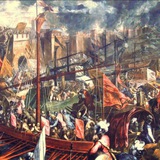
"This peace, however, was but of short duration, for the Greeks, on their return home, again fell back into their former errors, principally at the instigation ofthe wicked Mark of Ephesus. The chastisement of God soon overtook that fickle people; in 1453, Mahomet II. took Constantinople by assault, and gave it up to sack and slaughter; the infuriated soldiery slew all who came in their way, cast down the altars, profaned the monasteries, and despoiled the wretched inhabitants of all their property. Thus fell the empire of the East, after eleven centuries of a glorious existence. The Greeks continue, to the present day, obstinately attached to their errors; they are the slaves of the Turks in their ancient capital. That noble Church that gave to the world, Athanasius, Gregory, Basil, and so many other learned and holy Doctors, now lies trampled under foot, vice usurping the place of virtue, and ignorance seated in the chair of learning. The Greek Church, in a word, the Mother of many Saints and Doctors of the Church, has, on account of its separation from the Roman See, fallen into a state of deplorable barbarity and wretched slavery" - St. Alphonsus Liguori, "Against Heresies"
❤4🔥2👍1😁1
"Peter’s ecclesiastical policy was inspired above all by his determination to insure that the
Russian Church could no more attempt to place itself above the state, as Nikon had sought to do. Peter subordinated the church to the state. After the death of Patriarch Adrian in 1700, Peter refused to allow the appointment of a successor and in 1721 he issued a decree known as the Spiritual Regulation. This abolished the patriarchate and set up in its place a commission, the Spiritual College or Holy Synod, composed of twelve members, three of whom were bishops, and the rest drawn from the heads of monasteries or from the married clergy. The constitution of the Synod had no precedence in Orthodoxy and was not based on Orthodox canon law, but was copied from Protestant ecclesiastical synods in Germany. Its members were not chosen by the church but appointed by the emperor, who could dismiss them. A government official, the Chief Procurator, was the link between the government and the Holy Synod. Although not formally a member of the Synod, the Chief Procurator was a sort of ‘executive secretary’ who was responsible for the agenda of the Synod and conveyed its decisions to the emperor for his approval. In practice the Procurator wielded considerable power over church affairs and was in effect a ‘minister of religious affairs’. Peter’s reforms ended the uneasy balance of authority that had previously existed between patriarch and tsar, suppressing ecclesiastical criticism of the ruler and state policy and transforming the church into a department of the imperial administration, a ‘ministry of religion’."
Russian Church could no more attempt to place itself above the state, as Nikon had sought to do. Peter subordinated the church to the state. After the death of Patriarch Adrian in 1700, Peter refused to allow the appointment of a successor and in 1721 he issued a decree known as the Spiritual Regulation. This abolished the patriarchate and set up in its place a commission, the Spiritual College or Holy Synod, composed of twelve members, three of whom were bishops, and the rest drawn from the heads of monasteries or from the married clergy. The constitution of the Synod had no precedence in Orthodoxy and was not based on Orthodox canon law, but was copied from Protestant ecclesiastical synods in Germany. Its members were not chosen by the church but appointed by the emperor, who could dismiss them. A government official, the Chief Procurator, was the link between the government and the Holy Synod. Although not formally a member of the Synod, the Chief Procurator was a sort of ‘executive secretary’ who was responsible for the agenda of the Synod and conveyed its decisions to the emperor for his approval. In practice the Procurator wielded considerable power over church affairs and was in effect a ‘minister of religious affairs’. Peter’s reforms ended the uneasy balance of authority that had previously existed between patriarch and tsar, suppressing ecclesiastical criticism of the ruler and state policy and transforming the church into a department of the imperial administration, a ‘ministry of religion’."
Modern Orthodox Theology, by Paul Ladouceur
👍3