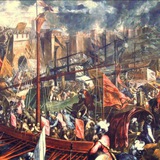
“An Anonymous Saint from the Gerontikon – a monk or a monastic from the Gerontikon, because he could not get himself to weep for his sins, would make a whip out of a rope and would beat himself so hard that he would weep from the pain. The brother who lived near him marveled at what this brother was doing and besought God to reveal to him whether the latter was doing right in tormenting himself. One night, he saw his brother wearing a crown and standing among the martyrs and someone came to him as he was dreaming: ‘Behold the good struggler who is tormenting himself for the sake of Christ, how he is crowned together with the martyrs.'” (Taken from Volume 3 of Evergetinos, p. 81)
❤🔥8❤1
"In 1975, the Holy Community of Mount Athos (which brings together the igumen of the Athonite monasteries) issued a statement condemning both academic theology and pietism, in response to Trembelas’s book Mysticism-Apophatism-Cataphatic Theology:
A scholastic and spiritually jejune theology is useless for the salvation of man. And a dogmatically spineless pietism which thinks that deification is an improvement in character and in the imitation of Christ should by its very nature be rejected. Such a theology is at its last breath; and such a way of life is powerless to withstand the general crisis of our era. The two together, theology and pietism, form one of the causes and the consequences of the spiritual decadence of our times.""
Modern Orthodox Theology, by Paul Ladouceur
A scholastic and spiritually jejune theology is useless for the salvation of man. And a dogmatically spineless pietism which thinks that deification is an improvement in character and in the imitation of Christ should by its very nature be rejected. Such a theology is at its last breath; and such a way of life is powerless to withstand the general crisis of our era. The two together, theology and pietism, form one of the causes and the consequences of the spiritual decadence of our times.""
Modern Orthodox Theology, by Paul Ladouceur
"The declaration of this group of Neo-Patristic Theologians of the school of Romanides and Yannaras, centred mostly in Thessalonica, is highly critical of the old ‘academic theology’ associated with the University of Athens, describing it as marked by ‘intellectualism, elitism, folklorism, aristocratism’; it is a theology ‘which falls short of concrete action’; but nonetheless, it ‘keeps a slow pace in its effort to land in reality’. It is even more critical of the more conservative tendency in Greek theology, which displays ‘an uncritical, stagnant, negative and offensive reaction against all free expressions’; it remains ‘incurably fanatic and racist’. Needless to say, the declaration was not well received everywhere, and Vassiliadis complains that the ‘theological climate’ is still ‘heavily occupied by the clouds of the old school of formalistic thought’ – that is, by academic theology."
Modern Orthodox Theology, by Paul Ladouceur
Modern Orthodox Theology, by Paul Ladouceur
🥱3
"During the communist period the Romanian Orthodox Church promoted a doctrine known as
the social apostolate, with a refinement called the servant church. Both sought to effect an artificial and uneasy rapprochement between the church and the communist authorities, as the leaders of the Romanian Orthodox Church sought to ingratiate themselves with Romania’s communist government in order to preserve some measure of freedom for religious activities in the face of official atheism and anti-religious persecution. The social apostolate is particularly associated with Patriarch Justinian (Marina) (1901–77; patriarch 1948–77), often called the ‘Red Patriarch’, and is expounded in twelve volumes of his collected sermons, speeches and writings on the social role of the church, intended mainly for the edification of the clergy.14 Theology, declares Justinian, must be mobilized ‘to serve life and the current problems that the church and the contemporary world face, and theological study and research must constitute real and useful contributions from the church towards solutions as much to its own problems as to those of contemporary humanity’. "
the social apostolate, with a refinement called the servant church. Both sought to effect an artificial and uneasy rapprochement between the church and the communist authorities, as the leaders of the Romanian Orthodox Church sought to ingratiate themselves with Romania’s communist government in order to preserve some measure of freedom for religious activities in the face of official atheism and anti-religious persecution. The social apostolate is particularly associated with Patriarch Justinian (Marina) (1901–77; patriarch 1948–77), often called the ‘Red Patriarch’, and is expounded in twelve volumes of his collected sermons, speeches and writings on the social role of the church, intended mainly for the edification of the clergy.14 Theology, declares Justinian, must be mobilized ‘to serve life and the current problems that the church and the contemporary world face, and theological study and research must constitute real and useful contributions from the church towards solutions as much to its own problems as to those of contemporary humanity’. "
Modern Orthodox Theology, by Paul Ladouceur
❤4🥱1
"The social apostolate was based on three principal thrusts: support for the new social and political orientations of the Romanian state; the mobilization of theology in the struggle for peace and progress; and engagement in ecumenism to foster unity in progress towards social justice, peace and disarmament, and against discrimination and colonialism. The church must become a servant church, actively engaged in building the new people’s republic, ‘with clergy dedicated to the service of society, as good citizens devoted to the state and the people’.16 The social apostolate justified ecclesial support of ideas such as collective ownership of the means of production, the foundation of the ‘ideal city’ on earth (equated with the Kingdom of God), the identification of the people with the state, the only guarantor of individual happiness; and the training of clergy to further communist theories and activities."
Modern Orthodox Theology, by Paul Ladouceur
"Leading Romanian Church officials defended the social apostolate doctrine as a continuation of the venerable Byzantine symphony theory of co-equal church and state authority, the prevalent political theology of the Byzantine Empire and of the old Muscovy Kingdom before the reforms of Peter the Great. The social apostolate was in fact a radical departure from the ‘symphony’ doctrine in that the church was clearly subordinate to the state, not its equal, and of course the People’s Republic of Romania, ideologically atheist and opposed to all forms of religion and religious belief, was far removed from the at least nominally Christian Byzantine Empire. In the vision of Justinian, his successors and the ecclesiastical apologists, the Gospel, as viewed through the prism of the social apostolate, required the church to become an active collaborator with the communist regime, since it promoted the well-being of the population, despite its atheistic ideology and its persecution of members of the church. The notion of the servant church was further expounded by the future Metropolitan of Transylvania, Antonie (Plamadeala) (1926–2005) in his doctoral thesis at Heythrop College (University of London), under the noscript ‘The Servant Church in Western Thought: An Orthodox Assessment’. Plamadeala, seen as ‘firmly among the collaborationist clergymen of the communist period’, developed the notion of the servant church as an extension of the social apostolate. Plamadeala refers to differences in nature, purpose and structure of the church and the state, but at the same time he sees no strict separation between the Orthodox Church and the Romanian people, nor between the church and the Romanian state."
Modern Orthodox Theology, by Paul Ladouceur👍1
"Metropolitan Antonie Plamadeala saw in the social preaching and ministries of John Chrysostom and other Fathers precursors of Marxism, and he even finds in Chrysostom’s sermons Marx’s theory of surplus value."
Modern Orthodox Theology, by Paul Ladouceur
"A leading Orthodox philosopher, diplomat and statesman from Lebanon, Charles Habib Malik (1906–87) was closely associated with the development of the Universal Declaration of Human Rights, adopted in 1948. In a 1982 paper on human rights, Stanley Harakas (b. 1932) wrote enthusiastically that ‘There is a natural and ready acceptance of human rights affirmations on the part of the Orthodox Church. … The Orthodox have accepted with remarkable alacrity the 1948 Universal Declaration of Human Rights.’"
Modern Orthodox Theology, by Paul Ladouceur
Antioch Patriarch John X lets the Grand Mufti of Syria speak in an Orthodox Church
https://youtu.be/xVhh-XmKDOI
https://youtu.be/xVhh-XmKDOI
YouTube
Blasphemy in Church - Patriarch John X Invites the Grand Mufti of Syria to Speak - English Subnoscripts
One blasphemy after another: Jesus is merely a prophet. The prophet Jesus and the prophet Mohammed are brothers. The Holy Spirit is the Archangel Gabriel. Christians should pray in mosques. Muslims should pray Islamic prayers inside Orthodox churches. The…
🥱3👍2
THE DOCTRINE OF REINCARNATION by Nicholas O. Lossky, in this book Nicholas O Lossky argues for Origenism and Reincarnation:
http://proroza.narod.ru/Lossky.htm
http://proroza.narod.ru/Lossky.htm
🥱3