📖 Ancient Restoration
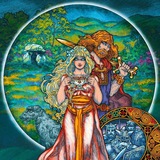
In mythology Síd-mounds are imagined as centres of fairy power & commerce, they have their own farmland & craftsmen, much like a ringfort.
On the inside, the fairy-mound radiates a mysterious golden light; crystal chairs sparkle, & music plays for the sídhe lord & his retainers.
📖 Ancient Restoration
On the inside, the fairy-mound radiates a mysterious golden light; crystal chairs sparkle, & music plays for the sídhe lord & his retainers.
The interference of the fairy-kind in worldly affairs is based on a desire to 'rekindle human glory' - They dwell on the heroic within man.
📖 Ancient Restoration
The interference of the fairy-kind in worldly affairs is based on a desire to 'rekindle human glory' - They dwell on the heroic within man.
Summit cairn on Sugarloaf Hill, Co Tipperary.
In the distance is Slievenamon, mound of the god Midir, which is also crowned by a cairn.
In the distance is Slievenamon, mound of the god Midir, which is also crowned by a cairn.
📖 Ancient Restoration
Summit cairn on Sugarloaf Hill, Co Tipperary. In the distance is Slievenamon, mound of the god Midir, which is also crowned by a cairn.
In early Irish literature, the fairy/sídhe have many names: 'god-men' (fir dé), 'god-kindreds' (cenéla dé), & 'god-peoples' (tuatha dé).
📖 Ancient Restoration
In early Irish literature, the fairy/sídhe have many names: 'god-men' (fir dé), 'god-kindreds' (cenéla dé), & 'god-peoples' (tuatha dé).
Three Irish words used to describe fairy:
Scál - An uncanny being, sometimes a god who passes on supernatural information.
Airdrech - A battlefield spirit, an omen, a prophetic sign.
Síabair - A spectral being who distorts & shape-shifts, takes on illusory appearances.
Scál - An uncanny being, sometimes a god who passes on supernatural information.
Airdrech - A battlefield spirit, an omen, a prophetic sign.
Síabair - A spectral being who distorts & shape-shifts, takes on illusory appearances.
The Rock of Cashel in County Tipperary.
Reputedly the site of the conversion of Aenghus the King of Munster by St. Patrick in the 5th century AD. #StPatricksDay ☘
Reputedly the site of the conversion of Aenghus the King of Munster by St. Patrick in the 5th century AD. #StPatricksDay ☘
📖 Ancient Restoration
The Rock of Cashel in County Tipperary. Reputedly the site of the conversion of Aenghus the King of Munster by St. Patrick in the 5th century AD. #StPatricksDay ☘
St Patrick baptises king Óengus in Cashel but stabs his crozier through his foot! [St Patrick's Church, Columbus, Ohio]
📖 Ancient Restoration
St Patrick baptises king Óengus in Cashel but stabs his crozier through his foot! [St Patrick's Church, Columbus, Ohio]
The shamrock as a strange three-leaved plant in Gerald of Wales' "Topographia Hibernica" (1188 AD): These images are the first depiction of the shamrock as a national symbol of Ireland, drawn by the Normans.
📖 Ancient Restoration
Photo
Early Irish stories about the shamrock mention of how a good king will literally cause the land to blossom in 'flowered clover' (scoth-shemrach). The goddess Tailtiú, in another tale, clears rough land until it's 'filled with green clover' of abundance.
📖 Ancient Restoration
Photo
How the shamrock became a symbol of Ireland:
'Scoth-shemrach', Irish for 'flowering clover': a phrase used for good, fertile land.
'Scotti-shemrach' a pun of the former, meaning 'the clovered Irish', i.e. a good and fertile people!🇮🇪
'Scoth-shemrach', Irish for 'flowering clover': a phrase used for good, fertile land.
'Scotti-shemrach' a pun of the former, meaning 'the clovered Irish', i.e. a good and fertile people!🇮🇪
📖 Ancient Restoration
Photo
The Céide Fields in County Mayo, Ireland - the most extensive Stone Age Monument in Europe. The site contains the oldest known field systems in the world dating back almost 6,000 years and preserved under a blanket of bog.
In ancient times, the fertility-goddess known as Sheela-na-gig was honored in Ireland. With the advent of Christianity, 18th March became known as "St Sheelah’s Day", a woman who was identified as the wife or mother of St Patrick.