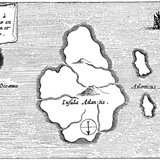
The temple at Edfu was built between 237 - 57 BC during the Ptolemaic period, but Dr. Manu Seyfzadeh, who first translated the temple innoscriptions into English, asserts that “the linguistic basis of the hieroglyphic texts at Edfu is Middle Egyptian, which ceased to be a spoken language at the end of the 18th Dynasty (circa 14th century BC)”. Dr. Seyfzadeh says that the Edfu texts are mere excerpts from a longer original document which was composed in Middle Egyptian. This does not conflict with Crantor’s claim (relayed by Proclus) that the story of Atlantis was still preserved, “written on pillars”, in his time (4th - 3rd centuries BC), as although this could not possibly be referring to the Ptolemaic temple of Edfu which had not yet been constructed, it could have instead referred to the source from which the Edfu innoscriptions were copied, which may have been extant in Crantor’s time but not in our own. In light of this information and the similarities between the Edfu texts and the Atlantis story, which we will examine next, it seems unlikely that Plato fabricated the story himself, but rather more likely that he is accurately reporting on its provenance when he writes that it came from an Egyptian source.
Going off of Dr. Seyfzadeh’s English translation of the Edfu texts, we can pick out a few strong similarities to the Atlantis story, which he himself points out.
The Edfu texts are estimated by Dr. Seyfzadeh to have been composed no later than 1,500 BC based on linguistic evidence. The texts are a redacted or excerpted copy of this, now lost, Middle Egyptian original document. The texts state that the span of Horus’ rule was 7,000 years from the time that the original document was composed (sometime before 1,500 BC). If the original was composed around 1,600 BC, that would put the beginning of Horus’ rule at 8,600 BC. This matches exactly with the Saitic priests’ timeline of their own ethnogenesis; of the “seed of their race”, the priests say that “the constitution is recorded in our sacred registers to be eight thousand years old.” Since the Saitic priests would have been telling this to Solon around 600 BC, that places the start of Saitic society, according to them, at 8,600 BC. It can hardly be a coincidence that both of these ancient documents (Plato’s dialogues and the Edfu texts) claim in one way or another that the political order of Egypt has roots that date back to 8,600 BC (give or take a century in either direction for the Edfu texts). One gives the date for the founding of Saitic society, and the other for the beginning of Horus’ reign, but both of these speak to some kind of sociopolitical, cultural, or religious inflection point in Egyptian society at or around 8,600 BC.
The relevant innoscription at Edfu starts with two “border contestants” making peace after a flood, according to Dr. Seyfzadeh. However, my interpretation of his translation of the passage has the flood occurring after the peace is made, as the “moment of high tide” is mentioned directly afterward. In any case, either the flood occurs shortly before or shortly after a peace is reached by the two combatants. This occurs at a place called “battle island”, “peace island”, “great primeval mound”, “primeval island”, “flood born, pristine sites”, “round arrival site”, and various other names throughout the story. Next, Horus seems to be threatened by the “RA snake”, from whom he is subsequently protected by the god Tatenen (who is also associated with the concept of the “primordial mound”). Horus is told by the “Temple God” to “see the potter’s wheel” when he embarks “for the place of building”. After the Shebtiu “thrust back the flood”, the four crews of Horus arrive at the distant primeval island by sea, and with the help of seven Khnums (a deity associated with the potter’s wheel) Horus establishes a settlement and his rulership there. Dr. Seyfzadeh even points out that a “Ring sea” is mentioned in the texts as part of Horus’ dominion.
Going off of Dr. Seyfzadeh’s English translation of the Edfu texts, we can pick out a few strong similarities to the Atlantis story, which he himself points out.
The Edfu texts are estimated by Dr. Seyfzadeh to have been composed no later than 1,500 BC based on linguistic evidence. The texts are a redacted or excerpted copy of this, now lost, Middle Egyptian original document. The texts state that the span of Horus’ rule was 7,000 years from the time that the original document was composed (sometime before 1,500 BC). If the original was composed around 1,600 BC, that would put the beginning of Horus’ rule at 8,600 BC. This matches exactly with the Saitic priests’ timeline of their own ethnogenesis; of the “seed of their race”, the priests say that “the constitution is recorded in our sacred registers to be eight thousand years old.” Since the Saitic priests would have been telling this to Solon around 600 BC, that places the start of Saitic society, according to them, at 8,600 BC. It can hardly be a coincidence that both of these ancient documents (Plato’s dialogues and the Edfu texts) claim in one way or another that the political order of Egypt has roots that date back to 8,600 BC (give or take a century in either direction for the Edfu texts). One gives the date for the founding of Saitic society, and the other for the beginning of Horus’ reign, but both of these speak to some kind of sociopolitical, cultural, or religious inflection point in Egyptian society at or around 8,600 BC.
The relevant innoscription at Edfu starts with two “border contestants” making peace after a flood, according to Dr. Seyfzadeh. However, my interpretation of his translation of the passage has the flood occurring after the peace is made, as the “moment of high tide” is mentioned directly afterward. In any case, either the flood occurs shortly before or shortly after a peace is reached by the two combatants. This occurs at a place called “battle island”, “peace island”, “great primeval mound”, “primeval island”, “flood born, pristine sites”, “round arrival site”, and various other names throughout the story. Next, Horus seems to be threatened by the “RA snake”, from whom he is subsequently protected by the god Tatenen (who is also associated with the concept of the “primordial mound”). Horus is told by the “Temple God” to “see the potter’s wheel” when he embarks “for the place of building”. After the Shebtiu “thrust back the flood”, the four crews of Horus arrive at the distant primeval island by sea, and with the help of seven Khnums (a deity associated with the potter’s wheel) Horus establishes a settlement and his rulership there. Dr. Seyfzadeh even points out that a “Ring sea” is mentioned in the texts as part of Horus’ dominion.
What’s even more astonishing is that Dr. Seyfzadeh has uncovered a possible etymological connection to the name “Atlantis” within the Edfu innoscriptions. By following known patterns of phonetic drift seen in Pre-Greek and Greek, Dr. Seyfzadeh has traced a reasonable progression by which the phrase “pristine sites born of the flood” could have been transliterated from Egyptian and eventually modified by the Greek tongue to sound like “Atlant msj nt”.
These passages of the Edfu texts bear an uncanny resemblance to the story of Atlantis.
A war between two factions, a peace is reached on the “primeval island”, the reference to a potter’s wheel in connection with the building of the site (just as Poseidon turned the rings of water and land of Atlantis “as with a lathe”), the “round arrival site” where Horus establishes his domain, perhaps around 8,600 BC, which includes a “Ring sea”. Dr. Seyfzadeh mentions that textual clues also point at this entire creation process being more of a resurrection than an original creation. This seems to line up quite well with the ending of the Critias, which was abruptly cut off before Plato finished it. Where the Critias left off, the Edfu texts sem to pick up and continue the story. The Edfu texts seem to pick up after the war of Atlantis has concluded, discussing the resettlement of the island after the flood subsided, perhaps mirroring details of the original creation of the island in its symbolic resurrection, notably the connection between the building process and a lathe (in the Greek version) or a potter’s wheel (in the Egyptian version).
These passages of the Edfu texts bear an uncanny resemblance to the story of Atlantis.
A war between two factions, a peace is reached on the “primeval island”, the reference to a potter’s wheel in connection with the building of the site (just as Poseidon turned the rings of water and land of Atlantis “as with a lathe”), the “round arrival site” where Horus establishes his domain, perhaps around 8,600 BC, which includes a “Ring sea”. Dr. Seyfzadeh mentions that textual clues also point at this entire creation process being more of a resurrection than an original creation. This seems to line up quite well with the ending of the Critias, which was abruptly cut off before Plato finished it. Where the Critias left off, the Edfu texts sem to pick up and continue the story. The Edfu texts seem to pick up after the war of Atlantis has concluded, discussing the resettlement of the island after the flood subsided, perhaps mirroring details of the original creation of the island in its symbolic resurrection, notably the connection between the building process and a lathe (in the Greek version) or a potter’s wheel (in the Egyptian version).
Forwarded from 🔥Spicy Steamed Memeballs 🧆 (15 51)
This media is not supported in your browser
VIEW IN TELEGRAM
When Columbus discovered the new world.
Forwarded from Maptism Channel (Henrikiki Kikiki)
The most terrifying theory of all is that PIE could be a WHG language. Hypothetically WHG Duvensee I2 -> Dnieper Donets I2 -> Sredny Stog I2
Forwarded from Maptism Channel (Henrikiki Kikiki)
Duvensee and Dnieper-Donest/Janislawice were infact so linked that very old literature refers to them as "Dnieper-Elbe" complex. This is almost never mentioned nowdays.
Forwarded from /r/Mapporn
Forwarded from /r/Mapporn
A true gem: Ottoman made ethnic map of Levant. (The map is in Turkish, translation of the key is below)
https://redd.it/1o5fbu1
@r_mapporn
https://redd.it/1o5fbu1
@r_mapporn
Forwarded from 🦧 Esoteric Schizoid Fern Bandar 🦧
never forget one of the main tribes in estonia during the middle ages were called Chud