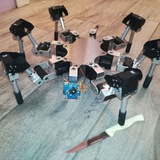
I've made a very small axis aligned solenoid magnetic simulator to optimize the design of a single stage elctromagnetic gun (commonly known as coilgun)
in this run I've optimized the design of a passive single stage coilgun (timings are driven by the RLC circuit formed by the coil, parasitic resistance and capacitor)
it reached an efficiency of 17% with the constraint of starting with 1kJ of energy and the peak output energy is 170J which is around half of that of a 9mm bullet so it is already lethal
I did this out of spite for all those youtubers who make coilguns by choosing the geometry and parameters randomly by hand or by trial and error when a much more efficient design can be engineered with simulation aided design and optimizer guided engineering processes
in this run I've optimized the design of a passive single stage coilgun (timings are driven by the RLC circuit formed by the coil, parasitic resistance and capacitor)
it reached an efficiency of 17% with the constraint of starting with 1kJ of energy and the peak output energy is 170J which is around half of that of a 9mm bullet so it is already lethal
I did this out of spite for all those youtubers who make coilguns by choosing the geometry and parameters randomly by hand or by trial and error when a much more efficient design can be engineered with simulation aided design and optimizer guided engineering processes
I took the solenoid magnetic field formulation that reduces the computation to very efficient elliptic integrals from here:
http://users.df.uba.ar/zanellaj/ft1_2011_1c/material_auxiliar/campo_solenoide_exacto_Derby.pdf
http://users.df.uba.ar/zanellaj/ft1_2011_1c/material_auxiliar/campo_solenoide_exacto_Derby.pdf
This media is not supported in your browser
VIEW IN TELEGRAM
and obviously here's the coilgun's simulation and visualization
the simulator and everything were written in c++ from scratch (no dependencies) as a pybind11 module to be fed to scipy.optimize to find the optimal coilgun design
the simulator and everything were written in c++ from scratch (no dependencies) as a pybind11 module to be fed to scipy.optimize to find the optimal coilgun design
This media is not supported in your browser
VIEW IN TELEGRAM
primo coilgun risonante
si vede bene nella velocità come stalla mentre passa per il centro e dopo gli viene data un'altra spinta da dietro
il Q è circa 1.1, che è ottimo perché devono esserci al massimo due semionde significative, una positiva e una negativa, altrimenti la terza semionda sarebbe positiva e tirerebbe indietro il proiettile
il Q è circa 1.1, che è ottimo perché devono esserci al massimo due semionde significative, una positiva e una negativa, altrimenti la terza semionda sarebbe positiva e tirerebbe indietro il proiettile
ho fatto un pò di analisi sulla rete neurale del robot e sono emerse un po di robe interessanti
1) i primi layer fanno più attenzione alle velocità delle zampe e la posizione del target mentre gli ultimi sulla velocità del corpo del robot
2) il robot usa molto poco le feature del lidar probabilmente perchè la maggior parte dei punti sono lontani dalle zampe il che è uno spreco considerando che il lidar usa 25 delle 94 feature totali
3) ovviamente le azioni di ogni giunto sono influenzate per lo più dalle posizioni e velocità dello stesso giunto e questa cosa potrebbe essere rinforzata architetturalmente invece di farla imparare da zero alla rete neurale sprecando sample di esplorazione
4) pare che l'obiettivo principale per il robot sia mantenere l'altezza del corpo e raggiungere il target sia secondario rispetto a questo (il che ha senso visto che viene brutalmente penalizzato se tocca le scale con la pancia durante il training)
p.s. i plot sono fatti con pearson correlation con random sample in input
1) i primi layer fanno più attenzione alle velocità delle zampe e la posizione del target mentre gli ultimi sulla velocità del corpo del robot
2) il robot usa molto poco le feature del lidar probabilmente perchè la maggior parte dei punti sono lontani dalle zampe il che è uno spreco considerando che il lidar usa 25 delle 94 feature totali
3) ovviamente le azioni di ogni giunto sono influenzate per lo più dalle posizioni e velocità dello stesso giunto e questa cosa potrebbe essere rinforzata architetturalmente invece di farla imparare da zero alla rete neurale sprecando sample di esplorazione
4) pare che l'obiettivo principale per il robot sia mantenere l'altezza del corpo e raggiungere il target sia secondario rispetto a questo (il che ha senso visto che viene brutalmente penalizzato se tocca le scale con la pancia durante il training)
p.s. i plot sono fatti con pearson correlation con random sample in input
altra roba interessante: dalla matrice di correlazione tra dof pos e output action emerge che la posizione della tibia dipende molto da quella del femore più che da quella della tibia stessa, probabilmente la NN ha imparato una sorta di cinematica inversa dove decide la posizione del femore e la posizione della tibia viene calcolata da quella
ho fatto un coso che compila xc32 (il compilatore per i pic32) versione PRO gratis
https://github.com/nikisalli/Free_XC32_PRO_Compiler/
fanculo Microchip Technology Inc.
https://github.com/nikisalli/Free_XC32_PRO_Compiler/
fanculo Microchip Technology Inc.
GitHub
GitHub - nikisalli/Free_XC32_PRO_Compiler: [Works!] Build your own license-free, GPL version of the latest gcc-based Microchip…
[Works!] Build your own license-free, GPL version of the latest gcc-based Microchip MPLAB X IDE XC32 C++ compiler - nikisalli/Free_XC32_PRO_Compiler
schematic file parser and schematic tokenizer to turn schematics into tensors
tokenizers and embedding tables are the building blocks to bridge discrete data with their continuous representations.
tokenizers and embedding tables are the building blocks to bridge discrete data with their continuous representations.
my rtx4090 has been grinding for days, I think I'll buy a second one soon.
the two charts show train and validation losses for two different models learning schematics. the purple one is attention based and generalizes way better. attention is all you need after all.
the two charts show train and validation losses for two different models learning schematics. the purple one is attention based and generalizes way better. attention is all you need after all.
I've made a simulator for a betatron.
an old type of particle accelerator that uses the electric field induced by a strong changing magnetic field to accelerate electrons to over 6MeV.
the line is the trajectory of an electron and its color is the energy.
the crazy thing is that you could potentially build this in your garage as it is cheap and easy to make (probably ~3000€ budget) and it would start pumping out extremely powerful x rays
it was tuned by hand lol
an old type of particle accelerator that uses the electric field induced by a strong changing magnetic field to accelerate electrons to over 6MeV.
the line is the trajectory of an electron and its color is the energy.
the crazy thing is that you could potentially build this in your garage as it is cheap and easy to make (probably ~3000€ budget) and it would start pumping out extremely powerful x rays
it was tuned by hand lol