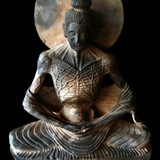
"All of the aggregates are impermanent, undergo change, and are eventually destroyed. What is new eventually decays, becomes old, and finally ends. We are not a single entity but rather a coming together of the five aggregates (form, feeling, perception, mental formations, and consciousness). These various components will change and eventually come to an end.
The components are also not single. For example, a form (such as the body) does not consist of one single unit but is made up of components that are continually changing and being destroyed. The view of the self also is called "the view of that which will be destroyed" because it is a view founded upon the aggregates coming together and then dispersing. Even though elements come together and make up an entity composed of many different things, we think ofthem as a single entity. For example, our body is composed of many parts and yet we consider ourselves to be a single individual.
We see ourselves as "one being," as an "I" or a "self' who took birth, has grown older and will die. But, in fact, the self is a composite of changing aggregates that come together, undergo change, and will finally end. As babies we had a small body and the thoughts of a baby. As a grown-up we have another body and the thoughts of an adult.
As long as we are not aware of the changes that take place from childhood through adolescence to old age, we think of ourselves as a single individual. If we examine this closely, however, we discover that there is no place where the self exists and that the view of a self is nothing but a delusion. This is the delusion based on ignorance that must be eliminated."
Thrangu Rinpoche
The components are also not single. For example, a form (such as the body) does not consist of one single unit but is made up of components that are continually changing and being destroyed. The view of the self also is called "the view of that which will be destroyed" because it is a view founded upon the aggregates coming together and then dispersing. Even though elements come together and make up an entity composed of many different things, we think ofthem as a single entity. For example, our body is composed of many parts and yet we consider ourselves to be a single individual.
We see ourselves as "one being," as an "I" or a "self' who took birth, has grown older and will die. But, in fact, the self is a composite of changing aggregates that come together, undergo change, and will finally end. As babies we had a small body and the thoughts of a baby. As a grown-up we have another body and the thoughts of an adult.
As long as we are not aware of the changes that take place from childhood through adolescence to old age, we think of ourselves as a single individual. If we examine this closely, however, we discover that there is no place where the self exists and that the view of a self is nothing but a delusion. This is the delusion based on ignorance that must be eliminated."
Thrangu Rinpoche
❤1
"First, if something doesn't exist, then it doesn't exist, but whatever does exist is composite and not a single, indivisible entity. All things are made up of various ingredients and these ingredients form existing things.
Therefore, all phenomena that exist are composed of various ingredients and as a result are impermanent. Living beings die, objects wear out and disintegrate. At this coarse or obvious level of impermanence, everything changes over time, and this is obvious and can be understood by everyone. The subtle level of impermanence is the main concern here; it is the momentary impermanence of every instant.
When looking at momentary impermanence on a gross level, we can see that a person changes from childhood to adulthood.
One may think that there is continuity in the change that takes place. One may wonder when this change takes place and conclude that every year, everybody is different. However, a change doesn't automatically take place at a certain point each year.
One may conclude that every month, everybody is different, but the change doesn't automatically take place at a certain point in each month either.
One may conclude that every day or every hour, everybody changes. We follow this reasoning down to every single instant in which a change takes place, so there is impermanence in every instant.
This is the subtle level of impermanence. It is easy to see changes that take place over the years, but, in fact, changes are taking place in every instant.
[...]
Whatever phenomena we can perceive are empty like water bubbles. Although we can hear and see things, nothing has a true reality in itself; there is no true self in the individual and no true existence of phenomena. In spite of the fact that they appear, phenomena have no substantial or true reality of their own. Thus it is said that all phenomena are empty and have no self."
Thrangu Rinpoche
Therefore, all phenomena that exist are composed of various ingredients and as a result are impermanent. Living beings die, objects wear out and disintegrate. At this coarse or obvious level of impermanence, everything changes over time, and this is obvious and can be understood by everyone. The subtle level of impermanence is the main concern here; it is the momentary impermanence of every instant.
When looking at momentary impermanence on a gross level, we can see that a person changes from childhood to adulthood.
One may think that there is continuity in the change that takes place. One may wonder when this change takes place and conclude that every year, everybody is different. However, a change doesn't automatically take place at a certain point each year.
One may conclude that every month, everybody is different, but the change doesn't automatically take place at a certain point in each month either.
One may conclude that every day or every hour, everybody changes. We follow this reasoning down to every single instant in which a change takes place, so there is impermanence in every instant.
This is the subtle level of impermanence. It is easy to see changes that take place over the years, but, in fact, changes are taking place in every instant.
[...]
Whatever phenomena we can perceive are empty like water bubbles. Although we can hear and see things, nothing has a true reality in itself; there is no true self in the individual and no true existence of phenomena. In spite of the fact that they appear, phenomena have no substantial or true reality of their own. Thus it is said that all phenomena are empty and have no self."
Thrangu Rinpoche
💯2
"When looking at momentary impermanence on a gross level, we can see that a person changes from childhood to adulthood. One may think that there is continuity in the change that takes place. One may wonder when this change takes place and conclude that every year, everybody is different.
However, a change doesn't automatically take place at a certain point each year. One may conclude that every month, everybody is different, but the change doesn't automatically take place at a certain point in each month either. One may conclude that every day or every hour, everybody changes.
We follow this reasoning down to every single instant in which a change takes place, so there is impermanence in every instant. This is the subtle level of impermanence. It is easy to see changes that take place over the years, but, in fact, changes are taking place in every instant. Chandrakirti said that even a solid-looking diamond, which is as large as a boulder, changes every single instant."
Thrangu Rinpoche
However, a change doesn't automatically take place at a certain point each year. One may conclude that every month, everybody is different, but the change doesn't automatically take place at a certain point in each month either. One may conclude that every day or every hour, everybody changes.
We follow this reasoning down to every single instant in which a change takes place, so there is impermanence in every instant. This is the subtle level of impermanence. It is easy to see changes that take place over the years, but, in fact, changes are taking place in every instant. Chandrakirti said that even a solid-looking diamond, which is as large as a boulder, changes every single instant."
Thrangu Rinpoche
💯4
"Whatever phenomena we can perceive are empty like water bubbles. Although we can hear and see things, nothing has a true reality in itself; there is no true self in the individual and no true existence of phenomena. In spite ofthe fact that they appear, phenomena have no substantial or true reality of their own. Thus it is said that all phenomena are empty and have no self."
Thrangu Rinpoche
Thrangu Rinpoche
❤4
"The Mind-only (Skt. Chittamatra) followers teach that all external appearances, including one's own body, are created by and are part of the mind. Objects do appear and we do perceive them, but none of the things that appear have any external existence;
they all arise within the mind itself.
How can this be? They give the example ofwhen we are asleep and we dream of a mountain, a house, animals, people, friends, enemies, and so forth, we see various things exactly as we would see them while awake. But, none of these things actually exist; they are all appearances arising from our mind. In the same way, all appearances that we normally perceive while awake also arise in the mind. They are nothing else but mind. This is why this tradition is called "Chittamatra," which in Sanskrit means "mind-only," that is, everything is "only" mind. First, there are tendencies or latencies (Tib. bag chag) that are created in the mind.
If the mind is habituated to something that is positive, gradually the mind gets better and better and one's thoughts become more and more virtuous. If, on the other hand, the mind becomes habituated to something that is negative, gradually the mind gets worse and worse and one's thoughts become more and more unvirtuous.
For example, slight anger may arise within us. If we take control of that anger and get rid of it, then it will not remain in our mind as a latency. If, on the other hand, we do not take control ofthat anger, it will become stronger and stronger. In the beginning we are stronger than the anger, but if we don't control it, the anger becomes stronger and we cannot get rid of it. In this process, what the mind allows to become a habitual pattern becomes more and more powerful.
This applies as well to positive emotions such as love, compassion, and the wish to benefit others. These thoughts can be small in the beginning, but if we cultivate them and habituate ourselves to them, they will increase and become more and more powerful.
The mind is therefore said to be dependent upon these latencies within it. In the Mind-only view, this mind is said to really exist, whereas appearances both in the outer world and in the mind itself are "imaginary," or, we could say, are creations of the mind or delusions."
Thrangu Rinpoche
they all arise within the mind itself.
How can this be? They give the example ofwhen we are asleep and we dream of a mountain, a house, animals, people, friends, enemies, and so forth, we see various things exactly as we would see them while awake. But, none of these things actually exist; they are all appearances arising from our mind. In the same way, all appearances that we normally perceive while awake also arise in the mind. They are nothing else but mind. This is why this tradition is called "Chittamatra," which in Sanskrit means "mind-only," that is, everything is "only" mind. First, there are tendencies or latencies (Tib. bag chag) that are created in the mind.
If the mind is habituated to something that is positive, gradually the mind gets better and better and one's thoughts become more and more virtuous. If, on the other hand, the mind becomes habituated to something that is negative, gradually the mind gets worse and worse and one's thoughts become more and more unvirtuous.
For example, slight anger may arise within us. If we take control of that anger and get rid of it, then it will not remain in our mind as a latency. If, on the other hand, we do not take control ofthat anger, it will become stronger and stronger. In the beginning we are stronger than the anger, but if we don't control it, the anger becomes stronger and we cannot get rid of it. In this process, what the mind allows to become a habitual pattern becomes more and more powerful.
This applies as well to positive emotions such as love, compassion, and the wish to benefit others. These thoughts can be small in the beginning, but if we cultivate them and habituate ourselves to them, they will increase and become more and more powerful.
The mind is therefore said to be dependent upon these latencies within it. In the Mind-only view, this mind is said to really exist, whereas appearances both in the outer world and in the mind itself are "imaginary," or, we could say, are creations of the mind or delusions."
Thrangu Rinpoche
❤3
Forwarded from Meditations of a Yogin
"Duality is the real root of our suffering and of all our conflicts. All our concepts and beliefs, no matter how profound they may seem, are like nets which trap us in dualism. When we discover our limits we have to try to overcome them, untying ourselves from whatever type of religious, political, or social conviction may contain us. We have to abandon such concepts as 'enlightenment', 'the nature of the mind', and so on, until we no longer neglect to integrate our knowledge with our actual existence."
- Namkhai Norbu
- Namkhai Norbu
🙏7
"According to Avalokitesvara, this sheet of paper is empty; but according to our analysis, it is full of everything. There seems to be a contradiction between our observation and his. Avalokita found the five skandhas empty. But, empty of what? The key word is empty. To be empty is to be empty of something.
The five skandhas, which may be translated into English as five heaps, or five aggregates, are the five elements that comprise a human being. These five elements flow like a river in every one of us. In fact, these are really five rivers flowing together in us: the river of form, which means our body, the river of feelings, the river of perceptions, the river of mental formations, and the river of consciousness. They are always flowing in us. So according to Avalokita, when he looked deeply into the nature of these five rivers, he suddenly saw that all five are empty.
And if we ask, "Empty of what?" he has to answer. And this is what he said: "They are empty of a separate self." That means none of these five rivers can exist by itself alone.
Each of the five rivers has to be made by the other four. They have to co-exist; they have to inter-be with all the others.
In our bodies we have lungs, heart, kidneys, stomach, and blood. None of these can exist independently. They can only co-exist with the others. Your lungs and your blood are two things, but neither can exist separately.
The lungs take in air and enrich the blood, and, in turn, the blood nourishes the lungs. Without the blood the lungs cannot be alive, and without the lungs, the blood cannot be cleansed. Lungs and blood inter-are. The same is true with kidneys and blood, kidneys and stomach, lungs and heart, blood and heart, and so on.
When Avalokita says that our sheet of paper is empty, he means it is empty of a separate, independent existence. It cannot just be by itself. It has to inter-be with the sunshine, the cloud, the forest, the logger, the mind, and everything else. It is empty of a separate self.
But, empty of a separate self means full of everything. So it seems that our observation and that of Avalokita do not contradict each other after all."
Thich Nhat Hanh
The five skandhas, which may be translated into English as five heaps, or five aggregates, are the five elements that comprise a human being. These five elements flow like a river in every one of us. In fact, these are really five rivers flowing together in us: the river of form, which means our body, the river of feelings, the river of perceptions, the river of mental formations, and the river of consciousness. They are always flowing in us. So according to Avalokita, when he looked deeply into the nature of these five rivers, he suddenly saw that all five are empty.
And if we ask, "Empty of what?" he has to answer. And this is what he said: "They are empty of a separate self." That means none of these five rivers can exist by itself alone.
Each of the five rivers has to be made by the other four. They have to co-exist; they have to inter-be with all the others.
In our bodies we have lungs, heart, kidneys, stomach, and blood. None of these can exist independently. They can only co-exist with the others. Your lungs and your blood are two things, but neither can exist separately.
The lungs take in air and enrich the blood, and, in turn, the blood nourishes the lungs. Without the blood the lungs cannot be alive, and without the lungs, the blood cannot be cleansed. Lungs and blood inter-are. The same is true with kidneys and blood, kidneys and stomach, lungs and heart, blood and heart, and so on.
When Avalokita says that our sheet of paper is empty, he means it is empty of a separate, independent existence. It cannot just be by itself. It has to inter-be with the sunshine, the cloud, the forest, the logger, the mind, and everything else. It is empty of a separate self.
But, empty of a separate self means full of everything. So it seems that our observation and that of Avalokita do not contradict each other after all."
Thich Nhat Hanh
💯6
"So many people regularly intoxicate themselves with all kinds of things, in order to try to temporarily escape from their boredom, problems, and suffering.
They chase after the fleeting experience of some kind of distorted state of perception, and an intoxicant induced bliss and happiness, which eventually puts so much strain on their mental and physical health, and also strain on those around them. This is very sad, because a samsaric sentient being’s perception is already distorted, and intoxicants just amplify it, which will just contribute to perpetuating samsara - their uncontrollable recurring rebirth with further problems and suffering.
If they are chasing after bliss and happiness, they should know that if you could take all of the bliss and happiness that comes from meditation, and put it into a bottle, and then give it to them, it would become their favourite drink. Because no intoxicant induced sensation could come close to the magnificent energetic bliss and happiness that one experiences from meditation.
Of course, unfortunately it is not possible to put the effects of meditation into a bottle. But the good news is, that unlike any expensive and harmful intoxicant, meditation is always free of charge, and there are no harmful side effects, and it is always good for your mental and physical health, and it is always available, and the more meditation that you do, the more health, bliss and happiness that you will experience, and the closer that you will get to your freedom from samsara, where you will experience the supreme everlasting pure bliss of nirvana, and further, the enlightened state of a buddha."
Chamtrul Rinpoche
They chase after the fleeting experience of some kind of distorted state of perception, and an intoxicant induced bliss and happiness, which eventually puts so much strain on their mental and physical health, and also strain on those around them. This is very sad, because a samsaric sentient being’s perception is already distorted, and intoxicants just amplify it, which will just contribute to perpetuating samsara - their uncontrollable recurring rebirth with further problems and suffering.
If they are chasing after bliss and happiness, they should know that if you could take all of the bliss and happiness that comes from meditation, and put it into a bottle, and then give it to them, it would become their favourite drink. Because no intoxicant induced sensation could come close to the magnificent energetic bliss and happiness that one experiences from meditation.
Of course, unfortunately it is not possible to put the effects of meditation into a bottle. But the good news is, that unlike any expensive and harmful intoxicant, meditation is always free of charge, and there are no harmful side effects, and it is always good for your mental and physical health, and it is always available, and the more meditation that you do, the more health, bliss and happiness that you will experience, and the closer that you will get to your freedom from samsara, where you will experience the supreme everlasting pure bliss of nirvana, and further, the enlightened state of a buddha."
Chamtrul Rinpoche
❤12
Forwarded from MahaYog - Yoga 🔱 and Buddhism ☸️
Not once in the entire endless series of lives was there a real birth. There was only the appearance of birth.
There was never a real death, only a change in appearance, similar to the transition from sleep to wakefulness...
... throughout the endless succession of lives, there was never any real experience of transitioning from one state to another or any real experience of being in any other place.
This is similar to images in a dream.
Longchenpa
There was never a real death, only a change in appearance, similar to the transition from sleep to wakefulness...
... throughout the endless succession of lives, there was never any real experience of transitioning from one state to another or any real experience of being in any other place.
This is similar to images in a dream.
Longchenpa
❤11
"In Buddhist noscriptures, this original nature is principally referred to as “mind” (sems), as in “ever-perfect mind” (kun tu bzang po’i sems) or “mind nature” (sems nyid ). In this context, “mind” does not mean object-bound experience but instead the ever-perfect and intrinsic awareness that has no beginning or end. Since it is free from the dichotomy of knower and known, this mind is no different from the reality it perceives.
Reality is a “continuum” in the sense that its nature does not change into something else and cannot be fragmented into parts. Regardless of the degree of evolution or debasement of an individual, that reality or ever-perfect mind remains unaltered as the very essence or nucleus of one’s being.
From the state of an ordinary individual, the beginning, so to speak, up to the end of awakening, such reality is unceasingly present. Hence, there is no ultimate distinction between an ordinary being and an awakened one."
Elio Guarisco
Reality is a “continuum” in the sense that its nature does not change into something else and cannot be fragmented into parts. Regardless of the degree of evolution or debasement of an individual, that reality or ever-perfect mind remains unaltered as the very essence or nucleus of one’s being.
From the state of an ordinary individual, the beginning, so to speak, up to the end of awakening, such reality is unceasingly present. Hence, there is no ultimate distinction between an ordinary being and an awakened one."
Elio Guarisco
❤9
"Continuum as actuality (rang bzhin), though deemed causal (rgyu), does not mean the presence of the original state of being as a mere potential to be actualized in the future. Actuality points to the full presence of original being, even when it is not recognized. Lack of recognition is like a veil or cloud of unawareness which, however thick, does not pollute the very nature of one’s original state. As explained by the Third Karmapa Rangjung Dorjé, actuality means “an awakened being attended by stains.” Although accompanied by impurity, the being remains the same, just as a gold statue wrapped in rags is still a gold statue."
Elio Guarisco
Elio Guarisco
❤2
"Actuality is not defined as an absolute and static emptiness. Its power of manifestation or “radiance” (mdangs), owing to unawareness of its nature and to emotional patterns related to unawareness, becomes the basis for the particular appearances or visions that seem to bind one. When the veils of unawareness and emotional patterns lessen to some extent, there arise pure visions and contemplative experiences reflecting the essential purity of the actuality.
When unawareness and emotional patterns are fully recognized as the mere play of the manifesting power of reality, the entire breadth of the potential of one’s being unfolds."
Elio Guarisco
When unawareness and emotional patterns are fully recognized as the mere play of the manifesting power of reality, the entire breadth of the potential of one’s being unfolds."
Elio Guarisco
🔥6
"As long as the state of enlightenment is not recognized, beings continue to experience illusory birth and death, along with the happiness and suffering inherent in conditioned existence. However, whatever the experience, the essence of enlightenment remains unpolluted, unobscured, and unmodified, just as sunlight maintains its nature of light regardless of the type of object it strikes.
The essence is not conditioned by any form of embodied life, whether fortunate or miserable, nor is it conditioned by any act, good or evil, or by knowledge or lack of knowledge. Although the essence is attended by impurity, its nature, like gold embedded in ore, remains always pure, untouched by emotional afflictions and conceptions."
Elio Guarisco
The essence is not conditioned by any form of embodied life, whether fortunate or miserable, nor is it conditioned by any act, good or evil, or by knowledge or lack of knowledge. Although the essence is attended by impurity, its nature, like gold embedded in ore, remains always pure, untouched by emotional afflictions and conceptions."
Elio Guarisco
❤4
Forwarded from Yogācāra 🕉 Buddhism
[T]hrough turning away from the linguistic fabrications of what is seen, heard, perceived, and spoken in the world, mastery over what is seen, heard, perceived, and spoken is attained.
— Vasubandhu
— Vasubandhu
🔥7🤔4
“All the rivers in the world, carrying the waters that ripen flowers and fruit and cause forests to thrive, flow due to the power of the Naga King who resides in Lake Madröpa. Similarly any explanation, debate, composition, practice, and attainment of fruition achieved by his retinue of disciples depends solely on the power of the Victorious One himself.”
Sūtrasamuccaya
Sūtrasamuccaya
❤5🔥2
“All the lokas must be regarded as planes of consciousness which are attainable... in the physical body.
In effect while still on earth we can raise ourselves to the plane of our choice and will inevitably re-manifest there when the term of earthly existence is ended. But any law, to be a true universal principle, must operate both ways; we cannot logically expect the cosmic law to work only in our favour. If it did, there would be no point in man’s freedom of choice in moral issues. Where it is open to man to go upward, forward, it must be open to him to descend in the scale of spiritual evolution also.
Greed, hatred, sensuality and inertia all have their appropriate spheres of manifestation and their corresponding corporeal forms. When these types of consciousness arise more frequently than their spiritual opposites of generosity, love, purity and energy, they create the form of the next birth.”
Francis Story
In effect while still on earth we can raise ourselves to the plane of our choice and will inevitably re-manifest there when the term of earthly existence is ended. But any law, to be a true universal principle, must operate both ways; we cannot logically expect the cosmic law to work only in our favour. If it did, there would be no point in man’s freedom of choice in moral issues. Where it is open to man to go upward, forward, it must be open to him to descend in the scale of spiritual evolution also.
Greed, hatred, sensuality and inertia all have their appropriate spheres of manifestation and their corresponding corporeal forms. When these types of consciousness arise more frequently than their spiritual opposites of generosity, love, purity and energy, they create the form of the next birth.”
Francis Story
“A Guru should never sell mantra-knowledge to a disciple. A Guru who sells mantra is sinful and surely goes to hell.
Mantra-dīkṣā is to be given only through generosity and grace. One whose mind is tainted by greed is not a Guru and cannot uplift a disciple.
Whoever gives dīkṣā out of desire for wealth takes the wrong path. For such a person, no siddhi of the mantra arises; the practice becomes fruitless.”
Kulārṇava Tantra 13.108–110
Mantra-dīkṣā is to be given only through generosity and grace. One whose mind is tainted by greed is not a Guru and cannot uplift a disciple.
Whoever gives dīkṣā out of desire for wealth takes the wrong path. For such a person, no siddhi of the mantra arises; the practice becomes fruitless.”
Kulārṇava Tantra 13.108–110
🔥5❤1👍1
Forwarded from Self-Immolation
Regarding the practice of Mantra & Tantra without the guidance of a Guru:
"Pustake likhitā vidyā yena sundari yapyate
Sidhir na jāyate tasya kalpakoti-ṣaṭair api.
O Beauteous one! He who does Japa of a Vidyā [Mantra] learnt from a book can never attain Siddhi even if he persists for countless millions of years."
Ṣaṭkarmadīpikā
"Pustake likhitā vidyā yena sundari yapyate
Sidhir na jāyate tasya kalpakoti-ṣaṭair api.
O Beauteous one! He who does Japa of a Vidyā [Mantra] learnt from a book can never attain Siddhi even if he persists for countless millions of years."
Ṣaṭkarmadīpikā
❤1
“How, then, are the two vehicles differentiated? Some say that the difference between Sūtra and Mantra is that Mantra was taught for those who can use desire as an aid in the path whereas the Perfection Vehicle was taught in order to tame beings within the context of separation from desire.
This opinion is wrong because both the Perfection Vehicle and the Mantra Vehicle have modes of advancing on the path without having abandoned desire and both have modes of progress by cultivating paths to abandon desire.
For, in Sūtra it is said that just as the filth of a city is helpful to the field of a sugarcane grower who knows how to utilize a substance which itself is not helpful, so the afflictions can be useful in the path. If one knows how to use the afflictions for the welfare of others, they can serve as aids in amassing the accumulations of merit, and in this sense desire is not one-pointedly to be avoided although, from the viewpoint of the entities of the afflictions, they are indeed to be abandoned.
Sūtra Bodhisattvas who have not yet thoroughly abandoned the afflictions of desire and hatred can use them for the benefit of others, as in the case of Bodhisattva kings who have fathered many children in order to further the welfare of the country through the work of their children. Here the afflictions act as secondary causes in the aiding of others.
Just as within Sūtra practice there are occasions when Bodhisattvas intentionally do not abandon afflictions but use them as aids, so in Mantra practice, according to the time and the situation, Bodhisattvas use the afflictions. However, on the occasions when there is no purpose for desire or hatred, a Mantra practitioner must intentionally seek to abandon them. If in order to be a practitioner of Mantra one necessarily had to have not abandoned desire and hatred, there would be no opportunity to become a Buddha through the Mantra path.”
Tenzin Gyatso, 14th Dalai Lama
This opinion is wrong because both the Perfection Vehicle and the Mantra Vehicle have modes of advancing on the path without having abandoned desire and both have modes of progress by cultivating paths to abandon desire.
For, in Sūtra it is said that just as the filth of a city is helpful to the field of a sugarcane grower who knows how to utilize a substance which itself is not helpful, so the afflictions can be useful in the path. If one knows how to use the afflictions for the welfare of others, they can serve as aids in amassing the accumulations of merit, and in this sense desire is not one-pointedly to be avoided although, from the viewpoint of the entities of the afflictions, they are indeed to be abandoned.
Sūtra Bodhisattvas who have not yet thoroughly abandoned the afflictions of desire and hatred can use them for the benefit of others, as in the case of Bodhisattva kings who have fathered many children in order to further the welfare of the country through the work of their children. Here the afflictions act as secondary causes in the aiding of others.
Just as within Sūtra practice there are occasions when Bodhisattvas intentionally do not abandon afflictions but use them as aids, so in Mantra practice, according to the time and the situation, Bodhisattvas use the afflictions. However, on the occasions when there is no purpose for desire or hatred, a Mantra practitioner must intentionally seek to abandon them. If in order to be a practitioner of Mantra one necessarily had to have not abandoned desire and hatred, there would be no opportunity to become a Buddha through the Mantra path.”
Tenzin Gyatso, 14th Dalai Lama
❤10