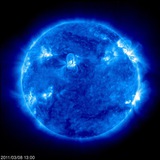
X-CLASS SOLAR FLARE: The sun just produced another X-flare. Earth-orbiting satellites detected the X2.2-class explosion on April 20th @ 0357 UT. Remarkably, it came from a farside sunspot. The source of the flare is AR2992, which yesterday rotated over the southwestern limb of the sun.
https://www.spaceweather.com/images2022/20apr22/x2p2_teal_anim_strip_opt.gif
https://www.spaceweather.com/images2022/20apr22/x2p2_teal_anim_strip_opt.gif
👍4
🚨SOLAR ACTIVITY IS INTENSIFYING: In the last 24 hours alone, the sun has produced more than 19 solar flares. The tally includes five M-class explosions and a powerful X2.2-class flare, described below. The fusillade is likely to continue as colossal sunspot complex AR2993-94 turns toward Earth in the days ahead.
👍5🔥2
STRONG EARTH-DIRECTED SOLAR FLARE: If you round up, it was an X-flare. On April 21st at 0157 UT, Earth-orbiting satellites detected a strong M9.6-class solar flare. The source was sunspot complex AR2993-94, which is almost directly facing Earth.
https://www.spaceweather.com/images2022/21apr22/teal_m9p6_anim_strip_opt.gif
Radiation from the flare caused a shortwave radio blackout over southeast Asia and Australia: blackout map. Remarkably, this is the second day in a row the same region of Earth has experienced a radio blackout. It happened yesterday, too, in response to an even stronger X2.2 flare.
Shortly after the flare, the US Air Force reported a Type II solar radio burst--a natural form of radio noise produced by shock waves in the leading edge of a CME. This means we can expect a CME to emerge from the blast site. Stay tuned for updates.
https://www.spaceweather.com/images2022/21apr22/teal_m9p6_anim_strip_opt.gif
Radiation from the flare caused a shortwave radio blackout over southeast Asia and Australia: blackout map. Remarkably, this is the second day in a row the same region of Earth has experienced a radio blackout. It happened yesterday, too, in response to an even stronger X2.2 flare.
Shortly after the flare, the US Air Force reported a Type II solar radio burst--a natural form of radio noise produced by shock waves in the leading edge of a CME. This means we can expect a CME to emerge from the blast site. Stay tuned for updates.
☄️THE LYRID METEOR SHOWER: Earth is entering a stream of debris from Comet Thatcher (C/1861 G1), source of the annual Lyrid meteor shower. Peak night is April 22nd.
Now for the bad news: Bright moonlight will interfere with the display, sharply reducing visible meteor rates to no more than 5 to 10 per hour.
2022 is not a good year for the Lyrids.
https://www.meteorshowers.org/view/Lyrids
Now for the bad news: Bright moonlight will interfere with the display, sharply reducing visible meteor rates to no more than 5 to 10 per hour.
2022 is not a good year for the Lyrids.
https://www.meteorshowers.org/view/Lyrids
www.meteorshowers.org
Lyrids meteor shower from space
Watch as Earth flies through clouds of meteors from the Lyrids meteor shower.
MORNING PLANETS: This is a great week to wake up early and look at the planets. They're all lined up. This morning, Jeff Dai photographed the pre-dawn scene from the Yunnan province of China.
"The display shocked me--it was so beautiful!" says Dai. "I watched as Saturn, Mars, Venus and Jupiter rose one by one in the eastern sky. The dawn was so serene. I could see all of these celestial wonders reflected in the peaceful waters of Lake Nian."
The view is about to improve. Venus and Jupiter are converging for a tight conjunction on April 30th and May 1st. They'll be so close together, some onlookers may think the planets have merged. On April 26th and 27th, the crescent Moon will glide by the converging pair. Set your alarm for dawn and enjoy the show.
"The display shocked me--it was so beautiful!" says Dai. "I watched as Saturn, Mars, Venus and Jupiter rose one by one in the eastern sky. The dawn was so serene. I could see all of these celestial wonders reflected in the peaceful waters of Lake Nian."
The view is about to improve. Venus and Jupiter are converging for a tight conjunction on April 30th and May 1st. They'll be so close together, some onlookers may think the planets have merged. On April 26th and 27th, the crescent Moon will glide by the converging pair. Set your alarm for dawn and enjoy the show.
👍2❤1