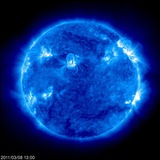
M-CLASS SOLAR FLARE: Rash-like sunspot AR2918 erupted during the early hours of Dec. 28th (0401 UT), producing a M1.8-class solar flare: movie. A pulse of X-rays ionized the top of Earth's atmosphere; this, in turn, caused a minor shortwave radio blackout over Australia: map. First-look data suggest no Earth-directed CME will emerge from the blast site.
NO CMEs THIS TIME:
A pair of M1-class solar flares yesterday did *not* hurl CMEs toward Earth. The impulsive flares were too shortlived to lift significant clouds of plasma out of the sun's atnosphere. Maybe next time? The source of the flares, sunspot AR2918, has an unstable 'beta-gamma' magnetic field that is poised to explode again.
A pair of M1-class solar flares yesterday did *not* hurl CMEs toward Earth. The impulsive flares were too shortlived to lift significant clouds of plasma out of the sun's atnosphere. Maybe next time? The source of the flares, sunspot AR2918, has an unstable 'beta-gamma' magnetic field that is poised to explode again.
👍1
What is ACE?
The NASA Advanced Composition Explorer (ACE) satellite enables SWPC to give advance warning of geomagnetic storms. Geomagnetic storms are a natural hazard, like hurricanes and tsunamis, which the National Oceanic and Atmospheric Administration (NOAA) Space Weather Prediction Center (SWPC) forecasts for the public's benefit.
Geomagnetic storms impact the electric power grid, aircraft operations, GPS, manned spaceflight, and satellite operations, to name some of the most damaging. Severe geomagnetic storms can result in electric utility blackouts over a wide area.
The location of ACE at the L1 libration point between the Earth and the Sun, about 1,500,000 km forward of Earth, enables ACE to give up to one hour advance warning of the arrival of damaging space weather events at Earth. SWPC issues warnings of imminent geomagnetic storms using these data.
https://www.swpc.noaa.gov/products/ace-real-time-solar-wind
The NASA Advanced Composition Explorer (ACE) satellite enables SWPC to give advance warning of geomagnetic storms. Geomagnetic storms are a natural hazard, like hurricanes and tsunamis, which the National Oceanic and Atmospheric Administration (NOAA) Space Weather Prediction Center (SWPC) forecasts for the public's benefit.
Geomagnetic storms impact the electric power grid, aircraft operations, GPS, manned spaceflight, and satellite operations, to name some of the most damaging. Severe geomagnetic storms can result in electric utility blackouts over a wide area.
The location of ACE at the L1 libration point between the Earth and the Sun, about 1,500,000 km forward of Earth, enables ACE to give up to one hour advance warning of the arrival of damaging space weather events at Earth. SWPC issues warnings of imminent geomagnetic storms using these data.
https://www.swpc.noaa.gov/products/ace-real-time-solar-wind
What is a Coronal Mass Ejection (CME)?
Coronal Mass Ejections (CMEs) are large expulsions of plasma and magnetic field from the Sun’s corona. They can eject billions of tons of coronal material and carry an embedded magnetic field (frozen in flux) that is stronger than the background solar wind interplanetary magnetic field (IMF) strength.
CMEs travel outward from the Sun at speeds ranging from slower than 250 kilometers per second (km/s) to as fast as near 3000 km/s. The fastest Earth-directed CMEs can reach our planet in as little as 15-18 hours. Slower CMEs can take several days to arrive.
They expand in size as they propagate away from the Sun and larger CMEs can reach a size comprising nearly a quarter of the space between Earth and the Sun by the time it reaches our planet.
Read more: https://www.swpc.noaa.gov/news/what-coronal-mass-ejection-cme
Coronal Mass Ejections (CMEs) are large expulsions of plasma and magnetic field from the Sun’s corona. They can eject billions of tons of coronal material and carry an embedded magnetic field (frozen in flux) that is stronger than the background solar wind interplanetary magnetic field (IMF) strength.
CMEs travel outward from the Sun at speeds ranging from slower than 250 kilometers per second (km/s) to as fast as near 3000 km/s. The fastest Earth-directed CMEs can reach our planet in as little as 15-18 hours. Slower CMEs can take several days to arrive.
They expand in size as they propagate away from the Sun and larger CMEs can reach a size comprising nearly a quarter of the space between Earth and the Sun by the time it reaches our planet.
Read more: https://www.swpc.noaa.gov/news/what-coronal-mass-ejection-cme
Space Weather Today pinned «What is ACE? The NASA Advanced Composition Explorer (ACE) satellite enables SWPC to give advance warning of geomagnetic storms. Geomagnetic storms are a natural hazard, like hurricanes and tsunamis, which the National Oceanic and Atmospheric Administration…»