🚨GLOBAL ERUPTION ON THE SUN 🔥
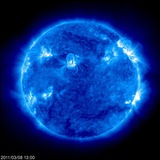
On Dec. 31st, two widely separated eruptions occured in tandem: a prominence in the sun's southern hemisphere and an M1-class flare in the sun's northern hemisphere.
The timing was probably no coincidence. NASA's Solar Dynamics Observatory long ago discovered that hemisphere-scale magnetic instabilities can ignite nearly simultaneous explosions across the face of the sun. This one did *not* hurl a CME toward Earth.
On Dec. 31st, two widely separated eruptions occured in tandem: a prominence in the sun's southern hemisphere and an M1-class flare in the sun's northern hemisphere.
The timing was probably no coincidence. NASA's Solar Dynamics Observatory long ago discovered that hemisphere-scale magnetic instabilities can ignite nearly simultaneous explosions across the face of the sun. This one did *not* hurl a CME toward Earth.
🔥1
QUADRANTID METEOR SHOWER: Earth is approaching a stream of debris from comet fragment 2003 EH1, source of the annual Quadrantid meteor shower. Forecasters expect the shower to peak at 20:40 UT (3:40 pm EST) on Jan. 3rd, producing more than 60 meteors/hour from a radiant near the North Star.
The timing of the peak favors European and Asian observers, although late arriving Quadrantids could sprinkle North America as well. Wherever you live, be alert for meteors on Monday night.
https://www.imo.net/viewing-the-2022-quadrantids/
The timing of the peak favors European and Asian observers, although late arriving Quadrantids could sprinkle North America as well. Wherever you live, be alert for meteors on Monday night.
https://www.imo.net/viewing-the-2022-quadrantids/
☄️QUADRANTID METEOR SHOWER🌌
Earth is approaching a stream of debris from comet fragment 2003 EH1, source of the annual Quadrantid meteor shower.
Forecasters expect the shower to peak at 20:40 UT (3:40 pm EST) on Jan. 3rd, producing more than 60 meteors/hour from a radiant near the North Star.
The timing of the peak favors European and Asian observers, although late arriving Quadrantids could sprinkle North America as well. Wherever you live, be alert for meteors on Monday night.
https://www.imo.net/viewing-the-2022-quadrantids/
Earth is approaching a stream of debris from comet fragment 2003 EH1, source of the annual Quadrantid meteor shower.
Forecasters expect the shower to peak at 20:40 UT (3:40 pm EST) on Jan. 3rd, producing more than 60 meteors/hour from a radiant near the North Star.
The timing of the peak favors European and Asian observers, although late arriving Quadrantids could sprinkle North America as well. Wherever you live, be alert for meteors on Monday night.
https://www.imo.net/viewing-the-2022-quadrantids/
www.imo.net
Viewing the 2022 Quadrantids | IMO
Heather Wendelboe processed this composite photograph of Quadrantid meteors from exposures taken on the morning of 3 January 2021, from Curt Gowdy State Park, Wyoming, USA © Heather Wendelboe (https://bolo-photo.com/)The Quadrantids can be one of the strongest…