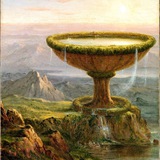
"The only thing that matters today is the activity of those who can ‘ride the wave’ and remain firm in their principles, unmoved by any concessions and indifferent to the fevers, the convulsions, the superstitions, and the prostitutions that characterize modern generations.
The only thing that matters is the silent endurance of a few, whose impassible presence as ‘stone guests’ helps to create new relationships, new distances, new values, and helps to construct a pole that, although it will certainly not prevent this world inhabited by the distracted and restless from being what it is, will still help to transmit to someone the sensation of the truth – a sensation that could become for them the principle of a liberating crisis."
Julius Evola
The only thing that matters is the silent endurance of a few, whose impassible presence as ‘stone guests’ helps to create new relationships, new distances, new values, and helps to construct a pole that, although it will certainly not prevent this world inhabited by the distracted and restless from being what it is, will still help to transmit to someone the sensation of the truth – a sensation that could become for them the principle of a liberating crisis."
Julius Evola
Forwarded from Go to @OdeToPower3 (Tiger)
This media is not supported in your browser
VIEW IN TELEGRAM
Forwarded from Acroaticus Atlas Aryanis
PART NINE
5. The Principle of Rhythm
"Everything flows, out and in; everything has its tides;
all things rise and fall; the pendulum-swing manifests in everything; the measure of the swing to the right is the measure of the swing to the left; rhythm compensates."
-The Kybalion.
"This Principle embodies the truth that in everything there is manifested a measured motion, to and fro; a flow and inflow; a swing backward and forward; a pendulum-like movement; a tide-like ebb and flow; a high-tide and low-tide; between the two poles which exist in accordance with the Principle of Polarity described a moment ago.
There is always an action and a reaction; an advance and a retreat; a rising and a sinking. This is in the affairs of the Universe, suns, worlds, men, animals, mind, energy, and matter. This law is manifest in the creation and destruction of worlds; in the rise and fall of nations; in the life of all things; and finally in the mental states of Man... "
@esotericatlantean
5. The Principle of Rhythm
"Everything flows, out and in; everything has its tides;
all things rise and fall; the pendulum-swing manifests in everything; the measure of the swing to the right is the measure of the swing to the left; rhythm compensates."
-The Kybalion.
"This Principle embodies the truth that in everything there is manifested a measured motion, to and fro; a flow and inflow; a swing backward and forward; a pendulum-like movement; a tide-like ebb and flow; a high-tide and low-tide; between the two poles which exist in accordance with the Principle of Polarity described a moment ago.
There is always an action and a reaction; an advance and a retreat; a rising and a sinking. This is in the affairs of the Universe, suns, worlds, men, animals, mind, energy, and matter. This law is manifest in the creation and destruction of worlds; in the rise and fall of nations; in the life of all things; and finally in the mental states of Man... "
@esotericatlantean
Forwarded from Acroaticus Atlas Aryanis
...continued
"(and it is with this latter that the Hermetists find the understanding of the Principle most important).
The Hermetists have grasped this Principle, finding its universal application, and have also discovered certain means to overcome its effects in themselves by the use of the appropriate formulas and methods.
They apply the Mental Law of Neutralization. They cannot annul the Principle, or cause it to cease its operation, but they have learned how to escape its effects upon themselves to a certain degree depending upon the Mastery of the Principle.
They have learned how to USE it, instead of being USED BY it. In this and similar methods, consist the Art of the Hermetists. The Master of Hermetics polarizes himself at the point at which he desires to rest, and then neutralizes the Rhythmic swing of the pendulum which would tend to carry him to the other pole.
All individuals who have attained any degree of Self-Mastery do this to a certain degree, more or less unconsciously, but the Master does this consciously, and by the use of his Will, and attains a degree of Poise and Mental Firmness almost impossible of belief on the part of the masses who are swung backward and forward like a pendulum.
This Principle and that of Polarity have been closely studied by the Hermetists, and the methods of counteracting, neutralizing, and USING them form an important part of the Hermetic Mental Alchemy."
-The Kybalion
@esotericatlantean
"(and it is with this latter that the Hermetists find the understanding of the Principle most important).
The Hermetists have grasped this Principle, finding its universal application, and have also discovered certain means to overcome its effects in themselves by the use of the appropriate formulas and methods.
They apply the Mental Law of Neutralization. They cannot annul the Principle, or cause it to cease its operation, but they have learned how to escape its effects upon themselves to a certain degree depending upon the Mastery of the Principle.
They have learned how to USE it, instead of being USED BY it. In this and similar methods, consist the Art of the Hermetists. The Master of Hermetics polarizes himself at the point at which he desires to rest, and then neutralizes the Rhythmic swing of the pendulum which would tend to carry him to the other pole.
All individuals who have attained any degree of Self-Mastery do this to a certain degree, more or less unconsciously, but the Master does this consciously, and by the use of his Will, and attains a degree of Poise and Mental Firmness almost impossible of belief on the part of the masses who are swung backward and forward like a pendulum.
This Principle and that of Polarity have been closely studied by the Hermetists, and the methods of counteracting, neutralizing, and USING them form an important part of the Hermetic Mental Alchemy."
-The Kybalion
@esotericatlantean
This media is not supported in your browser
VIEW IN TELEGRAM
"I love this music. Isn't it too dreamy?"
Audrey Horne, Twin Peaks
Aphex Twin, "Avril 14th"
Audrey Horne, Twin Peaks
Aphex Twin, "Avril 14th"
👍1
Forwarded from wandering spΛrtan
"Some people hear their own inner voices with great clearness. And they live by what they hear. Such people become crazy... or they become legend".
— Jim Harrison
— Jim Harrison
💯3
Forwarded from ᛉᛟ Viðr ᛟᛉ
“There are only a few clear truths in the world. One of them is that the protection of both nature and people entails firstly, severe restrictions to population, and secondly, drastic downscaling in the industry, consumption of goods and energy, and especially in international commerce. There is no other way to avoid the so-called ecocatastrophe.”
Pentti Linkola
Pentti Linkola
Forwarded from Wotansvolk
“Those who are too smart to engage in politics are punished by being governed by those who are dumber.”
― Plato
― Plato
Forwarded from Old and New European Art and Aesthetics
Excavation of the 'Oseberg Ship', a Viking Longship of the 9th century. 1904, Norway.
Forwarded from Æhtemen
Some elfish place names in England include Alvescot in Oxfordshire, from Ælfegescota meaning Ælf hēah's cot or Elf’s Cottage. Elvendon, also in Oxfordshire comes from Elvesdenegrof meaning Elves Wood Grove. Aluehou near Tetney in Lincolnshire comes from álfr haugr or the mound haunting by elves – somewhere to give blot on the next full moon as Frēa (Frey) and the ælfe will be invoked in many upcoming rites! Another mound haunted by elves is Elvinhowe in Gosforth in Newcastle, whilst Elveden is a valley near Thetford which is home to the elves.
Forwarded from Sigmund's Metaphysical Männerbund 🜨
Wolf-warriors/Úlfhednar
Völsunga saga recounts that during their period of exile, Sigmund and his son/nephew, Sinfjötli, (named as his nephew Fitela in Beowulf) come upon two men sleeping under wolf skins. After killing the men, they put on the hides and are cursed with lycanthropy, where they howled, fought and ate like wolves until they were able to take the skins off with magic spells ,after which they burned them.
Our number one scholar on the männerbünde, Kris Kershaw, regards this as Sigmund giving Sinfjotli his initiation and in the First Lay of Helgi Hundingsbane, from the Poetic Edda, Gudmund accuses Sinfjǫtli of being a werewolf.
🜨
Völsunga saga recounts that during their period of exile, Sigmund and his son/nephew, Sinfjötli, (named as his nephew Fitela in Beowulf) come upon two men sleeping under wolf skins. After killing the men, they put on the hides and are cursed with lycanthropy, where they howled, fought and ate like wolves until they were able to take the skins off with magic spells ,after which they burned them.
Our number one scholar on the männerbünde, Kris Kershaw, regards this as Sigmund giving Sinfjotli his initiation and in the First Lay of Helgi Hundingsbane, from the Poetic Edda, Gudmund accuses Sinfjǫtli of being a werewolf.
🜨
Faoladh | Werewolves of Ireland
The Irish werewolf is different from the Teutonic or European werewolf, as it is really not a “monster” at all.
Unlike its continental cousins, this shapeshifter is the guardian and protector of children, wounded men, and lost persons. According to some ancient sources, the Irish werewolves were even recruited by kings in time of war.
Known in their native land as the faoladh or conriocht, their predatory behavior is typical of the common wolf, not beneath the occasional nocturnal raid.
The Irish werewolf is different from the Teutonic or European werewolf, as it is really not a “monster” at all.
Unlike its continental cousins, this shapeshifter is the guardian and protector of children, wounded men, and lost persons. According to some ancient sources, the Irish werewolves were even recruited by kings in time of war.
Known in their native land as the faoladh or conriocht, their predatory behavior is typical of the common wolf, not beneath the occasional nocturnal raid.
Forwarded from Hyperborean Radio (Uncensored)
Gargoyle's are well known figures of modern fantasy, stone by day winged beasts by night. Terrifying visages upon ancient buildings staring down from ancient European cities. However, this Gargoyle, the one who fits well within the beasts of the night is a far more modern conception of what in the past were instead decorative water spouts. What people typically consider Gargoyle's are actually known as Grotesques. Though no one really calls them that as the legend of the Gargoyle has long ago subsumed the original term.
The tradition of decorative water spouts or gutters featuring monsters, dragons, humans, and chimeras of various kinds is not uncommon and was practiced across Europe and beyond. Some of them had specific stories or meanings attached to them, with the Lincoln Imp being an example of a grotesque that is tied into its own myth. The origin of the Gargoyle likely has to do with the legend of La Gargouille, a sort of dragon that plagued the town of Rouen until St. Romanus came and using the power of god tamed it, then took it into town where the people burnt it until all that remained was the neck and head which were fireproof. This was then mounted on the wall of the town, becoming the model of the Gargoyle for future generations. Though this may be a Christianized version of a practice from the ancient Celts, where the heads of the prey were possibly used as protective totems. This may be part of how the Gargoyle had its second function in the folklore. With the church including them in the architecture of cathedrals as a way to maintain attendance and acceptance of a foreign faith. The concept of protective totems made these into guardian spirits not dissimilar to the Chinese Stone Lions. These tales all seem to converge into the origin of the modern Gargoyle.
With monsters turned to stone or being the origin of a specific design. It seemed only a matter of time before these decorative demons would become a class of beasts all their own. As films, games, shows, and novels increasingly included the Gargoyle as one of its figures. With some taking a more tame approach while others embraced the demonic side espoused by the Church. The Gargoyle's current form has become a popular and beloved addition to the beasts and legends of European culture, and their status as protective wards and totems, more than deserves to return to the forefront. Whether demon or dragon, spirit or angel; The Gargoyle is a colorful and gothic addition to European culture.
The tradition of decorative water spouts or gutters featuring monsters, dragons, humans, and chimeras of various kinds is not uncommon and was practiced across Europe and beyond. Some of them had specific stories or meanings attached to them, with the Lincoln Imp being an example of a grotesque that is tied into its own myth. The origin of the Gargoyle likely has to do with the legend of La Gargouille, a sort of dragon that plagued the town of Rouen until St. Romanus came and using the power of god tamed it, then took it into town where the people burnt it until all that remained was the neck and head which were fireproof. This was then mounted on the wall of the town, becoming the model of the Gargoyle for future generations. Though this may be a Christianized version of a practice from the ancient Celts, where the heads of the prey were possibly used as protective totems. This may be part of how the Gargoyle had its second function in the folklore. With the church including them in the architecture of cathedrals as a way to maintain attendance and acceptance of a foreign faith. The concept of protective totems made these into guardian spirits not dissimilar to the Chinese Stone Lions. These tales all seem to converge into the origin of the modern Gargoyle.
With monsters turned to stone or being the origin of a specific design. It seemed only a matter of time before these decorative demons would become a class of beasts all their own. As films, games, shows, and novels increasingly included the Gargoyle as one of its figures. With some taking a more tame approach while others embraced the demonic side espoused by the Church. The Gargoyle's current form has become a popular and beloved addition to the beasts and legends of European culture, and their status as protective wards and totems, more than deserves to return to the forefront. Whether demon or dragon, spirit or angel; The Gargoyle is a colorful and gothic addition to European culture.