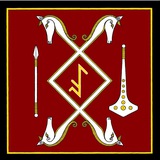
A Teutonic Symbol of Death? - Part 8
In its essence, ᛠ Éar is similar to the ᛇ,ᛦ Yew tree in its cycle of birth, life, death, and rebirth. When Fate ends our earthly life, we return to the soil (Éar). We then traveling the Hell-ways, thus returning to the sea (Éar) within Wyrd’s realm, to be judged before receiving life anew. In the underworld, the great Eormengrund, there are three springs: each containing the waters of creation, and it is this water (Éar) that cleanses Éarglæsiġ’s roots, thus sustaining the world tree. Death has no sting nor any reason for us to fear, for it is a passing into the next life, where we will meet the gods and walk with our forebears. The cycle of fate presses ever onward, for she always goes as she shall.
https://linktr.ee/TheFrithstead
In its essence, ᛠ Éar is similar to the ᛇ,ᛦ Yew tree in its cycle of birth, life, death, and rebirth. When Fate ends our earthly life, we return to the soil (Éar). We then traveling the Hell-ways, thus returning to the sea (Éar) within Wyrd’s realm, to be judged before receiving life anew. In the underworld, the great Eormengrund, there are three springs: each containing the waters of creation, and it is this water (Éar) that cleanses Éarglæsiġ’s roots, thus sustaining the world tree. Death has no sting nor any reason for us to fear, for it is a passing into the next life, where we will meet the gods and walk with our forebears. The cycle of fate presses ever onward, for she always goes as she shall.
https://linktr.ee/TheFrithstead
A Teutonic Symbol of Death? - Part 9
Our sources tell us that a “black and grey cloth” was used & we have cultural examples of the Yew tree representing death & mourning. With yews planted around religious sites & cemeteries, to the dead buried with yew shoots & its leaves a covering for graves & bodies, & the it’s use in longbows to Shakespeare’s writings & German headstone markers, the yew consistently holds its symbolism. The rune poems sources strengthen its significance. Éar in English sources & its cognate Aurr, in Norse sources are deeply imbedded terms within the core concepts of Teutonic polytheism. The most important aspect of Éar/Aurr is the fertile sea that waters & nourishes Eormensýl’s roots & the place where we travel upon our death where we stand before the gods at the Hellþing & rejoin our family line; thus, completing our cycle of fate (wyrd/orlæġ)
What is our symbol of death? We have two valid, source-backed, culturally relevant symbols. What say you?
https://linktr.ee/TheFrithstead
Our sources tell us that a “black and grey cloth” was used & we have cultural examples of the Yew tree representing death & mourning. With yews planted around religious sites & cemeteries, to the dead buried with yew shoots & its leaves a covering for graves & bodies, & the it’s use in longbows to Shakespeare’s writings & German headstone markers, the yew consistently holds its symbolism. The rune poems sources strengthen its significance. Éar in English sources & its cognate Aurr, in Norse sources are deeply imbedded terms within the core concepts of Teutonic polytheism. The most important aspect of Éar/Aurr is the fertile sea that waters & nourishes Eormensýl’s roots & the place where we travel upon our death where we stand before the gods at the Hellþing & rejoin our family line; thus, completing our cycle of fate (wyrd/orlæġ)
What is our symbol of death? We have two valid, source-backed, culturally relevant symbols. What say you?
https://linktr.ee/TheFrithstead
What is most important?
Anonymous Poll
52%
Frithstead Telegram
9%
Frithstead YouTube videos
5%
Frithstead Spotify Episodes
13%
Folcweard’s Publications (printed & ebook)?
39%
All the above
11%
I don’t care
👍1
👍5❤3
An Anglo-Saxon Royal Hall at Yeavering, Northumberland.
*Reconstruction by Peter Dunn
https://linktr.ee/TheFrithstead
*Reconstruction by Peter Dunn
https://linktr.ee/TheFrithstead
❤1
Hello and Goodbye in Old English
- Part 1 -
What the Anglo-Saxons didn’t say:
How did the Anglo-Saxons greet one another? Good Day, Good Morning, Good Afternoon, & Good Night are not attested phrases, i.e. they’re not found in the Old English writings, which indicates they didn’t use these expressions. It’s believed that these phrases weren’t even used. After the subsequent Norman invasion, the French greatly influenced the English tongue & introduced many new manners of speech. Good Day for example, is not attested in English until the early 1400s; about a century after the first French attestation. Moreover, the interjections Éalá and Hí were not used to mean Hello; they were merely interjections, such as Oh!, Alas!, Well!, or even Wow!
https://linktr.ee/TheFrithstead
- Part 1 -
What the Anglo-Saxons didn’t say:
How did the Anglo-Saxons greet one another? Good Day, Good Morning, Good Afternoon, & Good Night are not attested phrases, i.e. they’re not found in the Old English writings, which indicates they didn’t use these expressions. It’s believed that these phrases weren’t even used. After the subsequent Norman invasion, the French greatly influenced the English tongue & introduced many new manners of speech. Good Day for example, is not attested in English until the early 1400s; about a century after the first French attestation. Moreover, the interjections Éalá and Hí were not used to mean Hello; they were merely interjections, such as Oh!, Alas!, Well!, or even Wow!
https://linktr.ee/TheFrithstead
👍4
Hello and Goodbye in Old English - Part 2
What the Anglo-Saxons did say:
The Anglo-Saxon Greeting consisted of the verb to be, plus the adjectives Hál (Whole, Healthy, & or Safe) or Ġesund (Sound, Healthy, & or Safe). There are two forms of the to be verb: Wesan & Béon. In modern English, Wesan prevailed, as seen in (I) am/was, (you) are/were, (he/she/it) is/was, etc., with Béon only surviving in be, being, & been. Together, the Old English greeting was literally, “Be whole/healthy/safe (sound)”. In the Anglian dialects, the Wesan verb was preferred, e.g. Wes hál (sg.) & Wesaþ hále (pl.); whereas, the West Saxon dialects preferred the Béon verb, e.g. Béo ġesund (sg.) & Béoþ ġesunde (pl.).
https://linktr.ee/TheFrithstead
What the Anglo-Saxons did say:
The Anglo-Saxon Greeting consisted of the verb to be, plus the adjectives Hál (Whole, Healthy, & or Safe) or Ġesund (Sound, Healthy, & or Safe). There are two forms of the to be verb: Wesan & Béon. In modern English, Wesan prevailed, as seen in (I) am/was, (you) are/were, (he/she/it) is/was, etc., with Béon only surviving in be, being, & been. Together, the Old English greeting was literally, “Be whole/healthy/safe (sound)”. In the Anglian dialects, the Wesan verb was preferred, e.g. Wes hál (sg.) & Wesaþ hále (pl.); whereas, the West Saxon dialects preferred the Béon verb, e.g. Béo ġesund (sg.) & Béoþ ġesunde (pl.).
https://linktr.ee/TheFrithstead
❤3👍1
Hello and Goodbye in Old English
- Part 3
How did the Anglo-Saxons say Goodbye?
Instead of using the to be verbs, Wesan and Béon, as they were used in greetings, the Anglo-Saxons used the verb Faran, which means to go. Similar to the greetings, they retained Ġesund (Sound, Healthy, & or Safe); so, upon taking their leave, one would say, Far ġesund (sg.) & Faraþ ġesunde (pl.)., meaning “Go (in) health / (in) safety / (in) *wholeness”. *Wholeness in context means uninjured.
https://linktr.ee/TheFrithstead
- Part 3
How did the Anglo-Saxons say Goodbye?
Instead of using the to be verbs, Wesan and Béon, as they were used in greetings, the Anglo-Saxons used the verb Faran, which means to go. Similar to the greetings, they retained Ġesund (Sound, Healthy, & or Safe); so, upon taking their leave, one would say, Far ġesund (sg.) & Faraþ ġesunde (pl.)., meaning “Go (in) health / (in) safety / (in) *wholeness”. *Wholeness in context means uninjured.
https://linktr.ee/TheFrithstead
❤2
The Coppergate, or York Helmet, is a 700s CE Anglo-Saxon helmet discovered in May 1982 at the bottom of a well. The crested design was prevalent in England and Scandinavia from approximately 500 CE through to the 1000s CE. The helmet consists of four parts: an iron skull cap with brass edging and decorations, two iron cheek guards with brass edging, and chain mail protecting the neck. It appears to have been intentionally hidden in the well. Between 758 CE and 867 CE every Northumbrian King, whose fate is known, was either murdered, killed in battle, or dethroned. In the continuance of violence and political upheaval, the Scandinavians invaded in 866 CE. It makes one wonder about the life of the soldier who hid his helmet.
thefrithstead.com
thefrithstead.com
👍4
"For the belief in the gods has not been established by authority, custom or law, but rests on the unanimous and abiding consensus of mankind; their existence is therefore a necessary inference, since we possess an instinctive or rather an innate concept of them; but a belief which all men by nature share must necessarily be true; therefore it must be admitted that the gods exist."
- Marcus Tullius Cicero, De Natura Deorum
@collispalatinus
- Marcus Tullius Cicero, De Natura Deorum
@collispalatinus
👍1
As the seasons turns, life pushes onward & new growth emerges. May we strive to better ourselves & remain steadfast in honor & loyalty to our forebears, gods, bloodkin, & folk. Béoþ ġesunde.
Folcsida • Mǽġþ • Folc
https://linktr.ee/TheFrithstead
Folcsida • Mǽġþ • Folc
https://linktr.ee/TheFrithstead
❤4👍1
Found in 1934 in Bad Dürrenberg, Germany, an upper 20s woman, with a 6-12 mos child, was buried in an upright, sitting position, packed in red clay, indicative of high social status. Dating indicates they lived +/- 6,500 BCE. She had a head-dress, indicative of a Shaman, made from the bones several animals. Arrowheads & tools were present. Forensics say she died from an infection & passed the infection to her child through breast milk
Changes to the base of her skull & an abnormality of her cervical vertebrae, are indicative of significant physical effects upon her daily life, such as the sensation of insects crawling across her body (from nerve compression) & auditory or visual hallucinations. It’s theorized that by tilting her head, she could have effectively brought on near instantaneous altered state of consciousness, as blood flow was slowed or halted. While her skeletal abnormalities were debilitating, it seemed it gave her a position of prestige, as her tribe’s Shaman.
thefrithstead.com
Changes to the base of her skull & an abnormality of her cervical vertebrae, are indicative of significant physical effects upon her daily life, such as the sensation of insects crawling across her body (from nerve compression) & auditory or visual hallucinations. It’s theorized that by tilting her head, she could have effectively brought on near instantaneous altered state of consciousness, as blood flow was slowed or halted. While her skeletal abnormalities were debilitating, it seemed it gave her a position of prestige, as her tribe’s Shaman.
thefrithstead.com
👍6
On the Runes - Part 1
"Then gathered the Regin at their rökstóla" -- Voluspa
The refrain occurs 4 times in the Norse-Icelandic poem, Völuspá, where it presents the gods gathering at council. The word used of the gods, Regin, is found in each of the major Germanic languages group (North, West and East) and in each carries the sense of "to council, to decree, to judge (or might)", a rendering in line with the place of the Regin on their "Rökstóla" or stola (stools, seats, chairs) of Rök (judgement, fate)
In the Prose Edda we read,
"The third root of the Ash stands in heaven; and under that root is the spring, which is very holy, that is called the Well of Urðr; there the gods hold their tribunal (Dómstað, doom/judgement stead).
Runic study by Jamie Martin
https://linktr.ee/TheFrithstead
"Then gathered the Regin at their rökstóla" -- Voluspa
The refrain occurs 4 times in the Norse-Icelandic poem, Völuspá, where it presents the gods gathering at council. The word used of the gods, Regin, is found in each of the major Germanic languages group (North, West and East) and in each carries the sense of "to council, to decree, to judge (or might)", a rendering in line with the place of the Regin on their "Rökstóla" or stola (stools, seats, chairs) of Rök (judgement, fate)
In the Prose Edda we read,
"The third root of the Ash stands in heaven; and under that root is the spring, which is very holy, that is called the Well of Urðr; there the gods hold their tribunal (Dómstað, doom/judgement stead).
Runic study by Jamie Martin
https://linktr.ee/TheFrithstead
❤4👍1
Due to technical difficulties, I've been lacking in YouTube videos and Spotify episodes; however, I believe I've found a work-around. I currently re-did the last video & episode and am re-uploading them to Spotify and YouTube. New uploads are planned, so let's hope the tech-headaches don't return.
Check out the updated Spotify version now:
https://open.spotify.com/episode/6gASOXwQBLyDJnY1fcy2PS?si=iADQQsXYQ32BlPv6J1AWyw
Check out the updated Spotify version now:
https://open.spotify.com/episode/6gASOXwQBLyDJnY1fcy2PS?si=iADQQsXYQ32BlPv6J1AWyw
👍8
On the Runes - Part 2
In Hávamál 111,
"It is time to recite from the þulr's throne at Urðarbrunnr. … I heard judgements made about runes…".
And earlier in stanza 80,
"what you ask the runes, come from the Regin, which the great regin made, and the mighty Þulr painted”
And so the Regin gather "at the spring of Wyrd (Urðr)", where they hold their Thing and pronounce judgements.
It is also at the spring of Wyrd that one hears the councils of the runes, which spring from the Regin.
Runic study by Jamie Martin
https://linktr.ee/TheFrithstead
In Hávamál 111,
"It is time to recite from the þulr's throne at Urðarbrunnr. … I heard judgements made about runes…".
And earlier in stanza 80,
"what you ask the runes, come from the Regin, which the great regin made, and the mighty Þulr painted”
And so the Regin gather "at the spring of Wyrd (Urðr)", where they hold their Thing and pronounce judgements.
It is also at the spring of Wyrd that one hears the councils of the runes, which spring from the Regin.
Runic study by Jamie Martin
https://linktr.ee/TheFrithstead
On the Runes - Part 3
c.55 BCE, Julius Caesar wrote about the practices of the Teutonic peoples,
"the lots were consulted three times in his presence to determine if he would be burned to death immediately or whether he would be saved for some other time. By the beneficence of the lots he emerged unscathed"
In 98 CE Tacitus wrote the following,
"But they may not execute, they may not bind, they may not even strike an offender; those are the privileges solely of the priests, and they do such things not as a form of military punishment nor at the warlord's bidding, but as if such were at the express commands of the god that accompanies them to war"
In the 700s, Alcuin of York wrote,
"He became inflamed with rage and was determined to have vengeance on the man of God for the injury he had done to the gods of the island. For three days, in three villages, he spent his time casting the lots, but the lot of the damned would never fall"
Runic study by Jamie Martin
https://linktr.ee/TheFrithstead
c.55 BCE, Julius Caesar wrote about the practices of the Teutonic peoples,
"the lots were consulted three times in his presence to determine if he would be burned to death immediately or whether he would be saved for some other time. By the beneficence of the lots he emerged unscathed"
In 98 CE Tacitus wrote the following,
"But they may not execute, they may not bind, they may not even strike an offender; those are the privileges solely of the priests, and they do such things not as a form of military punishment nor at the warlord's bidding, but as if such were at the express commands of the god that accompanies them to war"
In the 700s, Alcuin of York wrote,
"He became inflamed with rage and was determined to have vengeance on the man of God for the injury he had done to the gods of the island. For three days, in three villages, he spent his time casting the lots, but the lot of the damned would never fall"
Runic study by Jamie Martin
https://linktr.ee/TheFrithstead
👍1