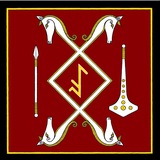
On the Runes - Part 2
In Hávamál 111,
"It is time to recite from the þulr's throne at Urðarbrunnr. … I heard judgements made about runes…".
And earlier in stanza 80,
"what you ask the runes, come from the Regin, which the great regin made, and the mighty Þulr painted”
And so the Regin gather "at the spring of Wyrd (Urðr)", where they hold their Thing and pronounce judgements.
It is also at the spring of Wyrd that one hears the councils of the runes, which spring from the Regin.
Runic study by Jamie Martin
https://linktr.ee/TheFrithstead
In Hávamál 111,
"It is time to recite from the þulr's throne at Urðarbrunnr. … I heard judgements made about runes…".
And earlier in stanza 80,
"what you ask the runes, come from the Regin, which the great regin made, and the mighty Þulr painted”
And so the Regin gather "at the spring of Wyrd (Urðr)", where they hold their Thing and pronounce judgements.
It is also at the spring of Wyrd that one hears the councils of the runes, which spring from the Regin.
Runic study by Jamie Martin
https://linktr.ee/TheFrithstead
On the Runes - Part 3
c.55 BCE, Julius Caesar wrote about the practices of the Teutonic peoples,
"the lots were consulted three times in his presence to determine if he would be burned to death immediately or whether he would be saved for some other time. By the beneficence of the lots he emerged unscathed"
In 98 CE Tacitus wrote the following,
"But they may not execute, they may not bind, they may not even strike an offender; those are the privileges solely of the priests, and they do such things not as a form of military punishment nor at the warlord's bidding, but as if such were at the express commands of the god that accompanies them to war"
In the 700s, Alcuin of York wrote,
"He became inflamed with rage and was determined to have vengeance on the man of God for the injury he had done to the gods of the island. For three days, in three villages, he spent his time casting the lots, but the lot of the damned would never fall"
Runic study by Jamie Martin
https://linktr.ee/TheFrithstead
c.55 BCE, Julius Caesar wrote about the practices of the Teutonic peoples,
"the lots were consulted three times in his presence to determine if he would be burned to death immediately or whether he would be saved for some other time. By the beneficence of the lots he emerged unscathed"
In 98 CE Tacitus wrote the following,
"But they may not execute, they may not bind, they may not even strike an offender; those are the privileges solely of the priests, and they do such things not as a form of military punishment nor at the warlord's bidding, but as if such were at the express commands of the god that accompanies them to war"
In the 700s, Alcuin of York wrote,
"He became inflamed with rage and was determined to have vengeance on the man of God for the injury he had done to the gods of the island. For three days, in three villages, he spent his time casting the lots, but the lot of the damned would never fall"
Runic study by Jamie Martin
https://linktr.ee/TheFrithstead
👍1
Due to technical difficulties, I've been lacking in YouTube videos and Spotify episodes; however, I believe I've found a work-around. I currently re-worked & updated the last video & episode and am re-uploading them to Spotify and YouTube. New uploads are planned, so let's hope the tech-headaches don't return.
Check out the updated YouTube version now:
https://youtu.be/SaQ1zAC-afMf
Check out the updated YouTube version now:
https://youtu.be/SaQ1zAC-afMf
YouTube
Folcsida and The Frithstead
What is Folcsida and The Frithstead?
What is the mission and purpose of The Frithstead?
What is the Call of the Frithstead?
What is the mission and purpose of The Frithstead?
What is the Call of the Frithstead?
On the Runes - Part 3
Thietmar of Merseberg on Divination
To carefully protect this shrine, the inhabitants have special priests. When they convene to offer sacrifices or assuage their anger, the priests sit while everyone else stands. Murmuring together in secret, they tremble & dig in the earth so that, after casting lots, they acquire certainty in questionable matters. When finished, they cover the lots with green grass & after placing two spears crosswise on the ground, lead over them a horse; the largest of all & venerate as sacred. That which the casting of lots had already revealed to them, should also be foretold by this almost divine beast, it’s carried out in fact. Otherwise, the unhappy folk reject it. An ancient … tradition also testifies that, if … a long period of internal warfare is imminent, a boar whose teeth are white & glistening with foam will emerge from the lake & appear while disporting itself in the mire
Runic study by Jamie Martin
https://linktr.ee/TheFrithstead
Thietmar of Merseberg on Divination
To carefully protect this shrine, the inhabitants have special priests. When they convene to offer sacrifices or assuage their anger, the priests sit while everyone else stands. Murmuring together in secret, they tremble & dig in the earth so that, after casting lots, they acquire certainty in questionable matters. When finished, they cover the lots with green grass & after placing two spears crosswise on the ground, lead over them a horse; the largest of all & venerate as sacred. That which the casting of lots had already revealed to them, should also be foretold by this almost divine beast, it’s carried out in fact. Otherwise, the unhappy folk reject it. An ancient … tradition also testifies that, if … a long period of internal warfare is imminent, a boar whose teeth are white & glistening with foam will emerge from the lake & appear while disporting itself in the mire
Runic study by Jamie Martin
https://linktr.ee/TheFrithstead
👍1
What’s your level of Old English interest?
Anonymous Poll
59%
If you create a Telegram group to learn about it, I’ll join!
13%
Just continue to post about it l.
20%
I’m neutral; passing interest maybe.
6%
Not my thing & don’t care
2%
Other (leave comment)
Forwarded from The American Spirit
Joseph Palmer, Bearded Heretic
It may seem odd to think of today but once having a beard was so culturally unacceptable that people were berated, ostracized and insulted for wearing a beard. Such was the story of Joseph Palmer, an American farmer who grew a beard and was not only accused of being a heretic who emulated Satan with his mane, but was attacked with scissors in an attempt to remove his beard and then thrown in prison when the burly American proceeded to defend himself with a knife and stab some Christian Zealots in the leg. Serving a 15 month prison term for "assault" Palmer would eventually leave after his mother pleaded him to pay the fine, which he had refused as it would be akin to admitting he was at fault. He then joined the ill fated Utopian group the Fruitlands and after it fell apart bought the land and farmed it. His grave contains the Quote
"Persecuted for Wearing the Beard"
By the time of his death beards had gone from hirsute heresy to the norm once more.
It may seem odd to think of today but once having a beard was so culturally unacceptable that people were berated, ostracized and insulted for wearing a beard. Such was the story of Joseph Palmer, an American farmer who grew a beard and was not only accused of being a heretic who emulated Satan with his mane, but was attacked with scissors in an attempt to remove his beard and then thrown in prison when the burly American proceeded to defend himself with a knife and stab some Christian Zealots in the leg. Serving a 15 month prison term for "assault" Palmer would eventually leave after his mother pleaded him to pay the fine, which he had refused as it would be akin to admitting he was at fault. He then joined the ill fated Utopian group the Fruitlands and after it fell apart bought the land and farmed it. His grave contains the Quote
"Persecuted for Wearing the Beard"
By the time of his death beards had gone from hirsute heresy to the norm once more.
Loga is not a god, but a níðing sentenced for the crime of orchestrating Bældæġ's death & cast into the dark & frigid depths of Mysthell & bound by his children’s entrails
He was not just a trickster, a god of mischief, nor Wóden's son. These come from Marvel Comics. He’s a traitorous Eoten, who lies at every turn
His trickery began for amusement, but became malicious. Despite all he’d done, it wasn't until in Éagor's hall, did he confess to murdering Wóden’s son. Declared a níðing and given the punishment of one. This is a testament to the patience & mercy of our gods
There are no historical locations named after him & no authentic lore referencing his worship. To honor Loga is to blaspheme against the gods by aligning as their enemy
We, their children, worship the Ésa, as well as the Wanas & Ylfe; they alone deserve our praise, devotion, & love
Hail the true Holy Gods!
~ Sworen þám Ésum
https://linktr.ee/TheFrithstead
He was not just a trickster, a god of mischief, nor Wóden's son. These come from Marvel Comics. He’s a traitorous Eoten, who lies at every turn
His trickery began for amusement, but became malicious. Despite all he’d done, it wasn't until in Éagor's hall, did he confess to murdering Wóden’s son. Declared a níðing and given the punishment of one. This is a testament to the patience & mercy of our gods
There are no historical locations named after him & no authentic lore referencing his worship. To honor Loga is to blaspheme against the gods by aligning as their enemy
We, their children, worship the Ésa, as well as the Wanas & Ylfe; they alone deserve our praise, devotion, & love
Hail the true Holy Gods!
~ Sworen þám Ésum
https://linktr.ee/TheFrithstead
👍9❤4👎2
In response to yesterdays Loga post, there are some who view Loga as god. The issue here, I believe, is timeline placement. When he was Wóden’s blood-oath kinsman, and counted amongst the Ése, he was considered a god; however, because of his guilty verdict (in Lokasenna), his dastardly deed (in killing Bældæġ), he was dishonorably released from the oath & discounted from Ése status. These things, with his subsequent punishment, reduced him to no longer being a god, but a níðing traitor worthy of scorn & contempt. Throughout Heathen times, our folk was strongly centered on law and order, bolstered by foundational morals, such honor, piety, courage, hospitality, etc. Ragnarǫk aside, as that’s a future event, but everything in the Lore is recordings of past events, mythological truths given to us as a guide to gain necessary knowledge & understanding.
👍12
Episode 2 now on Spotify!
https://open.spotify.com/episode/4110J3w1kFv4MMWLht9CJQ?si=dYXo2uJaTyi9NxPRML6T1Q
https://open.spotify.com/episode/4110J3w1kFv4MMWLht9CJQ?si=dYXo2uJaTyi9NxPRML6T1Q
👍3
Forwarded from The Frithstead (ᛉ Folcweard ᛦ)
The Forces of Chaos - Part 2
The Eotenas are the enemies of the gods and man. The Higher powers are separated by tribal affiliations, just as we are. Allegiances are made and each are bound by that choice. One cannot simply honor the Eotenas because some of the gods are “Part Eoten”. Either we’re loyal to the gods or we’re not. Wóden, Hanwer, and Léod claim descent through both the god and eoten lines; however, when two opposing forces join, a choice will have to be made; one cannot serve two masters. Wóden is the Ealfæder & king of the Ésa. Hanwer, aligned with Wóden and fathered the Wanas. Léod, father of the Ylfas & Dweorgas (Dvergar), however, rebelled and aligned as the Eotenas. We either follow the gods or we do not. Honoring the Éotanas, such as Loga (Loki) or Goldwǽġe (Gullveig) is to declare oneself an enemy of the gods and man and won’t bode well for you at the Helþing. Rise up and take a stand. We cannot walk both paths. Declare your spiritual choice.
https://linktr.ee/TheFrithstead
The Eotenas are the enemies of the gods and man. The Higher powers are separated by tribal affiliations, just as we are. Allegiances are made and each are bound by that choice. One cannot simply honor the Eotenas because some of the gods are “Part Eoten”. Either we’re loyal to the gods or we’re not. Wóden, Hanwer, and Léod claim descent through both the god and eoten lines; however, when two opposing forces join, a choice will have to be made; one cannot serve two masters. Wóden is the Ealfæder & king of the Ésa. Hanwer, aligned with Wóden and fathered the Wanas. Léod, father of the Ylfas & Dweorgas (Dvergar), however, rebelled and aligned as the Eotenas. We either follow the gods or we do not. Honoring the Éotanas, such as Loga (Loki) or Goldwǽġe (Gullveig) is to declare oneself an enemy of the gods and man and won’t bode well for you at the Helþing. Rise up and take a stand. We cannot walk both paths. Declare your spiritual choice.
https://linktr.ee/TheFrithstead
👍3
Forwarded from Sigmund's Metaphysical Männerbund 🜨
Book recommendation - The Elder Gods: The Otherworld of Early England by Stephen Pollington.
Stephen Pollington is probably the best known author on Anglo Saxon history and Old English, and for good reason. I endorse any of his books, but this one in particular, The Elder Gods, is a must read for all Anglo Saxon heathens.
Here, Pollington condenses an enormous amount of information in the space of around 450 pages and its very comprehensive, covering the gods, myth, burial customs, types of ritual, poetry, archaeology, folklore, the three functions, supernatural entities, art, magic, runes, etc. It discusses pretty much everything you need to know and I hold it as one of the most important books in my collection.
🜨
https://www.asbooks.co.uk/t%20elder-gods.htm
Stephen Pollington is probably the best known author on Anglo Saxon history and Old English, and for good reason. I endorse any of his books, but this one in particular, The Elder Gods, is a must read for all Anglo Saxon heathens.
Here, Pollington condenses an enormous amount of information in the space of around 450 pages and its very comprehensive, covering the gods, myth, burial customs, types of ritual, poetry, archaeology, folklore, the three functions, supernatural entities, art, magic, runes, etc. It discusses pretty much everything you need to know and I hold it as one of the most important books in my collection.
🜨
https://www.asbooks.co.uk/t%20elder-gods.htm
Forwarded from Survive the Jive: All-feed
The Norse god Baldr is the same as the English god Bældæg "pyre day" and the latter refers to some kind of fire festival in Germanic cultures. The two names sound the same but they are not cognates, however other evidence proves they are the same god as I show here
https://odysee.com/@SurvivetheJive:c/balday:2?r=AEKqgwkPWidrWMdxwxNjBE8p3kA9tT6n
https://odysee.com/@SurvivetheJive:c/balday:2?r=AEKqgwkPWidrWMdxwxNjBE8p3kA9tT6n
Odysee
The Anglo-Saxon god Bældæg is the Norse Baldr
A video about the Anglo-Saxon god Bældæg "pyre day". Bældæg is attested in Anglo-Saxon genealogies as the son of Woden. He is often argued to be the English equivalent of the Norse god Baldr who is Oð...
Forwarded from Sigmund's Metaphysical Männerbund 🜨
One of my favourite historical figures.
There's a lot of uncertainty and legend around Hereward the Wake, but we're told he was born into nobility in 1035 and held lands in Lincolnshire.
At 18 he was exiled by Edward the Confessor, where he travelled between Cornwall, Ireland and Flanders adventuring.
He returned to England in 1067 to find that his lands had been taken and his brother killed by the Normans. He took revenge, killing 15 men single handedly, and fled back to Flanders.
He returned again in 1070 to join the English rebellion centred in the fens around the Isle of Ely, becoming quite a nuisance to the Normans and was soon joined by Morcar, the former earl of Northrumbia.
In 1071 they made their final stand at the fortress on Ely where Morcar was captured but Hereward escaped.
The accounts vary about what happened next but I think it likely he fled abroad as an exile as so many other English nobles did, but his legend lived on, perhaps influencing other outlaw figures like Robin Hood.
🜨
There's a lot of uncertainty and legend around Hereward the Wake, but we're told he was born into nobility in 1035 and held lands in Lincolnshire.
At 18 he was exiled by Edward the Confessor, where he travelled between Cornwall, Ireland and Flanders adventuring.
He returned to England in 1067 to find that his lands had been taken and his brother killed by the Normans. He took revenge, killing 15 men single handedly, and fled back to Flanders.
He returned again in 1070 to join the English rebellion centred in the fens around the Isle of Ely, becoming quite a nuisance to the Normans and was soon joined by Morcar, the former earl of Northrumbia.
In 1071 they made their final stand at the fortress on Ely where Morcar was captured but Hereward escaped.
The accounts vary about what happened next but I think it likely he fled abroad as an exile as so many other English nobles did, but his legend lived on, perhaps influencing other outlaw figures like Robin Hood.
🜨