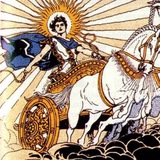
Adonis of Arkaim
“Once you had passions and named them evil. But now you have only your virtues: they grew out of your passions. You set your highest goal at the heart of these passions, and then they became your virtues and passions of pleasure. And whether you stemmed from…
We’re out here doing alchemy and shit
🔥8👏1
Another buddhist friend’s channel. Check him out, he knows his shit
https://news.1rj.ru/str/Advayajnana
https://news.1rj.ru/str/Advayajnana
Telegram
Meditations of a Yogin
Thoughts of a Sadhaka.
Forwarded from The Elders of the Black Sun II
greek_buddha_pyrrho_s_encounter_with_early_buddhism_in_central_asia.pdf
1.7 MB
"... it must be noted that the Buddha is the only Indian holy man, before early modern times who bares an epithet explicitly identifying him as a non-Indian, a foreigner. It would have been unthinkably odd for an Indian saint to be given a foreign epithet if he was not actually a foreigner. Moreover the Scythians-Sakas are well attested in Greek and Persian historical sources before even the traditional "high" date of the Buddha so the epithet should have originally been applied to him already in Central Asia proper or its eastern extension into India - Eastern Gandhara..."
👍2
Forwarded from Indo-European Way
"In contemporary Western popular culture, the Buddha is commonly portrayed as an androgynous, asexual character, often in a seated meditation posture and wearing a beatific smile (...) in Indian Buddhist literature, however, a very different version of the Buddha and his monastic followers appears: the Buddha is described as the paragon of masculinity, the “ultimate man” (purusottama), and is referred to by a range of epithets that extol his manly qualities, his extraordinarily beautiful body, his superhuman virility and physical strength, his skill in martial arts, and the effect he has on women who see him. Many Buddhist monks are depicted as young, handsome, and virile, and the greatest challenge to their religious devotion is lustful women propositioning them for sex. This is even true of elderly monks, who also fend off unwanted advances.
(...)
Why, then, have contemporary interpreters of Buddhism generally overlooked these discourses? Why has the supremely masculine Buddha depicted in the Pali canon and other Indic literature been eclipsed by the androgynous figure of modern imagination and the ascetic meditation master and philosopher of scholars? Part of the reason probably lies in the backgrounds of contemporary interpreters of Buddhism and the blind spots that every culture bequeaths to its inhabitants (...) in addition, most modern scholars of Buddhism were born and raised in societies in which Judeo-Christian traditions predominate, and even those who are not overtly religious have been influenced by them.
(...)
Since undertaking this project, I have been struck by the pervasiveness of ultramasculine images in Indian Buddhist texts—texts that in some cases I had read many times without even noticing these tropes. Once I began looking, however, they seemed to leap from the pages and confront me with a completely new version of the Buddha, one who personified the ideals of the Indian warrior class (ksatriya), who caused women to faint because of his physical beauty, and who converted people to his teachings through the perceptual impact of his extraordinary physique.
In the “Discourse to Canki,” for example, the Buddha is described as “handsome, good looking, graceful, possessing supreme beauty of complexion, with sublime beauty and sublime presence, remarkable to behold.” In the “Discourse to Sonadanda,” a group of brahmans comes to visit him. One of them, a young man named Angaka, is described as “handsome, good-looking, pleasant to look at, of supremely fair complexion, in form and complexion like the god Brahma, of excellent appearance,” but the brahman who gives this denoscription hastens to add that the Buddha is even more handsome."
-- John Powers, "A Bull of a Man : Images of Masculinity, Sex, and the Body in Indian Buddhism", pp. 1-3
(...)
Why, then, have contemporary interpreters of Buddhism generally overlooked these discourses? Why has the supremely masculine Buddha depicted in the Pali canon and other Indic literature been eclipsed by the androgynous figure of modern imagination and the ascetic meditation master and philosopher of scholars? Part of the reason probably lies in the backgrounds of contemporary interpreters of Buddhism and the blind spots that every culture bequeaths to its inhabitants (...) in addition, most modern scholars of Buddhism were born and raised in societies in which Judeo-Christian traditions predominate, and even those who are not overtly religious have been influenced by them.
(...)
Since undertaking this project, I have been struck by the pervasiveness of ultramasculine images in Indian Buddhist texts—texts that in some cases I had read many times without even noticing these tropes. Once I began looking, however, they seemed to leap from the pages and confront me with a completely new version of the Buddha, one who personified the ideals of the Indian warrior class (ksatriya), who caused women to faint because of his physical beauty, and who converted people to his teachings through the perceptual impact of his extraordinary physique.
In the “Discourse to Canki,” for example, the Buddha is described as “handsome, good looking, graceful, possessing supreme beauty of complexion, with sublime beauty and sublime presence, remarkable to behold.” In the “Discourse to Sonadanda,” a group of brahmans comes to visit him. One of them, a young man named Angaka, is described as “handsome, good-looking, pleasant to look at, of supremely fair complexion, in form and complexion like the god Brahma, of excellent appearance,” but the brahman who gives this denoscription hastens to add that the Buddha is even more handsome."
-- John Powers, "A Bull of a Man : Images of Masculinity, Sex, and the Body in Indian Buddhism", pp. 1-3
👍7🔥1
Let me tell you about my personal experience with smoking Marlboros... I don't find it particularly detrimental to my health. When I do smoke, I do it. The cigarette ends, I put it down, and watch throughout the process. And you have accomplished another occupation in your life, as much as your toilet flushing down.
Chogyam Trungpa
Chogyam Trungpa
😢2
Adonis of Arkaim
Eternity is in love with the productions of time William Blake
I'll be elaborating on this quote a lot in the near future
[Dharmadhatu] is the unimpeded mutual solution of all particularities, where each particularity, besides being itself, penetrates all other particularities and is in turn penetrated by them. This harmonious interplay between particularities and also between each particularity and universality creates a luminous universe, free from spatial and temporal limitations and yet no less the world of daily affairs. This is called dharmadhatu. In it, the boundaries of each particularity melt away, and the reality of each becomes infinitely interfused with every other being.
🔥10❤1👍1
Adonis of Arkaim
Let me tell you about my personal experience with smoking Marlboros... I don't find it particularly detrimental to my health. When I do smoke, I do it. The cigarette ends, I put it down, and watch throughout the process. And you have accomplished another occupation…
Everything in your life can be a meditation. Be eternally present. Don’t live unconsciously and let the moments slip by unattended.
Every moment contains the whole of eternity.
Every moment contains the whole of eternity.
❤11👍2
Just so, although obscured behind afflictions,
The dharmadhatu has no trace of flaw.
While samsara blocks its light, it does not illuminate;
Nirvana gained, its light will brilliantly shine.
…
The dharmadhatu is not the self.
It is neither man nor woman either;
And being beyond everything perceivable,
Just how could it be thought of as oneself?
Nagarjuna (Praise of Dharmadhatu)
The dharmadhatu has no trace of flaw.
While samsara blocks its light, it does not illuminate;
Nirvana gained, its light will brilliantly shine.
…
The dharmadhatu is not the self.
It is neither man nor woman either;
And being beyond everything perceivable,
Just how could it be thought of as oneself?
Nagarjuna (Praise of Dharmadhatu)
🔥2
I’m a little torn on what to do with this page, honestly. Im not a teacher, and even if I was, I can’t teach you anything here. None of these quotes really make sense until you practice, it’s just words on a screen. So I’m not really sure what it’s for.
I’ve gotten very tired of conceptualizing lately.
I’ve gotten very tired of conceptualizing lately.
🙏2
Adonis of Arkaim
I’m a little torn on what to do with this page, honestly. Im not a teacher, and even if I was, I can’t teach you anything here. None of these quotes really make sense until you practice, it’s just words on a screen. So I’m not really sure what it’s for. …
Just remember to meditate, and that concepts are gay
👍5