In Goethe’s Faust, Mephistopheles takes Faust to a mountain where he witnesses a Witch’s Sabbath. The unholy meeting of demons and humans featured satanic offerings and resulted in plagues. Stories of these gatherings have a long history in European literature.
This work is scandalous by most people’s sensibilities–however, it is illustrative of contradictory attitude towards nudity in nineteenth century France and most of western society.
At a time when it was shameful to see a woman’s ankles in public, it was somehow acceptable for more-than-suggestive works featuring nudity, as long as the narrative was tied to some redeemable theme.
Faust's Vision (also known as The Departure of the Witches), 1878 by Luis Ricardo Falero
This work is scandalous by most people’s sensibilities–however, it is illustrative of contradictory attitude towards nudity in nineteenth century France and most of western society.
At a time when it was shameful to see a woman’s ankles in public, it was somehow acceptable for more-than-suggestive works featuring nudity, as long as the narrative was tied to some redeemable theme.
Faust's Vision (also known as The Departure of the Witches), 1878 by Luis Ricardo Falero
“There is no light without shadow and no psychic wholeness without imperfection. To round itself out, life calls not for perfection but for completeness; and for this the “thorn in the flesh” is needed, the suffering of defects without which there is no progress and no ascent.” (Carl Jung, Psychology and Alchemy)
.
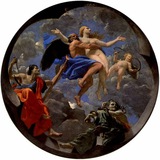
Art: Jules-Élie Delaunay: Ixion précipité dans les Enfers
.
.
Art: Jules-Élie Delaunay: Ixion précipité dans les Enfers
.
Karl Friedrich Schinkel (13 March 1781 – 9 October 1841) was a Prussian architect, city planner, and painter who also designed stage sets, like the background for Mozart's Magic Flute.