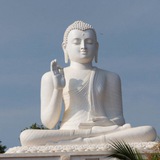
“There are four persons, ananda, worthy of a stupa. Who are the four? A Tathagata, a Fully Awakened Buddha; a Paccekabuddha; a disciple of the Tathagata who is an Arahant; and a universal monarch (Chakravartin).”
“And why, Ananda, is a stupa for the Tathagata worthy of a stupa? At the thought: ‘This is the stupa of the Tathagata, the Arahant, the Fully Awakened Buddha,’ the hearts of many people are inspired, and they gain in happiness and faith, leading to a good rebirth.”
“And likewise with regard to the other three: a Paccekabuddha, an Arahant disciple of the Tathagata, and a universal monarch. That is why, ananda, there are four persons worthy of a stupa.”
Digha Nikaya, Sutta 16 : Mahaparinibbana Sutta
“And why, Ananda, is a stupa for the Tathagata worthy of a stupa? At the thought: ‘This is the stupa of the Tathagata, the Arahant, the Fully Awakened Buddha,’ the hearts of many people are inspired, and they gain in happiness and faith, leading to a good rebirth.”
“And likewise with regard to the other three: a Paccekabuddha, an Arahant disciple of the Tathagata, and a universal monarch. That is why, ananda, there are four persons worthy of a stupa.”
Digha Nikaya, Sutta 16 : Mahaparinibbana Sutta
❤1👍1🥰1😍1🏆1
Forwarded from Buddha Dharma books
Free Buddha Dharma ebook
The Colour Illustrated Story of the Buddha
By Piyaratne Hewabattage
This is a book which tells a story. The story is unlike many others, because, although it has all the right ingredients, (kings, princesses, chariots and the like), this particular one is about a historical person who lived in India in the 6th century, B.C.
The Way of Life taught by the Buddha is followed by more than one fifth of the world population today and it is hoped that this book may promote interest in Buddhism as well as help to bring about under- standing between different cultures. It meets a long-felt need in the West for a book to be read by and to children about the Buddha's life and times.
The publishers would like to thank everyone who helped to make this book a fact, both friends here in England and those in Sri Lanka. We hope very much that this will be the first in a series of books and that our helpers will continue to give us their kind assistance in the future.
Stories are for children, but they are also for adults so we hope that this rather special one will be enjoyed by everyone who has the capacity and imagination which is so uniquely a privilege of children the whole world over.
Free download here:
http://ftp.budaedu.org/ebooks/pdf/EN063.pdf
=============
The Colour Illustrated Story of the Buddha
By Piyaratne Hewabattage
This is a book which tells a story. The story is unlike many others, because, although it has all the right ingredients, (kings, princesses, chariots and the like), this particular one is about a historical person who lived in India in the 6th century, B.C.
The Way of Life taught by the Buddha is followed by more than one fifth of the world population today and it is hoped that this book may promote interest in Buddhism as well as help to bring about under- standing between different cultures. It meets a long-felt need in the West for a book to be read by and to children about the Buddha's life and times.
The publishers would like to thank everyone who helped to make this book a fact, both friends here in England and those in Sri Lanka. We hope very much that this will be the first in a series of books and that our helpers will continue to give us their kind assistance in the future.
Stories are for children, but they are also for adults so we hope that this rather special one will be enjoyed by everyone who has the capacity and imagination which is so uniquely a privilege of children the whole world over.
Free download here:
http://ftp.budaedu.org/ebooks/pdf/EN063.pdf
=============
👍1🥰1
Dhammapada Verse 112
Sappadasatthera Vatthu
Yo ca vassasatam jive
kusito1 hinaviriyo
ekaham jivitam seyyo
viriyamarabhato dalham.
Verse 112: Better than a hundred years in the life of a person who is idle and inactive, is a day in the life of one who makes a zealous and strenuous effort (in Tranquillity and Insight Development Practice).
1. kusito: an idle person; according to the Commentary, an idle person is one who passes his time only in evil thoughts.
The Story of Thera Sappadasa
While residing at the Jetavana monastery, the Buddha uttered Verse (112) of this book, with reference to Thera Sappadasa.
Once a bhikkhu was not feeling happy with the life of a bhikkhu; at the same time he felt that it would be improper and humiliating for him to return to the life of a householder. So he thought it would be better to die. So thinking, on one occasion, he put his hand into a pot where there was a snake but the snake did not bite him. This was because in a past existence the snake was a slave and the bhikkhu was his master. Because of this incident the bhikkhu was known as Thera Sappadasa. On another occasion, Thera Sappadasa took a razor to cut his throat; but as he placed the razor on his throat he reflected on the purity of his morality practice throughout his life as a bhikkhu and his whole body was suffused with delightful satisfaction (piti) and bliss (sukha). Then detaching himself from piti, he directed his mind to the development of Insight Knowledge and soon attained arahatship, and he returned to the monastery.
On arrival at the monastery, other bhikkhus asked him where he had been and why he took the knife along with him. When he told them about his intention to take his life, they asked him why he did not do so. He answered, "I originally intended to cut my throat with this knife, but I have now cut off all moral defilements with the knife of Insight Knowledge." The bhikkhus did not believe him; so they went to the Buddha and asked. "Venerable Sir, this bhikkhu claims, that he has attained arahatship as he was putting the knife to his throat to kill himself. Is it possible to attain Arahatta Magga within such a short time?" To them the Buddha said, "Bhikkhus! Yes, it is possible; for one who is zealous and strenuous in the practice of Tranquillity and Insight Development, arahatship can be gained in an instant. As the bhikkhu walks in meditation, he can attain arahatship even before his raised foot touches the ground."
Then the Buddha spoke in verse as follows:
Verse 112: Better than a hundred years in the life of a person who is idle and inactive, is a day in the life of one who makes a zealous and strenuous effort (in Tranquillity and Insight Development Practice).
Dhammapada, beloved and favorite teachings of the Buddha channel:
https://news.1rj.ru/str/dhammapadas
====================
Sappadasatthera Vatthu
Yo ca vassasatam jive
kusito1 hinaviriyo
ekaham jivitam seyyo
viriyamarabhato dalham.
Verse 112: Better than a hundred years in the life of a person who is idle and inactive, is a day in the life of one who makes a zealous and strenuous effort (in Tranquillity and Insight Development Practice).
1. kusito: an idle person; according to the Commentary, an idle person is one who passes his time only in evil thoughts.
The Story of Thera Sappadasa
While residing at the Jetavana monastery, the Buddha uttered Verse (112) of this book, with reference to Thera Sappadasa.
Once a bhikkhu was not feeling happy with the life of a bhikkhu; at the same time he felt that it would be improper and humiliating for him to return to the life of a householder. So he thought it would be better to die. So thinking, on one occasion, he put his hand into a pot where there was a snake but the snake did not bite him. This was because in a past existence the snake was a slave and the bhikkhu was his master. Because of this incident the bhikkhu was known as Thera Sappadasa. On another occasion, Thera Sappadasa took a razor to cut his throat; but as he placed the razor on his throat he reflected on the purity of his morality practice throughout his life as a bhikkhu and his whole body was suffused with delightful satisfaction (piti) and bliss (sukha). Then detaching himself from piti, he directed his mind to the development of Insight Knowledge and soon attained arahatship, and he returned to the monastery.
On arrival at the monastery, other bhikkhus asked him where he had been and why he took the knife along with him. When he told them about his intention to take his life, they asked him why he did not do so. He answered, "I originally intended to cut my throat with this knife, but I have now cut off all moral defilements with the knife of Insight Knowledge." The bhikkhus did not believe him; so they went to the Buddha and asked. "Venerable Sir, this bhikkhu claims, that he has attained arahatship as he was putting the knife to his throat to kill himself. Is it possible to attain Arahatta Magga within such a short time?" To them the Buddha said, "Bhikkhus! Yes, it is possible; for one who is zealous and strenuous in the practice of Tranquillity and Insight Development, arahatship can be gained in an instant. As the bhikkhu walks in meditation, he can attain arahatship even before his raised foot touches the ground."
Then the Buddha spoke in verse as follows:
Verse 112: Better than a hundred years in the life of a person who is idle and inactive, is a day in the life of one who makes a zealous and strenuous effort (in Tranquillity and Insight Development Practice).
Dhammapada, beloved and favorite teachings of the Buddha channel:
https://news.1rj.ru/str/dhammapadas
====================
Telegram
Dhammapada - Buddha Dharma Teachings
Daily teachings of the Dhammapada, beloved and favorite teachings of the Buddha
❤2💯1🏆1
Dhammapada Verse 113
Patacaratheri Vatthu
Yo ca vassasatam jive
apassam udayabbayam1
ekaham jivitam seyyo
passato udayabbayam.
Verse 113: Better than a hundred years in the life of a person who does not perceive the arising and the dissolving of the five aggregates (khandhas), is a day in the life of one who perceives the arising and dissolving of the five aggregates.
1. Udayabbayam: the arising and the dissolving of the five aggregates (khandhas). Udayabbayanana is the knowledge acquired through Insight Development Practice, indicating the impermanent characteristics of the five aggregates.
The Story of Theri Patacara
While residing at the Jetavana monastery, the Buddha uttered Verse (113) of this book, with reference to Patacara.
Patacara was the daughter of a rich man from Savatthi. She was very beautiful and was guarded very strictly by her parents. But one day, she eloped with a young male attendant of the family and went to live in a village, as a poor man's wife. In due course she became pregnant and as the time for confinement drew near, she asked permission from her husband to return to her parents in Savatthi, but her husband discouraged her. So, one day, while her husband was away, she set out for the home of her parents. Her husband followed her and caught up with her on the way and pleaded with her to return with him; but she refused. It so happened that as her time was drawing so near, she had to give birth to a son in one of the bushes. After the birth of her son she returned home with her husband.
Then, she was again with child and as the time for confinement drew nears taking her son with her, she again set out for the home of her parents in Savatthi. Her husband followed her and caught up with her on the way; but her time for delivery was coming on very fast and it was also raining hard. The husband looked for a suitable place for confinement and while he was clearing a little patch of land, he was bitten by a poisonous snake, and died instantaneously. Patacara waited for her husband, and while waiting for his return she gave birth to her second son. In the morning, she searched for her husband, but only found his dead body. Saying to herself that her husband died on account of her, she continued on her way to her parents.
Because it had rained incessantly the whole night, the river Aciravati was in spate; so it was not possible for her to cross the river carrying both her sons. Leaving the elder boy on this side of the river, she crossed the stream with her day-old son and left him on the other bank. She then came back for the elder boy. While she was still in the middle of the river, a large hawk hovered over the younger child taking it for a piece of meat. She shouted to frighten away the bird, but it was all in vain; the child was carried away by the hawk. Meanwhile, the elder boy heard his mother shouting from the middle of the stream and thought she was calling out to him to come to her. So he entered the stream to go to his mother, and was carried away by the strong current. Thus, Patacara lost her two sons as well as her husband.
So she wept and lamented loudly, "A son is carried away by a hawk, another son is carried away by the current, my husband is also dead, bitten by a poisonous snake!" Then, she saw a man from Savatthi and she tearfully asked after her parents. The man replied that due to a violent storm in Savatthi the previous night, the house of her parents had fallen down and that both her parents together with her three brothers, had died, and had been cremated on one funeral pyre. On hearing this tragic news, Patacara went stark mad. She did not even notice that her clothes had fallen off from her and that she was half-naked. She went about the streets, shouting out her woes.
Patacaratheri Vatthu
Yo ca vassasatam jive
apassam udayabbayam1
ekaham jivitam seyyo
passato udayabbayam.
Verse 113: Better than a hundred years in the life of a person who does not perceive the arising and the dissolving of the five aggregates (khandhas), is a day in the life of one who perceives the arising and dissolving of the five aggregates.
1. Udayabbayam: the arising and the dissolving of the five aggregates (khandhas). Udayabbayanana is the knowledge acquired through Insight Development Practice, indicating the impermanent characteristics of the five aggregates.
The Story of Theri Patacara
While residing at the Jetavana monastery, the Buddha uttered Verse (113) of this book, with reference to Patacara.
Patacara was the daughter of a rich man from Savatthi. She was very beautiful and was guarded very strictly by her parents. But one day, she eloped with a young male attendant of the family and went to live in a village, as a poor man's wife. In due course she became pregnant and as the time for confinement drew near, she asked permission from her husband to return to her parents in Savatthi, but her husband discouraged her. So, one day, while her husband was away, she set out for the home of her parents. Her husband followed her and caught up with her on the way and pleaded with her to return with him; but she refused. It so happened that as her time was drawing so near, she had to give birth to a son in one of the bushes. After the birth of her son she returned home with her husband.
Then, she was again with child and as the time for confinement drew nears taking her son with her, she again set out for the home of her parents in Savatthi. Her husband followed her and caught up with her on the way; but her time for delivery was coming on very fast and it was also raining hard. The husband looked for a suitable place for confinement and while he was clearing a little patch of land, he was bitten by a poisonous snake, and died instantaneously. Patacara waited for her husband, and while waiting for his return she gave birth to her second son. In the morning, she searched for her husband, but only found his dead body. Saying to herself that her husband died on account of her, she continued on her way to her parents.
Because it had rained incessantly the whole night, the river Aciravati was in spate; so it was not possible for her to cross the river carrying both her sons. Leaving the elder boy on this side of the river, she crossed the stream with her day-old son and left him on the other bank. She then came back for the elder boy. While she was still in the middle of the river, a large hawk hovered over the younger child taking it for a piece of meat. She shouted to frighten away the bird, but it was all in vain; the child was carried away by the hawk. Meanwhile, the elder boy heard his mother shouting from the middle of the stream and thought she was calling out to him to come to her. So he entered the stream to go to his mother, and was carried away by the strong current. Thus, Patacara lost her two sons as well as her husband.
So she wept and lamented loudly, "A son is carried away by a hawk, another son is carried away by the current, my husband is also dead, bitten by a poisonous snake!" Then, she saw a man from Savatthi and she tearfully asked after her parents. The man replied that due to a violent storm in Savatthi the previous night, the house of her parents had fallen down and that both her parents together with her three brothers, had died, and had been cremated on one funeral pyre. On hearing this tragic news, Patacara went stark mad. She did not even notice that her clothes had fallen off from her and that she was half-naked. She went about the streets, shouting out her woes.
Viber
Buddha
Buddha dharma teachings from the suttas and commentaries from Theravada tradition
💯1🏆1
While the Buddha was giving a discourse at the Jetavana monastery, he saw Patacara at a distance; so he willed that she should come to the congregation. The crowd seeing her coming tried to stop her, saying "Don't let the mad woman come in." But the Buddha told them not to prevent her coming in. When Patacara was close enough to hear him, he told her to be careful and to keep calm. Then, she realized that she did not have her skirt on and shamefacedly sat down. Someone gave her a piece of cloth and she wrapped herself up in it. She then told the Buddha how she had lost her sons, her husband, her brothers and her parents.
The Buddha said to her, "Patacara, have no fear; you have now come to one who can protect you and guide you. Throughout this round of existences (samsara), the amount of tears you have shed on account of the death of your sons, husbands, parents and brothers is voluminous; it is even more than the waters of the four oceans." Thus the Buddha expounded to her the Anamatagga Sutta, which dealt with countless existences, and she felt relieved. Then, the Buddha added that one should not think too much about those who were gone, but that one should purify oneself and strive to realize Nibbana. On hearing this exhortation from the Buddha, Patacara attained Sotapatti Fruition.
Then, Patacara became a bhikkhuni. One day, she was cleaning her feet with water from a water-pot. As she poured the water for the first time, it flowed only a short distance and disappeared; then she poured for the second time and the water went a little farther, but the water she poured for the third time went the farthest. As she looked at the flow and the disappearance of water poured cut successively for three times, she came to perceive clearly the three stages in the life of beings. The Buddha seeing her through supernormal power from the Jetavana monastery sent forth his radiance and appeared to her in person. He then said to her, "Patacara, you are now on the right track, and you now have the true perception of the aggregates (khandhas). One who does not perceive the impermanence, unsatisfactoriness and insubstantiality of the aggregates is useless, even if he were to live for a hundred years.
Then the Buddha spoke in verse as follows:
Verse 113: Better than a hundred years in the life of a person who does not perceive the arising and the dissolving of the five aggregates (khandhas), is a day in the life of one who perceives the arising and dissolving of the five aggregates.
At the end of the discourse, Patacara attained arahatship.
Buddha dharma teachings channel:
https://invite.viber.com/?g2=AQAKw1y3rv%2F6sk61PI2W4izuIiaEZj8YZujhY1tSzL%2B07s7rFnVFDAd0bAYFaMLw
====================
The Buddha said to her, "Patacara, have no fear; you have now come to one who can protect you and guide you. Throughout this round of existences (samsara), the amount of tears you have shed on account of the death of your sons, husbands, parents and brothers is voluminous; it is even more than the waters of the four oceans." Thus the Buddha expounded to her the Anamatagga Sutta, which dealt with countless existences, and she felt relieved. Then, the Buddha added that one should not think too much about those who were gone, but that one should purify oneself and strive to realize Nibbana. On hearing this exhortation from the Buddha, Patacara attained Sotapatti Fruition.
Then, Patacara became a bhikkhuni. One day, she was cleaning her feet with water from a water-pot. As she poured the water for the first time, it flowed only a short distance and disappeared; then she poured for the second time and the water went a little farther, but the water she poured for the third time went the farthest. As she looked at the flow and the disappearance of water poured cut successively for three times, she came to perceive clearly the three stages in the life of beings. The Buddha seeing her through supernormal power from the Jetavana monastery sent forth his radiance and appeared to her in person. He then said to her, "Patacara, you are now on the right track, and you now have the true perception of the aggregates (khandhas). One who does not perceive the impermanence, unsatisfactoriness and insubstantiality of the aggregates is useless, even if he were to live for a hundred years.
Then the Buddha spoke in verse as follows:
Verse 113: Better than a hundred years in the life of a person who does not perceive the arising and the dissolving of the five aggregates (khandhas), is a day in the life of one who perceives the arising and dissolving of the five aggregates.
At the end of the discourse, Patacara attained arahatship.
Buddha dharma teachings channel:
https://invite.viber.com/?g2=AQAKw1y3rv%2F6sk61PI2W4izuIiaEZj8YZujhY1tSzL%2B07s7rFnVFDAd0bAYFaMLw
====================
Viber
Buddha
Buddha dharma teachings from the suttas and commentaries from Theravada tradition
👍2💯1🏆1
Free from Fear
When we are not fully present, we are not really living
By Thich Nhat Hanh
Our greatest fear is that when we die, we will become nothing. Many of us believe our entire existence is limited to a particular period, our “lifespan.” We believe it begins when we are born—when, out of being nothing, we become something—and it ends when we die and become nothing again. So we are filled with a fear of annihilation.
But if we look deeply, we can have a very different understanding of our existence. We can see that birth and death are just notions; they’re not real. The Buddha taught that there is no birth and no death. Our belief that these ideas about birth and death are real creates a powerful illusion that causes us a great deal of suffering. When we understand that we can’t be destroyed, we’re liberated from fear. It’s a huge relief. We can enjoy life and appreciate it in a new way.
When I lost my mother, I suffered a lot. The day she died, I wrote in my journal, “The greatest misfortune of my life has happened.” I grieved her death for more than a year. Then one night, I was sleeping in my hermitage—a hut that lay behind a temple, halfway up a hill covered with tea plants in the highlands of Vietnam. I had a dream about my mother. I saw myself sitting with her, and we were having a wonderful talk. She looked young and beautiful, with her hair flowing down around her shoulders. It was so pleasant to sit and talk to her as if she had never died.
When I woke up, I had a very strong feeling that I had never lost my mother. The sense that my mother was still with me was very clear. I understood then that the idea of having lost my mother was just that: an idea. It was obvious in that moment that my mother was still alive in me and always would be.
I opened the door and went outside. The entire hillside was bathed in moonlight. Walking slowly in that soft light through the rows of tea plants, I observed that my mother was indeed still with me. My mother was the moonlight caressing me as she had so often done, very gentle, very sweet. Every time my feet touched the earth, I knew my mother was there with me. I knew this body was not mine alone but a living continuation of my mother and father, my grandparents and great-grandparents, and of all my ancestors. These feet I saw as “my” feet were actually “our” feet. Together my mother and I were leaving footprints in the damp soil.
From that moment on, the idea that I had lost my mother no longer existed. All I had to do was look at the palm of my hand, or feel the breeze on my face or the earth under my feet, to remember that my mother is always with me, available at any time.
When you lose a loved one, you suffer. But if you know how to look deeply, you have a chance to realize that his or her nature is truly the nature of no-birth, no-death. There is manifestation, and there is the cessation of manifestation in order to have another manifestation. You have to be alert to recognize the new manifestations of one person. But with practice and effort, you can do it. Pay attention to the world around you, to the leaves and the flowers, to the birds and the rain. If you can stop and look deeply, you will recognize your beloved manifesting again and again in many forms. You will release your fear and pain, and again embrace the joy of life.
The Present Is Free from Fear
When we are not fully present, we are not really living. We’re not really there, either for our loved ones or for ourselves. If we’re not there, then where are we? We are running, running, running, even during our sleep. We run because we’re trying to escape from our fear.
We cannot enjoy life if we spend our time and energy worrying about what happened yesterday and what will happen tomorrow. If we’re afraid all the time, we miss out on the wonderful fact that we’re alive and can be happy right now. In everyday life, we tend to believe that happiness is only possible in the future. We’re always looking for the “right” conditions that we don’t yet have to make us happy.
When we are not fully present, we are not really living
By Thich Nhat Hanh
Our greatest fear is that when we die, we will become nothing. Many of us believe our entire existence is limited to a particular period, our “lifespan.” We believe it begins when we are born—when, out of being nothing, we become something—and it ends when we die and become nothing again. So we are filled with a fear of annihilation.
But if we look deeply, we can have a very different understanding of our existence. We can see that birth and death are just notions; they’re not real. The Buddha taught that there is no birth and no death. Our belief that these ideas about birth and death are real creates a powerful illusion that causes us a great deal of suffering. When we understand that we can’t be destroyed, we’re liberated from fear. It’s a huge relief. We can enjoy life and appreciate it in a new way.
When I lost my mother, I suffered a lot. The day she died, I wrote in my journal, “The greatest misfortune of my life has happened.” I grieved her death for more than a year. Then one night, I was sleeping in my hermitage—a hut that lay behind a temple, halfway up a hill covered with tea plants in the highlands of Vietnam. I had a dream about my mother. I saw myself sitting with her, and we were having a wonderful talk. She looked young and beautiful, with her hair flowing down around her shoulders. It was so pleasant to sit and talk to her as if she had never died.
When I woke up, I had a very strong feeling that I had never lost my mother. The sense that my mother was still with me was very clear. I understood then that the idea of having lost my mother was just that: an idea. It was obvious in that moment that my mother was still alive in me and always would be.
I opened the door and went outside. The entire hillside was bathed in moonlight. Walking slowly in that soft light through the rows of tea plants, I observed that my mother was indeed still with me. My mother was the moonlight caressing me as she had so often done, very gentle, very sweet. Every time my feet touched the earth, I knew my mother was there with me. I knew this body was not mine alone but a living continuation of my mother and father, my grandparents and great-grandparents, and of all my ancestors. These feet I saw as “my” feet were actually “our” feet. Together my mother and I were leaving footprints in the damp soil.
From that moment on, the idea that I had lost my mother no longer existed. All I had to do was look at the palm of my hand, or feel the breeze on my face or the earth under my feet, to remember that my mother is always with me, available at any time.
When you lose a loved one, you suffer. But if you know how to look deeply, you have a chance to realize that his or her nature is truly the nature of no-birth, no-death. There is manifestation, and there is the cessation of manifestation in order to have another manifestation. You have to be alert to recognize the new manifestations of one person. But with practice and effort, you can do it. Pay attention to the world around you, to the leaves and the flowers, to the birds and the rain. If you can stop and look deeply, you will recognize your beloved manifesting again and again in many forms. You will release your fear and pain, and again embrace the joy of life.
The Present Is Free from Fear
When we are not fully present, we are not really living. We’re not really there, either for our loved ones or for ourselves. If we’re not there, then where are we? We are running, running, running, even during our sleep. We run because we’re trying to escape from our fear.
We cannot enjoy life if we spend our time and energy worrying about what happened yesterday and what will happen tomorrow. If we’re afraid all the time, we miss out on the wonderful fact that we’re alive and can be happy right now. In everyday life, we tend to believe that happiness is only possible in the future. We’re always looking for the “right” conditions that we don’t yet have to make us happy.
Telegram
Dhammapada - Buddha Dharma Teachings
Daily teachings of the Dhammapada, beloved and favorite teachings of the Buddha
👍1💯1
We ignore what is happening right in front of us. We look for something that will make us feel more solid, safer, more secure. But we’re afraid all the time of what the future will bring—afraid we’ll lose our jobs, our possessions, the people around us whom we love. So we wait and hope for that magical moment—always sometime in the future—when everything will be as we want it to be. We forget that life is available only in the present moment. The Buddha said, “It is possible to live happily in the present moment. It is the only moment we have.”
The Here and Now
I have arrived, I am home
In the here, in the now
I am solid, I am free
In the ultimate I dwell
When we come back to the here and now, we recognize the many conditions of happiness that already exist. The practice of mindfulness is the practice of coming back to the here and now to be deeply in touch with ourselves and with life. We have to train ourselves to do this. Even if we’re very intelligent and grasp the principle right away, we still have to train ourselves to really live this way. We have to train ourselves to recognize the many conditions for happiness that are already here.
You can recite the poem above as you breathe in and out. You can practice this poem when you drive to your office. You may not have arrived at your office, but even while driving you have already arrived at your true home, the present moment. When you arrive at your office, this is also your true home. In your office, you are also in the here and now. Just practicing the first line of the poem, “I have arrived, I am home,” can make you very happy. Whether you are sitting, walking, watering the vegetable garden, or feeding your child, it is always possible to practice “I have arrived, I am home.” I have run all my life; I am not going to run anymore; now I am determined to stop and really live my life.
When we practice breathing in and we say, “I have arrived,” and we really arrive, that is success. To be fully present, 100 percent alive, is a real achievement. The present moment has become our true home. When we breathe out and say, “I am home” and we really feel at home, we no longer have to be afraid. We really don’t need to run anymore.
We repeat this mantra, “I have arrived, I am home,” until it feels real. We repeat breathing in and out and taking steps until we are firmly established in the here and now. The words should not be an obstacle—the words only help you concentrate and keep your insight alive. It is the insight that keeps you home, not the words.
The Two Dimensions of Reality
If you have succeeded in arriving at home, truly dwelling in the here and now, you already have the solidity and freedom that are the foundation of your happiness. Then you are able to see the two dimensions of reality, the historical and the ultimate.
To represent the two dimensions of reality, we use the images of the wave and water. Looking at the dimension of the wave, the historical dimension, we see that the wave seems to have a beginning and an end. The wave can be high or low compared with other waves. The wave might be more or less beautiful than other waves. The wave might be there or not there; it might be there now but later not there. All these notions are there when we first touch the historical dimension: birth and death, being and nonbeing, high and low, coming and going, and so on. But we know that when we touch the wave more deeply, we touch water. The water is the other dimension of the wave. It represents the ultimate dimension.
In the historical dimension we talk in terms of life, death, being, nonbeing, high, low, coming, going, but in the ultimate dimension, all these notions are removed. If the wave is capable of touching the water within herself, if the wave can live the life of water at the same time, then she will not be afraid of all these notions: beginning and ending, birth and death, being or non-being; non-fear will bring her solidity and joy. Her true nature is the nature of no-birth and no-death, no beginning and no end. That is the nature of water.
The Here and Now
I have arrived, I am home
In the here, in the now
I am solid, I am free
In the ultimate I dwell
When we come back to the here and now, we recognize the many conditions of happiness that already exist. The practice of mindfulness is the practice of coming back to the here and now to be deeply in touch with ourselves and with life. We have to train ourselves to do this. Even if we’re very intelligent and grasp the principle right away, we still have to train ourselves to really live this way. We have to train ourselves to recognize the many conditions for happiness that are already here.
You can recite the poem above as you breathe in and out. You can practice this poem when you drive to your office. You may not have arrived at your office, but even while driving you have already arrived at your true home, the present moment. When you arrive at your office, this is also your true home. In your office, you are also in the here and now. Just practicing the first line of the poem, “I have arrived, I am home,” can make you very happy. Whether you are sitting, walking, watering the vegetable garden, or feeding your child, it is always possible to practice “I have arrived, I am home.” I have run all my life; I am not going to run anymore; now I am determined to stop and really live my life.
When we practice breathing in and we say, “I have arrived,” and we really arrive, that is success. To be fully present, 100 percent alive, is a real achievement. The present moment has become our true home. When we breathe out and say, “I am home” and we really feel at home, we no longer have to be afraid. We really don’t need to run anymore.
We repeat this mantra, “I have arrived, I am home,” until it feels real. We repeat breathing in and out and taking steps until we are firmly established in the here and now. The words should not be an obstacle—the words only help you concentrate and keep your insight alive. It is the insight that keeps you home, not the words.
The Two Dimensions of Reality
If you have succeeded in arriving at home, truly dwelling in the here and now, you already have the solidity and freedom that are the foundation of your happiness. Then you are able to see the two dimensions of reality, the historical and the ultimate.
To represent the two dimensions of reality, we use the images of the wave and water. Looking at the dimension of the wave, the historical dimension, we see that the wave seems to have a beginning and an end. The wave can be high or low compared with other waves. The wave might be more or less beautiful than other waves. The wave might be there or not there; it might be there now but later not there. All these notions are there when we first touch the historical dimension: birth and death, being and nonbeing, high and low, coming and going, and so on. But we know that when we touch the wave more deeply, we touch water. The water is the other dimension of the wave. It represents the ultimate dimension.
In the historical dimension we talk in terms of life, death, being, nonbeing, high, low, coming, going, but in the ultimate dimension, all these notions are removed. If the wave is capable of touching the water within herself, if the wave can live the life of water at the same time, then she will not be afraid of all these notions: beginning and ending, birth and death, being or non-being; non-fear will bring her solidity and joy. Her true nature is the nature of no-birth and no-death, no beginning and no end. That is the nature of water.
👍1🏆1
All of us are like that wave. We have our historical dimension. We speak in terms of beginning to be at a certain point in time, and ceasing to be at another point in time. We believe that we are now existing and that before our birth we did not exist. We get caught in these notions, and that is why we have fear, we have jealousy, we have craving, we have all these conflicts and afflictions within us. Now if we are capable of arriving, of being more solid and free, it will be possible for us to touch our true nature, the ultimate dimension of ourselves. In touching that ultimate dimension, we break free from all these notions that have made us suffer.
When fear loses some of its power, we can look deeply into its origin from the perspective of the ultimate dimension. In the historical dimension, we see birth, death, and old age, but in the ultimate dimension birth and death are not the true nature of things. The true nature of things is free from birth and death. The first step is to practice in the historical dimension, and the second step is to practice in the ultimate dimension. In the first step we accept that birth and death are happening, but in the second step, because we’re in touch with the ultimate dimension, we realize that birth and death come from our own conceptual minds and not from any true reality. By being in contact with the ultimate dimension we are able to be in touch with the reality of all things, which is birthless and deathless.
Practicing in the historical dimension is very important for our success practicing in the ultimate dimension. Practice in the ultimate dimension means being in touch with our no-birth, no-death nature, like a wave being in touch with its true nature of water. We can ask metaphorically, “Where does the wave come from, and where will it go?” And we can answer in the same manner, “The wave comes from water and will return to water.” In reality, there is no coming and going. The wave is always water; it doesn’t “come from” water, and it doesn’t go anywhere. It is always water; coming and going are just mental constructions. The wave has never left the water, so to say the wave “comes from” the water is not really correct. As it is always water, we cannot say it “returns to” water. Right at the moment when the wave is a wave, it is already water. Birth and death, coming and going are just concepts. When we are in touch with our no-birth, no-death nature, we have no fear.
No Coming, No Going
For many of us, the notions of birth and death, coming and going, cause our greatest pain. We think the person we loved came to us from somewhere and has now gone away somewhere. But our true nature is the nature of no coming and no going. We have not come from anywhere, and we will not go anywhere. When conditions are sufficient, we manifest in a particular way. When conditions are no longer sufficient, we no longer manifest in that way. This doesn’t mean that we don’t exist. If we’re afraid of death, it’s because we don’t understand that things do not really die.
There’s a tendency for people to think that they can eliminate what they don’t want: they can burn down a village, they can kill a person. But destroying someone doesn’t reduce that person to nothing. They killed Mahatma Gandhi. They shot Martin Luther King, Jr. But these people are still among us today. They continue to exist in many forms. Their spirit goes on. Therefore, when we look deeply into our self—into our body, our feelings, and our perceptions—when we look into the mountains, the rivers, or another person, we have to be able to see and touch the nature of no-birth and no-death in them. This is one of the most important practices in the Buddhist tradition.
Finding Solid Ground
In our daily lives, our fear causes us to lose ourselves. Our body is here, but our mind is all over the place. Sometimes we plunge ourselves into a book, and the book carries us far away from our body and the reality where we are. Then, as soon as we lift our head out of the book, we’re back to being carried away by worries and fear.
When fear loses some of its power, we can look deeply into its origin from the perspective of the ultimate dimension. In the historical dimension, we see birth, death, and old age, but in the ultimate dimension birth and death are not the true nature of things. The true nature of things is free from birth and death. The first step is to practice in the historical dimension, and the second step is to practice in the ultimate dimension. In the first step we accept that birth and death are happening, but in the second step, because we’re in touch with the ultimate dimension, we realize that birth and death come from our own conceptual minds and not from any true reality. By being in contact with the ultimate dimension we are able to be in touch with the reality of all things, which is birthless and deathless.
Practicing in the historical dimension is very important for our success practicing in the ultimate dimension. Practice in the ultimate dimension means being in touch with our no-birth, no-death nature, like a wave being in touch with its true nature of water. We can ask metaphorically, “Where does the wave come from, and where will it go?” And we can answer in the same manner, “The wave comes from water and will return to water.” In reality, there is no coming and going. The wave is always water; it doesn’t “come from” water, and it doesn’t go anywhere. It is always water; coming and going are just mental constructions. The wave has never left the water, so to say the wave “comes from” the water is not really correct. As it is always water, we cannot say it “returns to” water. Right at the moment when the wave is a wave, it is already water. Birth and death, coming and going are just concepts. When we are in touch with our no-birth, no-death nature, we have no fear.
No Coming, No Going
For many of us, the notions of birth and death, coming and going, cause our greatest pain. We think the person we loved came to us from somewhere and has now gone away somewhere. But our true nature is the nature of no coming and no going. We have not come from anywhere, and we will not go anywhere. When conditions are sufficient, we manifest in a particular way. When conditions are no longer sufficient, we no longer manifest in that way. This doesn’t mean that we don’t exist. If we’re afraid of death, it’s because we don’t understand that things do not really die.
There’s a tendency for people to think that they can eliminate what they don’t want: they can burn down a village, they can kill a person. But destroying someone doesn’t reduce that person to nothing. They killed Mahatma Gandhi. They shot Martin Luther King, Jr. But these people are still among us today. They continue to exist in many forms. Their spirit goes on. Therefore, when we look deeply into our self—into our body, our feelings, and our perceptions—when we look into the mountains, the rivers, or another person, we have to be able to see and touch the nature of no-birth and no-death in them. This is one of the most important practices in the Buddhist tradition.
Finding Solid Ground
In our daily lives, our fear causes us to lose ourselves. Our body is here, but our mind is all over the place. Sometimes we plunge ourselves into a book, and the book carries us far away from our body and the reality where we are. Then, as soon as we lift our head out of the book, we’re back to being carried away by worries and fear.
❤1💯1
But we rarely go back to our inner peace, to our clarity, to the buddhanature in each of us, so that we can be in touch with Mother Earth.
Many people forget their own body. They live in an imaginary world. They have so many plans and fears, so many agitations and dreams, and they don’t live in their body. While we’re caught in fear and trying to plan our way out of fear, we aren’t able to see all the beauty that Mother Earth offers us. Mindfulness reminds you to go to your in-breath and to be totally with your in-breath, be totally with your out-breath. Bring your mind back to your body and be in the present moment. Look deeply straight in front of you at what is wonderful in the present moment. Mother Earth is so powerful, so generous, and so supportive. Your body is so wonderful. When you’ve practiced and you are solid like the earth, you face your difficulty directly, and it begins to dissipate.
Practice
Breathing in the Present
Please take a moment to enjoy the simple practice of mindful breathing: “Breathing in, I know that I am breathing in; breathing out, I know that I am breathing out.” If you do that with a little concentration, then you’ll be able to really be there. The moment you begin to practice mindful breathing, your body and your mind begin to come back together. It takes only 10 to 20 seconds to accomplish this miracle, the oneness of body and mind in the present moment. And every one of us can do it, even a child.
As the Buddha said, “The past no longer is, the future is not yet here; there is only one moment in which life is available, and that is the present moment.” To meditate with mindful breathing is to bring body and mind back to the present moment so that you do not miss your appointment with life.
Thich Nhat Hanh (1926–2022) was a Vietnamese Buddhist monk, author, and peace activist who was nominated for the Nobel Peace Prize by Martin Luther King Jr.
===
Dhammapada, beloved and favorite teachings of the Buddha channel:
https://news.1rj.ru/str/dhammapadas
_
Many people forget their own body. They live in an imaginary world. They have so many plans and fears, so many agitations and dreams, and they don’t live in their body. While we’re caught in fear and trying to plan our way out of fear, we aren’t able to see all the beauty that Mother Earth offers us. Mindfulness reminds you to go to your in-breath and to be totally with your in-breath, be totally with your out-breath. Bring your mind back to your body and be in the present moment. Look deeply straight in front of you at what is wonderful in the present moment. Mother Earth is so powerful, so generous, and so supportive. Your body is so wonderful. When you’ve practiced and you are solid like the earth, you face your difficulty directly, and it begins to dissipate.
Practice
Breathing in the Present
Please take a moment to enjoy the simple practice of mindful breathing: “Breathing in, I know that I am breathing in; breathing out, I know that I am breathing out.” If you do that with a little concentration, then you’ll be able to really be there. The moment you begin to practice mindful breathing, your body and your mind begin to come back together. It takes only 10 to 20 seconds to accomplish this miracle, the oneness of body and mind in the present moment. And every one of us can do it, even a child.
As the Buddha said, “The past no longer is, the future is not yet here; there is only one moment in which life is available, and that is the present moment.” To meditate with mindful breathing is to bring body and mind back to the present moment so that you do not miss your appointment with life.
Thich Nhat Hanh (1926–2022) was a Vietnamese Buddhist monk, author, and peace activist who was nominated for the Nobel Peace Prize by Martin Luther King Jr.
===
Dhammapada, beloved and favorite teachings of the Buddha channel:
https://news.1rj.ru/str/dhammapadas
_
Telegram
Dhammapada - Buddha Dharma Teachings
Daily teachings of the Dhammapada, beloved and favorite teachings of the Buddha
❤1👍1🙏1🏆1