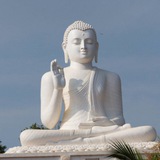
Dhammapada Verse 181
Devorohana Vatthu
Ye jhanapasuta dhira
nekkhammupasame rata
devapi tesam pihayanti
sambuddhanam satimatam.
Verse 181: The wise who practise jhana concentration and Insight Meditation take delight in the peace of liberation from sensual pleasures and moral defilements. Such wise and mindful ones, who truly comprehend the Four Noble Truths (i.e., Arahats and Buddhas) are held dear also by the devas.
The Story of the Buddha's Return from the Tavatimsa Deva World
On return from the Tavatimsa deva world, the Buddha uttered Verse (181) of this book at Sankassanagara, in reply to Thera Sariputta's words of welcome.
On one occasion, while at Savatthi, the Buddha performed the Miracle of the Pairs in answer to the challenge of the ascetics of various sects. After this, the Buddha went to the Tavatimsa deva world; his mother who had been reborn in the Tusita deva world as a deva known as Santusita also came to the Tavatimsa deva world. There the Buddha expounded the Abhidhamma to the devas and the brahmas throughout the three months of the vassa. As a result, Santusita deva attained Sotapatti Fruition; so did numerous other devas and brahmas.
During that period Thera Sariputta spent the vassa at Sankassanagara, thirty yojanas away from Savatthi. During his stay there, as regularly instructed by the Buddha, he taught the Abhidhamma to the five hundred bhikkhus staying with him and covered the whole course by the end of the vassa.
Towards the end of the vassa, Thera Maha Moggalana went to the Tavatimsa deva world to see the Buddha. Then, he was told that the Buddha would return to the human world on the full moon day at the end of the vassa to the place where Thera Sariputta was spending the vassa.
As promised, the Buddha came with the six coloured rays shining forth from his body to the city-gate of Sankassanagara, on the night of the full moon day of the month of Assayuja when the moon was shining brightly. He was accompanied by a large following of devas on one side and a large following of brahmas on the other. A large gathering headed by Thera Sariputta welcomed the Buddha back to this world; and the whole town was lit up. Thera Sariputta was awed by the grandeur and glory of the whole scene of the Buddha's return. He respectfully approached the Buddha and said, "Venerable Sir! We have never seen or even heard of such magnificent and resplendent glory. Indeed, Venerable Sir, you are loved, respected and revered alike by devas, brahmas and men!" To him the Buddha said, "My son Sariputta, the Buddhas who are endowed with unique qualities are truly loved by men and devas alike."
Then the Buddha spoke in verse as follows:
Verse 181: The wise who practise jhana concentration and Insight Meditation take delight in the peace of liberation from sensual pleasures and moral defilements. Such wise and mindful ones, who truly comprehend the Four Noble Truths (i.e., Arahats and Buddhas) are held dear also by the devas.
At the end of the discourse the five hundred bhikkhus who were the pupils of Thera Sariputta attained arahatship and a great many from the congregation attained Sotapatti Fruition.
===
Buddha dharma teachings channel:
https://news.1rj.ru/str/lorddivinebuddha
====================
Devorohana Vatthu
Ye jhanapasuta dhira
nekkhammupasame rata
devapi tesam pihayanti
sambuddhanam satimatam.
Verse 181: The wise who practise jhana concentration and Insight Meditation take delight in the peace of liberation from sensual pleasures and moral defilements. Such wise and mindful ones, who truly comprehend the Four Noble Truths (i.e., Arahats and Buddhas) are held dear also by the devas.
The Story of the Buddha's Return from the Tavatimsa Deva World
On return from the Tavatimsa deva world, the Buddha uttered Verse (181) of this book at Sankassanagara, in reply to Thera Sariputta's words of welcome.
On one occasion, while at Savatthi, the Buddha performed the Miracle of the Pairs in answer to the challenge of the ascetics of various sects. After this, the Buddha went to the Tavatimsa deva world; his mother who had been reborn in the Tusita deva world as a deva known as Santusita also came to the Tavatimsa deva world. There the Buddha expounded the Abhidhamma to the devas and the brahmas throughout the three months of the vassa. As a result, Santusita deva attained Sotapatti Fruition; so did numerous other devas and brahmas.
During that period Thera Sariputta spent the vassa at Sankassanagara, thirty yojanas away from Savatthi. During his stay there, as regularly instructed by the Buddha, he taught the Abhidhamma to the five hundred bhikkhus staying with him and covered the whole course by the end of the vassa.
Towards the end of the vassa, Thera Maha Moggalana went to the Tavatimsa deva world to see the Buddha. Then, he was told that the Buddha would return to the human world on the full moon day at the end of the vassa to the place where Thera Sariputta was spending the vassa.
As promised, the Buddha came with the six coloured rays shining forth from his body to the city-gate of Sankassanagara, on the night of the full moon day of the month of Assayuja when the moon was shining brightly. He was accompanied by a large following of devas on one side and a large following of brahmas on the other. A large gathering headed by Thera Sariputta welcomed the Buddha back to this world; and the whole town was lit up. Thera Sariputta was awed by the grandeur and glory of the whole scene of the Buddha's return. He respectfully approached the Buddha and said, "Venerable Sir! We have never seen or even heard of such magnificent and resplendent glory. Indeed, Venerable Sir, you are loved, respected and revered alike by devas, brahmas and men!" To him the Buddha said, "My son Sariputta, the Buddhas who are endowed with unique qualities are truly loved by men and devas alike."
Then the Buddha spoke in verse as follows:
Verse 181: The wise who practise jhana concentration and Insight Meditation take delight in the peace of liberation from sensual pleasures and moral defilements. Such wise and mindful ones, who truly comprehend the Four Noble Truths (i.e., Arahats and Buddhas) are held dear also by the devas.
At the end of the discourse the five hundred bhikkhus who were the pupils of Thera Sariputta attained arahatship and a great many from the congregation attained Sotapatti Fruition.
===
Buddha dharma teachings channel:
https://news.1rj.ru/str/lorddivinebuddha
====================
Telegram
Buddha
Buddha dharma teachings from the suttas and commentaries
👏1🏆1
Forwarded from Buddha Dharma books
Free Buddha Dharma ebook
The Buddhist Way
By Dr. Sri K Dhammananda
Happy events such as birth and marriage, and sad occasions like sickness and death in aperson's existence very often necessitate the observance of certain rites, which have been performed in every society from time immemorial. Such rites, which originated even long before the various major world religions became established, have been handed down by our forefathers, and in the passage of time, have gradually assumed the form of traditional customary practices until the present day. We continue to practise many of these rites through ignorance and fear, not daring to change or discard them even with the acquisition of a modern education and sophisticated life-style.
In particular many of the rites performed on sad occasions like death and funerals are shrouded in mystery and superstition, and very often incur a tremendous financial burden on bereaved families.This is one of the major reasons why many Buddhists are easily converted to other religions because it offers good ammunition for other religionists to hurl their criticisms and attacks the Buddhists. It is imperative that the Buddhist community in this country should awaken to this situation and make courageous efforts to make reforms in the performance of their rites and rituals in consonance with correct Buddhist religious principles.
This book presents in a simple and understandable manner the various rites which could be performed by Buddhists on happy and sad occasions in their lives. It is hoped that they will make efforts to understand them and practise them when the occasion arises. By so doing, they will not only attain satisfaction and a sense of security in the knowledge that they are performing proper Buddhist rites, but also help to enhance the image of their own religion in the eyes of others.
Free download available:
https://static.sariputta.com/pdf/tipitaka/229/buddhistway_pdf.pdf
=============
The Buddhist Way
By Dr. Sri K Dhammananda
Happy events such as birth and marriage, and sad occasions like sickness and death in aperson's existence very often necessitate the observance of certain rites, which have been performed in every society from time immemorial. Such rites, which originated even long before the various major world religions became established, have been handed down by our forefathers, and in the passage of time, have gradually assumed the form of traditional customary practices until the present day. We continue to practise many of these rites through ignorance and fear, not daring to change or discard them even with the acquisition of a modern education and sophisticated life-style.
In particular many of the rites performed on sad occasions like death and funerals are shrouded in mystery and superstition, and very often incur a tremendous financial burden on bereaved families.This is one of the major reasons why many Buddhists are easily converted to other religions because it offers good ammunition for other religionists to hurl their criticisms and attacks the Buddhists. It is imperative that the Buddhist community in this country should awaken to this situation and make courageous efforts to make reforms in the performance of their rites and rituals in consonance with correct Buddhist religious principles.
This book presents in a simple and understandable manner the various rites which could be performed by Buddhists on happy and sad occasions in their lives. It is hoped that they will make efforts to understand them and practise them when the occasion arises. By so doing, they will not only attain satisfaction and a sense of security in the knowledge that they are performing proper Buddhist rites, but also help to enhance the image of their own religion in the eyes of others.
Free download available:
https://static.sariputta.com/pdf/tipitaka/229/buddhistway_pdf.pdf
=============
❤1👍1🏆1
Forwarded from Buddha
Free Buddha Dharma ebook
Essentials of Buddhism
Ven. Pategama Gnanarama Ph.D.
Essentials of Buddhism is written based on the Theravada Buddhism syllabus of the Postgraduate Diploma Examination in Buddhist Studies course of the Buddhist and Pali University of Sri Lanka. Since the work is meant for students, every chapter appears as a unit by itself and is confined to a few pages. Ven. Ganarama is the Principal of the Buddhist and Pali College of Singapore.
Free download here:
https://static.sariputta.com/pdf/tipitaka/735/essentialsofpdf.pdf
Essentials of Buddhism
Ven. Pategama Gnanarama Ph.D.
Essentials of Buddhism is written based on the Theravada Buddhism syllabus of the Postgraduate Diploma Examination in Buddhist Studies course of the Buddhist and Pali University of Sri Lanka. Since the work is meant for students, every chapter appears as a unit by itself and is confined to a few pages. Ven. Ganarama is the Principal of the Buddhist and Pali College of Singapore.
Free download here:
https://static.sariputta.com/pdf/tipitaka/735/essentialsofpdf.pdf
👍1💯1🏆1
Dhammapada Verse 182
Erakapattanagaraja Vatthu
Kiccho manussapatilabho
kiccham maccana jivitam
kiccham saddhammassavanam
kiccho buddhanamuppado.
Verse 182: Hard to gain is birth as man; hard is the life of mortals; hard to get is the opportunity of hearing the Ariya Dhamma (Teaching of the Buddhas); hard it is for a Buddha to appear.
The Story of Erakapatta the Naga King
While residing near Baranasi the Buddha uttered Verse (182) of this book, with reference to Erakapatta, a king of nagas (dragons).
Once there was a naga king by the name of Erakapatta. In one of his past existences during the time of Kassapa Buddha he had been a bhikkhu for a long time. Through worry (kukkucca) over a minor offence he had committed during that time, he was reborn as a naga. As a naga, he waited for the appearance of a Buddha. Erakapatta had a very beautiful daughter, and he made use of her as a means of finding the Buddha. He made it known that whoever could answer her questions could claim her for a wife. Twice every month, Erakapatta made her dance in the open and sing out her questions. Many suitors came to answer her questions hoping to claim her, but no one could give the correct answer.
One day, the Buddha saw a youth named Uttara in his vision. He also knew that the youth would attain Sotapatti Fruition in connection with the questions put by the daughter of Erakapatta the naga. By then the youth was already on his way to see Erakapatta's daughter. The Buddha stopped him and taught him how to answer the questions. While he was being taught, Uttara attained Sotapatti Fruition. Now that Uttara had attained Sotapatti Fruition, he had no desire for the naga princess. However, Uttara still went to answer the questions for the benefit of numerous other beings.
The first four questions were:
1. Who is a ruler?
2. Is one who is overwhelmed by the mist of moral defilements to be called a ruler?
3. What ruler is free from moral defilements?
4. What sort of person is to be called a fool?
The answers to the above questions were:
1. He who controls the six senses is a ruler.
2. One who is overwhelmed by the mist of moral defilements is not to be called a ruler; he who is free from craving is called a ruler.
3. The ruler who is free from craving is free from moral defilements.
4. A person who hankers after sensual pleasures is called a fool.
Having had the correct answers to the above, the naga princess sang out questions regarding the floods (oghas) of sensual desire, of renewed existence, of false doctrine and of ignorance, and how they could be overcome. Uttara answered these questions as taught by the Buddha.
When Erakapatta heard these answers he knew that a Buddha had appeared in this world. So he asked Uttara to take him to the Buddha. On seeing the Buddha, Erakapatta related to the Buddha how he had been a bhikkhu during the time of Kassapa Buddha, how he had accidentally caused a grass blade to be broken off while travelling in a boat, and how he had worried over that little offence for having failed to do the act of exoneration as prescribed, and finally how he was reborn as a naga. After hearing him, the Buddha told him how difficult it was to be born in the human world, and to be born during the appearance of the Buddhas or during the time of their Teaching.
Then the Buddha spoke in verse as follows:
Verse 182: Hard to gain is birth as man; hard is the life of mortals; hard to get is the opportunity of hearing the Ariya Dhamma (Teaching of the Buddhas); hard it is for a Buddha to appear.
The above discourse benefited numerous beings. Erakapatta being an animal could not attain Sotapatti Fruition then and there.
===
Tibetan Buddhism - Vajrayana, Tantrayana and esoteric Buddhism channel:
https://news.1rj.ru/str/tibetanbuddha
Vajrayana Tantrayana Buddhism channel:
https://news.1rj.ru/str/tantrayanabuddhism
====================
Erakapattanagaraja Vatthu
Kiccho manussapatilabho
kiccham maccana jivitam
kiccham saddhammassavanam
kiccho buddhanamuppado.
Verse 182: Hard to gain is birth as man; hard is the life of mortals; hard to get is the opportunity of hearing the Ariya Dhamma (Teaching of the Buddhas); hard it is for a Buddha to appear.
The Story of Erakapatta the Naga King
While residing near Baranasi the Buddha uttered Verse (182) of this book, with reference to Erakapatta, a king of nagas (dragons).
Once there was a naga king by the name of Erakapatta. In one of his past existences during the time of Kassapa Buddha he had been a bhikkhu for a long time. Through worry (kukkucca) over a minor offence he had committed during that time, he was reborn as a naga. As a naga, he waited for the appearance of a Buddha. Erakapatta had a very beautiful daughter, and he made use of her as a means of finding the Buddha. He made it known that whoever could answer her questions could claim her for a wife. Twice every month, Erakapatta made her dance in the open and sing out her questions. Many suitors came to answer her questions hoping to claim her, but no one could give the correct answer.
One day, the Buddha saw a youth named Uttara in his vision. He also knew that the youth would attain Sotapatti Fruition in connection with the questions put by the daughter of Erakapatta the naga. By then the youth was already on his way to see Erakapatta's daughter. The Buddha stopped him and taught him how to answer the questions. While he was being taught, Uttara attained Sotapatti Fruition. Now that Uttara had attained Sotapatti Fruition, he had no desire for the naga princess. However, Uttara still went to answer the questions for the benefit of numerous other beings.
The first four questions were:
1. Who is a ruler?
2. Is one who is overwhelmed by the mist of moral defilements to be called a ruler?
3. What ruler is free from moral defilements?
4. What sort of person is to be called a fool?
The answers to the above questions were:
1. He who controls the six senses is a ruler.
2. One who is overwhelmed by the mist of moral defilements is not to be called a ruler; he who is free from craving is called a ruler.
3. The ruler who is free from craving is free from moral defilements.
4. A person who hankers after sensual pleasures is called a fool.
Having had the correct answers to the above, the naga princess sang out questions regarding the floods (oghas) of sensual desire, of renewed existence, of false doctrine and of ignorance, and how they could be overcome. Uttara answered these questions as taught by the Buddha.
When Erakapatta heard these answers he knew that a Buddha had appeared in this world. So he asked Uttara to take him to the Buddha. On seeing the Buddha, Erakapatta related to the Buddha how he had been a bhikkhu during the time of Kassapa Buddha, how he had accidentally caused a grass blade to be broken off while travelling in a boat, and how he had worried over that little offence for having failed to do the act of exoneration as prescribed, and finally how he was reborn as a naga. After hearing him, the Buddha told him how difficult it was to be born in the human world, and to be born during the appearance of the Buddhas or during the time of their Teaching.
Then the Buddha spoke in verse as follows:
Verse 182: Hard to gain is birth as man; hard is the life of mortals; hard to get is the opportunity of hearing the Ariya Dhamma (Teaching of the Buddhas); hard it is for a Buddha to appear.
The above discourse benefited numerous beings. Erakapatta being an animal could not attain Sotapatti Fruition then and there.
===
Tibetan Buddhism - Vajrayana, Tantrayana and esoteric Buddhism channel:
https://news.1rj.ru/str/tibetanbuddha
Vajrayana Tantrayana Buddhism channel:
https://news.1rj.ru/str/tantrayanabuddhism
====================
Telegram
Tibetan Buddhism Vajrayana Tantrayana esoteric tradition
Buddha Dharma teachings from the esoteric Vajrayana or Tantrayana Buddhism, includes all major schools Nyingma, Kagyu, Gelug, Sakya, Jonang and Bonpo.
🏆1🆒1
Dhammapada Verses 183, 184 and 185
Anandattherapanha Vatthu
Sabbapapassa akaranam
ku salassa upasampada
sacittapariyodapanam
etam buddhana sasanam.
Khanti paramam tapo titikkha
nibbanam paramam vadanti buddha
na hi pabbajito parupaghati
na samano hoti param vihethayanto.
Anupavado anupaghato
patimokkhe ca samvaro
mattannuta ca bhattasmim
pantanca sayanasanam
adhicitte ca ayogo
etam buddhana sasanam.
Verse 183: Not to do evil, to cultivate merit, to purify one's mind - this is the Teaching of the Buddhas.
Verse 184: The best moral practice is patience and forbearance; "Nibbana is Supreme", said the Buddhas. A bhikkhu does not harm others; one who harms others is not a bhikkhu.
Verse 185: Not to revile, not to do any harm, to practise restraint according to the Fundamental Instructions for the bhikkhus, to be moderate in taking food, to dwell in a secluded place, to devote oneself to higher concentration - this is the Teaching of the Buddhas.
The Story of the Question Raised by Thera Ananda
While residing at the Jetavana monastery, the Buddha uttered Verses (183), (184) and (185) of this book, with reference to the question raised by Thera Ananda regarding Fundamental Instructions to bhikkhus by the preceding Buddhas.
On one occasion, Thera Ananda asked the Buddha whether the Fundamental Instructions to bhikkhus given by the preceding Buddhas were the same as those of the Buddha himself. To him the Buddha replied that the instructions given by all the Buddhas are as given in the following verses:
Then the Buddha spoke in verse as follows:
Verse 183: Not to do evil, to cultivate merit, to purify one's mind - this is the Teaching of the Buddhas.
Verse 184: The best moral practice is patience and forbearance; "Nibbana is Supreme", said the Buddhas. A bhikkhu does not harm others; one who harms others is not a bhikkhu.
Verse 185: Not to revile, not to do any harm, to practise restraint according to the Fundamental Instructions for the bhikkhus, to be moderate in taking food, to dwell in a secluded place, to devote oneself to higher concentration - this is the Teaching of the Buddhas.
===
Words of the Buddha channel:
https://news.1rj.ru/str/wordsofbuddha
====================
Anandattherapanha Vatthu
Sabbapapassa akaranam
ku salassa upasampada
sacittapariyodapanam
etam buddhana sasanam.
Khanti paramam tapo titikkha
nibbanam paramam vadanti buddha
na hi pabbajito parupaghati
na samano hoti param vihethayanto.
Anupavado anupaghato
patimokkhe ca samvaro
mattannuta ca bhattasmim
pantanca sayanasanam
adhicitte ca ayogo
etam buddhana sasanam.
Verse 183: Not to do evil, to cultivate merit, to purify one's mind - this is the Teaching of the Buddhas.
Verse 184: The best moral practice is patience and forbearance; "Nibbana is Supreme", said the Buddhas. A bhikkhu does not harm others; one who harms others is not a bhikkhu.
Verse 185: Not to revile, not to do any harm, to practise restraint according to the Fundamental Instructions for the bhikkhus, to be moderate in taking food, to dwell in a secluded place, to devote oneself to higher concentration - this is the Teaching of the Buddhas.
The Story of the Question Raised by Thera Ananda
While residing at the Jetavana monastery, the Buddha uttered Verses (183), (184) and (185) of this book, with reference to the question raised by Thera Ananda regarding Fundamental Instructions to bhikkhus by the preceding Buddhas.
On one occasion, Thera Ananda asked the Buddha whether the Fundamental Instructions to bhikkhus given by the preceding Buddhas were the same as those of the Buddha himself. To him the Buddha replied that the instructions given by all the Buddhas are as given in the following verses:
Then the Buddha spoke in verse as follows:
Verse 183: Not to do evil, to cultivate merit, to purify one's mind - this is the Teaching of the Buddhas.
Verse 184: The best moral practice is patience and forbearance; "Nibbana is Supreme", said the Buddhas. A bhikkhu does not harm others; one who harms others is not a bhikkhu.
Verse 185: Not to revile, not to do any harm, to practise restraint according to the Fundamental Instructions for the bhikkhus, to be moderate in taking food, to dwell in a secluded place, to devote oneself to higher concentration - this is the Teaching of the Buddhas.
===
Words of the Buddha channel:
https://news.1rj.ru/str/wordsofbuddha
====================
Telegram
Words of the Buddha
Daily teachings of Buddha Dharma
👏1🆒1
Forwarded from Buddha Dharma books
Free Buddha Dharma ebook
The Satipatthana Vipassana
By Mahasi Sayadaw Gyi
As mentioned in the introduction to the original text, the daily talks given by the Venerable Mahasi Sayadawgyi to every batch of new yogis since the arrival at the Mahasi Sasana Yeiktha had been tape-recorded on 27th July 1951. This had been transcribed and published in book form in 1954, followed by twenty editions up to now. This Myanmar book had been translated into English by the late U Pe Thin, who had also translated a number of discourses of Mahasi Sayadawgyi. Although the first English Edition was no longer with the Buddha Sasana Nuggaha Organization, it has come to our knowledge that this first English Edition was published by the Department of Religious Affairs in 1954 and again in January 1979.
Free download here:
http://www.mediafire.com/file/dubb6hlfz5zol3d/
=============
The Satipatthana Vipassana
By Mahasi Sayadaw Gyi
As mentioned in the introduction to the original text, the daily talks given by the Venerable Mahasi Sayadawgyi to every batch of new yogis since the arrival at the Mahasi Sasana Yeiktha had been tape-recorded on 27th July 1951. This had been transcribed and published in book form in 1954, followed by twenty editions up to now. This Myanmar book had been translated into English by the late U Pe Thin, who had also translated a number of discourses of Mahasi Sayadawgyi. Although the first English Edition was no longer with the Buddha Sasana Nuggaha Organization, it has come to our knowledge that this first English Edition was published by the Department of Religious Affairs in 1954 and again in January 1979.
Free download here:
http://www.mediafire.com/file/dubb6hlfz5zol3d/
=============
❤2👏1
Dhammapada Verses 186 and 187
Anabhiratabhikkhu Vatthu
Na kahapana vassena
titti kamesu vijjati
appassada dukha kama
iti vinnaya pandito.
Api dibbesu kamesu
ratim so nadhigacchati
tanhakkhayarato hoti
sammasambuddhasavako.
Verses 186 & 187: Not by a shower of coins can sensual desires be satiated; sensual desires give little pleasure and are fraught with evil consequences (dukkha). Knowing this, the wise man, who is the disciple of the Buddha, does not find delight even in the pleasures of the devas, but rejoices in the cessation of craving (i.e., Nibbana).
The Story of a Dissatisfied Young Bhikkhu
While residing at the Jetavana monastery, the Buddha uttered Verses (186) and (187) of this book, with reference to a young bhikkhu who was unhappy with his life as a bhikkhu.
Once, there was a young bhikkhu at the Jetavana monastery. One day his teacher sent him to another monastery to study. While he was away, his father became seriously ill and died without seeing him. But his father left for him one hundred kahapanas with his brother, the boy's uncle. On his return, his uncle told him about his father's death and about the one hundred kahapanas left to him. At first, he said that he had no need of the money. Later, he thought that it might be better to return to lay-life, and as a result, he got dissatisfied with the life of a bhikkhu. Gradually, he began to lose interest in his life and was also losing weight. When other bhikkhus knew about this, they took him to the Buddha.
The Buddha asked him whether it was true that he was feeling unhappy with his life as a bhikkhu and whether he had any capital to start the life of a layman. He answered that it was true and that be had one hundred kahapanas to start his life with. Then the Buddha explained to him that he would need to get food, clothing, household utensils, two oxen, ploughs, pickaxes, knives, etc., so that his one hundred in cash would hardly meet the expenses. The Buddha then told him that for human beings there could never be enough, not even for Universal Monarchs who could call for a shower of coins or gems or any amount of wealth and treasures at any moment. Further, the Buddha related the story of Mandatu, the Universal Monarch, who enjoyed the glory of the devas both in the Catumaharajika and Tavatimsa realms for a long time. After spending a long time in Tavatimsa, one day, Mandatu wished that he were the sole ruler of Tavatimsa, instead of sharing it with Sakka. But this time, his wish could not be fulfilled and instantly he became old and decrepit; he returned to the human world and died soon after.
Then the Buddha spoke in verse as follows:
Verses 186 & 187: Not by a shower of coins can sensual desires be satiated; sensual desires give little pleasure and are fraught with evil consequences (dukkha). Knowing this, the wise man, who is the disciple of the Buddha, does not find delight even in the pleasures of the devas, but rejoices in the cessation of craving (i.e., Nibbana).
At the end of the discourse the young bhikkhu attained Sotapatti Fruition.
===
Dhammapada, beloved and favorite teachings of the Buddha channel:
https://news.1rj.ru/str/dhammapadas
====================
Anabhiratabhikkhu Vatthu
Na kahapana vassena
titti kamesu vijjati
appassada dukha kama
iti vinnaya pandito.
Api dibbesu kamesu
ratim so nadhigacchati
tanhakkhayarato hoti
sammasambuddhasavako.
Verses 186 & 187: Not by a shower of coins can sensual desires be satiated; sensual desires give little pleasure and are fraught with evil consequences (dukkha). Knowing this, the wise man, who is the disciple of the Buddha, does not find delight even in the pleasures of the devas, but rejoices in the cessation of craving (i.e., Nibbana).
The Story of a Dissatisfied Young Bhikkhu
While residing at the Jetavana monastery, the Buddha uttered Verses (186) and (187) of this book, with reference to a young bhikkhu who was unhappy with his life as a bhikkhu.
Once, there was a young bhikkhu at the Jetavana monastery. One day his teacher sent him to another monastery to study. While he was away, his father became seriously ill and died without seeing him. But his father left for him one hundred kahapanas with his brother, the boy's uncle. On his return, his uncle told him about his father's death and about the one hundred kahapanas left to him. At first, he said that he had no need of the money. Later, he thought that it might be better to return to lay-life, and as a result, he got dissatisfied with the life of a bhikkhu. Gradually, he began to lose interest in his life and was also losing weight. When other bhikkhus knew about this, they took him to the Buddha.
The Buddha asked him whether it was true that he was feeling unhappy with his life as a bhikkhu and whether he had any capital to start the life of a layman. He answered that it was true and that be had one hundred kahapanas to start his life with. Then the Buddha explained to him that he would need to get food, clothing, household utensils, two oxen, ploughs, pickaxes, knives, etc., so that his one hundred in cash would hardly meet the expenses. The Buddha then told him that for human beings there could never be enough, not even for Universal Monarchs who could call for a shower of coins or gems or any amount of wealth and treasures at any moment. Further, the Buddha related the story of Mandatu, the Universal Monarch, who enjoyed the glory of the devas both in the Catumaharajika and Tavatimsa realms for a long time. After spending a long time in Tavatimsa, one day, Mandatu wished that he were the sole ruler of Tavatimsa, instead of sharing it with Sakka. But this time, his wish could not be fulfilled and instantly he became old and decrepit; he returned to the human world and died soon after.
Then the Buddha spoke in verse as follows:
Verses 186 & 187: Not by a shower of coins can sensual desires be satiated; sensual desires give little pleasure and are fraught with evil consequences (dukkha). Knowing this, the wise man, who is the disciple of the Buddha, does not find delight even in the pleasures of the devas, but rejoices in the cessation of craving (i.e., Nibbana).
At the end of the discourse the young bhikkhu attained Sotapatti Fruition.
===
Dhammapada, beloved and favorite teachings of the Buddha channel:
https://news.1rj.ru/str/dhammapadas
====================
Telegram
Dhammapada - Buddha Dharma Teachings
Daily teachings of the Dhammapada, beloved and favorite teachings of the Buddha
❤1👏1🏆1