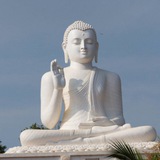
The Buddha's reply to Aggidatta was, "Aggidatta, people go to mountains, forests, gardens and parks, and trees for refuge when they are threatened with danger, but these things cannot offer them any protection. Only those who take refuge in the Buddha, the Dhamma and the Samgha are liberated from the round of rebirths (samsara)".
Then the Buddha spoke in verse as follows:
Verse 188: When threatened with danger, men go to many a refuge, - to mountains and forests, to parks and gardens, and to sacred trees.
Verse 189: But such a refuge is not a safe refuge, not the best refuge. One is not liberated from all evil consequences of existence (dukkha) for having come to such a refuge.
Verses 190 & 191: One, who takes refuge in the Buddha, the Dhamma and the Samgha, sees with Magga Insight the Four Noble Truths, viz., Dukkha, the Cause of Dukkha, the Cessation of Dukkha, and the Noble Path of Eight Constituents which leads to the Cessation of Dukkha.
Verse 192: This, indeed, is the safe refuge; this is the best refuge. Having come to this refuge, one is liberated from all dukkha.
At the end of the discourse Aggidatta and all his followers attained arahatship. All of them entered the Order of the bhikkhus. On that day, when the disciples of Aggidatta from Anga, Magadha and Kuru came to pay respect to him, they saw their teacher and his followers garbed as bhikkhus and they were puzzled and wondered, "Who is the more powerful? Our teacher or Samana Gotama? Our teacher must be more powerful because Samana Gotama has come to our teacher." The Buddha knew what they were thinking; Aggidatta also felt that he must set their minds at rest. So, he paid obeisance to the Buddha in the presence of his disciples, and said, "Venerable Sir! You are my teacher, I am but a disciple of yours." Thus, the audience came to realize the supremacy of the Buddha.
===
Buddha dharma teachings channel:
https://invite.viber.com/?g2=AQAKw1y3rv%2F6sk61PI2W4izuIiaEZj8YZujhY1tSzL%2B07s7rFnVFDAd0bAYFaMLw
====================
Then the Buddha spoke in verse as follows:
Verse 188: When threatened with danger, men go to many a refuge, - to mountains and forests, to parks and gardens, and to sacred trees.
Verse 189: But such a refuge is not a safe refuge, not the best refuge. One is not liberated from all evil consequences of existence (dukkha) for having come to such a refuge.
Verses 190 & 191: One, who takes refuge in the Buddha, the Dhamma and the Samgha, sees with Magga Insight the Four Noble Truths, viz., Dukkha, the Cause of Dukkha, the Cessation of Dukkha, and the Noble Path of Eight Constituents which leads to the Cessation of Dukkha.
Verse 192: This, indeed, is the safe refuge; this is the best refuge. Having come to this refuge, one is liberated from all dukkha.
At the end of the discourse Aggidatta and all his followers attained arahatship. All of them entered the Order of the bhikkhus. On that day, when the disciples of Aggidatta from Anga, Magadha and Kuru came to pay respect to him, they saw their teacher and his followers garbed as bhikkhus and they were puzzled and wondered, "Who is the more powerful? Our teacher or Samana Gotama? Our teacher must be more powerful because Samana Gotama has come to our teacher." The Buddha knew what they were thinking; Aggidatta also felt that he must set their minds at rest. So, he paid obeisance to the Buddha in the presence of his disciples, and said, "Venerable Sir! You are my teacher, I am but a disciple of yours." Thus, the audience came to realize the supremacy of the Buddha.
===
Buddha dharma teachings channel:
https://invite.viber.com/?g2=AQAKw1y3rv%2F6sk61PI2W4izuIiaEZj8YZujhY1tSzL%2B07s7rFnVFDAd0bAYFaMLw
====================
Viber
Buddha
Buddha dharma teachings from the suttas and commentaries from Theravada tradition
👏1💯1
Dhammapada Verse 193
Anandattherapanha Vatthu
Dullabho purisajanno1
na so sabbattha jayati
yattha so jayati dhiro
tam kulam sukhamedhati.2
Verse 193: It is hard to find the noblest of men; he is not born everywhere nor in every clan. To whatever clan such a wise man is born, that clan prospers.
1. purisajanno: According to the Commentary, a Buddha is intended.
2. sukhamedhati: lit., attains happiness or thrives in happiness.
The Story of the Question Raised by Thera Ananda
While residing at the Jetavana monastery, the Buddha uttered Verse (193) of this book, with reference to the question raised by Thera Ananda.
One day, Thera Ananda pondered thus: "Our Teacher has told us that thoroughbreds of elephants are born only among Chaddanta and Uposatha breeds, that thoroughbreds of horses are born only among the Sindh breed, that thoroughbreds of cattle are born only among the Usabha breed. Thus, he had talked to us only about the thoroughbreds of elephants, horses, and cattle, but not of the noblest of men (purisajanno)."
After reflecting thus, Thera Ananda went to the Buddha, and put to him the question of the noblest of men. To him the Buddha replied, "Ananda, the noblest of men is not born everywhere, he is born only among Khattiyamahasala and Brahmanamahasala, the wealthy clans of Khattiya and Brahmana."
Then the Buddha spoke in verse as follows:
Verse 193: It is hard to find the noblest of men; he is not born everywhere nor in every clan. To whatever clan such a wise man is born, that clan prospers.
===
Words of the Buddha channel:
https://invite.viber.com/?g2=AQAFqzqlj7FmI061PX17rxWMAtZ%2BRuso%2FH2KmHKZSgnv7v9DD8X0bDkKnZDr9JDq
====================
Anandattherapanha Vatthu
Dullabho purisajanno1
na so sabbattha jayati
yattha so jayati dhiro
tam kulam sukhamedhati.2
Verse 193: It is hard to find the noblest of men; he is not born everywhere nor in every clan. To whatever clan such a wise man is born, that clan prospers.
1. purisajanno: According to the Commentary, a Buddha is intended.
2. sukhamedhati: lit., attains happiness or thrives in happiness.
The Story of the Question Raised by Thera Ananda
While residing at the Jetavana monastery, the Buddha uttered Verse (193) of this book, with reference to the question raised by Thera Ananda.
One day, Thera Ananda pondered thus: "Our Teacher has told us that thoroughbreds of elephants are born only among Chaddanta and Uposatha breeds, that thoroughbreds of horses are born only among the Sindh breed, that thoroughbreds of cattle are born only among the Usabha breed. Thus, he had talked to us only about the thoroughbreds of elephants, horses, and cattle, but not of the noblest of men (purisajanno)."
After reflecting thus, Thera Ananda went to the Buddha, and put to him the question of the noblest of men. To him the Buddha replied, "Ananda, the noblest of men is not born everywhere, he is born only among Khattiyamahasala and Brahmanamahasala, the wealthy clans of Khattiya and Brahmana."
Then the Buddha spoke in verse as follows:
Verse 193: It is hard to find the noblest of men; he is not born everywhere nor in every clan. To whatever clan such a wise man is born, that clan prospers.
===
Words of the Buddha channel:
https://invite.viber.com/?g2=AQAFqzqlj7FmI061PX17rxWMAtZ%2BRuso%2FH2KmHKZSgnv7v9DD8X0bDkKnZDr9JDq
====================
Viber
Words Of The Buddha
Daily teachings from Buddha Dharma
🏆2💯1
Forwarded from Buddha Dharma books
Free Buddha Dharma ebook
Pratical Insight Meditation
By Mahasi Sayadaw Gyi
The Venerable Mahasi Sayadawgyi had written his great work of treatise on Vipassana Meditation in two volumes in 1945. The first publication was in 1954 followed by thirteen editions up to now. Volume I of this treatise had been translated into English by U Min Swe and published in December 1980.
Free download available:
https://www.mediafire.com/file/16x75rem5jyw3zd/
=============
Pratical Insight Meditation
By Mahasi Sayadaw Gyi
The Venerable Mahasi Sayadawgyi had written his great work of treatise on Vipassana Meditation in two volumes in 1945. The first publication was in 1954 followed by thirteen editions up to now. Volume I of this treatise had been translated into English by U Min Swe and published in December 1980.
Free download available:
https://www.mediafire.com/file/16x75rem5jyw3zd/
=============
👏2💯1
Dhammapada Verse 194
Sambahulabhikkhu Vatthu
Sukho buddhanamuppado
sukha saddhammadesana
sukha sanghassa samaggi
samagganam tapo sukho.
Verse 194: Happy is the arising of a Buddha; happy is the exposition of the Ariya Dhamma; happy is the harmony amongst the Samgha; happy is the practice of those in harmony.
The Story of Many Bhikkhus
While residing at the Jetavana monastery, the Buddha uttered Verse (194) of this book, with reference to many bhikkhus.
Once, five hundred bhikkhus were discussing the question "What constitutes happiness?" These bhikkhus realized that happiness meant different things to different people. Thus, they said, "To some people to have the riches and glory like that of a king's is happiness, to some people sensual pleasure is happiness, but to others to have good rice cooked with meat is happiness." While they were talking, the Buddha came in. After learning the subject of their talk, the Buddha said, "Bhikkhus, all the pleasures you have mentioned do not get you out of the round of rebirths. In this world, these constitute happiness: the arising of a Buddha, the opportunity to hear the Teaching of the Sublime Truth, and the harmony amongst the bhikkhus,"
Then the Buddha spoke in verse as follows:
Verse 194: Happy is the arising of a Buddha; happy is the exposition of the Ariya Dhamma; happy is the harmony amongst the Samgha; happy is the practice of those in harmony.
At the end of the discourse the five hundred bhikkhus attained arahatship.
===
Dhammapada, beloved and favorite teachings of the Buddha channel:
https://invite.viber.com/?g2=AQBLD6phsgvP%2F061YjEM3K%2BNeH1Yb372b9mtfQX2EmuBpgoLUoc99BDMfzHghrme
====================
Sambahulabhikkhu Vatthu
Sukho buddhanamuppado
sukha saddhammadesana
sukha sanghassa samaggi
samagganam tapo sukho.
Verse 194: Happy is the arising of a Buddha; happy is the exposition of the Ariya Dhamma; happy is the harmony amongst the Samgha; happy is the practice of those in harmony.
The Story of Many Bhikkhus
While residing at the Jetavana monastery, the Buddha uttered Verse (194) of this book, with reference to many bhikkhus.
Once, five hundred bhikkhus were discussing the question "What constitutes happiness?" These bhikkhus realized that happiness meant different things to different people. Thus, they said, "To some people to have the riches and glory like that of a king's is happiness, to some people sensual pleasure is happiness, but to others to have good rice cooked with meat is happiness." While they were talking, the Buddha came in. After learning the subject of their talk, the Buddha said, "Bhikkhus, all the pleasures you have mentioned do not get you out of the round of rebirths. In this world, these constitute happiness: the arising of a Buddha, the opportunity to hear the Teaching of the Sublime Truth, and the harmony amongst the bhikkhus,"
Then the Buddha spoke in verse as follows:
Verse 194: Happy is the arising of a Buddha; happy is the exposition of the Ariya Dhamma; happy is the harmony amongst the Samgha; happy is the practice of those in harmony.
At the end of the discourse the five hundred bhikkhus attained arahatship.
===
Dhammapada, beloved and favorite teachings of the Buddha channel:
https://invite.viber.com/?g2=AQBLD6phsgvP%2F061YjEM3K%2BNeH1Yb372b9mtfQX2EmuBpgoLUoc99BDMfzHghrme
====================
Viber
Dhammapada - Buddha Dharma Teachings
Daily teachings of the Dhammapada, beloved and favorite teachings of the Buddha
❤2👌1
The Broken Gong
A Theravada monk on silencing the inner commentary that permeates our lives
By Thanissaro Bhikkhu
If you’ve ever participated in a Zoom meeting, you may have had the experience where someone has two microphones open in the same room. The sound gets echoed again and again and again. It’s called a positive feedback loop—not because it’s a good thing, but because it strengthens itself.
Our minds are like that. You comment on something that’s happening, and it seems to ricochet around in the mind. It’s as if like there are lots of voices inside all agreeing, which makes what they say seem more and more real, more and more worthy of credence. But it drives you crazy—in some cases, literally, crazy. People who go off alone often have nothing but their own echo chamber inside. Something gets amplified, magnified, copied again and again, and becomes an obsession.
Of course, in the time of the Buddha, they didn’t have Zoom meetings, but they did have gongs. The Buddha says, ideally, you want to make your mind like a broken gong. People can hit it, but there’s no reverberation. It’s not a very pretty image, but it makes an important point. What other people say, what you say, hits your ear, and you want to leave it right there. Don’t add any reverb.
This is one of the Buddha’s recommendations for how you deal with unpleasant words. Tell yourself, “An unpleasant sound has made contact at the ear. When the sound ends, when the contact ends, that should be it.” Anything beyond that, any commentary inside, is your own amplification, your own addition to the initial suffering, which may not have been all that much to begin with. Or it may have been pretty strong, but you amplify it even further, making it bigger than it has to be.
The same principle applies to physical pain. Our comments on the pain are often more unbearable than the pain itself. We can get worked up about a physical sensation that we haven’t really examined all that carefully.
The best way to stop this sort of commentary is to look into the actual sensation, to see what’s there in and of itself. We don’t like doing that.
Our comments on the pain are often more unbearable than the pain itself.
It requires sustained focus, which can be tiring. This is why the strategy in meditation is to focus on other parts of the body first, to see if you can make them comfortable with the breath. This is one of the reasons why full-body awareness, full-body breathing, is an important part of the Buddha’s toolbox. If you focus just on the nose, it’s hard to have a very pleasant sensation of breathing just at the nose. But if you focus on how the breathing process feels, say, in your throat, in your chest, in your abdomen, you can derive more pleasure from each in and out breath.
Then you can look at the extent to which you tense up your shoulders or your back when you breathe in: Is it at all necessary? Can you breathe in and out without adding to that tension? Can you think of the breath energy penetrating parts of the body that have been pretty impervious or shut off from the breathing process? See what happens. When you do all this, the breath can become very satisfying, very gratifying, and it gives you a good place to stand.
Then if there’s a pain in the knee, the hips, or the back as you meditate, you can look at it from another part of the body. You’re not totally immersed in the pain itself. You can ask different questions about it. Question your perceptions around the pain.
Your inner commentary involves two levels of fabrication: what the Buddha called verbal fabrication, which is your conversation inside about the pain, and mental fabrication, the perceptions, the images you hold in mind and around the pain. One important perception to question concerns the relationship between your sensation of the body and the sensation of the pain. Are they right in the same spot? Are they the same thing?
A Theravada monk on silencing the inner commentary that permeates our lives
By Thanissaro Bhikkhu
If you’ve ever participated in a Zoom meeting, you may have had the experience where someone has two microphones open in the same room. The sound gets echoed again and again and again. It’s called a positive feedback loop—not because it’s a good thing, but because it strengthens itself.
Our minds are like that. You comment on something that’s happening, and it seems to ricochet around in the mind. It’s as if like there are lots of voices inside all agreeing, which makes what they say seem more and more real, more and more worthy of credence. But it drives you crazy—in some cases, literally, crazy. People who go off alone often have nothing but their own echo chamber inside. Something gets amplified, magnified, copied again and again, and becomes an obsession.
Of course, in the time of the Buddha, they didn’t have Zoom meetings, but they did have gongs. The Buddha says, ideally, you want to make your mind like a broken gong. People can hit it, but there’s no reverberation. It’s not a very pretty image, but it makes an important point. What other people say, what you say, hits your ear, and you want to leave it right there. Don’t add any reverb.
This is one of the Buddha’s recommendations for how you deal with unpleasant words. Tell yourself, “An unpleasant sound has made contact at the ear. When the sound ends, when the contact ends, that should be it.” Anything beyond that, any commentary inside, is your own amplification, your own addition to the initial suffering, which may not have been all that much to begin with. Or it may have been pretty strong, but you amplify it even further, making it bigger than it has to be.
The same principle applies to physical pain. Our comments on the pain are often more unbearable than the pain itself. We can get worked up about a physical sensation that we haven’t really examined all that carefully.
The best way to stop this sort of commentary is to look into the actual sensation, to see what’s there in and of itself. We don’t like doing that.
Our comments on the pain are often more unbearable than the pain itself.
It requires sustained focus, which can be tiring. This is why the strategy in meditation is to focus on other parts of the body first, to see if you can make them comfortable with the breath. This is one of the reasons why full-body awareness, full-body breathing, is an important part of the Buddha’s toolbox. If you focus just on the nose, it’s hard to have a very pleasant sensation of breathing just at the nose. But if you focus on how the breathing process feels, say, in your throat, in your chest, in your abdomen, you can derive more pleasure from each in and out breath.
Then you can look at the extent to which you tense up your shoulders or your back when you breathe in: Is it at all necessary? Can you breathe in and out without adding to that tension? Can you think of the breath energy penetrating parts of the body that have been pretty impervious or shut off from the breathing process? See what happens. When you do all this, the breath can become very satisfying, very gratifying, and it gives you a good place to stand.
Then if there’s a pain in the knee, the hips, or the back as you meditate, you can look at it from another part of the body. You’re not totally immersed in the pain itself. You can ask different questions about it. Question your perceptions around the pain.
Your inner commentary involves two levels of fabrication: what the Buddha called verbal fabrication, which is your conversation inside about the pain, and mental fabrication, the perceptions, the images you hold in mind and around the pain. One important perception to question concerns the relationship between your sensation of the body and the sensation of the pain. Are they right in the same spot? Are they the same thing?
Telegram
Ajahn Chah - Theravada Thailand Buddhism
Collection of teachings of Venerable Ajahn Chah, a foremost meditation and Buddhist teacher from Thailand
👌1🏆1
One way to answer that question is to ask yourself: Where is the sharpest point of the pain right now? You’ll notice that as soon as you focus on it, it moves. It goes someplace else. So you follow it. You keep this up for a while, and there will be a sense that the pain and the body separate out from each other, like cream separating out of milk.
Back in the old days when they didn’t have homogenized milk, I remember when the milkman would come and place the milk at the back door. There’d be about an inch of cream on the top of each bottle. It naturally separated out. In the same way, when you start questioning the perception where the mind says to itself, “The pain is right there and it really hurts right there in that part of the body,” question it. You’ll begin to notice that body sensations and pain sensations can separate out from each other. Sometimes when the pain sensation separates out, it disappears. Sometimes it hovers there, separate from the body. Sometimes you have the weird sense that when it separates out from the body, it slips into your heart and disappears there.
This way, you change your commentary, you change the things you’re saying to yourself. You learn how to say healthier things.
Then you can take this skill and apply it to other parts of your life as well. If you find you’re driving yourself crazy over some incident in your family life, at work, whatever, and it echoes, echoes, echoes, echoes in the mind, you can question it: What actually happened, and where right now is the sensation of that event? It’s at the contact at the mind. But why does it have to contact the mind now, when the incident happened a long time ago? Or even if it’s happening right now, why do you have to comment on it in a way that stabs the mind and drives you crazy? You have the choice.
This is one of the reasons why the Buddha taught the Dhamma to begin with. People were suffering and they didn’t see that they had any choice in the matter. They felt they just had to suffer, to put up with it as part of life. You hear this now, again and again, even in Buddhist circles: Aging is part of life, so we have to learn how to accept it. Death is part of life, so we have to learn how to accept it. Well, yes, we accept the fact that it happens, but you don’t have to accept the fact that you’re going to suffer from it.
The strange thing is, when you begin to learn how not to suffer from it right now, you’re creating the conditions where you won’t have to experience it at all sometime in the future. In other words, it is possible to find the deathless inside when you question the way you put things together right now. Remember, the present moment is a construct. There’s the raw material coming in from your past kamma. Any sights, sounds, smells, tastes, or tactile sensations that come your way, any ideas that come popping into the mind: They’re all the results of past kamma. The Buddha says to see it that way. But past kamma isn’t everything. How you put it together right now in the present is important, too. In fact, that’s what makes the difference between whether you’re going to suffer from the past kamma or not.
It’s like going into your kitchen. You open your refrigerator, and there’s nothing there but raw eggs. You weren’t looking forward to having eggs today, but that’s what you’ve got, so that’s what you’ll eat. Still, you don’t have to eat them raw. You can cook them, do all kinds of things with them: boil them, fry them, steam them, scramble them.
So there are these potentials coming from the past, and what matters is what you do with them, in terms of how you breathe, how you talk to yourself, and the images you hold in mind. So learn how to question the way you talk to yourself and the images you hold in mind. Question even the way you breathe. We’re told again and again, “When you’re doing breath meditation, just let the breath do its own thing. Don’t try to control it.” But you’ve got the opportunity to make it really pleasant, and the Buddha encourages you to do that.
Back in the old days when they didn’t have homogenized milk, I remember when the milkman would come and place the milk at the back door. There’d be about an inch of cream on the top of each bottle. It naturally separated out. In the same way, when you start questioning the perception where the mind says to itself, “The pain is right there and it really hurts right there in that part of the body,” question it. You’ll begin to notice that body sensations and pain sensations can separate out from each other. Sometimes when the pain sensation separates out, it disappears. Sometimes it hovers there, separate from the body. Sometimes you have the weird sense that when it separates out from the body, it slips into your heart and disappears there.
This way, you change your commentary, you change the things you’re saying to yourself. You learn how to say healthier things.
Then you can take this skill and apply it to other parts of your life as well. If you find you’re driving yourself crazy over some incident in your family life, at work, whatever, and it echoes, echoes, echoes, echoes in the mind, you can question it: What actually happened, and where right now is the sensation of that event? It’s at the contact at the mind. But why does it have to contact the mind now, when the incident happened a long time ago? Or even if it’s happening right now, why do you have to comment on it in a way that stabs the mind and drives you crazy? You have the choice.
This is one of the reasons why the Buddha taught the Dhamma to begin with. People were suffering and they didn’t see that they had any choice in the matter. They felt they just had to suffer, to put up with it as part of life. You hear this now, again and again, even in Buddhist circles: Aging is part of life, so we have to learn how to accept it. Death is part of life, so we have to learn how to accept it. Well, yes, we accept the fact that it happens, but you don’t have to accept the fact that you’re going to suffer from it.
The strange thing is, when you begin to learn how not to suffer from it right now, you’re creating the conditions where you won’t have to experience it at all sometime in the future. In other words, it is possible to find the deathless inside when you question the way you put things together right now. Remember, the present moment is a construct. There’s the raw material coming in from your past kamma. Any sights, sounds, smells, tastes, or tactile sensations that come your way, any ideas that come popping into the mind: They’re all the results of past kamma. The Buddha says to see it that way. But past kamma isn’t everything. How you put it together right now in the present is important, too. In fact, that’s what makes the difference between whether you’re going to suffer from the past kamma or not.
It’s like going into your kitchen. You open your refrigerator, and there’s nothing there but raw eggs. You weren’t looking forward to having eggs today, but that’s what you’ve got, so that’s what you’ll eat. Still, you don’t have to eat them raw. You can cook them, do all kinds of things with them: boil them, fry them, steam them, scramble them.
So there are these potentials coming from the past, and what matters is what you do with them, in terms of how you breathe, how you talk to yourself, and the images you hold in mind. So learn how to question the way you talk to yourself and the images you hold in mind. Question even the way you breathe. We’re told again and again, “When you’re doing breath meditation, just let the breath do its own thing. Don’t try to control it.” But you’ve got the opportunity to make it really pleasant, and the Buddha encourages you to do that.
👏1🕊1
As he said, you train yourself to breathe in and out sensitive to pleasure, breathe in and out sensitive to rapture. Pleasure and rapture of this sort don’t just happen on their own. You don’t sit there waiting for them to happen. You can change the way you breathe so that it induces feelings of pleasure and rapture. You’ve got that potential. There are lots of different potentials there. You can talk to yourself in ways that increase your suffering or decrease it. Why choose to increase it when you have the other opportunity? The perceptions you hold in mind you can change as well.
So realize that you have this power, and view the Buddha’s teachings basically as advice in all these levels of fabrication. Bodily: Learn how to breathe in a new way. Verbal: Talk to yourself in a new way. Ask new questions. The Buddha made a science of questions, you know. He divided questions into four types: the questions that deserve categorical answers, those that have to be reanalyzed before you answer them, those where you have to question the questioner before you answer them, and those where you put the question aside because it’s not worth answering. These categories don’t apply only to questions coming from other people. They also apply to what the mind says inside to itself, the questions it raises, the way it looks at things.
So when a question comes up in your mind, you can ask yourself: Which category does it belong to? Does it really deserve an answer? Is the answer something that’s going to apply only to specific incidents? Or is it a general principle that’s true across the board? There are a lot of ways we get ourselves into trouble by holding on to something that was true for one set of circumstances and then automatically applying it to something else where it doesn’t really fit. So learn new questions. Question the way you talk to yourself, question your mental fabrications, the way you slap perceptions on things. Take some of the Buddha’s recommendations and try them on for size.
This way you find that in the present moment there’s the potential to suffer, but there’s also the potential not to suffer. We’re working on the skill of how not to suffer, no matter what happens.
That’s our gift from the Buddha. So don’t leave it on the shelf. Take it down and put it to use.
===
Thanissaro Bhikkhu is an American Theravada Buddhist monk trained in the Thai Forest Tradition. He currently serves as abbot of the Metta Forest Monastery in San Diego County, California and is a frequent contributor to Tricycle. His latest book is Good Heart, Good Mind: The Practice of the Ten Perfections. Thanissaro Bhikkhu’s talks, writings, and translations are all freely available at his website:
www.dhammatalks.org
===
Ajahn Chah, Buddhist teacher of Thai forest meditation of Theravada Buddhism channel:
https://news.1rj.ru/str/ajahnchah_buddhism
===
So realize that you have this power, and view the Buddha’s teachings basically as advice in all these levels of fabrication. Bodily: Learn how to breathe in a new way. Verbal: Talk to yourself in a new way. Ask new questions. The Buddha made a science of questions, you know. He divided questions into four types: the questions that deserve categorical answers, those that have to be reanalyzed before you answer them, those where you have to question the questioner before you answer them, and those where you put the question aside because it’s not worth answering. These categories don’t apply only to questions coming from other people. They also apply to what the mind says inside to itself, the questions it raises, the way it looks at things.
So when a question comes up in your mind, you can ask yourself: Which category does it belong to? Does it really deserve an answer? Is the answer something that’s going to apply only to specific incidents? Or is it a general principle that’s true across the board? There are a lot of ways we get ourselves into trouble by holding on to something that was true for one set of circumstances and then automatically applying it to something else where it doesn’t really fit. So learn new questions. Question the way you talk to yourself, question your mental fabrications, the way you slap perceptions on things. Take some of the Buddha’s recommendations and try them on for size.
This way you find that in the present moment there’s the potential to suffer, but there’s also the potential not to suffer. We’re working on the skill of how not to suffer, no matter what happens.
That’s our gift from the Buddha. So don’t leave it on the shelf. Take it down and put it to use.
===
Thanissaro Bhikkhu is an American Theravada Buddhist monk trained in the Thai Forest Tradition. He currently serves as abbot of the Metta Forest Monastery in San Diego County, California and is a frequent contributor to Tricycle. His latest book is Good Heart, Good Mind: The Practice of the Ten Perfections. Thanissaro Bhikkhu’s talks, writings, and translations are all freely available at his website:
www.dhammatalks.org
===
Ajahn Chah, Buddhist teacher of Thai forest meditation of Theravada Buddhism channel:
https://news.1rj.ru/str/ajahnchah_buddhism
===
Telegram
Ajahn Chah - Theravada Thailand Buddhism
Collection of teachings of Venerable Ajahn Chah, a foremost meditation and Buddhist teacher from Thailand
❤1👍1👌1💯1
“Having ventured out from my day’s abiding
at Vulture’s Peak Mountain,
I saw an elephant going in and out
the river by the shore.
A man took a pole with a hook,
and said to him: ‘give me your foot.’
The elephant held out his foot,
and the man mounted him.
Once I saw the untamed tamed,
brought under human control,
from there I sought one-pointedness of mind—
This is why I went to the forest."
Thig 3.4 Dantikātherīgāthā: Verses of the Elder Dantikā
at Vulture’s Peak Mountain,
I saw an elephant going in and out
the river by the shore.
A man took a pole with a hook,
and said to him: ‘give me your foot.’
The elephant held out his foot,
and the man mounted him.
Once I saw the untamed tamed,
brought under human control,
from there I sought one-pointedness of mind—
This is why I went to the forest."
Thig 3.4 Dantikātherīgāthā: Verses of the Elder Dantikā
👍3🕊1🤗1🆒1
Forwarded from Buddha Dharma books
Free Buddha Dharma ebook
What The Buddha Taught
Walpola Sri Rahula
Here is an exposition of Buddhism conceived in a resolutely modern spirit by one of the most qualified and enlightened representatives of that religion. The Rev. Dr. W. Rahula received the traditional training and education of a Buddhist monk in Ceylon, and held eminent positions in one of the leading monastic institutes (Pirivena) in that island, where the Law of the Buddha flourishes from the time of Asoka and has preserved all its vitality up to this day. Thus brought up in an ancient tradition, he decided, at this time when all traditions are called in question, to face the spirit and the methods of international scientific learning. He entered the Ceylon University, obtained the B.A. Honours degree (London), and then won the degree of Doctor of Philosophy of the Ceylon University on a highly learned thesis on the History of Buddhism in Ceylon. Having worked with distinguished professors at the University of Calcutta and come in contact with adepts of Mahayana (the Great Vehicle), that form of Buddhism which reigns from Tibet to the Far East, he decided to go into the Tibetan and Chinese texts in order to widen his œcumenism, and he has honoured us by coming to the University of Paris (Sorbonne) to prepare a study of Asanga, the illustrious philosopher of Mahayana, whose principal works in the original Sanskrit are lost, and can only be read in their Tibetan and Chinese translations. It is now eight years since Dr. Rahula is among us, wearing the yellow robe, breathing the air of the Occident, searching perhaps in our old troubled mirror a universalized reflection of the religion which is his.
Free download here:
https://www.theravada.gr/wp-content/uploads/2021/05/Dr_Walpola_Rahula_What_the_Buddha_Taught.pdf
=============
What The Buddha Taught
Walpola Sri Rahula
Here is an exposition of Buddhism conceived in a resolutely modern spirit by one of the most qualified and enlightened representatives of that religion. The Rev. Dr. W. Rahula received the traditional training and education of a Buddhist monk in Ceylon, and held eminent positions in one of the leading monastic institutes (Pirivena) in that island, where the Law of the Buddha flourishes from the time of Asoka and has preserved all its vitality up to this day. Thus brought up in an ancient tradition, he decided, at this time when all traditions are called in question, to face the spirit and the methods of international scientific learning. He entered the Ceylon University, obtained the B.A. Honours degree (London), and then won the degree of Doctor of Philosophy of the Ceylon University on a highly learned thesis on the History of Buddhism in Ceylon. Having worked with distinguished professors at the University of Calcutta and come in contact with adepts of Mahayana (the Great Vehicle), that form of Buddhism which reigns from Tibet to the Far East, he decided to go into the Tibetan and Chinese texts in order to widen his œcumenism, and he has honoured us by coming to the University of Paris (Sorbonne) to prepare a study of Asanga, the illustrious philosopher of Mahayana, whose principal works in the original Sanskrit are lost, and can only be read in their Tibetan and Chinese translations. It is now eight years since Dr. Rahula is among us, wearing the yellow robe, breathing the air of the Occident, searching perhaps in our old troubled mirror a universalized reflection of the religion which is his.
Free download here:
https://www.theravada.gr/wp-content/uploads/2021/05/Dr_Walpola_Rahula_What_the_Buddha_Taught.pdf
=============
❤2👍1🤝1
Dhammapada Verses 195 and 196
Kassapadasabalassa Suvannacetiya Vatthu
Pujarahe pujayato
buddhe yadi va savake
papancasamatikkante1
tinnasokapariddave.
Te tadise pujayato
nibbute akutobhaye
na sakka punnam sahkhatum
imettamapi kenaci.
Verse 195: He pays homage to those who are worthy of veneration, whether they are the Buddhas or their disciples who have overcome obstacles (to Insight Development) and have rid themselves of sorrow and lamentation.
Verse 196: The merit gained by such a person who pays homage to those who have been freed from moral defilements and have nothing to fear, cannot be measured by anyone, as this much or that much.
1. papancasamatikkante: lit., who have got rid of craving, pride and wrong view, factors lengthening samsara.
The Story of the Golden Stupa of Kassapa Buddha
While travelling from Savatthi to Baranasi, the Buddha uttered Verses (195) and (196) of this book, with reference to a brahmin and the golden stupa of Kassapa Buddha.
On one occasion, while the Buddha and his followers were on a journey to Baranasi they came to a field where there was a spirit-shrine. Not far from the shrine, a brahmin was ploughing the field; seeing the brahmin the Buddha sent for him. When he arrived, the brahmin made obeisance to the shrine but not to the Buddha. To him the Buddha said, "Brahmin, by paying respect to the shrine you are doing a meritorious deed." That made the brahmin happy. After thus putting him in a favourable frame of mind, the Buddha, by his supernormal power, brought forth the golden stupa of Kassapa Buddha and let it remain visible in the sky. The Buddha then explained to the brahmin and the other bhikkhus that there were four classes of persons worthy of a stupa. They are: the Buddhas (Tathagatas) who are homage-worthy and perfectly self-enlightened, the Paccekabuddhas, the Ariya disciples, and the Universal Monarchs. He also told them about the three types of stupas erected in honour of these four classes of persons. The stupas where corporeal relics are enshrined are known as Sariradhatu cetiya; the stupas and figures made in the likeness of the above four personages are known as Uddissa cetiya; and the stupas where personal effects like robes, bowls, etc. of those revered personages are enshrined are known as Paribhoga cetiya. The Bodhi tree is also included in the Paribhoga cetiya. The Buddha then stressed the importance of paying homage to those who are worthy of veneration.
Then the Buddha spoke in verse as follows:
Verse 195: He pays homage to those who are worthy of veneration, whether they are the Buddhas or their disciples who have overcome obstacles (to Insight Development) and have rid themselves of sorrow and lamentation.
Verse 196: The merit gained by such a person who pays homage to those who have been freed from moral defilements and have nothing to fear, cannot be measured by anyone, as this much or that much.
At the end of the discourse the brahmin attained Sotapatti Fruition. The stupa of Kassapa Buddha remained visible for seven more days, and people kept on coming to the stupa to pay homage and obeisance. At the end of seven days, as willed by the Buddha, the stupa disappeared, and in the place of the shrine erected to the spirits, there appeared miraculously, a big stone stupa.
End of Chapter Fourteen: The Buddha (Buddhavagga)
===
Ajahn Chah, Buddhist teacher of Thai forest meditation of Theravada Buddhism channel:
https://news.1rj.ru/str/ajahnchah_buddhism
====================
Kassapadasabalassa Suvannacetiya Vatthu
Pujarahe pujayato
buddhe yadi va savake
papancasamatikkante1
tinnasokapariddave.
Te tadise pujayato
nibbute akutobhaye
na sakka punnam sahkhatum
imettamapi kenaci.
Verse 195: He pays homage to those who are worthy of veneration, whether they are the Buddhas or their disciples who have overcome obstacles (to Insight Development) and have rid themselves of sorrow and lamentation.
Verse 196: The merit gained by such a person who pays homage to those who have been freed from moral defilements and have nothing to fear, cannot be measured by anyone, as this much or that much.
1. papancasamatikkante: lit., who have got rid of craving, pride and wrong view, factors lengthening samsara.
The Story of the Golden Stupa of Kassapa Buddha
While travelling from Savatthi to Baranasi, the Buddha uttered Verses (195) and (196) of this book, with reference to a brahmin and the golden stupa of Kassapa Buddha.
On one occasion, while the Buddha and his followers were on a journey to Baranasi they came to a field where there was a spirit-shrine. Not far from the shrine, a brahmin was ploughing the field; seeing the brahmin the Buddha sent for him. When he arrived, the brahmin made obeisance to the shrine but not to the Buddha. To him the Buddha said, "Brahmin, by paying respect to the shrine you are doing a meritorious deed." That made the brahmin happy. After thus putting him in a favourable frame of mind, the Buddha, by his supernormal power, brought forth the golden stupa of Kassapa Buddha and let it remain visible in the sky. The Buddha then explained to the brahmin and the other bhikkhus that there were four classes of persons worthy of a stupa. They are: the Buddhas (Tathagatas) who are homage-worthy and perfectly self-enlightened, the Paccekabuddhas, the Ariya disciples, and the Universal Monarchs. He also told them about the three types of stupas erected in honour of these four classes of persons. The stupas where corporeal relics are enshrined are known as Sariradhatu cetiya; the stupas and figures made in the likeness of the above four personages are known as Uddissa cetiya; and the stupas where personal effects like robes, bowls, etc. of those revered personages are enshrined are known as Paribhoga cetiya. The Bodhi tree is also included in the Paribhoga cetiya. The Buddha then stressed the importance of paying homage to those who are worthy of veneration.
Then the Buddha spoke in verse as follows:
Verse 195: He pays homage to those who are worthy of veneration, whether they are the Buddhas or their disciples who have overcome obstacles (to Insight Development) and have rid themselves of sorrow and lamentation.
Verse 196: The merit gained by such a person who pays homage to those who have been freed from moral defilements and have nothing to fear, cannot be measured by anyone, as this much or that much.
At the end of the discourse the brahmin attained Sotapatti Fruition. The stupa of Kassapa Buddha remained visible for seven more days, and people kept on coming to the stupa to pay homage and obeisance. At the end of seven days, as willed by the Buddha, the stupa disappeared, and in the place of the shrine erected to the spirits, there appeared miraculously, a big stone stupa.
End of Chapter Fourteen: The Buddha (Buddhavagga)
===
Ajahn Chah, Buddhist teacher of Thai forest meditation of Theravada Buddhism channel:
https://news.1rj.ru/str/ajahnchah_buddhism
====================
Telegram
Ajahn Chah - Theravada Thailand Buddhism
Collection of teachings of Venerable Ajahn Chah, a foremost meditation and Buddhist teacher from Thailand
❤1👏1👌1