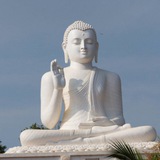
Dhammapada Verses 209, 210 and 211
Tayojanapabbajita Vatthu
Ayoge yunja'mattanam
yogasminca ayojayam
attham hit va piyaggahi
piheta'ttanuyoginam.
Ma piyehi samaganchi
appiyehi kudacanam
piyanam adassanam dukkham
appiyananca dassanam.
Tasma piyam na kayiratha
piyapayo hi papako
gantha tesam na vijjanti
yesam natthi piyappiyam.
Verse 209: He who does what should not be done and fails to do what should be done, who forsakes the noble aim of life (i.e., Morality, Concentration and Insight) and grasps at sensual pleasure, covets the benefits gained by those who exert themselves (in meditation).
Verse 210: Do not associate with those who are dear, and never with those who are not dear to you; not seeing the dear ones is painful, and seeing those who are not dear to you is also painful.
Verse 211: Therefore, one should hold nothing dear; separation from the loved ones is painful; there are no fetters for those who do not love or hate.
The Story of Three Ascetics
While residing at the Jetavana monastery, the Buddha uttered Verses (209), (210) and (211) of this book, with reference to a trio, consisting of a father, a mother and a son.
Once in Savatthi, the only son of a family first became a bhikkhu; the father followed suit and finally, the mother also became a bhikkhuni. They were so attached to one another that they rarely stayed apart. The family stayed in the monastery as if they were in their own house, talking and eating together, thus making themselves a nuisance to others. Other bhikkhus reported their behaviour to the Buddha and he called them to his presence, and said to them, "Once you have joined the Order, you should no longer stay together like a family. Not seeing those who are dear, and seeing those who are not dear to one, are both painful; so you should not hold any being or anything dear to you".
Then the Buddha spoke in verse as follows:
Verse 209: He who does what should not be done and fails to do what should be done, who forsakes the noble aim of life (i. e., Morality, Concentration and Insight) and grasps at sensual pleasure, covets the benefits gained by those who exert themselves (in meditation).
Verse 210: Do not associate with those who are dear, and never with those who are not dear to you; not seeing the dear ones is painful, and seeing those who are not dear to you is also painful.
Verse 211: Therefore, one should hold nothing dear; separation from the loved ones is painful; there are no fetters for those who do not love or hate.
====================
Ajahn Chah, Buddhist teacher of Thai forest meditation of Theravada Buddhism channel:
https://news.1rj.ru/str/ajahnchah_buddhism
===
Tayojanapabbajita Vatthu
Ayoge yunja'mattanam
yogasminca ayojayam
attham hit va piyaggahi
piheta'ttanuyoginam.
Ma piyehi samaganchi
appiyehi kudacanam
piyanam adassanam dukkham
appiyananca dassanam.
Tasma piyam na kayiratha
piyapayo hi papako
gantha tesam na vijjanti
yesam natthi piyappiyam.
Verse 209: He who does what should not be done and fails to do what should be done, who forsakes the noble aim of life (i.e., Morality, Concentration and Insight) and grasps at sensual pleasure, covets the benefits gained by those who exert themselves (in meditation).
Verse 210: Do not associate with those who are dear, and never with those who are not dear to you; not seeing the dear ones is painful, and seeing those who are not dear to you is also painful.
Verse 211: Therefore, one should hold nothing dear; separation from the loved ones is painful; there are no fetters for those who do not love or hate.
The Story of Three Ascetics
While residing at the Jetavana monastery, the Buddha uttered Verses (209), (210) and (211) of this book, with reference to a trio, consisting of a father, a mother and a son.
Once in Savatthi, the only son of a family first became a bhikkhu; the father followed suit and finally, the mother also became a bhikkhuni. They were so attached to one another that they rarely stayed apart. The family stayed in the monastery as if they were in their own house, talking and eating together, thus making themselves a nuisance to others. Other bhikkhus reported their behaviour to the Buddha and he called them to his presence, and said to them, "Once you have joined the Order, you should no longer stay together like a family. Not seeing those who are dear, and seeing those who are not dear to one, are both painful; so you should not hold any being or anything dear to you".
Then the Buddha spoke in verse as follows:
Verse 209: He who does what should not be done and fails to do what should be done, who forsakes the noble aim of life (i. e., Morality, Concentration and Insight) and grasps at sensual pleasure, covets the benefits gained by those who exert themselves (in meditation).
Verse 210: Do not associate with those who are dear, and never with those who are not dear to you; not seeing the dear ones is painful, and seeing those who are not dear to you is also painful.
Verse 211: Therefore, one should hold nothing dear; separation from the loved ones is painful; there are no fetters for those who do not love or hate.
====================
Ajahn Chah, Buddhist teacher of Thai forest meditation of Theravada Buddhism channel:
https://news.1rj.ru/str/ajahnchah_buddhism
===
Telegram
Ajahn Chah - Theravada Thailand Buddhism
Collection of teachings of Venerable Ajahn Chah, a foremost meditation and Buddhist teacher from Thailand
👏1💯1🤗1
Free Buddha Dharma ebook
Meditation is The Only Way
By Venerable Sri K Dhammananda
Free download available:
https://ia802700.us.archive.org/9/items/meditation-the-only-way-new/Meditation%20The%20Only%20Way%20New.pdf
https://ftp.budaedu.org/ebooks/pdf/EN158.pdf
===
Meditation is The Only Way
By Venerable Sri K Dhammananda
Free download available:
https://ia802700.us.archive.org/9/items/meditation-the-only-way-new/Meditation%20The%20Only%20Way%20New.pdf
https://ftp.budaedu.org/ebooks/pdf/EN158.pdf
===
❤1👍1
Free Buddha Dharma ebook
Meditation is The Only Way
By Venerable Sri K Dhammananda
Since earliest times men have recognized the vast benefits that can be gained through mind control. While meditation was practised in Europe over the last two thousand years, it was in India and later in China that the techniques of mind control were fully recognized and developed. Over a period of more than four thousand years, religious and spiritual disciplines were centred around meditational practices, but it was the Buddha who gave meditation a central place for gaining Enlightenment, and final salvation. All other religious systems use meditation to direct the mind towards external powers, but the Buddha taught us to use meditation to look within ourselves, to gain INSIGHT and thus develop ourselves without depending on external powers.
The primary purpose of meditation is to help the individual to control the mind and train it to bring inner peace to the individual who practises it. In this way a great deal of mental energy can be concentrated and thus make the mind capable of harnessing great power. Examples of the kind of power that mind control can give are the miracles performed by saints and religious leaders, e.g. walking on water, being in two places at the same time, going through solid walls, light emanating from the body etc. However, the Buddha taught that such mental power was not the final goal of his teaching. Mind control through meditation brings calmness but the Buddha has taught that such control is merely superficial. The suppression of the mental defilements is temporary. They can come to the surface of the mind at any time and hinder the spiritual development. These defilements like anger, hatred, greed, pride, illusion, wrong views must be completely rooted out from the mind through the development of Metta (goodwill), Karuna (compassion), Mudita (sympathetic joy), Uppekkha (equanimity) before one begins to tread the path towards emancipation.
Free download available:
https://ia802700.us.archive.org/9/items/meditation-the-only-way-new/Meditation%20The%20Only%20Way%20New.pdf
https://ftp.budaedu.org/ebooks/pdf/EN158.pdf
===
Meditation is The Only Way
By Venerable Sri K Dhammananda
Since earliest times men have recognized the vast benefits that can be gained through mind control. While meditation was practised in Europe over the last two thousand years, it was in India and later in China that the techniques of mind control were fully recognized and developed. Over a period of more than four thousand years, religious and spiritual disciplines were centred around meditational practices, but it was the Buddha who gave meditation a central place for gaining Enlightenment, and final salvation. All other religious systems use meditation to direct the mind towards external powers, but the Buddha taught us to use meditation to look within ourselves, to gain INSIGHT and thus develop ourselves without depending on external powers.
The primary purpose of meditation is to help the individual to control the mind and train it to bring inner peace to the individual who practises it. In this way a great deal of mental energy can be concentrated and thus make the mind capable of harnessing great power. Examples of the kind of power that mind control can give are the miracles performed by saints and religious leaders, e.g. walking on water, being in two places at the same time, going through solid walls, light emanating from the body etc. However, the Buddha taught that such mental power was not the final goal of his teaching. Mind control through meditation brings calmness but the Buddha has taught that such control is merely superficial. The suppression of the mental defilements is temporary. They can come to the surface of the mind at any time and hinder the spiritual development. These defilements like anger, hatred, greed, pride, illusion, wrong views must be completely rooted out from the mind through the development of Metta (goodwill), Karuna (compassion), Mudita (sympathetic joy), Uppekkha (equanimity) before one begins to tread the path towards emancipation.
Free download available:
https://ia802700.us.archive.org/9/items/meditation-the-only-way-new/Meditation%20The%20Only%20Way%20New.pdf
https://ftp.budaedu.org/ebooks/pdf/EN158.pdf
===
👏1💯1🏆1
Free Buddha Dharma ebook
Meditation is The Only Way
By Venerable Sri K Dhammananda
Free download available:
https://ia802700.us.archive.org/9/items/meditation-the-only-way-new/Meditation%20The%20Only%20Way%20New.pdf
https://ftp.budaedu.org/ebooks/pdf/EN158.pdf
===
Meditation is The Only Way
By Venerable Sri K Dhammananda
Free download available:
https://ia802700.us.archive.org/9/items/meditation-the-only-way-new/Meditation%20The%20Only%20Way%20New.pdf
https://ftp.budaedu.org/ebooks/pdf/EN158.pdf
===
❤1👍1🥰1🤗1
Dhammapada Verse 212
Annatarakutumbika Vatthu
Piyato jayati soko
piyato jayati bhayam
piyato vippamuttassa
natthi soko kuto bhayam.
Verse 212: Affection begets sorrow, affection begets fear. For him who is free from affection there is no sorrow; how can there be fear for him?
The Story of a Rich Householder
While residing at the Jetavana monastery, the Buddha uttered Verse (212) of this book, with reference to a rich householder who had lost his son.
Once, a householder was feeling very distressed over the death of his son. He often went to the cemetery and wept there. Early one morning, the Buddha saw the rich householder in his vision. So, taking a bhikkhu along with him, the Buddha went to the house of that man. There, he asked the man why he was feeling so unhappy. Then, the man related to the Buddha about the death of his son and about the pain and sorrow he was suffering. To him the Buddha said, "My disciple, death does not occur only in one place. All beings that are born must die one day; indeed, life ends in death. You must ever be mindful of the fact that life ends in death. Do not imagine that only your beloved son is subject to death. Do not be so distressed or be so shaken. Sorrow and fear arise out of affection."
Then the Buddha spoke in verse as follows:
Verse 212: Affection begets sorrow, affection begets fear. For him who is free from affection there is no sorrow; how can there be fear for him?
At the end of the discourse, the rich householder attained Sotapatti Fruition.
====================
Free Buddhism books, teachings, podcasts and videos from Theravada, Mahayana and Vajrayana traditions:
https://news.1rj.ru/str/buddha_ebooks
===
Annatarakutumbika Vatthu
Piyato jayati soko
piyato jayati bhayam
piyato vippamuttassa
natthi soko kuto bhayam.
Verse 212: Affection begets sorrow, affection begets fear. For him who is free from affection there is no sorrow; how can there be fear for him?
The Story of a Rich Householder
While residing at the Jetavana monastery, the Buddha uttered Verse (212) of this book, with reference to a rich householder who had lost his son.
Once, a householder was feeling very distressed over the death of his son. He often went to the cemetery and wept there. Early one morning, the Buddha saw the rich householder in his vision. So, taking a bhikkhu along with him, the Buddha went to the house of that man. There, he asked the man why he was feeling so unhappy. Then, the man related to the Buddha about the death of his son and about the pain and sorrow he was suffering. To him the Buddha said, "My disciple, death does not occur only in one place. All beings that are born must die one day; indeed, life ends in death. You must ever be mindful of the fact that life ends in death. Do not imagine that only your beloved son is subject to death. Do not be so distressed or be so shaken. Sorrow and fear arise out of affection."
Then the Buddha spoke in verse as follows:
Verse 212: Affection begets sorrow, affection begets fear. For him who is free from affection there is no sorrow; how can there be fear for him?
At the end of the discourse, the rich householder attained Sotapatti Fruition.
====================
Free Buddhism books, teachings, podcasts and videos from Theravada, Mahayana and Vajrayana traditions:
https://news.1rj.ru/str/buddha_ebooks
===
Telegram
Buddha Dharma books
Free Buddhism books, teachings, podcasts and videos from Theravada, Mahayana and Vajrayana traditions
❤1🥰1👏1🙏1
Forwarded from Ajahn Chah - Theravada Thailand Buddhism
Free Buddha Dharma ebook
A Taste of Freedom
By Ajahn Chah
Venerable Ajahn Chah always gave his talks in simple, everyday language. His objective was to clarify the Dhamma, not to confuse his listeners with an overload of information. Consequently the talks presented here have been rendered into correspondingly simple English. The aim of the translators has been to present Ajahn Chah’s teaching in both the spirit and the letter.
Free download available:
https://static.sariputta.com/pdf/tipitaka/265/a_taste_of_freedom_pdf.pdf
===
A Taste of Freedom
By Ajahn Chah
Venerable Ajahn Chah always gave his talks in simple, everyday language. His objective was to clarify the Dhamma, not to confuse his listeners with an overload of information. Consequently the talks presented here have been rendered into correspondingly simple English. The aim of the translators has been to present Ajahn Chah’s teaching in both the spirit and the letter.
Free download available:
https://static.sariputta.com/pdf/tipitaka/265/a_taste_of_freedom_pdf.pdf
===
👍2👏1🏆1
Dhammapada Verse 213
Visakha Vatthu
Pemato jayati soko
pemato jayati bhayam
pemato vippamuttassa
natthi soko kuto bhayam.
Verse 213: Endearment begets sorrow, endearment begets fear. For him who is free from endearment there is no sorrow; how can there be fear for him?
The Story of Visakha
While residing at the Jetavana monastery, the Buddha uttered Verse (213) of this book, with reference to Visakha, the renowned donor of the Pubbarama monastery.
One day, a granddaughter of Visakha named Sudatta died and Visakha felt very deeply about her loss and was sorrowing over the child's death. So she went to the Buddha; when the Buddha saw her, he said, "Visakha, don't you realize that many people die in Savatthi every day? If you were to regard all of them as you regard your own grandchild you would have to be endlessly weeping and mourning. Let not the death of a child affect you too much. Sorrow and fear arise out of endearment."
Then the Buddha spoke in verse as follows:
Verse 213: Endearment begets sorrow, endearment begets fear. For him who is free from endearment there is no sorrow; how can there be fear for him?
====================
Buddha dharma teachings channel:
https://news.1rj.ru/str/lorddivinebuddha
===
Visakha Vatthu
Pemato jayati soko
pemato jayati bhayam
pemato vippamuttassa
natthi soko kuto bhayam.
Verse 213: Endearment begets sorrow, endearment begets fear. For him who is free from endearment there is no sorrow; how can there be fear for him?
The Story of Visakha
While residing at the Jetavana monastery, the Buddha uttered Verse (213) of this book, with reference to Visakha, the renowned donor of the Pubbarama monastery.
One day, a granddaughter of Visakha named Sudatta died and Visakha felt very deeply about her loss and was sorrowing over the child's death. So she went to the Buddha; when the Buddha saw her, he said, "Visakha, don't you realize that many people die in Savatthi every day? If you were to regard all of them as you regard your own grandchild you would have to be endlessly weeping and mourning. Let not the death of a child affect you too much. Sorrow and fear arise out of endearment."
Then the Buddha spoke in verse as follows:
Verse 213: Endearment begets sorrow, endearment begets fear. For him who is free from endearment there is no sorrow; how can there be fear for him?
====================
Buddha dharma teachings channel:
https://news.1rj.ru/str/lorddivinebuddha
===
Telegram
Buddha
Buddha dharma teachings from the suttas and commentaries
👏2👌1🏆1
Dhammapada Verse 214
Licchavi Vatthu
Ratiya jayati soko
ratiya jayati bhayam
ratiya vippamuttassa
natthi soko kuto bhayam.
Verse 214: Attachment (to sensual pleasures) begets sorrow, attachment begets fear. For him who is free from attachment there is no sorrow; how can there be fear for him?
The Story of Licchavi Princes
While residing at the Kutagara monastery in Vesali, the Buddha uttered Verse (214) of this book, with reference to the Licchavi princes.
On one festival day, the Buddha entered the town of Vesali, accompanied by a retinue of bhikkhus. On their way, they met some Licchavi princes, who had come out elegantly dressed up. The Buddha seeing them in full regalia said to the bhikkhus, "Bhikkhus, those who have not been to the Tavatimsa deva world should have a good look at these Licchavi princes." The princes were then on their way to a pleasure garden. There, they quarrelled over a prostitute and soon came to blows. As a result, some of them had to be carried home, bleeding. As the Buddha returned with the bhikkhus after his meal in the town, they saw the wounded princes being carried home.
In connection with the above incident the bhikkhus remarked, "For the sake of a woman, these Licchavi princes are ruined." To them the Buddha replied, "Bhikkhus, sorrow and fear arise out of enjoyment of sensual pleasures and attachment to them."
Then the Buddha spoke in verse as follows:
Verse 214: Attachment (to sensual pleasures) begets sorrow, attachment begets fear. For him who is free from attachment there is no sorrow; how can there be fear for him?
====================
Tibetan Buddhism - Vajrayana, Tantrayana and esoteric Buddhism channel:
https://news.1rj.ru/str/tibetanbuddha
Vajrayana Tantrayana Buddhism channel:
https://news.1rj.ru/str/tantrayanabuddhism
===
Licchavi Vatthu
Ratiya jayati soko
ratiya jayati bhayam
ratiya vippamuttassa
natthi soko kuto bhayam.
Verse 214: Attachment (to sensual pleasures) begets sorrow, attachment begets fear. For him who is free from attachment there is no sorrow; how can there be fear for him?
The Story of Licchavi Princes
While residing at the Kutagara monastery in Vesali, the Buddha uttered Verse (214) of this book, with reference to the Licchavi princes.
On one festival day, the Buddha entered the town of Vesali, accompanied by a retinue of bhikkhus. On their way, they met some Licchavi princes, who had come out elegantly dressed up. The Buddha seeing them in full regalia said to the bhikkhus, "Bhikkhus, those who have not been to the Tavatimsa deva world should have a good look at these Licchavi princes." The princes were then on their way to a pleasure garden. There, they quarrelled over a prostitute and soon came to blows. As a result, some of them had to be carried home, bleeding. As the Buddha returned with the bhikkhus after his meal in the town, they saw the wounded princes being carried home.
In connection with the above incident the bhikkhus remarked, "For the sake of a woman, these Licchavi princes are ruined." To them the Buddha replied, "Bhikkhus, sorrow and fear arise out of enjoyment of sensual pleasures and attachment to them."
Then the Buddha spoke in verse as follows:
Verse 214: Attachment (to sensual pleasures) begets sorrow, attachment begets fear. For him who is free from attachment there is no sorrow; how can there be fear for him?
====================
Tibetan Buddhism - Vajrayana, Tantrayana and esoteric Buddhism channel:
https://news.1rj.ru/str/tibetanbuddha
Vajrayana Tantrayana Buddhism channel:
https://news.1rj.ru/str/tantrayanabuddhism
===
Telegram
Tibetan Buddhism Vajrayana Tantrayana esoteric tradition
Buddha Dharma teachings from the esoteric Vajrayana or Tantrayana Buddhism, includes all major schools Nyingma, Kagyu, Gelug, Sakya, Jonang and Bonpo.
💯2👍1
Forwarded from Words of the Buddha
Seeing the Silliness of Me
Theravada teacher Ajahn Sundara on the importance of not taking yourself so seriously.
By Ajahn Sundara
We are all very keen to liberate ourselves from what we think of as the obstacles in our lives—one of which we call the “me” that is creating all our troubles. But we often don’t know how to liberate ourselves, because this “me” comes in many disguises. How many times in your practice have you thought you’ve got it right—that sense of, “Now I’ve got the insight, I know what to do, I won’t be fooled again, I’m sure things will be all right”—only to see the same old habits jump out at you again? You say to yourself, “I’ve seen clearly that this anger is totally useless, I’ve seen it arising and passing away, I’ve seen the suffering it causes me.” Then something happens, and you’re back on the same track, angry about something silly, irrelevant, totally meaningless. This is what practice is for: to exacerbate the sense of self; to show us the silliness, stupidity, and meaninglessness of what we call “me.”
We usually take ourselves too seriously; this is one way the self fools us. For instance, you might acknowledge about yourself, “Oh, I’m really short tempered, not always a nice person.” While saying it, you might feel a great sense of integrity, that you are really being honest. But when somebody else describes you in the same way, what happens? “How dare you say that about me! Who do you think you are, anyway?” You may not say that, but you will feel it—“I am hurt.”
A lot of the time, we live our lives as if this “me” is all we have. If that were true, it would be a pretty miserable predicament, because this reactive little ego of ours is really quite treacherous. It is very clever, very intelligent, very rational. It can express itself brilliantly, so we have a hard time staying present and aware with what is happening before the “me” has exploded with some kind of splendid rationale—justifying itself, covering itself up, pretending that it’s not doing what it’s doing. But then suddenly we might realize that it’s all empty, it’s not really me. We may discover that this little blot of “me” is actually only a blot. It’s not the whole space of our life, it’s not the whole mind. Most of us understand that life is bigger than the little “me” that bars the way to ease, freedom, peace, confidence, faith, and so on.
So why do we hang on to it? What’s the point? A most tricky aspect of the manifestation of the sense of self is the desire to get rid of things we don’t like. We can observe this pattern in our meditation when we react with aversion to unpleasant thoughts, memories, or feelings. Instead of just being aware of them, we want to push them away, deny them, change them, or just distract ourselves. When we describe it, study it, analyze it, even watch it rising and passing away, the strongest thought underlying our sense of self is “it should not be like this.” We are often unaware of this judgmental attitude that can be quite deluding and unkind. Furthermore, it tends to make us view life in a negative way. There is deep suffering ingrained in that mode of apprehending ourselves.
It’s important to hear the story of “me,” because that is often how we can let it go—by expressing it in words or having a mirror in someone else who reflects it back at us with compassion.
“It should not be like this.” This is really a mantra of ignorance. How many times do we fall into that pattern? When we are mindful, everything falls into place. We think “it should be like this.” When we lose mindfulness, it becomes “it should not be like this.” Then it’s back to being in touch with clarity, confidence, awareness—and back and forth. This is what prevents the mind from releasing, from flowing, from relaxing, from just letting things be as they are. For most Westerners, this is the strongest obstacle in our practice—the wish for things to be other than [what] they are. Sometimes we even use practice to reinforce this habit of mind.
Theravada teacher Ajahn Sundara on the importance of not taking yourself so seriously.
By Ajahn Sundara
We are all very keen to liberate ourselves from what we think of as the obstacles in our lives—one of which we call the “me” that is creating all our troubles. But we often don’t know how to liberate ourselves, because this “me” comes in many disguises. How many times in your practice have you thought you’ve got it right—that sense of, “Now I’ve got the insight, I know what to do, I won’t be fooled again, I’m sure things will be all right”—only to see the same old habits jump out at you again? You say to yourself, “I’ve seen clearly that this anger is totally useless, I’ve seen it arising and passing away, I’ve seen the suffering it causes me.” Then something happens, and you’re back on the same track, angry about something silly, irrelevant, totally meaningless. This is what practice is for: to exacerbate the sense of self; to show us the silliness, stupidity, and meaninglessness of what we call “me.”
We usually take ourselves too seriously; this is one way the self fools us. For instance, you might acknowledge about yourself, “Oh, I’m really short tempered, not always a nice person.” While saying it, you might feel a great sense of integrity, that you are really being honest. But when somebody else describes you in the same way, what happens? “How dare you say that about me! Who do you think you are, anyway?” You may not say that, but you will feel it—“I am hurt.”
A lot of the time, we live our lives as if this “me” is all we have. If that were true, it would be a pretty miserable predicament, because this reactive little ego of ours is really quite treacherous. It is very clever, very intelligent, very rational. It can express itself brilliantly, so we have a hard time staying present and aware with what is happening before the “me” has exploded with some kind of splendid rationale—justifying itself, covering itself up, pretending that it’s not doing what it’s doing. But then suddenly we might realize that it’s all empty, it’s not really me. We may discover that this little blot of “me” is actually only a blot. It’s not the whole space of our life, it’s not the whole mind. Most of us understand that life is bigger than the little “me” that bars the way to ease, freedom, peace, confidence, faith, and so on.
So why do we hang on to it? What’s the point? A most tricky aspect of the manifestation of the sense of self is the desire to get rid of things we don’t like. We can observe this pattern in our meditation when we react with aversion to unpleasant thoughts, memories, or feelings. Instead of just being aware of them, we want to push them away, deny them, change them, or just distract ourselves. When we describe it, study it, analyze it, even watch it rising and passing away, the strongest thought underlying our sense of self is “it should not be like this.” We are often unaware of this judgmental attitude that can be quite deluding and unkind. Furthermore, it tends to make us view life in a negative way. There is deep suffering ingrained in that mode of apprehending ourselves.
It’s important to hear the story of “me,” because that is often how we can let it go—by expressing it in words or having a mirror in someone else who reflects it back at us with compassion.
“It should not be like this.” This is really a mantra of ignorance. How many times do we fall into that pattern? When we are mindful, everything falls into place. We think “it should be like this.” When we lose mindfulness, it becomes “it should not be like this.” Then it’s back to being in touch with clarity, confidence, awareness—and back and forth. This is what prevents the mind from releasing, from flowing, from relaxing, from just letting things be as they are. For most Westerners, this is the strongest obstacle in our practice—the wish for things to be other than [what] they are. Sometimes we even use practice to reinforce this habit of mind.
Telegram
Words of the Buddha
Daily teachings of Buddha Dharma
❤1👌1