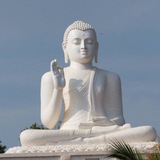
Dhammapada Verse 217
Pancasatadaraka Vatthu
Siladassanasampannam
dhammattham saccavedinam
attano kamma kubbanam
tam jano kurute piyam.
Verse 217: He who is endowed with Virtue and Insight, who is established in the Dhamma, who has realized the Truth and performs his own duties, is loved by all men.
The Story of Five Hundred Boys
While residing at the Veluvana monastery, the Buddha uttered Verse (217) of this book, with reference to five hundred boys.
On one festival day, the Buddha entered the city of Rajagaha for alms-food, accompanied by a number of bhikkhus. On their way, they met five hundred boys going to a pleasure garden. The boys were carrying some baskets of pan-cakes but they did not offer anything to the Buddha and his bhikkhus. But the Buddha said to his bhikkhus, "Bhikkhus, you shall eat those pan-cakes today; the owner is coming close behind us. We shall proceed only after taking some of these pan-cakes." After saying this, the Buddha and his bhikkhus rested under the shade of a tree. Just at that moment Thera Kassapa came along, and the boys seeing him paid obeisance to him and offered all their pan-cakes to the thera.
The thera then told the boys, "My teacher the Exalted One is resting underneath a tree over there accompanied by some bhikkhus; go and make an offering of your pan-cakes to him and the bhikkhus." The boys did as they were told. The Buddha accepted their offering of pan-cakes. Later, when the bhikkhus remarked that the boys were very partial to Thera Kassapa, the Buddha said to them, "Bhikkhus, all bhikkhus who are like my son Kassapa are liked by both devas and men. Such bhikkhus always receive ample offerings of the four requisites of bhikkhus."
Then the Buddha spoke in verse as follows:
Verse 217: He who is endowed with Virtue and Insight, who is established in the Dhamma, who has realized the Truth and performs his own duties, is loved by all men.
At the end of the discourse the five hundred boys attained Sotapatti Fruition.
====================
Buddha dharma teachings channel:
https://invite.viber.com/?g2=AQAKw1y3rv%2F6sk61PI2W4izuIiaEZj8YZujhY1tSzL%2B07s7rFnVFDAd0bAYFaMLw
===
Pancasatadaraka Vatthu
Siladassanasampannam
dhammattham saccavedinam
attano kamma kubbanam
tam jano kurute piyam.
Verse 217: He who is endowed with Virtue and Insight, who is established in the Dhamma, who has realized the Truth and performs his own duties, is loved by all men.
The Story of Five Hundred Boys
While residing at the Veluvana monastery, the Buddha uttered Verse (217) of this book, with reference to five hundred boys.
On one festival day, the Buddha entered the city of Rajagaha for alms-food, accompanied by a number of bhikkhus. On their way, they met five hundred boys going to a pleasure garden. The boys were carrying some baskets of pan-cakes but they did not offer anything to the Buddha and his bhikkhus. But the Buddha said to his bhikkhus, "Bhikkhus, you shall eat those pan-cakes today; the owner is coming close behind us. We shall proceed only after taking some of these pan-cakes." After saying this, the Buddha and his bhikkhus rested under the shade of a tree. Just at that moment Thera Kassapa came along, and the boys seeing him paid obeisance to him and offered all their pan-cakes to the thera.
The thera then told the boys, "My teacher the Exalted One is resting underneath a tree over there accompanied by some bhikkhus; go and make an offering of your pan-cakes to him and the bhikkhus." The boys did as they were told. The Buddha accepted their offering of pan-cakes. Later, when the bhikkhus remarked that the boys were very partial to Thera Kassapa, the Buddha said to them, "Bhikkhus, all bhikkhus who are like my son Kassapa are liked by both devas and men. Such bhikkhus always receive ample offerings of the four requisites of bhikkhus."
Then the Buddha spoke in verse as follows:
Verse 217: He who is endowed with Virtue and Insight, who is established in the Dhamma, who has realized the Truth and performs his own duties, is loved by all men.
At the end of the discourse the five hundred boys attained Sotapatti Fruition.
====================
Buddha dharma teachings channel:
https://invite.viber.com/?g2=AQAKw1y3rv%2F6sk61PI2W4izuIiaEZj8YZujhY1tSzL%2B07s7rFnVFDAd0bAYFaMLw
===
Viber
Buddha
Buddha dharma teachings from the suttas and commentaries from Theravada tradition
👏1🏆1
Forwarded from Words of the Buddha
Free Buddha Dharma ebook
A Heart Released: The Teachings of Phra Ajaan Mun, translated by Ṭhānissaro Bhikkhu. (revised Dec. 15, 2018)
Much has been written about the life of Phra Ajaan Mun Bhūridatta Thera (1870-1949), the founder of the Thai Forest Tradition, but very little was recorded of his teachings during his lifetime. (Most of his teachings he left in the form of people: the students whose lives were profoundly shaped by the experience of living and practicing meditation under his guidance.) The first piece translated here, A Heart Released (Muttodaya), is a record of passages from his sermons, made during the years 1944-45 by two monks who were staying under his guidance. The second, The Ever-present Truth, is drawn from notes of Ajaan Mun’s sermons taken by two of his students during the last two years of his life, covering a wide range of topics, including some standard accounts of the Buddha’s life. And the third, the poem The Ballad of Liberation from the Khandhas, was found after his death among the few papers he left behind.
Free download available:
https://www.dhammatalks.org/Archive/Writings/Ebooks/AHeartReleased_181215.pdf
===
A Heart Released: The Teachings of Phra Ajaan Mun, translated by Ṭhānissaro Bhikkhu. (revised Dec. 15, 2018)
Much has been written about the life of Phra Ajaan Mun Bhūridatta Thera (1870-1949), the founder of the Thai Forest Tradition, but very little was recorded of his teachings during his lifetime. (Most of his teachings he left in the form of people: the students whose lives were profoundly shaped by the experience of living and practicing meditation under his guidance.) The first piece translated here, A Heart Released (Muttodaya), is a record of passages from his sermons, made during the years 1944-45 by two monks who were staying under his guidance. The second, The Ever-present Truth, is drawn from notes of Ajaan Mun’s sermons taken by two of his students during the last two years of his life, covering a wide range of topics, including some standard accounts of the Buddha’s life. And the third, the poem The Ballad of Liberation from the Khandhas, was found after his death among the few papers he left behind.
Free download available:
https://www.dhammatalks.org/Archive/Writings/Ebooks/AHeartReleased_181215.pdf
===
👏1🙏1🏆1
Forwarded from Words of the Buddha
The Buddha as a Farmer
How the farming culture of the Buddha’s day may have shaped his ideas on patience
By Thanissaro Bhikkhu
We all know that the Buddha was a noble warrior, so it’s no surprise that there are similes in his teachings where he compares meditators to soldiers, elephants in battle, or warhorses.
What we don’t usually appreciate is that the Buddha was also part of a farming culture. The Majjhima Nikaya talks about his father plowing one day when the Buddha was a young boy. There’s also a passage in which his cousins talk about the drawbacks of lay life, wherein many have to do with farming: you bring in the crops, plant them, cultivate them again, and bring them in once more. There’s no end to it.
It’s good to think about what it would do to a person’s mind, living with crops, and being a farmer. One of the things that you learn as a farmer is patience. You do what you can to get the crops to grow, but they grow on their own. You can help them along to some extent, if you are consistent in your support, but you still have to be very patient about the results. If you plant a rice grain and then, when the shoot comes up, you pull it up to make it taller, it’s going to die.
There’s a similar principle in cooking. Some things must be put in the oven at a very low temperature. If you turn up the heat to make them cook more quickly, they will burn.
In our culture, which tends to be very impatient, we have to learn patience. And there’s no quick solution; learning patience itself requires patience. When you meditate, for instance, you have to keep coming back to the breath, learning how to talk to yourself as you’re doing this. You’re trying to quiet the mind, and it won’t get still. You give yourself encouragement. You focus on the causes of a quiet mind, you keep coming back to them, and after a while they will begin to have an influence on the mind.
We can’t tell beforehand who’s going to be fast or who’s going to be slow in making progress on the path. As the Thai Forest Tradition meditation teacher Ajaan Lee says, some people are like banana trees. You cut the trees, and they grow a couple of inches within a couple of hours. Other trees are much slower. You watch them day after day, and they don’t seem to be growing at all. So whether you’re going to be a fast tree or a slow tree, you can make sure that you’re a healthy tree. You try to keep encouraging yourself.
Learning patience itself requires patience.
This encouragement has to do with dealing with both the unskillful qualities that you see in yourself as well as the skillful qualities that you wish to develop. With the unskillful qualities, you have to remember that you don’t just sit there and accept them. You accept the fact that they’re there, you don’t deny it, but that’s not the total solution to the problem.
There’s so much modern dhamma where practitioners are told to just learn how to accept things. Accept everything and it’ll be okay. But the Buddha said you don’t accept the fact that you’ve created aversion and delusion in the mind and that they’re going to stay there. You accept the fact that they’re there, but you want to do something about them.
This is going to take time because the roots are deep. They’re old habits. You’ve been letting them run your lives for how many lifetimes, you don’t know.
This is where the Buddha says to take delight in abandoning and delight in developing. That means that with each little step in the right direction, you learn to encourage yourself. Appreciate it. Each step in the wrong direction, you tell yourself, “This is just a temporary setback.” You have to tune your emotions.
I know a therapist who works in a school for kids with challenges. She asks the students to rate on a scale of one to ten different negative things that can happen in their lives. For most of them, everything is a ten. Your brother gets stabbed: ten. You’ve got a date and you can’t figure out which dress to wear: ten. That attitude turns everything into a crisis.
How the farming culture of the Buddha’s day may have shaped his ideas on patience
By Thanissaro Bhikkhu
We all know that the Buddha was a noble warrior, so it’s no surprise that there are similes in his teachings where he compares meditators to soldiers, elephants in battle, or warhorses.
What we don’t usually appreciate is that the Buddha was also part of a farming culture. The Majjhima Nikaya talks about his father plowing one day when the Buddha was a young boy. There’s also a passage in which his cousins talk about the drawbacks of lay life, wherein many have to do with farming: you bring in the crops, plant them, cultivate them again, and bring them in once more. There’s no end to it.
It’s good to think about what it would do to a person’s mind, living with crops, and being a farmer. One of the things that you learn as a farmer is patience. You do what you can to get the crops to grow, but they grow on their own. You can help them along to some extent, if you are consistent in your support, but you still have to be very patient about the results. If you plant a rice grain and then, when the shoot comes up, you pull it up to make it taller, it’s going to die.
There’s a similar principle in cooking. Some things must be put in the oven at a very low temperature. If you turn up the heat to make them cook more quickly, they will burn.
In our culture, which tends to be very impatient, we have to learn patience. And there’s no quick solution; learning patience itself requires patience. When you meditate, for instance, you have to keep coming back to the breath, learning how to talk to yourself as you’re doing this. You’re trying to quiet the mind, and it won’t get still. You give yourself encouragement. You focus on the causes of a quiet mind, you keep coming back to them, and after a while they will begin to have an influence on the mind.
We can’t tell beforehand who’s going to be fast or who’s going to be slow in making progress on the path. As the Thai Forest Tradition meditation teacher Ajaan Lee says, some people are like banana trees. You cut the trees, and they grow a couple of inches within a couple of hours. Other trees are much slower. You watch them day after day, and they don’t seem to be growing at all. So whether you’re going to be a fast tree or a slow tree, you can make sure that you’re a healthy tree. You try to keep encouraging yourself.
Learning patience itself requires patience.
This encouragement has to do with dealing with both the unskillful qualities that you see in yourself as well as the skillful qualities that you wish to develop. With the unskillful qualities, you have to remember that you don’t just sit there and accept them. You accept the fact that they’re there, you don’t deny it, but that’s not the total solution to the problem.
There’s so much modern dhamma where practitioners are told to just learn how to accept things. Accept everything and it’ll be okay. But the Buddha said you don’t accept the fact that you’ve created aversion and delusion in the mind and that they’re going to stay there. You accept the fact that they’re there, but you want to do something about them.
This is going to take time because the roots are deep. They’re old habits. You’ve been letting them run your lives for how many lifetimes, you don’t know.
This is where the Buddha says to take delight in abandoning and delight in developing. That means that with each little step in the right direction, you learn to encourage yourself. Appreciate it. Each step in the wrong direction, you tell yourself, “This is just a temporary setback.” You have to tune your emotions.
I know a therapist who works in a school for kids with challenges. She asks the students to rate on a scale of one to ten different negative things that can happen in their lives. For most of them, everything is a ten. Your brother gets stabbed: ten. You’ve got a date and you can’t figure out which dress to wear: ten. That attitude turns everything into a crisis.
Telegram
Words of the Buddha
Daily teachings of Buddha Dharma
❤1💯1🤗1
Forwarded from Words of the Buddha
You have to realize that some things are minor, some things are major. Your ability to make things minor—in other words, to see a setback as not such a big deal—is an important mental skill.
Patience is a skill in learning how to talk to yourself, learning how to give yourself encouragement, to remind yourself that what you’re experiencing right now is a combination of past habits and present habits, present actions. The past habits may be very strong, but they’re not consistently strong. And because they’re past karma, they’re going to wear out someday. But you can speed up the process a bit by being as skillful as you can in your breathing, in how you talk to yourself, and the perceptions you hold in mind: those three fabrications.
Keeping the image of farming in mind, of plants growing, is one useful perception to help with the process and relax the mind into a more patient observer. As for times when skillful qualities might even get in the way, a lot of that problem is impatience. As my teacher, the Thai Buddhist monk Ajaan Fuang, used to say, there are two types of people who come to meditation: those who don’t think enough and those who think too much. Those who don’t think enough don’t have much trouble getting the mind to settle down. But once they settle down, they don’t know what to do with it and they like to stay right there. Those who think too much like to think, and are proud of their thinking, or are entertained by their thinking. Those are the ones who have to learn how to be quiet and let the mind grow at its own pace.
With each little step in the right direction, you learn to encourage yourself. Appreciate it. Each step in the wrong direction, you tell yourself, “This is just a temporary setback.”
Again, it’s like a tree or a plant that you’ve planted in a field. You tend to it, but the plant’s going to do the growing. If you want to get everything well figured out ahead of time, what you get is what Ajaan Lee calls vipassana-sanna: ideas about the insight but not the genuine thing.
As the Buddha said, if you’re good at insight but weak in tranquility, you’ve got to work on the tranquility. Figure out how to get the mind to settle down, how to get it to enjoy staying here.
Part of that has to do with talking to yourself about it. The other part has to do with learning how to talk to your impatience. We’re so used to living with computers that move their ones and zeros around at incredible speed. But the mind isn’t composed of ones and zeros. It’s organic. Again, think of the tree, especially a large tree. It has many different branches to grow. They have to nourish many fruits. So it’s going to take time.
Here again, learn how to talk to yourself. Remind yourself that there are a lot of things you can’t figure out ahead of time, so you’re going to learn as you feel your way. As you get a better intuitive sense of what’s going on, then you can know where to push, where not to push.
The farmer knows not to pull the plant up out of the ground, but the farmer also knows when to water, when to add fertilizer, when to weed, when to be quick in harvesting, and when to wait. Even though the work may be repetitive, have confidence that the results are going to be good. Remind yourself, if you don’t train your mind—and part of training the mind is getting it to be still—it’s just going to go back to its old habits. You’re going to learn something new, to create something new, grow something new.
Patience is a skill in learning how to talk to yourself, learning how to give yourself encouragement, to remind yourself that what you’re experiencing right now is a combination of past habits and present habits, present actions. The past habits may be very strong, but they’re not consistently strong. And because they’re past karma, they’re going to wear out someday. But you can speed up the process a bit by being as skillful as you can in your breathing, in how you talk to yourself, and the perceptions you hold in mind: those three fabrications.
Keeping the image of farming in mind, of plants growing, is one useful perception to help with the process and relax the mind into a more patient observer. As for times when skillful qualities might even get in the way, a lot of that problem is impatience. As my teacher, the Thai Buddhist monk Ajaan Fuang, used to say, there are two types of people who come to meditation: those who don’t think enough and those who think too much. Those who don’t think enough don’t have much trouble getting the mind to settle down. But once they settle down, they don’t know what to do with it and they like to stay right there. Those who think too much like to think, and are proud of their thinking, or are entertained by their thinking. Those are the ones who have to learn how to be quiet and let the mind grow at its own pace.
With each little step in the right direction, you learn to encourage yourself. Appreciate it. Each step in the wrong direction, you tell yourself, “This is just a temporary setback.”
Again, it’s like a tree or a plant that you’ve planted in a field. You tend to it, but the plant’s going to do the growing. If you want to get everything well figured out ahead of time, what you get is what Ajaan Lee calls vipassana-sanna: ideas about the insight but not the genuine thing.
As the Buddha said, if you’re good at insight but weak in tranquility, you’ve got to work on the tranquility. Figure out how to get the mind to settle down, how to get it to enjoy staying here.
Part of that has to do with talking to yourself about it. The other part has to do with learning how to talk to your impatience. We’re so used to living with computers that move their ones and zeros around at incredible speed. But the mind isn’t composed of ones and zeros. It’s organic. Again, think of the tree, especially a large tree. It has many different branches to grow. They have to nourish many fruits. So it’s going to take time.
Here again, learn how to talk to yourself. Remind yourself that there are a lot of things you can’t figure out ahead of time, so you’re going to learn as you feel your way. As you get a better intuitive sense of what’s going on, then you can know where to push, where not to push.
The farmer knows not to pull the plant up out of the ground, but the farmer also knows when to water, when to add fertilizer, when to weed, when to be quick in harvesting, and when to wait. Even though the work may be repetitive, have confidence that the results are going to be good. Remind yourself, if you don’t train your mind—and part of training the mind is getting it to be still—it’s just going to go back to its old habits. You’re going to learn something new, to create something new, grow something new.
❤2👍2🏆1
Forwarded from Words of the Buddha
Learn how to be patient when you need to be patient, and the patience here goes together with persistence. We know the Buddha said to be heedful, to act “as if your head were on fire.” Learn to translate that into a consistent persistence. Don’t bash your head trying to put out the fire.
===
Thanissaro Bhikkhu is an American Theravada Buddhist monk trained in the Thai Forest Tradition. He currently serves as abbot of the Metta Forest Monastery in San Diego County, California. His latest book is Good Heart, Good Mind: The Practice of the Ten Perfections.
Thanissaro Bhikkhu’s talks, writings, and translations are all freely available at his website
dhammatalks.org
===
Words of the Buddha channel:
https://news.1rj.ru/str/wordsofbuddha
===
===
Thanissaro Bhikkhu is an American Theravada Buddhist monk trained in the Thai Forest Tradition. He currently serves as abbot of the Metta Forest Monastery in San Diego County, California. His latest book is Good Heart, Good Mind: The Practice of the Ten Perfections.
Thanissaro Bhikkhu’s talks, writings, and translations are all freely available at his website
dhammatalks.org
===
Words of the Buddha channel:
https://news.1rj.ru/str/wordsofbuddha
===
Telegram
Words of the Buddha
Daily teachings of Buddha Dharma
👏1🙏1🤗1
Namakāra Gāthā
Araham Sammā-Sambuddho Bhagavā,
Buddham Bhagavantam abhivādemi.
Svākkhāto Bhagavatā Dhammo,
Dhammam namassāmi.
Supaṭipanno Bhagavato sāvaka-sangho,
Sangham namāmi.
The Blessed One is the Arahant, the Perfectly and Fully Awakened One;
I pay homage to the Buddha, the Blessed One.
The Dhamma is well-expounded by the Blessed One;
I pay homage to the Dhamma.
The Saṅgha of the Blessed One's disciples has practiced well;
I pay homage to the Saṅgha.
Araham Sammā-Sambuddho Bhagavā,
Buddham Bhagavantam abhivādemi.
Svākkhāto Bhagavatā Dhammo,
Dhammam namassāmi.
Supaṭipanno Bhagavato sāvaka-sangho,
Sangham namāmi.
The Blessed One is the Arahant, the Perfectly and Fully Awakened One;
I pay homage to the Buddha, the Blessed One.
The Dhamma is well-expounded by the Blessed One;
I pay homage to the Dhamma.
The Saṅgha of the Blessed One's disciples has practiced well;
I pay homage to the Saṅgha.
❤4🙏2🥰1🤗1
Dhammapada Verse 218
Eka Anagamitthera Vatthu
Chandajato anakkhate
manasa ca phuto siya
kamesu ca appatibaddhacitto
"uddhamsoto"1 ti vuccati.
Verse 218: He who has developed a desire for the Ineffable (i.e., Nibbana), whose mind reaches the same, and is no longer attached to the sensual world (kamaloka), is called one who is bound upstream (uddhamsoto).
1. uddhamsoto: one who is going upstream, i.e., one who is bound for the "Pure Abodes", (Sudahavasa Brahmaloka). The reference is to the anagami or now-returner, who is born in the Aviha Suddhavasa and from there passes upwards till he reaches the Akanittha Suddhavasa, the highest of the five Pure Abodes. (The Commentary)
The Story of an Anagami Thera
While residing at the Jetavana monastery, the Buddha uttered Verse (218) of this book, with reference to a thera who was an Anagami.
On one occasion, the pupils of the thera asked him whether he had attained any of the maggas; but he did not say anything although he had attained the Anagami Magga, the third magga. He kept silent because he had resolved not to talk about his attainment until he had attained arahatship. But the thera passed away without attaining arahatship, and also without saying anything about his attainment of Anagami Magga Insight.
His pupils thought their teacher had passed away without attaining any of the maggas and they felt sorry for him. They went to the Buddha and asked him where their teacher was reborn. The Buddha replied, "Bhikkhus! Your teacher, who was an Anagami before he passed away, is now reborn in the abodes of the Brahmas (Suddhavasa Brahmaloka). He did not reveal his attainment of Anagami Magga because he felt ashamed that he had achieved only that much, and he was ardently striving to attain arahatship. Your teacher is now freed from the attachment to the sensual world (kamaloka) and would certainly rise to higher realms."
Then the Buddha spoke in verse as follows:
Verse 218: He who has developed a desire for the Ineffable (i.e., Nibbana), whose mind reaches the same, and is no longer attached to the sensual world (kamaloka), is called one who is bound upstream (uddhamsoto).
At the end of the discourse those bhikkhus attained arahatship.
====================
Words of the Buddha channel:
https://invite.viber.com/?g2=AQAFqzqlj7FmI061PX17rxWMAtZ%2BRuso%2FH2KmHKZSgnv7v9DD8X0bDkKnZDr9JDq
===
Eka Anagamitthera Vatthu
Chandajato anakkhate
manasa ca phuto siya
kamesu ca appatibaddhacitto
"uddhamsoto"1 ti vuccati.
Verse 218: He who has developed a desire for the Ineffable (i.e., Nibbana), whose mind reaches the same, and is no longer attached to the sensual world (kamaloka), is called one who is bound upstream (uddhamsoto).
1. uddhamsoto: one who is going upstream, i.e., one who is bound for the "Pure Abodes", (Sudahavasa Brahmaloka). The reference is to the anagami or now-returner, who is born in the Aviha Suddhavasa and from there passes upwards till he reaches the Akanittha Suddhavasa, the highest of the five Pure Abodes. (The Commentary)
The Story of an Anagami Thera
While residing at the Jetavana monastery, the Buddha uttered Verse (218) of this book, with reference to a thera who was an Anagami.
On one occasion, the pupils of the thera asked him whether he had attained any of the maggas; but he did not say anything although he had attained the Anagami Magga, the third magga. He kept silent because he had resolved not to talk about his attainment until he had attained arahatship. But the thera passed away without attaining arahatship, and also without saying anything about his attainment of Anagami Magga Insight.
His pupils thought their teacher had passed away without attaining any of the maggas and they felt sorry for him. They went to the Buddha and asked him where their teacher was reborn. The Buddha replied, "Bhikkhus! Your teacher, who was an Anagami before he passed away, is now reborn in the abodes of the Brahmas (Suddhavasa Brahmaloka). He did not reveal his attainment of Anagami Magga because he felt ashamed that he had achieved only that much, and he was ardently striving to attain arahatship. Your teacher is now freed from the attachment to the sensual world (kamaloka) and would certainly rise to higher realms."
Then the Buddha spoke in verse as follows:
Verse 218: He who has developed a desire for the Ineffable (i.e., Nibbana), whose mind reaches the same, and is no longer attached to the sensual world (kamaloka), is called one who is bound upstream (uddhamsoto).
At the end of the discourse those bhikkhus attained arahatship.
====================
Words of the Buddha channel:
https://invite.viber.com/?g2=AQAFqzqlj7FmI061PX17rxWMAtZ%2BRuso%2FH2KmHKZSgnv7v9DD8X0bDkKnZDr9JDq
===
Viber
Words Of The Buddha
Daily teachings from Buddha Dharma
👍2🙏1👌1🏆1🤝1
Forwarded from Buddha Dharma books
Free Buddha Dharma ebook
DYING TO LIVE
The Role of Kamma in Dying and Rebirth
By Aggacitta Bhikkhu
DIFFERENT PEOPLE HAVE different views and beliefs about what happens after death. Although all Buddhist Schools are unanimous that death marks the end and beginning of life for sentient beings still bound to saüsàra [the round of births], not all share the same views, observations and interpretations with regard to the actual process of dying and rebirth.
Tibetan (Vajrayàna) and Chinese (Mahàyàna) Buddhists believe that after death, the spirit of the dead person passes through an intermediate period (bardo in Tibetan, zhong yin in Mandarin)—which may last for as long as forty-nine days—during which it undergoes a series of unearthly, extraordinary experiences, including a “small death” at the end of each week, before it is finally reborn into another realm of existence. In contrast, orthodox Theravada Buddhism, which is the earliest, most authentic, extant record of Gotama Buddha’s teaching, asserts that rebirth takes place immediately after death.
It may not be too naive to suggest that this difference between the schools could be more apparent than real; for if one regarded the entity in the bardo/zhong yin as another reborn being, then this doctrinal inconsistency could very well be reconciled, although Theravadins may still question the weekly “small deaths” and forty-nine day duration. But it is not within the scope of this booklet to speculate on the rationale and credibility of this belief. Rather, the purpose of this work is to present a comprehensive picture of kamma and the often unpredictable role it plays in the process of dying and rebirth according to orthodox Theravada doctrine.
Free download available:
https://static.sariputta.com/pdf/tipitaka/763/dietolivepdf.pdf
===
DYING TO LIVE
The Role of Kamma in Dying and Rebirth
By Aggacitta Bhikkhu
DIFFERENT PEOPLE HAVE different views and beliefs about what happens after death. Although all Buddhist Schools are unanimous that death marks the end and beginning of life for sentient beings still bound to saüsàra [the round of births], not all share the same views, observations and interpretations with regard to the actual process of dying and rebirth.
Tibetan (Vajrayàna) and Chinese (Mahàyàna) Buddhists believe that after death, the spirit of the dead person passes through an intermediate period (bardo in Tibetan, zhong yin in Mandarin)—which may last for as long as forty-nine days—during which it undergoes a series of unearthly, extraordinary experiences, including a “small death” at the end of each week, before it is finally reborn into another realm of existence. In contrast, orthodox Theravada Buddhism, which is the earliest, most authentic, extant record of Gotama Buddha’s teaching, asserts that rebirth takes place immediately after death.
It may not be too naive to suggest that this difference between the schools could be more apparent than real; for if one regarded the entity in the bardo/zhong yin as another reborn being, then this doctrinal inconsistency could very well be reconciled, although Theravadins may still question the weekly “small deaths” and forty-nine day duration. But it is not within the scope of this booklet to speculate on the rationale and credibility of this belief. Rather, the purpose of this work is to present a comprehensive picture of kamma and the often unpredictable role it plays in the process of dying and rebirth according to orthodox Theravada doctrine.
Free download available:
https://static.sariputta.com/pdf/tipitaka/763/dietolivepdf.pdf
===
👍2🙏1🏆1
Dhammapada Verses 219 and 220
Nandiya Vatthu
Cirappavsim purisam
durato sotthimagatam
natimitta suhajja ca
abhinandanti agatam.
Tatheva katapunnampi
asma loka param gatam
punnani patiganhanti
piyam nativa agatam.
Verse 219: A man who has long been absent and has returned home safely from a distance is welcomed with joy by relatives, friends and well-wishers on his return.
Verse 220: In the same way, his good deeds will receive him who has done good when he goes from this world to the other, as relatives receive a dear one on his return.
The Story of Nandiya
While residing at the Isipatana wood, the Buddha uttered Verses (219) and (220) of this book, with reference to Nandiya.
Nandiya was a rich man from Baranasi. After listening to the Buddha's discourse on the benefits of building monasteries for bhikkhus, Nandiya built the Mahavihara monastery at Isipatana. The building was pinnacled and fully furnished. As soon as the monastery was offered to the Buddha, a mansion came up for Nandiya at the Tavatimsa deva world.
One day, when Thera Maha Moggalana visited the Tavatimsa deva world he saw the mansion which was meant for the donor of the Mahavihara monastery at Isipatana. On his return from the Tavatimsa deva world, Thera Maha Moggalana asked the Buddha, "Venerable Sir! For those who perform meritorious deeds, do they have mansions and other riches prepared in the deva world even while they are still living in this world ?" To him the Buddha said, "My son, why do you ask? Have you not yourself seen the mansion and riches waiting for Nandiya in the Tavatimsa deva world? The devas await the coming of the good and generous ones, as relatives await the return of one who is long absent. When the good ones die, they are welcomed joyously to the abode of the devas."
Then the Buddha spoke in verse as follows:
Verse 219: A man who has long been absent and has returned home safely from a distance is welcomed with joy by relatives, friends and well-wishers on his return.
Verse 220: In the same way, his good deeds will receive him who has done good when he goes from this world to the other, as relatives receive a dear one on his return.
End of Chapter Sixteen: Affection (Piyavagga)
====================
Dhammapada, beloved and favorite teachings of the Buddha channel:
https://invite.viber.com/?g2=AQBLD6phsgvP%2F061YjEM3K%2BNeH1Yb372b9mtfQX2EmuBpgoLUoc99BDMfzHghrme
===
Nandiya Vatthu
Cirappavsim purisam
durato sotthimagatam
natimitta suhajja ca
abhinandanti agatam.
Tatheva katapunnampi
asma loka param gatam
punnani patiganhanti
piyam nativa agatam.
Verse 219: A man who has long been absent and has returned home safely from a distance is welcomed with joy by relatives, friends and well-wishers on his return.
Verse 220: In the same way, his good deeds will receive him who has done good when he goes from this world to the other, as relatives receive a dear one on his return.
The Story of Nandiya
While residing at the Isipatana wood, the Buddha uttered Verses (219) and (220) of this book, with reference to Nandiya.
Nandiya was a rich man from Baranasi. After listening to the Buddha's discourse on the benefits of building monasteries for bhikkhus, Nandiya built the Mahavihara monastery at Isipatana. The building was pinnacled and fully furnished. As soon as the monastery was offered to the Buddha, a mansion came up for Nandiya at the Tavatimsa deva world.
One day, when Thera Maha Moggalana visited the Tavatimsa deva world he saw the mansion which was meant for the donor of the Mahavihara monastery at Isipatana. On his return from the Tavatimsa deva world, Thera Maha Moggalana asked the Buddha, "Venerable Sir! For those who perform meritorious deeds, do they have mansions and other riches prepared in the deva world even while they are still living in this world ?" To him the Buddha said, "My son, why do you ask? Have you not yourself seen the mansion and riches waiting for Nandiya in the Tavatimsa deva world? The devas await the coming of the good and generous ones, as relatives await the return of one who is long absent. When the good ones die, they are welcomed joyously to the abode of the devas."
Then the Buddha spoke in verse as follows:
Verse 219: A man who has long been absent and has returned home safely from a distance is welcomed with joy by relatives, friends and well-wishers on his return.
Verse 220: In the same way, his good deeds will receive him who has done good when he goes from this world to the other, as relatives receive a dear one on his return.
End of Chapter Sixteen: Affection (Piyavagga)
====================
Dhammapada, beloved and favorite teachings of the Buddha channel:
https://invite.viber.com/?g2=AQBLD6phsgvP%2F061YjEM3K%2BNeH1Yb372b9mtfQX2EmuBpgoLUoc99BDMfzHghrme
===
Viber
Dhammapada - Buddha Dharma Teachings
Daily teachings of the Dhammapada, beloved and favorite teachings of the Buddha
👍1🥰1🙏1🏆1🤗1