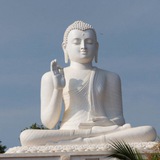
Forwarded from Words of the Buddha
Only when their respective conditions are met can these forms of justice be objective and binding on all. Even in a non-Buddhist worldview, these forms of justice lead to inevitable conflicts. In the Buddha’s worldview, though, it’s impossible that their conditions could ever be met.
This relates to the second set of lessons about justice that the Buddha gained from his awakening, lessons about time and rebirth. In the first knowledge he gained on the night of his awakening, he saw his own past lives, back through countless eons, repeatedly rising and falling through many levels of being and through the evolution and collapse of many universes. As he later said, the beginning point of the process—called samsara, this bad habit we have of “wandering on”—was inconceivable. Not just unknowable. Inconceivable. This means that there can be no clear point from which we can begin the tally of wrongs and rights that retributive justice demands.
In the second knowledge, he saw that the process of death and rebirth applied to all beings in the universe, and that—because it had gone on so long—it would be hard to find a person who had never been your mother, father, brother, sister, son, or daughter in the course of that long, long time. We’ve all been oppressors and oppressed, over and over again.
He also saw that the universe was shaped by the conflicting intentions of all its many beings, and that it serves the designs of no one in particular. As one dhamma summary has it, “There is no one in charge” (Majjhima Nikaya 82). This means that the universe has no purpose, there’s no ideal state to return to, and there’s no source to determine how the goods of the universe should be distributed. So there’s no way that ideas of restorative or distributive justice could be universally binding.
What’s more, the universe has the potential to continue without end. Unlike a monotheistic universe, with its creator passing final judgment, samsara offers no prospect of a fair or just closure—or even, apart from nibbana, any closure at all.
This point has two consequences. The first is that there can be no valid theory of ends justifying the means, because samsara involves nothing but means. This is why the Buddha answered the question of how to attain long-term happiness within the universe not with a demand for a fair society but with a recommendation for meritorious actions—i.e., actions that, in creating happiness and freedom, harm no one.
These actions come down to three: generosity, virtue, and the development of universal goodwill. To provide for your own long-term happiness, you adopt these actions yourself. To provide for the long-term happiness of others, you persuade them to adopt them. Unlike theories of justice, which require stories to justify the punishments they often call for, meritorious actions require no justifications at all. They obviously come from a good heart, and because they spread their goodness all around, they’re genuine means for fostering harmony and peace.
For a just society to be possible, it’s essential that people first train their hearts and minds.
The second consequence of the fact that, aside from nibbana, there is no closure to samsara is that even if you could create a just society, it wouldn’t last. That’s because, unless the human heart is trained, justice wouldn’t satisfy it. As the Buddha commented to Mara—the only being who ever invited him to rule justly over others (Samyutta Nikaya 4:20)—even two mountains the size of the Himalayas made of solid gold wouldn’t be enough to satisfy the wants of any one person. No matter how fairly wealth and opportunities were distributed under your rule, there would always be those dissatisfied with their portions. As a result, there would always be people you’d have to fight in order to maintain your power.
This relates to the second set of lessons about justice that the Buddha gained from his awakening, lessons about time and rebirth. In the first knowledge he gained on the night of his awakening, he saw his own past lives, back through countless eons, repeatedly rising and falling through many levels of being and through the evolution and collapse of many universes. As he later said, the beginning point of the process—called samsara, this bad habit we have of “wandering on”—was inconceivable. Not just unknowable. Inconceivable. This means that there can be no clear point from which we can begin the tally of wrongs and rights that retributive justice demands.
In the second knowledge, he saw that the process of death and rebirth applied to all beings in the universe, and that—because it had gone on so long—it would be hard to find a person who had never been your mother, father, brother, sister, son, or daughter in the course of that long, long time. We’ve all been oppressors and oppressed, over and over again.
He also saw that the universe was shaped by the conflicting intentions of all its many beings, and that it serves the designs of no one in particular. As one dhamma summary has it, “There is no one in charge” (Majjhima Nikaya 82). This means that the universe has no purpose, there’s no ideal state to return to, and there’s no source to determine how the goods of the universe should be distributed. So there’s no way that ideas of restorative or distributive justice could be universally binding.
What’s more, the universe has the potential to continue without end. Unlike a monotheistic universe, with its creator passing final judgment, samsara offers no prospect of a fair or just closure—or even, apart from nibbana, any closure at all.
This point has two consequences. The first is that there can be no valid theory of ends justifying the means, because samsara involves nothing but means. This is why the Buddha answered the question of how to attain long-term happiness within the universe not with a demand for a fair society but with a recommendation for meritorious actions—i.e., actions that, in creating happiness and freedom, harm no one.
These actions come down to three: generosity, virtue, and the development of universal goodwill. To provide for your own long-term happiness, you adopt these actions yourself. To provide for the long-term happiness of others, you persuade them to adopt them. Unlike theories of justice, which require stories to justify the punishments they often call for, meritorious actions require no justifications at all. They obviously come from a good heart, and because they spread their goodness all around, they’re genuine means for fostering harmony and peace.
For a just society to be possible, it’s essential that people first train their hearts and minds.
The second consequence of the fact that, aside from nibbana, there is no closure to samsara is that even if you could create a just society, it wouldn’t last. That’s because, unless the human heart is trained, justice wouldn’t satisfy it. As the Buddha commented to Mara—the only being who ever invited him to rule justly over others (Samyutta Nikaya 4:20)—even two mountains the size of the Himalayas made of solid gold wouldn’t be enough to satisfy the wants of any one person. No matter how fairly wealth and opportunities were distributed under your rule, there would always be those dissatisfied with their portions. As a result, there would always be people you’d have to fight in order to maintain your power.
👍1🏆1
Forwarded from Words of the Buddha
This shows the weakness of the idea that we need a just society before we can enjoy the “luxury” of meditation. Actually, the priorities go the other way around: For a just society to be possible, it’s essential that people first train their hearts and minds.
So the fact that the universe, as the Buddha saw it, serves no one’s design and is aimed at no overarching purpose militates against the pursuit of justice as an overriding goal. That’s its downside. Its upside is that 1) because you don’t have to serve anyone else’s overarching purpose, and 2) because your experience of pleasure and pain isn’t totally determined by your past karma, you’re free to pursue the end of suffering if you choose to do so.
Even if you don’t accept the Buddhist worldview in its entirety, it’s undeniable that for a path to freedom from suffering to be possible, these two conditions have to be met.
It was because the Buddha saw that a just society wouldn’t satisfy the untrained human heart that he focused his energies not on working for justice but on teaching people how to train their own hearts. That way, as long as they continue engaging in samsara, they can minimize the suffering they cause to themselves and others, and they can use their generosity, virtue, and limitless goodwill to mitigate suffering wherever they can. When they finally kick the samsara habit, they can reach the freedom of an unconditioned happiness that causes no one to suffer at all.
So if we follow the principles of the Buddha’s teachings, instead of falling into the trap of inflicting our notions of justice on one another, we can foster the conditions that allow for even the Angulimalas of the world to put down their weapons and gain freedom, whether they deserve it or not.
===
Thanissaro Bhikkhu is an American Theravada Buddhist monk trained in the Thai Forest Tradition. He currently serves as abbot of the Metta Forest Monastery in San Diego County, California and is a frequent contributor to Tricycle. His latest book is Good Heart, Good Mind: The Practice of the Ten Perfections. Thanissaro Bhikkhu’s talks, writings, and translations are all freely available at his website,
dhammatalks.org
===
Words of the Buddha channel:
https://news.1rj.ru/str/wordsofbuddha
===
So the fact that the universe, as the Buddha saw it, serves no one’s design and is aimed at no overarching purpose militates against the pursuit of justice as an overriding goal. That’s its downside. Its upside is that 1) because you don’t have to serve anyone else’s overarching purpose, and 2) because your experience of pleasure and pain isn’t totally determined by your past karma, you’re free to pursue the end of suffering if you choose to do so.
Even if you don’t accept the Buddhist worldview in its entirety, it’s undeniable that for a path to freedom from suffering to be possible, these two conditions have to be met.
It was because the Buddha saw that a just society wouldn’t satisfy the untrained human heart that he focused his energies not on working for justice but on teaching people how to train their own hearts. That way, as long as they continue engaging in samsara, they can minimize the suffering they cause to themselves and others, and they can use their generosity, virtue, and limitless goodwill to mitigate suffering wherever they can. When they finally kick the samsara habit, they can reach the freedom of an unconditioned happiness that causes no one to suffer at all.
So if we follow the principles of the Buddha’s teachings, instead of falling into the trap of inflicting our notions of justice on one another, we can foster the conditions that allow for even the Angulimalas of the world to put down their weapons and gain freedom, whether they deserve it or not.
===
Thanissaro Bhikkhu is an American Theravada Buddhist monk trained in the Thai Forest Tradition. He currently serves as abbot of the Metta Forest Monastery in San Diego County, California and is a frequent contributor to Tricycle. His latest book is Good Heart, Good Mind: The Practice of the Ten Perfections. Thanissaro Bhikkhu’s talks, writings, and translations are all freely available at his website,
dhammatalks.org
===
Words of the Buddha channel:
https://news.1rj.ru/str/wordsofbuddha
===
Telegram
Words of the Buddha
Daily teachings of Buddha Dharma
🥰1👏1
Every kind of delighting or longing,
So often attaching to all kinds of stuff,
Yearned for because of deep-rooted confusion
— All these, with their roots, have been vanquished by me (Buddha)
I'm devoid of attachment, longing, or thirst,
And see clearly amidst all phenomena.
Having gained the sublime, highest awakening,
I meditate in ripened seclusion (a desolate forest)
Katthaharaka Sutta: Buddha in the Forest
Samyutta Nikaya 7.18
So often attaching to all kinds of stuff,
Yearned for because of deep-rooted confusion
— All these, with their roots, have been vanquished by me (Buddha)
I'm devoid of attachment, longing, or thirst,
And see clearly amidst all phenomena.
Having gained the sublime, highest awakening,
I meditate in ripened seclusion (a desolate forest)
Katthaharaka Sutta: Buddha in the Forest
Samyutta Nikaya 7.18
❤1🤗1
Dhammapada Verse 226
Punnadasi Vatthu
Sada jagaramananam
ahorattanusi kkhinam
nibbanam adhimuttanam
attham gacchanti asava.
Verse 226: In those who are ever vigilant, who by day and by night train themselves in the three sikkhas (i.e., sila, samadhi and panna), and who have their mind directed towards Nibbana, moral intoxicants become extinct.
The Story of Punna, the Slave Girl
While residing at the Gijjhakuta mountain, the Buddha uttered Verse (226) of this book, with reference to a slave girl in Rajagaha.
One night, Punna the slave girl was up pounding rice for her master. As she got tired she rested for a while. While resting, she saw Thera Dabba leading some bhikkhus to their respective monasteries on their return from listening to the Dhamma. The girl seeing them up so late, pondered, "I have to be up at this late hour because I am so poor and have to work hard. But, why are these good people up at this late hour? Maybe a bhikkhu is sick, or are they being troubled by a snake?"
Early in the morning the next day, Punna took some broken rice, soaked it in water and made a pan-cake out of it. Then, intending to eat it at the riverside she took her cheap, coarse pan-cake along with her. On the way, she saw the Buddha coming on an alms-round. She wanted to offer her pan-cake to the Buddha, but she was not sure whether the Buddha would condescend to eat such cheap, coarse pan-cake. The Buddha knew her thoughts. He accepted her pan-cake and asked Thera Ananda to spread the small mat on the ground. The Buddha sat on the mat and ate the pan-cake offered by the slave girl. After eating, the Buddha called Punna to him and answered the question which was troubling her. Said the Buddha to the slave girl, "Punna, you cannot go to sleep because you are poor and so have to work hard. As for my sons the bhikkhus, they do not go to sleep because they have to be always vigilant and ever mindful."
Then the Buddha spoke in verse as follows:
Verse 226: In those who are ever vigilant, who by day and by night train themselves in the three sikkhas (i.e., sila, samadhi and panna), and who have their mind directed towards Nibbana, moral intoxicants become extinct.
At the end of the discourse Punna attained Sotapatti Fruition.
====================
Dhammapada, beloved and favorite teachings of the Buddha channel:
https://news.1rj.ru/str/dhammapadas
===
Punnadasi Vatthu
Sada jagaramananam
ahorattanusi kkhinam
nibbanam adhimuttanam
attham gacchanti asava.
Verse 226: In those who are ever vigilant, who by day and by night train themselves in the three sikkhas (i.e., sila, samadhi and panna), and who have their mind directed towards Nibbana, moral intoxicants become extinct.
The Story of Punna, the Slave Girl
While residing at the Gijjhakuta mountain, the Buddha uttered Verse (226) of this book, with reference to a slave girl in Rajagaha.
One night, Punna the slave girl was up pounding rice for her master. As she got tired she rested for a while. While resting, she saw Thera Dabba leading some bhikkhus to their respective monasteries on their return from listening to the Dhamma. The girl seeing them up so late, pondered, "I have to be up at this late hour because I am so poor and have to work hard. But, why are these good people up at this late hour? Maybe a bhikkhu is sick, or are they being troubled by a snake?"
Early in the morning the next day, Punna took some broken rice, soaked it in water and made a pan-cake out of it. Then, intending to eat it at the riverside she took her cheap, coarse pan-cake along with her. On the way, she saw the Buddha coming on an alms-round. She wanted to offer her pan-cake to the Buddha, but she was not sure whether the Buddha would condescend to eat such cheap, coarse pan-cake. The Buddha knew her thoughts. He accepted her pan-cake and asked Thera Ananda to spread the small mat on the ground. The Buddha sat on the mat and ate the pan-cake offered by the slave girl. After eating, the Buddha called Punna to him and answered the question which was troubling her. Said the Buddha to the slave girl, "Punna, you cannot go to sleep because you are poor and so have to work hard. As for my sons the bhikkhus, they do not go to sleep because they have to be always vigilant and ever mindful."
Then the Buddha spoke in verse as follows:
Verse 226: In those who are ever vigilant, who by day and by night train themselves in the three sikkhas (i.e., sila, samadhi and panna), and who have their mind directed towards Nibbana, moral intoxicants become extinct.
At the end of the discourse Punna attained Sotapatti Fruition.
====================
Dhammapada, beloved and favorite teachings of the Buddha channel:
https://news.1rj.ru/str/dhammapadas
===
Telegram
Dhammapada - Buddha Dharma Teachings
Daily teachings of the Dhammapada, beloved and favorite teachings of the Buddha
🙏2👍1👏1😘1
Forwarded from Buddha Dharma books
Free Buddha Dharma ebook
Buddhism in a Nutshell
by Narada Mahathera
An excellent introductory overview of the fundamental principles of the Buddhist doctrine, this book covers many topics such as the life of the Buddha, the Dhamma, the Four Noble Truths, the Law of Kamma, Rebirth, Dependent Origination, Anatta, and Nibbana. Some of the chapters include: "The Dhamma: Is it a Philosophy?," "Is it a Religion?," "Is Buddhism an Ethical System?," and "Rebirth."
Free download here:
https://static.sariputta.com/pdf/tipitaka/222/nutshell_pdf.pdf
===
Buddhism in a Nutshell
by Narada Mahathera
An excellent introductory overview of the fundamental principles of the Buddhist doctrine, this book covers many topics such as the life of the Buddha, the Dhamma, the Four Noble Truths, the Law of Kamma, Rebirth, Dependent Origination, Anatta, and Nibbana. Some of the chapters include: "The Dhamma: Is it a Philosophy?," "Is it a Religion?," "Is Buddhism an Ethical System?," and "Rebirth."
Free download here:
https://static.sariputta.com/pdf/tipitaka/222/nutshell_pdf.pdf
===
👏1💯1🏆1
Dhammapada Verses 227, 228, 229 and 230
Atula Upasaka Vatthu
Poranametam Atula
netam ajjatanamiva
nindanti tunhimasinam
nindanti bahubhaninam
mitabhanimpi nindanti
natthi loke anindito.
Na cahu na ca bhavissati
na cetarahi vijjati
ekantam nindito poso
ekantam va pasamsito.
Yam ce vinnu pasamsanti
anuvicca suve suve
acchiddavuttim medhavim
pannasilasamahitam.
Nikkham jambonadasseva1
ko tam ninditumarahati
devapi nam pasamsanti
brahmunapi pasamsito.
Verse 227: It is not new, O Atula! It has always been done from ancient times. They blame one who is silent, they blame one who speaks much, they blame one who speaks little. There is no one in this world who is not blamed.
Verse 228: There never has been, there never will be, nor is there now, anyone who is always blamed or always praised.
Verses 229 - 230: If the wise praise him day after day, knowing him to be truly faultless, wise and endowed with knowledge and virtue, who would blame him, who is like a nikkha of pure gold? The devas praise him; he is praised even by the great Brahmas.
1. nikkham jambonadasseva: like a nikkha of jambonada gold. Jambonada gold which comes from Jambu river is the finest gold. A nikkha can be a weight-unit of gold, an ornament or a coin.
The Story of Atula the Lay-disciple
While residing at the Jetavana monastery, the Buddha uttered Verses (227) to (230) of this book, with reference to Atula and his companions.
Once, Atula and his companions numbering five hundred, wishing to listen to words of dhamma, went to Thera Revata. The thera however was very aloof like a lion; he did not say anything to them. They were very much dissatisfied and so they went to Thera Sariputta. When Thera Sariputta learned why they had come, he expounded exhaustively on the Abhidhamma. He also was not to their liking, and they grumbled that Thera Sariputta had been too lengthy and too profound. Next, Atula and his party approached Thera Ananda. Thera Ananda expounded to them the bare essentials of the Dhamma. This time, they remarked that Thera Ananda had been too brief and too sketchy. Finally they came to the Buddha and said to him, "Venerable Sir, we have come to listen to your teaching. We have been to other teachers before we come here, but we are not satisfied with any of them. Thera Revata did not bother to teach us and he just kept silent; Thera Sariputta was too exhaustive and the Dhamma he taught us was too difficult for us. As for Thera Ananda, he was too brief and too sketchy. We do not like any of their discourses."
To them the Buddha said, "My disciples, blaming others is not something new. There is no one in this world who is never blamed; people would blame even a king, or even a Buddha. To be blamed or to be praised by a fool is of no consequence; one is truly blamed only when he is blamed by a wise man, and truly praised only when praised by a wise man."
Then the Buddha spoke in verse as follows:
Verse 227: It is not new, O Atula! It has always been done from ancient times. They blame one who is silent, they blame one who speaks much, they blame one who speaks little. There is no one in this world who is not blamed.
Verse 228: There never has been, there never will be, nor is there now, anyone who is always blamed or always praised.
Verses 229 - 230: If the wise praise him day after day, knowing him to be truly faultless, wise and endowed with knowledge and virtue, who would blame him, who is like a nikkha of pure gold? The devas praise him; he is praised even by the great Brahmas.
At the end of the discourse Atula and his companions attained Sotapatti Fruition.
===
Buddha dharma teachings channel:
https://invite.viber.com/?g2=AQAKw1y3rv%2F6sk61PI2W4izuIiaEZj8YZujhY1tSzL%2B07s7rFnVFDAd0bAYFaMLw
===
Atula Upasaka Vatthu
Poranametam Atula
netam ajjatanamiva
nindanti tunhimasinam
nindanti bahubhaninam
mitabhanimpi nindanti
natthi loke anindito.
Na cahu na ca bhavissati
na cetarahi vijjati
ekantam nindito poso
ekantam va pasamsito.
Yam ce vinnu pasamsanti
anuvicca suve suve
acchiddavuttim medhavim
pannasilasamahitam.
Nikkham jambonadasseva1
ko tam ninditumarahati
devapi nam pasamsanti
brahmunapi pasamsito.
Verse 227: It is not new, O Atula! It has always been done from ancient times. They blame one who is silent, they blame one who speaks much, they blame one who speaks little. There is no one in this world who is not blamed.
Verse 228: There never has been, there never will be, nor is there now, anyone who is always blamed or always praised.
Verses 229 - 230: If the wise praise him day after day, knowing him to be truly faultless, wise and endowed with knowledge and virtue, who would blame him, who is like a nikkha of pure gold? The devas praise him; he is praised even by the great Brahmas.
1. nikkham jambonadasseva: like a nikkha of jambonada gold. Jambonada gold which comes from Jambu river is the finest gold. A nikkha can be a weight-unit of gold, an ornament or a coin.
The Story of Atula the Lay-disciple
While residing at the Jetavana monastery, the Buddha uttered Verses (227) to (230) of this book, with reference to Atula and his companions.
Once, Atula and his companions numbering five hundred, wishing to listen to words of dhamma, went to Thera Revata. The thera however was very aloof like a lion; he did not say anything to them. They were very much dissatisfied and so they went to Thera Sariputta. When Thera Sariputta learned why they had come, he expounded exhaustively on the Abhidhamma. He also was not to their liking, and they grumbled that Thera Sariputta had been too lengthy and too profound. Next, Atula and his party approached Thera Ananda. Thera Ananda expounded to them the bare essentials of the Dhamma. This time, they remarked that Thera Ananda had been too brief and too sketchy. Finally they came to the Buddha and said to him, "Venerable Sir, we have come to listen to your teaching. We have been to other teachers before we come here, but we are not satisfied with any of them. Thera Revata did not bother to teach us and he just kept silent; Thera Sariputta was too exhaustive and the Dhamma he taught us was too difficult for us. As for Thera Ananda, he was too brief and too sketchy. We do not like any of their discourses."
To them the Buddha said, "My disciples, blaming others is not something new. There is no one in this world who is never blamed; people would blame even a king, or even a Buddha. To be blamed or to be praised by a fool is of no consequence; one is truly blamed only when he is blamed by a wise man, and truly praised only when praised by a wise man."
Then the Buddha spoke in verse as follows:
Verse 227: It is not new, O Atula! It has always been done from ancient times. They blame one who is silent, they blame one who speaks much, they blame one who speaks little. There is no one in this world who is not blamed.
Verse 228: There never has been, there never will be, nor is there now, anyone who is always blamed or always praised.
Verses 229 - 230: If the wise praise him day after day, knowing him to be truly faultless, wise and endowed with knowledge and virtue, who would blame him, who is like a nikkha of pure gold? The devas praise him; he is praised even by the great Brahmas.
At the end of the discourse Atula and his companions attained Sotapatti Fruition.
===
Buddha dharma teachings channel:
https://invite.viber.com/?g2=AQAKw1y3rv%2F6sk61PI2W4izuIiaEZj8YZujhY1tSzL%2B07s7rFnVFDAd0bAYFaMLw
===
Viber
Buddha
Buddha dharma teachings from the suttas and commentaries from Theravada tradition
👏1🏆1
Forwarded from Ajahn Chah - Theravada Thailand Buddhism
Free Buddha Dharma ebook
A Still Forest Pool: The Insight Meditation of Ajahn Chah
Compiled by Jack Kornfield and Paul Breiter
Ajahn Chah spent many years walking and meditating in the forest monastery of Wat Ba Pong, engaging in the uncomplicated and disciplined Buddhist practice called dhudanga. A Still Forest Pool reflects the quiet, intensive, and joyous practice of the forest monks of Thailand. Achaan Chah’s humble words, compiled by two Westerners who are former ordained monks, awaken the spirit of inquiry, wonderment, understanding, and deep inner peace.
Free download available:
https://ftp.budaedu.org/ebooks/pdf/EN164.pdf
===
A Still Forest Pool: The Insight Meditation of Ajahn Chah
Compiled by Jack Kornfield and Paul Breiter
Ajahn Chah spent many years walking and meditating in the forest monastery of Wat Ba Pong, engaging in the uncomplicated and disciplined Buddhist practice called dhudanga. A Still Forest Pool reflects the quiet, intensive, and joyous practice of the forest monks of Thailand. Achaan Chah’s humble words, compiled by two Westerners who are former ordained monks, awaken the spirit of inquiry, wonderment, understanding, and deep inner peace.
Free download available:
https://ftp.budaedu.org/ebooks/pdf/EN164.pdf
===
❤1🏆1
Dhammapada Verses 231, 232, 233 and 234
Chabbaggiya Vatthu
Kayappakopam rakkheyya
kayena sambyuto siya
kayaduccaritam hitva
kayena sucaritam care.
Vacipakopam rakkheyya
vacaya samvuto siya
vaciduccaritam hitva
vacaya sucaritam care.
Manopakopam rakkheyya
manasa samvuto siya
manoduccaritam hitva
manasa sucaritam care.
Kayena samvuta dhira
atho vacaya sambuta
manasa samvuta dhira
te ye suparisamvuta.
Verse 231: Guard against evil deeds, control your body. Giving up evil deeds, cultivate good deeds.
Verse 232: Guard against evil speech, control your speech. Giving up evil speech, cultivate good speech.
Verse 233: Guard against evil thoughts, control your mind. Giving up evil thoughts, cultivate good thoughts.
Verse 234: The wise are controlled in deed, they are controlled in speech, they are controlled in thought. Indeed, they are perfectly self-controlled.
The Story of a Group of Six Bhikkhus
While residing at the Veluvana monastery, the Buddha uttered Verses (231) to (234) of this book, with reference to a group of six bhikkhus.
Six bhikkhus wearing wooden sandals, and each holding a staff with both hands, were walking to and fro on a big stone slab, making much noise. The Buddha hearing the noises asked Thera Ananda what was going on, and Thera Ananda told him about the six bhikkhus. The Buddha then prohibited the bhikkhus from wearing wooden sandals. He further exhorted the bhikkhus to restrain themselves both in words and deeds.
Then the Buddha spoke in verse as follows:
Verse 231: Guard against evil deeds, control your body. Giving up evil deeds, cultivate good deeds.
Verse 232: Guard against evil speech, control your speech. Giving up evil speech, cultivate good speech.
Verse 233: Guard against evil thoughts, control your mind. Giving up evil thoughts, cultivate good thoughts.
Verse 234: The wise are controlled in deed, they are controlled in speech, they are controlled in thought. Indeed, they are perfectly self-controlled.
End of Chapter Seventeen: Anger (Kodhavagga)
===
Words of the Buddha channel:
https://invite.viber.com/?g2=AQAFqzqlj7FmI061PX17rxWMAtZ%2BRuso%2FH2KmHKZSgnv7v9DD8X0bDkKnZDr9JDq
===
Chabbaggiya Vatthu
Kayappakopam rakkheyya
kayena sambyuto siya
kayaduccaritam hitva
kayena sucaritam care.
Vacipakopam rakkheyya
vacaya samvuto siya
vaciduccaritam hitva
vacaya sucaritam care.
Manopakopam rakkheyya
manasa samvuto siya
manoduccaritam hitva
manasa sucaritam care.
Kayena samvuta dhira
atho vacaya sambuta
manasa samvuta dhira
te ye suparisamvuta.
Verse 231: Guard against evil deeds, control your body. Giving up evil deeds, cultivate good deeds.
Verse 232: Guard against evil speech, control your speech. Giving up evil speech, cultivate good speech.
Verse 233: Guard against evil thoughts, control your mind. Giving up evil thoughts, cultivate good thoughts.
Verse 234: The wise are controlled in deed, they are controlled in speech, they are controlled in thought. Indeed, they are perfectly self-controlled.
The Story of a Group of Six Bhikkhus
While residing at the Veluvana monastery, the Buddha uttered Verses (231) to (234) of this book, with reference to a group of six bhikkhus.
Six bhikkhus wearing wooden sandals, and each holding a staff with both hands, were walking to and fro on a big stone slab, making much noise. The Buddha hearing the noises asked Thera Ananda what was going on, and Thera Ananda told him about the six bhikkhus. The Buddha then prohibited the bhikkhus from wearing wooden sandals. He further exhorted the bhikkhus to restrain themselves both in words and deeds.
Then the Buddha spoke in verse as follows:
Verse 231: Guard against evil deeds, control your body. Giving up evil deeds, cultivate good deeds.
Verse 232: Guard against evil speech, control your speech. Giving up evil speech, cultivate good speech.
Verse 233: Guard against evil thoughts, control your mind. Giving up evil thoughts, cultivate good thoughts.
Verse 234: The wise are controlled in deed, they are controlled in speech, they are controlled in thought. Indeed, they are perfectly self-controlled.
End of Chapter Seventeen: Anger (Kodhavagga)
===
Words of the Buddha channel:
https://invite.viber.com/?g2=AQAFqzqlj7FmI061PX17rxWMAtZ%2BRuso%2FH2KmHKZSgnv7v9DD8X0bDkKnZDr9JDq
===
Viber
Words Of The Buddha
Daily teachings from Buddha Dharma
👍1🥰1🙏1💯1
Forwarded from Buddha Dharma books
Free Buddha Dharma ebook
The Basic Method of Meditation
By Ajahn Brahmavamso
The Basic Method of Meditation by Ajahn Brahm is a classic introduction and overview introducing new meditators to the terrain of the mind that they will encounter as they develop the successive stages of meditation.
Free download here:
https://ftp.budaedu.org/ebooks/pdf/EN179.pdf
===
The Basic Method of Meditation
By Ajahn Brahmavamso
The Basic Method of Meditation by Ajahn Brahm is a classic introduction and overview introducing new meditators to the terrain of the mind that they will encounter as they develop the successive stages of meditation.
Free download here:
https://ftp.budaedu.org/ebooks/pdf/EN179.pdf
===
❤1💯1