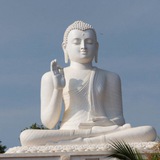
Sanghanussati Bhavana is the recollection on the qualities of the community of Ariya sangha.
Supatipanno Bhagavato savakasangho, ²ujupatipanno Bhagavato savakasangho, ³nayapatipanno Bhagavato savakasangho, 4samicipatpanno Bhagavato savakasangho; yadidam cattari purisa yugani attha purisa puggala, esa Bhagavato savakasangho, 5ahuneyyo, 6pahuneyyo, 7dakkhineyyo, 8anjali karaniyo, 9anuttaram punnakkhettam lokassa ti.”
“ 1Well attained is the Order of the Blessed One’s disciples, 2upright is the Order of the Blessed One’s disciples, 3true is the Order of the Blessed One’s disciples,4proper is the Order of the Blessed One’s disciples. That is, the four pairs of persons, the eight individual persons, this is the Order of the Blessed One’s disciples; 5worthy of gifts, 6worthy of hospitality, 7worthy of offerings, 8worthy of salutations, 9an incomparable field of merits for the world. ”
Supatipanno Bhagavato savakasangho, ²ujupatipanno Bhagavato savakasangho, ³nayapatipanno Bhagavato savakasangho, 4samicipatpanno Bhagavato savakasangho; yadidam cattari purisa yugani attha purisa puggala, esa Bhagavato savakasangho, 5ahuneyyo, 6pahuneyyo, 7dakkhineyyo, 8anjali karaniyo, 9anuttaram punnakkhettam lokassa ti.”
“ 1Well attained is the Order of the Blessed One’s disciples, 2upright is the Order of the Blessed One’s disciples, 3true is the Order of the Blessed One’s disciples,4proper is the Order of the Blessed One’s disciples. That is, the four pairs of persons, the eight individual persons, this is the Order of the Blessed One’s disciples; 5worthy of gifts, 6worthy of hospitality, 7worthy of offerings, 8worthy of salutations, 9an incomparable field of merits for the world. ”
❤1🤗1😘1
Dhammapada Verse 240
Tissatthera Vatthu
Ayasava malan samutthitam
tatutthaya tameva khadati
evam atidhonacarinam1
sani kammani nayanti duggatim.
Verse 240: Just as rust is formed from iron, and corrodes the iron from which it is formed, so also, his own deeds lead the transgressor to a lower plane of existence (duggati).
1. atidhonacarinam - transgressor: i.e., one who transgresses or indulges too much in the use of 'dhona', the four requisites of a bhikkhu.
The Story of Thera Tissa
While residing at the Jetavana monastery, the Buddha uttered Verse (240) of this book, with reference to Thera Tissa.
Once there was a thera named Tissa in Savatthi. One day, he received a set of fine robes and was very pleased. He intended to wear those robes the next day. But that very night he died and because he was attached to the fine set of robes, he was reborn as a louse and lived within the folds of the robes. As there was no one to inherit his belongings, it was decided that this particular set of robes should be shared by other bhikkhus. When the bhikkhus were preparing to share out among themselves, the louse was very much agitated and cried out, "They are destroying my robes!" This cry was heard by the Buddha by means of his divine power of hearing. So he sent someone to stop the bhikkhus and instructed them to dispose of the robes only at the end of seven days. On the eighth day, the set of the robes which belonged to Thera Tissa was shared out by the bhikkhus.
Later, the Buddha was asked by the bhikkhus why he had told them to wait for seven days before sharing out the robes of Thera Tissa. To them the Buddha replied, "My sons, Tissa had his mind attached to this particular set of robes at the time of his death, and so he was reborn as a louse and stayed in the folds of the robes. When you all were preparing to share out the robes, Tissa the louse was very much in agony and was running about to and fro in the folds of the robes. If you had taken the robes at that time Tissa the louse would have felt very bitter against you and he would have to go to niraya. But now, Tissa has been reborn in the Tusita deva world, and that is why I have allowed you to take the robes. Indeed, bhikkhus, attachment is very dangerous; as rust corrodes iron from which it is formed, so also, attachment destroys one and sends one to niraya. A bhikkhu should not indulge too much in the use of the four requisites or be very much attached to them."
Then the Buddha spoke in verse as follows:
Verse 240: Just as rust is formed from iron, and corrodes the iron from which it is formed, so also, his own deeds lead the transgressor to a lower plane of existence (duggati).
===
Ajahn Chah, Buddhist teacher of Thai forest meditation of Theravada Buddhism channel:
https://news.1rj.ru/str/ajahnchah_buddhism
===
Tissatthera Vatthu
Ayasava malan samutthitam
tatutthaya tameva khadati
evam atidhonacarinam1
sani kammani nayanti duggatim.
Verse 240: Just as rust is formed from iron, and corrodes the iron from which it is formed, so also, his own deeds lead the transgressor to a lower plane of existence (duggati).
1. atidhonacarinam - transgressor: i.e., one who transgresses or indulges too much in the use of 'dhona', the four requisites of a bhikkhu.
The Story of Thera Tissa
While residing at the Jetavana monastery, the Buddha uttered Verse (240) of this book, with reference to Thera Tissa.
Once there was a thera named Tissa in Savatthi. One day, he received a set of fine robes and was very pleased. He intended to wear those robes the next day. But that very night he died and because he was attached to the fine set of robes, he was reborn as a louse and lived within the folds of the robes. As there was no one to inherit his belongings, it was decided that this particular set of robes should be shared by other bhikkhus. When the bhikkhus were preparing to share out among themselves, the louse was very much agitated and cried out, "They are destroying my robes!" This cry was heard by the Buddha by means of his divine power of hearing. So he sent someone to stop the bhikkhus and instructed them to dispose of the robes only at the end of seven days. On the eighth day, the set of the robes which belonged to Thera Tissa was shared out by the bhikkhus.
Later, the Buddha was asked by the bhikkhus why he had told them to wait for seven days before sharing out the robes of Thera Tissa. To them the Buddha replied, "My sons, Tissa had his mind attached to this particular set of robes at the time of his death, and so he was reborn as a louse and stayed in the folds of the robes. When you all were preparing to share out the robes, Tissa the louse was very much in agony and was running about to and fro in the folds of the robes. If you had taken the robes at that time Tissa the louse would have felt very bitter against you and he would have to go to niraya. But now, Tissa has been reborn in the Tusita deva world, and that is why I have allowed you to take the robes. Indeed, bhikkhus, attachment is very dangerous; as rust corrodes iron from which it is formed, so also, attachment destroys one and sends one to niraya. A bhikkhu should not indulge too much in the use of the four requisites or be very much attached to them."
Then the Buddha spoke in verse as follows:
Verse 240: Just as rust is formed from iron, and corrodes the iron from which it is formed, so also, his own deeds lead the transgressor to a lower plane of existence (duggati).
===
Ajahn Chah, Buddhist teacher of Thai forest meditation of Theravada Buddhism channel:
https://news.1rj.ru/str/ajahnchah_buddhism
===
Telegram
Ajahn Chah - Theravada Thailand Buddhism
Collection of teachings of Venerable Ajahn Chah, a foremost meditation and Buddhist teacher from Thailand
👏1🏆1
Forwarded from Buddha Dharma books
Free Buddha Dharma ebook
The Blessings of Pindapata
By Bhikkhu Khantipalo
To those who live in lands where the teachings of the Lord Buddha have been long established, the sight of a bhikkhu (Buddhist monk) collecting food in the early morning, is a common one. But where the teachings are newly arrived, or where bhikkhus are few, the practice of giving food to wandering monks is known only by pictures or from written accounts.
Neither of these convey the real atmosphere of this giving and receiving to those interested in the Buddhist Way and yet live in countries where the Teaching is not the traditional form of religion. Even many Buddhists living in Northern Buddhist lands may know little of pindapatta for the practice of alms-gathering by bhikkhus there has, for various reasons which we need not here investigate, been largely discontinued and the traditional practice now survives only in Southeast Asian countries practicing the Theraváda Buddhist tradition.
Free download available:
https://www.accesstoinsight.org/lib/authors/khantipalo/wheel073.pdf
===
The Blessings of Pindapata
By Bhikkhu Khantipalo
To those who live in lands where the teachings of the Lord Buddha have been long established, the sight of a bhikkhu (Buddhist monk) collecting food in the early morning, is a common one. But where the teachings are newly arrived, or where bhikkhus are few, the practice of giving food to wandering monks is known only by pictures or from written accounts.
Neither of these convey the real atmosphere of this giving and receiving to those interested in the Buddhist Way and yet live in countries where the Teaching is not the traditional form of religion. Even many Buddhists living in Northern Buddhist lands may know little of pindapatta for the practice of alms-gathering by bhikkhus there has, for various reasons which we need not here investigate, been largely discontinued and the traditional practice now survives only in Southeast Asian countries practicing the Theraváda Buddhist tradition.
Free download available:
https://www.accesstoinsight.org/lib/authors/khantipalo/wheel073.pdf
===
👍2🏆1😘1
Dhammapada Verse 241
Laludayi Vatthu
Asajjhayamala manta
anutthanamala ghara
malam vanaassa kosajjam
pamado rakkhato malam.
Verse 241: Non-recitation is the taint of learning; non-maintenance is the taint of houses; indolence is the taint of beauty; unmindfulness is the taint of one who keeps watch.
The Story of Laludayi
While residing at the Jetavana monastery, the Buddha uttered Verse (241) of this book, with reference to Thera Laludayi.
In Savatthi, people coming back after hearing the discourses given by Thera Sariputta and Thera Maha Moggallana were always full of praise for the two Chief Disciples. On one occasion, Laludayi, hearing their praises, said to those people that they would be saying the same about him after listening to his discourses. So Laludayi was asked to deliver a discourse; he climbed on to the platform but he could not say anything. So he asked the audience to let another bhikkhu take the turn first and that he would take the next turn. In this way, he put off three times.
The audience lost patience with him and shouted, "You big fool! When we praised the two Chief Disciples you were vainly boasting that you could preach like them. Why don't you preach now ?" So Laludayi ran away and the crowd chased him. As he was frightened and was not looking where he was going, he fell into a latrine pit.
When the Buddha was told about this incident, he said, "Laludayi had learned very little of the Dhamma; he does not recite the religious texts regularly; he has not memorized anything. Whatever little he has learned gets rusty by not reciting."
Then the Buddha spoke in verse as follows:
Verse 241: Non-recitation is the taint of learning; non-maintenance is the taint of houses; indolence is the taint of beauty; unmindfulness is the taint of one who keeps watch.
===
Free Buddhism books, teachings, podcasts and videos from Theravada, Mahayana and Vajrayana traditions:
https://news.1rj.ru/str/buddha_ebooks
===
Laludayi Vatthu
Asajjhayamala manta
anutthanamala ghara
malam vanaassa kosajjam
pamado rakkhato malam.
Verse 241: Non-recitation is the taint of learning; non-maintenance is the taint of houses; indolence is the taint of beauty; unmindfulness is the taint of one who keeps watch.
The Story of Laludayi
While residing at the Jetavana monastery, the Buddha uttered Verse (241) of this book, with reference to Thera Laludayi.
In Savatthi, people coming back after hearing the discourses given by Thera Sariputta and Thera Maha Moggallana were always full of praise for the two Chief Disciples. On one occasion, Laludayi, hearing their praises, said to those people that they would be saying the same about him after listening to his discourses. So Laludayi was asked to deliver a discourse; he climbed on to the platform but he could not say anything. So he asked the audience to let another bhikkhu take the turn first and that he would take the next turn. In this way, he put off three times.
The audience lost patience with him and shouted, "You big fool! When we praised the two Chief Disciples you were vainly boasting that you could preach like them. Why don't you preach now ?" So Laludayi ran away and the crowd chased him. As he was frightened and was not looking where he was going, he fell into a latrine pit.
When the Buddha was told about this incident, he said, "Laludayi had learned very little of the Dhamma; he does not recite the religious texts regularly; he has not memorized anything. Whatever little he has learned gets rusty by not reciting."
Then the Buddha spoke in verse as follows:
Verse 241: Non-recitation is the taint of learning; non-maintenance is the taint of houses; indolence is the taint of beauty; unmindfulness is the taint of one who keeps watch.
===
Free Buddhism books, teachings, podcasts and videos from Theravada, Mahayana and Vajrayana traditions:
https://news.1rj.ru/str/buddha_ebooks
===
Telegram
Buddha Dharma books
Free Buddhism books, teachings, podcasts and videos from Theravada, Mahayana and Vajrayana traditions
👏1🏆1
Forwarded from Buddha Dharma books
Free Buddha Dharma ebook
Come & See, by Phra Ajaan Funn Ācāro. (revised July 8, 2019)
Three Dhamma talks on the importance of being in touch with the truths inside—the truths of the body and of the mind—so that the mind can be trained to bring about happiness, both on the personal and on the social level. Translated by Ṭhānissaro Bhikkhu.
Free download available:
https://www.dhammatalks.org/Archive/Writings/Ebooks/ComeAndSee190708.pdf
===
Come & See, by Phra Ajaan Funn Ācāro. (revised July 8, 2019)
Three Dhamma talks on the importance of being in touch with the truths inside—the truths of the body and of the mind—so that the mind can be trained to bring about happiness, both on the personal and on the social level. Translated by Ṭhānissaro Bhikkhu.
Free download available:
https://www.dhammatalks.org/Archive/Writings/Ebooks/ComeAndSee190708.pdf
===
👏1🏆1
Forwarded from Words of the Buddha
Stepping Towards Enlightenment
How deep can your meditation go? Thai forest monk Ajahn Brahm traces the path from mindfulness to profound meditative states through the sixteen steps of anapanasati.
By Ajahn Brahm
Part 1 of 2
The essence of Buddhism is the enlightenment of the Buddha. Many centuries ago in India, the wandering monk Gautama remembered a childhood experience of jhana, mental or meditative absorption, and realized that jhana is the way to awakening. He went to a quiet stretch of forest on the banks of a great river, sat on a cushion of grass under a shady fig tree, and meditated. The method of meditation that he used is called anapanasati, mindfulness of the in and out breaths. Through this practice, he entered jhana, emerged, and quickly gained the insights of enlightenment. Henceforth he was called the Buddha, the Awakened One.
The Buddha continued to teach anapanasati for the remainder of his life. It was the method that had given him enlightenment, the meditation practice par excellence, and he imparted that same method to all his disciples both in the monastery and in the city. This foremost method of meditation is bequeathed to us today in the original Buddhist texts as part of many suttas, but most notably the Anapanasati Sutta.
The Buddha described the practice of anapanasati as consisting of preliminary preparations followed by sixteen steps. The first twelve of those steps are instructions for entering jhana, and the final four steps are instructions on what to do when you emerge.
Before giving instructions for experiencing the bliss and beauty of jhana, I will briefly cover the preliminary stages of meditation. If you pass through these initial stages too quickly, you may find that the preparatory work has not been completed. It’s like trying to build a house on a makeshift foundation—the structure goes up very quickly, but it may come down too soon! You would be wise to spend a lot of time making the groundwork and foundations solid. Then, when you proceed to the higher stories—the ecstatic states of meditation—they will be stable.
Foremost, the Buddha said, go to a quiet place where you will not be disturbed by people, sounds, or things like mosquitoes. Tough guys might want to meditate in mosquito-ridden jungles or in the middle of tiger paths, but this is more likely to build only endurance and not the ease of jhana. The Buddha instead praised pleasant places like orchards or parks similar to Bodh Gaya, where he gained enlightenment. Next, sit on a comfortable seat. You may sit on a cushion, on a bench, or even on a chair as long as it isn’t too comfortable. The comfort required for success in breath meditation is that level where your body can be at ease for long periods of time and also alert.
You are now asked to set up mindfulness “in front of you,” to give it priority. We establish this preliminary level of mindfulness by practicing present-moment awareness (giving up the baggage of past and future) and then silent present-moment awareness (refining your practice of being with every experience as it happens to the level where you do not have the space for inner speech). When you let go of the past, you will be free in the present moment. As for the future—the anticipations, fears, plans, and expectations—let that go too. Now you should proceed to the even more beautiful and truthful silence of the mind. A useful technique for developing inner silence is recognizing the space between thoughts. Attend closely with sharp mindfulness when one thought ends and before another begins—there! That is silent awareness! It may be only momentary at first, but as you recognize that fleeting silence, you become accustomed to it; the silence lasts longer. You begin to enjoy the silence and that is why it grows. But remember, silence is shy. If silence hears you talking about her, she vanishes immediately.
How deep can your meditation go? Thai forest monk Ajahn Brahm traces the path from mindfulness to profound meditative states through the sixteen steps of anapanasati.
By Ajahn Brahm
Part 1 of 2
The essence of Buddhism is the enlightenment of the Buddha. Many centuries ago in India, the wandering monk Gautama remembered a childhood experience of jhana, mental or meditative absorption, and realized that jhana is the way to awakening. He went to a quiet stretch of forest on the banks of a great river, sat on a cushion of grass under a shady fig tree, and meditated. The method of meditation that he used is called anapanasati, mindfulness of the in and out breaths. Through this practice, he entered jhana, emerged, and quickly gained the insights of enlightenment. Henceforth he was called the Buddha, the Awakened One.
The Buddha continued to teach anapanasati for the remainder of his life. It was the method that had given him enlightenment, the meditation practice par excellence, and he imparted that same method to all his disciples both in the monastery and in the city. This foremost method of meditation is bequeathed to us today in the original Buddhist texts as part of many suttas, but most notably the Anapanasati Sutta.
The Buddha described the practice of anapanasati as consisting of preliminary preparations followed by sixteen steps. The first twelve of those steps are instructions for entering jhana, and the final four steps are instructions on what to do when you emerge.
Before giving instructions for experiencing the bliss and beauty of jhana, I will briefly cover the preliminary stages of meditation. If you pass through these initial stages too quickly, you may find that the preparatory work has not been completed. It’s like trying to build a house on a makeshift foundation—the structure goes up very quickly, but it may come down too soon! You would be wise to spend a lot of time making the groundwork and foundations solid. Then, when you proceed to the higher stories—the ecstatic states of meditation—they will be stable.
Foremost, the Buddha said, go to a quiet place where you will not be disturbed by people, sounds, or things like mosquitoes. Tough guys might want to meditate in mosquito-ridden jungles or in the middle of tiger paths, but this is more likely to build only endurance and not the ease of jhana. The Buddha instead praised pleasant places like orchards or parks similar to Bodh Gaya, where he gained enlightenment. Next, sit on a comfortable seat. You may sit on a cushion, on a bench, or even on a chair as long as it isn’t too comfortable. The comfort required for success in breath meditation is that level where your body can be at ease for long periods of time and also alert.
You are now asked to set up mindfulness “in front of you,” to give it priority. We establish this preliminary level of mindfulness by practicing present-moment awareness (giving up the baggage of past and future) and then silent present-moment awareness (refining your practice of being with every experience as it happens to the level where you do not have the space for inner speech). When you let go of the past, you will be free in the present moment. As for the future—the anticipations, fears, plans, and expectations—let that go too. Now you should proceed to the even more beautiful and truthful silence of the mind. A useful technique for developing inner silence is recognizing the space between thoughts. Attend closely with sharp mindfulness when one thought ends and before another begins—there! That is silent awareness! It may be only momentary at first, but as you recognize that fleeting silence, you become accustomed to it; the silence lasts longer. You begin to enjoy the silence and that is why it grows. But remember, silence is shy. If silence hears you talking about her, she vanishes immediately.
Telegram
Words of the Buddha
Daily teachings of Buddha Dharma
💯1🆒1